HomeAuto NIST Quantum Sensors Sharpen Nuclear Safeguards With Eightfold Precision Gain
NIST Quantum Sensors Sharpen Nuclear Safeguards With Eightfold Precision Gain
September 13, 2026:
Nist.gov
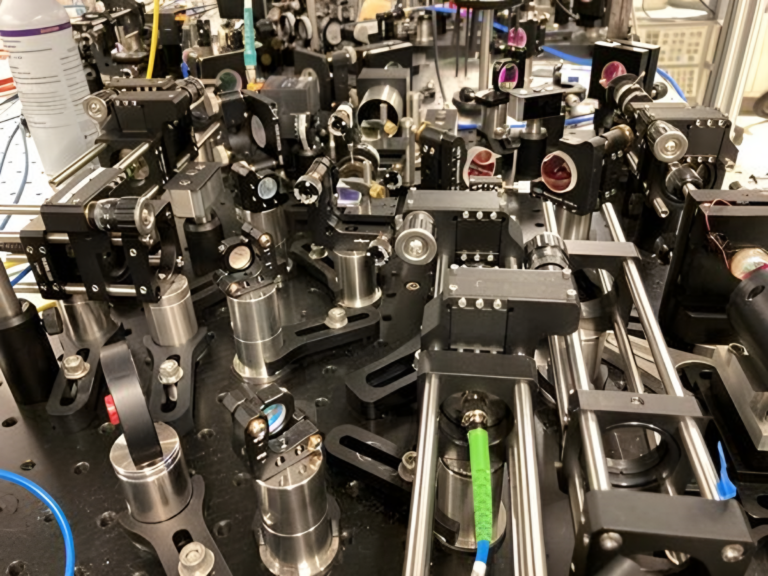
When an international inspector walks into a nuclear facility to verify what is inside, the measurement tools available have quietly had a ceiling — one that now, as of Wednesday, has risen dramatically higher. Researchers at the National Institute of Standards and Technology have published the most precise X-ray energy measurements ever recorded for uranium, plutonium, and neptunium, cutting measurement uncertainty by a factor of three to eight compared to the best previous results. The instrument behind the breakthrough: an array of roughly 250 quantum sensors, each held at a temperature a fraction of a degree above absolute zero (-273.15°C, or -459.67°F), that can feel the energy of a single X-ray photon as a brief tremor of heat.
The finding, published September 10 in Physical Review Letters, addresses a problem that has complicated nuclear inspections for decades. The three actinide elements in question — uranium, plutonium, and neptunium — do something inconvenient: they emit X-rays at energies that overlap with the gamma-ray signatures inspectors use to identify and count isotopes. Subtracted imprecisely, that X-ray background introduces errors into exactly the measurements that matter most. The new data dramatically narrows those error bars.
What Nuclear Inspectors Actually Measure
To understand what changed, consider what the International Atomic Energy Agency (IAEA), the world’s nuclear inspectorate, actually does when it sends a team to verify a declared nuclear facility. Inspectors carry detectors that capture a radiation spectrum — a kind of fingerprint. Different radioactive isotopes emit gamma rays at characteristic energies, and the height of each peak in the spectrum tells analysts how much of a given isotope is present.
The ratio of uranium-235 to uranium-238 is the number that matters most. In nature, uranium-235 makes up just 0.7% of all uranium. Fuel for a commercial reactor requires it enriched to a few percent. Weapons-grade uranium reaches around 90%. Measuring that ratio precisely — and knowing when it is not what a facility claims — is the technical core of treaty verification. Under the Non-Proliferation Treaty, which has 191 parties and has been in force since 1970, the IAEA administers safeguards at roughly 1,300 nuclear facilities worldwide.
The complication the NIST team just addressed: the X-rays that uranium, plutonium, and neptunium emit fall squarely on top of the gamma-ray peaks inspectors need to read. To extract clean gamma-ray data, analysts must subtract the X-ray background — and that subtraction is only as accurate as the X-ray reference values that anchor it. Until this week, those reference values carried significant uncertainty, meaning every subtraction introduced its own errors.
How Cold Is Cold Enough: The Physics of Transition-Edge Sensors
The instruments NIST used are called transition-edge sensors, or TES devices — a class of quantum sensor developed by NIST’s Quantum Sensors Division over several decades and now deployed across research facilities worldwide.
The operating principle rests on a specific property of superconductors. Cooled far enough, certain metals shed all electrical resistance and enter a superconducting state. Warm them even slightly — by a fraction of a millikelvin — and they return to normal metallic behavior, with measurable resistance. A transition-edge sensor exploits precisely the boundary between these two states. Its sensing element is a thin superconducting film — typically a molybdenum-copper or tungsten bilayer — maintained at its film’s critical transition temperature, somewhere between 70 and 100 millikelvins above absolute zero.
When a single X-ray photon strikes the sensor, it imparts a tiny pulse of thermal energy — enough to briefly push the film across the phase boundary. The resulting spike in electrical resistance is directly proportional to the photon’s energy. A superconducting quantum interference device (SQUID) reads the tiny current change and feeds it to room-temperature electronics. The result is an energy measurement of extraordinary precision.
“The sensitivity of the TES reduced the uncertainty of the X-ray energy measurements by one-third to one-eighth compared with previous measurements,” said Jonathan Dean, a physicist jointly affiliated with NIST and the University of Colorado Boulder who co-led the study.
The sensor achieves energy resolutions of roughly one to six electron-volts at the relevant X-ray energies — compared to the 500 to 700 eV resolution of a high-purity germanium (HPGe) detector, the workhorse of current nuclear safeguards gamma spectroscopy. In practical terms: the TES is like a barcode scanner that can distinguish adjacent stripes that the previous instrument would blur into one. That gap in resolution is what, historically, has made actinide X-ray reference data so imprecise — HPGe simply cannot resolve the relevant spectral lines sharply enough.
The NIST breakthrough was enabled by key work in 1995, when NIST physicist K.D. Irwin solved the TES thermal-runaway problem by voltage-biasing the film and coupling it to a SQUID amplifier, establishing negative electrothermal feedback and enabling stable operation of large detector arrays. The study published this week used an array of approximately 250 sensors operating in parallel, providing the high photon-counting rate needed to accumulate robust statistics on rare actinide X-ray events.
The collaboration spanned NIST, the University of Colorado Boulder, Los Alamos National Laboratory, Houghton University, and the Kastler Brossel Laboratory at Sorbonne University in Paris.
From Background Noise to Cleaner Inspections
The practical consequence is straightforward: with actinide X-ray energies now pinned to a tighter tolerance, analysts subtracting that background from measured spectra will carry less uncertainty forward into their isotope ratio results. That propagates directly into the accuracy of nuclear material accounting.
“Our measurements support international nuclear safeguards by enabling more precise accounting of material in nuclear facilities,” Dean said in a statement.
The IAEA’s safeguards system rests on quantitative material balances — confirming that the amount of nuclear material entering and leaving a facility matches declared records, within agreed uncertainty bounds. Those bounds are formally defined in the IAEA’s International Target Values for Measurement Uncertainties in Safeguarding Nuclear Materials (STR-368, Revision 1.1, 2022), the agency’s official standard for acceptable measurement precision. With TES delivering an order-of-magnitude improvement over HPGe for X-ray reference data, the technical floor for achievable precision has shifted — a development that the ITV framework will eventually need to reflect.
The improvement also affects the pace of nuclear power operations. Generating electricity from uranium fission is a multistep process — mining, conversion, enrichment, fuel fabrication, reactor loading, reprocessing — and at each step the composition of the nuclear material must be verified before operations can proceed. Faster, more confident measurements shorten the verification hold between steps. “Measuring the composition more quickly should shorten the hold-up time between steps,” Dean noted, adding that the improvement “has the potential to increase efficiency and reduce costs at nuclear power plants.”
Does It Work in the Field?
The one significant constraint on TES technology for nuclear safeguards is portability. The sensors must be cooled to near absolute zero by an adiabatic demagnetization refrigerator (ADR) — a system that is substantial in size and cannot, with current technology, be made handheld. An IAEA inspector cannot carry a TES array into a facility the way they carry an HPGe detector.
NIST and Los Alamos National Laboratory have addressed this by deploying TES arrays at three Department of Energy laboratories for fixed-site nuclear material monitoring — an approach suited to high-value, permanent monitoring installations. For other applications, samples can be collected at a nuclear facility and transported to a TES-equipped laboratory. “Our instruments are compatible with both approaches,” Dean said.
Miniaturization is a declared priority. NIST has documented a commercialization trajectory for its ADR refrigeration systems — NIST-designed compact refrigeration systems for TES applications were already commercially available by the 2010s through licensing agreements with US companies. Two US companies now manufacture compact refrigeration systems based on NIST designs specifically for TES applications, and NIST is actively pursuing further miniaturization to reduce cost and size.
The same TES technology that produced this nuclear safeguards advance is already operating across a wide range of applications: the SLAC National Accelerator Laboratory at Stanford, the Advanced Photon Source synchrotron at Argonne National Laboratory, the National Synchrotron Light Source at Brookhaven National Laboratory, and the CERN particle accelerator in Switzerland. A new TES detector is being installed at NASA’s Goddard Space Flight Center to study neutron stars and black hole accretion disks.
What Does This Mean for Nuclear Treaty Verification?
The IAEA’s safeguards system functions as what the agency calls a “confidence-building measure and early warning” mechanism, and the trigger that sets in motion other responses by the international community when violations occur. That function depends entirely on measurement. A detection threshold that cannot catch small diversions offers correspondingly weak assurance. Tightening the measurement floor — by resolving a spectral interference that has degraded accuracy for decades — directly expands what inspectors can detect and confidently exclude.
The study was authored by A. Wessels and colleagues and titled “Measured and theoretical Kα x-ray emission linewidths of U, Np, and Pu,” published in Physical Review Letters.
Frequently Asked Questions
Why do X-rays interfere with nuclear safeguards measurements in the first place?
Radioactive elements like uranium, plutonium, and neptunium emit both gamma rays and X-rays. Inspectors identify isotopes by the gamma-ray signatures — characteristic energy peaks that act as fingerprints. The problem is that the X-rays from these same elements land in the same energy region as those gamma-ray peaks, adding background noise that makes the gamma signals harder to read precisely. To extract accurate isotope ratios, analysts must subtract out the X-ray background, and that subtraction is only as accurate as the reference values for the X-ray energies. The NIST study cut the uncertainty in those reference values by factors of three to eight, making the subtraction far more precise.
How does a transition-edge sensor actually detect a single X-ray photon?
A transition-edge sensor is a thin superconducting metal film held at the precise temperature where it sits on the boundary between two states: a zero-resistance superconductor and a normal metal with measurable resistance. That boundary is extraordinarily narrow — about one millikelvin wide. When a single X-ray photon strikes the sensor, the tiny amount of heat it deposits is enough to briefly push the film across that boundary, causing a measurable spike in electrical resistance. The size of the spike is proportional to the photon’s energy, making the sensor a precision energy meter. A superconducting quantum interference device (SQUID) reads the resulting current change. The sensor must be cooled to within a fraction of a degree of absolute zero (-273.15°C, or -459.67°F) for this to work.
Could the IAEA’s official measurement uncertainty standards need to be updated as a result?
Potentially, yes. The IAEA’s International Target Values for Measurement Uncertainties in Safeguarding Nuclear Materials (STR-368, 2022) define the acceptable precision benchmarks for nuclear material accounting. Those benchmarks were calibrated against the best available detector technology — primarily high-purity germanium detectors — at the time of their development. Transition-edge sensors now demonstrate energy resolutions roughly one to two orders of magnitude finer than HPGe for the X-ray lines that matter most in actinide spectroscopy. As TES measurements become the authoritative reference data, the ITV standards will face pressure to reflect what is now achievable, potentially raising the bar for what constitutes a verified material balance.
Can these sensors be taken into a nuclear facility for an on-site inspection?
Not yet in a handheld form. TES arrays require an adiabatic demagnetization refrigerator to maintain their near-absolute-zero operating temperature, and those cooling systems are currently too bulky for field-portable use. NIST and Los Alamos National Laboratory have installed TES detector arrays at three Department of Energy laboratories for fixed-site monitoring. For nuclear facilities without on-site TES systems, samples can be collected and transported to a TES-equipped laboratory. NIST is actively working to miniaturize and reduce the cost of the cooling equipment, and two US companies already manufacture compact commercial refrigeration systems based on NIST designs for TES applications.