September 12, 2026:


PLAYISM and Taiwanese developer Crimson Dusk released a new trailer on September 10 confirming that Homura Hime — a 3D bullet-hell action game already available on PC — will arrive on Nintendo Switch 2 in 2027, sliding past its original 2026 console window. The Switch 2 version delayed to 2027 from the previously announced 2026 release. Switch 2 players who don’t want to wait have an option in hand: the PC version launched on Steam on March 4, 2026, and landed a “Very Positive” rating at release.
The Switch 2 date shift is the top-line news, but what makes Homura Hime worth tracking is the story behind the game itself. Crimson Dusk spent eight years building it — starting in 2018 as a solo project by a Taiwanese student named Sam, whose prototype attracted attention at a student contest and led him to found the studio in May 2020 to scale the project up. Before the PC launch, the studio secured something few indie developers manage: a direct playtest and candid design critique from Yoko Taro and Takahisa Taura, the director and action designer behind NieR: Automata — the game Crimson Dusk openly named as its primary creative influence.
Homura Hime — “Flame Princess” in Japanese — is set in a world where humans and demons coexist, but uneasy coexistence is the best-case scenario. Souls who die burdened by powerful emotions or deep regret are transformed into archdemons — beings capable of corrupting the world around them and spawning hordes of instinct-driven monsters in their wake. The High Priestess, faced with five extraordinarily powerful demon girls threatening everything, dispatches her strongest exorcist: the titular Homura Hime and her devoted aide Ann. That’s the mission — purify the world, defeat the demon girls, and unravel the mystery behind Homura’s own shadowed past. The tone sits in the register of anime tragedy fused with stylized spectacle: serious enough that the stakes feel real, kinetic enough that the combat never loses its momentum.
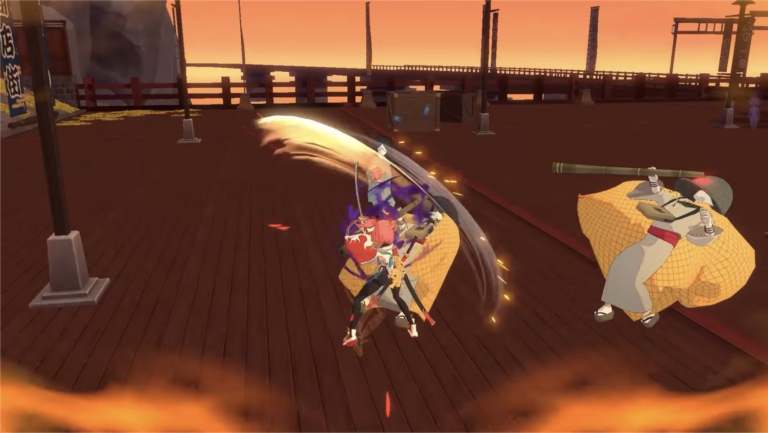
The game’s appeal to Switch 2 players comes from its specific mechanical identity. Homura Hime is not simply an action game with bullet-hell visual noise layered on top. Crimson Dusk built the two systems to depend on each other, as the developer explained in depth.
The combat architecture has three interdependent layers. The melee layer gives players light attacks, heavy attacks, chained strikes, and upward slashes, with parries that can be combined into four distinct follow-up moves — including air juggling and a self-propelled sword that circles and hits enemies independently. A hit meter tracks continuous attack chains and multiplies the player’s score. The shooting layer gives Homura a long-range purifying shot that depletes a gauge; once the gauge is empty, she cannot fire. And here is the specific design decision distinguishing the game: successfully parrying an enemy attack during the cooldown restores the shooting gauge.
Taura himself flagged this exact mechanic during the pre-launch playtest. He told Crimson Dusk he had wanted to implement a shooting gauge that depletes and locks out the player in NieR: Automata, but was blocked — and seeing it realized in Homura Hime made him say he was honestly a little jealous. That is not a polite endorsement. That is the action designer of one of the most praised third-person combat games of the past decade describing an indie studio as having implemented a mechanic he could not.
The skill layer rounds out the system: skills deal extra damage with beneficial effects but operate on cooldowns, requiring players to think about timing outside of the moment-to-moment melee and dodge rhythm. Defeating archdemons rewards players with new special weapons and equipment, adding a light progression layer on top of the combo and parry core.
The Automaton Media three-way interview, conducted on February 25, 2026 — about a week before the PC launch — is the most substantive piece of context around the game. Yoko Taro’s assessment was candid and ultimately generous: he praised the game’s density of ideas and its refusal to shrink its ambitions to fit an indie budget, while naming specific design issues (a mandatory platforming section with a hook jump that was too difficult to parse, a ravine crossing that front-loaded aerial dash mechanics before basic jumps) that Crimson Dusk then fixed before release. Taura’s feedback on the shooting gauge cooldown duration and display placement was similarly specific — and similarly implemented.
Yoko Taro also addressed the “low-budget NieR: Automata” label that players had attached to early footage. His view: influence acknowledged publicly is better than influence obscured, he has no objection to studios learning from Automata, and the core controls of Homura Hime — parry feel, overall action structure — are “very solid.” He added that what matters most for an indie working on this scale is differentiation in presentation, not just mechanics. Crimson Dusk’s answer to that was the parry-plus-bullet-hell hybrid: a specific, recognizable signature that players can attach to the game’s identity.
The studio implemented the feedback before launch in a last-minute update cycle.
The game’s production values extend to its voice cast, which signals an unusual level of ambition for a debut title from a small Taiwanese studio. Voicing the title character, Homura Hime, is Tomori Kusunoki — best known internationally as Makima in Chainsaw Man and winner of the 13th Seiyuu Awards’ Best Rookie Voice Actress in 2019. Manaka Iwami voices Ann, Saku Mizuno voices Kushinada, and the rest of the cast includes Hana Hishikawa, Chiyo Ousaki, Juri Nagatsuma, Tomoyo Takayanagi, Matsuri Mizuguchi, Chiharu, Ai Yamamoto, Yuna Taniguchi, Fairouz Ai, You Taichi, and Haruno Inoue.
Most intriguingly, veteran performer Takehito Koyasu — whose career spans more than 200 anime and game roles, including DIO in JoJo’s Bizarre Adventure and Zeke Jaeger in Attack on Titan — is listed in a role credited simply as “???”, unrevealed as of the time of writing.
Homura Hime launched on Steam on March 4, 2026. At release it earned a “Very Positive” rating with 62 percent of critics on OpenCritic recommending it, peaking at 949 concurrent players according to SteamDB.
The slip from 2026 to 2027 for Switch 2 adds roughly a year of wait time for console-only players, but Crimson Dusk’s track record of acting on feedback is reassuring context. The studio implemented Yoko Taro and Taura’s suggestions in a single pre-launch update cycle. If the extra time on the Switch 2 version reflects similar attention to the specific demands of the platform — Joy-Con input mapping, performance targets in handheld mode, the shorter session rhythms of portable play — the additional wait may yield a meaningfully better experience than a rushed 2026 port.
No specific date within 2027 has been announced, and no pricing for the Switch 2 version has been disclosed. The PC version is available now on Steam.
The PC version launched on Steam on March 4, 2026, and is available now. Switch 2 players will need to wait until 2027. If you own a PC capable of running the game, buying the Steam version is a viable option to avoid the delay. No pricing for the Switch 2 version has been announced yet, so there is no pricing comparison available to inform the decision.
The key mechanical distinction is the parry-shooting integration. Homura Hime’s ranged attack depletes a gauge and locks out until recharged, and successfully parrying an enemy during the cooldown restores that gauge — making melee and bullet-hell genuinely interdependent rather than separate modes. Action designer Takahisa Taura of NieR: Automata specifically cited this as a mechanic he had wanted to put in Automata himself. The bullet-hell patterns are designed as a primary threat in specific scenarios rather than background decoration.
Not as formal co-developers, but Yoko Taro and Takahisa Taura played the game before launch, gave specific design feedback in a three-way interview with Automaton Media, and Crimson Dusk implemented their suggestions in a last-minute update before the March 4 PC release. Yoko Taro praised the game’s density of ideas and its “very solid” parry feel. Their involvement was consultative and publicly disclosed, not a formal creative partnership.
Homura Hime is the debut title from Crimson Dusk, a Taiwanese indie studio founded in May 2020 and headquartered in Taichung City. The studio was established specifically to scale up a solo project its founder, Sam, began in 2018 as a student and revealed at a contest — where its early build attracted enough attention to warrant forming a full team. PLAYISM, a Japanese indie publisher founded in 2011 and known for titles including OMORI and SIGNALIS, is handling publishing duties.