HomeAuto Space Academy Site Competition Opens as Congress, Not the Commission, Controls Its Future
Space Academy Site Competition Opens as Congress, Not the Commission, Controls Its Future
September 12, 2026:
THOMAS SHEA/AFP via Getty Images
NASA opened a formal, nationwide competition on Sept. 10 inviting state governors to submit proposals for hosting the proposed US Space Academy — kicking off an intense interstate bidding war — but the institution cannot become real without an Act of Congress that has not been sought and may face long odds, according to a space policy expert who called the plan unlikely to survive the legislative process.
The request for information, or RFI, sets an Oct. 26, 2026 deadline for governors or their designated representatives to submit details on their state’s readiness to host the institution. The Presidential Commission on the United States Space Academy — established by President Trump’s executive order signed Aug. 28 and chaired by NASA Administrator Jared Isaacman — held its first meeting on Sept. 9 before publishing the RFI the following day.
“I do not see this as a proposal that has a serious chance of becoming reality,” Todd Harrison, a space policy expert at the American Enterprise Institute, told Newsweek. “And this is not something NASA or the Space Force actually needs. The United States already has the best private and public universities in the world for aerospace engineering and related disciplines.” Harrison added that creating the institution would “require authorization and funding from Congress” — and called that outcome “unlikely to happen.”
Why Congress, Not the Commission, Is the Real Gating Body
The executive order establishes a commission and directs it to submit recommendations within 120 days — placing the report’s expected deadline around late December 2026. But the White House’s own fact sheet on the commission acknowledges that implementation will follow “approval by the President and any necessary legislative action” — meaning the commission’s report is an advisory input to Congress, not a building permit.
Every existing US military service academy was created by a separate Act of Congress and is governed by federal statute under Title 10 of the US Code. The Army’s Military Academy at West Point, the Naval Academy in Annapolis, Maryland, and the Air Force Academy in Colorado Springs, Colorado, each cost approximately $1 billion annually to operate, and admission requires a congressional nomination for most applicants. A Space Academy modeled on that architecture would carry a similar price tag, making congressional buy-in not a formality but a prerequisite.
Air & Space Forces Magazine, which covers the Space Force and aerospace policy, reported this point directly: “The President doesn’t have the authority to create the academy on his own — that would require an act of Congress.”
Political timing adds another layer of uncertainty. Harrison warned there may not be enough time for the commission to complete its work and put the question to a legislative vote before the end of the current congressional session — and Republicans could lose their majority in the House or Senate after November 2026 midterm elections, which would reset the legislative calendar entirely.
Rep. George Whitesides (D-CA) — a former NASA Chief of Staff and former CEO of Virgin Galactic — said he found the concept “intriguing” but raised concerns about both funding and the commission’s composition, noting that no members of Congress sit on the body designing the institution. “I am open-minded to hear thoughtful answers to these questions, but I recommend that Congress be engaged quickly and substantively or else this intriguing idea will be stuck on the launch pad,” Whitesides said.
Rep. Zoe Lofgren (D-CA), ranking Democrat on the House Science, Space, and Technology Committee, also called for greater congressional representation on the commission.
An Academy Built for a 25% Vacancy Rate — and a Faster Alternative
The academy’s policy rationale rests on a documented and severe workforce shortage. A 2026 Government Accountability Office report found that the Space Force had filled only approximately 13,509 of the roughly 18,000 positions it identified as necessary to carry out its missions in fiscal year 2025 — leaving nearly one-quarter of positions vacant. The service also lost nearly 14% of its civilian workforce during the Trump administration’s broader federal workforce reduction, with Space Systems Command — the Space Force’s acquisition arm — hit particularly hard.
For the broader commercial space industry, the Space Foundation reported 18% five-year employment growth in 2025 but noted that roughly 15% to 25% of open positions at space companies remained unfilled for more than six months, and that approximately 25% of the entire space workforce is nearing retirement age. NASA’s own workforce skews older: only 17% of the agency’s staff is under 35, according to Space Foundation data.
The problem is real. The debate among experts is whether a new physical campus — with a projected groundbreaking no earlier than 2027 and initial enrollment targeted for 2028 — is the right structural fix.
Harrison argues it is not. He suggested the administration instead create a scholarship program modeled on the Reserve Officers’ Training Corps, or ROTC, in which the government would fund students pursuing relevant degrees at existing universities in exchange for a commitment to work at NASA, the Space Force, or another federal agency for a defined period. “Instead of competing with our world-class institutions, you would let them produce the best and the brightest talent with a commitment to go into the government,” he said. “Establishing a physical academy is going to take years, whereas if you make it a scholarship program, you could literally start awarding scholarships next school year.”
Charles Galbreath, director of the Mitchell Institute’s Spacepower Advantage Center of Excellence, pushed back on the ROTC comparison, arguing that physical co-location creates a kind of intellectual density that distributed university programs cannot replicate. “When you have people that are colocated, they’re going to breed new ideas as well,” Galbreath said. “If you’re a student and you’re learning about orbital mechanics from a NASA PhD who designed the trajectories for a multi-planetary flyby, you’re getting the best.”
John Logsdon, founder and professor emeritus of the Space Policy Institute at George Washington University, told Newsweek he considers Huntsville, Alabama, a strong candidate for the academy’s location. “The NASA Marshall Spaceflight Center is already located there and the Space Force HQ is scheduled to move there from Colorado Springs,” Logsdon said, adding: “Of course, Congressional interest could affect the location.”
States Already Jockeying — Before the RFI Was Even Live
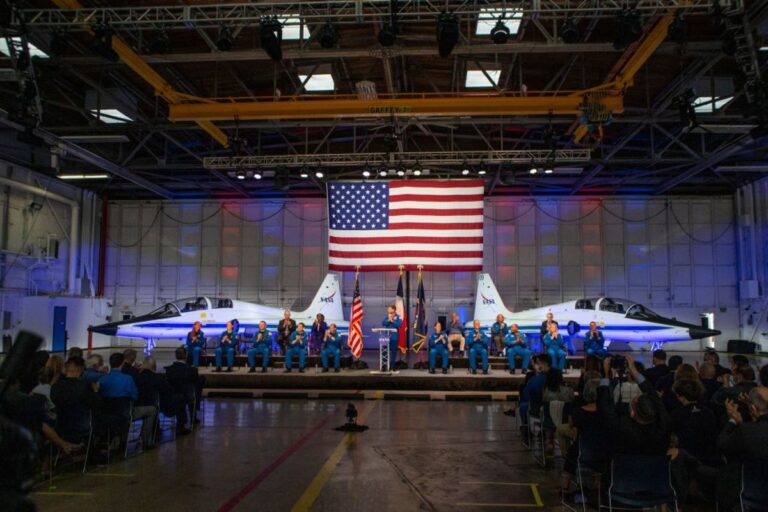
The political competition for the academy’s home began before NASA formally published the RFI. At the Aug. 28 signing ceremony at Johnson Space Center in Houston, Trump jokingly called out two of Texas’s most prominent space-policy figures. “I know where some people want it, that are in this audience,” Trump said, then addressed Sen. Ted Cruz (R-TX), who chairs the Senate Commerce, Science, and Transportation Committee and holds oversight authority over NASA: “Just leave me alone, Ted. Please leave me alone.”
Cruz’s House counterpart, Rep. Brian Babin (R-TX), chairs the House Science, Space, and Technology Committee and represents the district that includes Johnson Space Center — giving Texas formidable congressional leverage over both the authorization and the siting of any new institution.
Florida moved quickly in formal channels. Senators Ashley Moody and Rick Scott sent a letter to the White House on Sept. 3 making the case for their state’s bid, citing NASA’s Kennedy Space Center and the US Space Force’s Cape Canaveral Space Force Station as key assets. Alabama’s Rep. Dale Strong indicated that Huntsville — already home to the US Space and Rocket Center’s Space Camp — has been actively discussed as a candidate.
Colorado Springs rounds out the short list of structural front-runners: it is already home to US Space Command and several major Space Force units, as well as the Air Force Academy itself.
That last point carries institutional weight. The Air Force Academy’s 2026 graduating class included 93 Space Force Guardians — meaning the existing pipeline already channels some talent into the Space Force without a new institution. The US Air Force Academy Alumni Association said it will “closely monitor developments” following Trump’s announcement. A Department of the Air Force spokesperson declined to comment.
Galbreath of the Mitchell Institute noted that the academy’s eventual footprint decision — single campus versus distributed hubs — will be a significant cost driver for the commission to resolve. “Cost will be an important factor as the commission considers its footprint,” he said.
What the Commission Must Deliver — and What It Cannot
The commission’s charge, as laid out in the executive order and White House fact sheet, encompasses six major areas: a governance framework for the institution; academic curriculum and degree programs; service obligations for graduates; eligibility requirements including citizenship and security clearance standards; a process for selecting the permanent location; and, crucially, a legislative strategy — a formal recognition that no academy can open without Congress.
The commission is chaired by Isaacman, with Michael Kratsios (Assistant to the President for Science and Technology) and Kevin Hassett (Director of the National Economic Council) as vice chairs and NASA Deputy Administrator Matt Anderson as executive director. Additional commission members include Defense Secretary Pete Hegseth, White House Chief of Staff Susie Wiles, OMB Director Russell Vought, and Secretary of the Air Force Troy Meink — but no members of Congress.
On the model question, Eric Merriam, a professor at the University of Central Florida and former Air Force Academy assistant professor, said the most distinctive feature of a Space Academy — relative to existing service academies — would be its decoupling of free education from mandatory military service. Graduates could fulfill their obligation by working at NASA or in civilian government roles, a design that Merriam called a potential draw for students who want to contribute to the space program without joining the military.
The academy is among the latest components in a multi-year build-out of US space policy. The Aug. 28 signing followed a new National Space Transportation Policy memorandum on Aug. 20, a December 2025 “Ensuring American Space Superiority” executive order, and a July 2026 FAA proposed rulemaking to waive environmental reviews for launch infrastructure. The administration has set a target of more than 1,000 space launches and reentries on American soil annually by 2030.
Space Academy Competition Timeline
Governors and their representatives have until Oct. 26, 2026 to submit RFI responses to NASA. The commission is expected to deliver its formal recommendations to the president by approximately late December 2026 — the 120-day mark from the Aug. 28 executive order. From there, any action to formally charter the academy, authorize its budget, and begin construction will require Congress, and the real negotiating over both location and funding will intensify in that forum.
The administration has targeted a groundbreaking no later than 2027, temporarily hosting a first cohort of 300 students in 2028, and full permanent operation by 2031. That timeline assumes Congress acts within roughly one year of the commission’s report — a pace Harrison described as optimistic. Whether the Space Academy joins West Point and Annapolis as one of America’s defining institutions, or stalls as an executive order that never cleared Capitol Hill, will be decided not by governors submitting RFI responses, but by votes Congress has not yet been asked to take.
Frequently Asked Questions
What is the US Space Academy and how would it be different from existing military academies?
The proposed US Space Academy would be a NASA-led, tuition-free, four-year institution designed to train engineers, scientists, operators, and public servants for careers across the US Space Force, NASA, and the commercial space industry. Unlike existing military service academies — West Point, the Naval Academy, and the Air Force Academy — the Space Academy’s graduates would not necessarily be commissioned as military officers. Officials have said graduates could fulfill their service obligation by working at NASA or in civilian government roles, making it a hybrid model with no direct parallel in the current federal education system.
Does the executive order actually create the Space Academy?
No. The executive order establishes a Presidential Commission to study the academy’s design and submit recommendations — it does not create the institution itself. Under federal law, a new service academy requires an Act of Congress to authorize, charter, and fund. The commission’s report, expected in late December 2026, will then need to be translated into legislation and passed by both chambers before any campus can be built. Several defense policy analysts have noted that this congressional step is far from guaranteed.
Which states are the strongest candidates to host the Space Academy?
The leading structural candidates, based on existing space infrastructure, include Huntsville, Alabama (NASA Marshall Space Flight Center; Space Force HQ potentially relocating there), Colorado Springs, Colorado (US Space Command headquarters; Air Force Academy), Cape Canaveral / Kennedy Space Center, Florida (Florida’s senators formally lobbied the White House in September 2026), and Houston, Texas (NASA Johnson Space Center; home of the signing ceremony). Political considerations — including which congressional delegations hold the most leverage over the authorization process — will shape the final outcome alongside any objective site criteria.
Could a simpler program address the Space Force’s workforce shortage faster?
Todd Harrison of the American Enterprise Institute argues yes. He has proposed an ROTC-style scholarship program as an alternative: the federal government would fund students pursuing space-relevant degrees at existing universities in exchange for a defined period of service in the Space Force, NASA, or another federal agency. Harrison says such a program “could literally start awarding scholarships next school year,” while a physical academy would take years just to break ground. Charles Galbreath of the Mitchell Institute disagrees, arguing that co-location generates intellectual synergies that distributed university programs cannot replicate.