HomeAuto Australia Receives First Sold Electric Semi-Trucks: Windrose E700 Cuts Costs 84 Percent
Australia Receives First Sold Electric Semi-Trucks: Windrose E700 Cuts Costs 84 Percent
September 12, 2026:
Windrose.tech
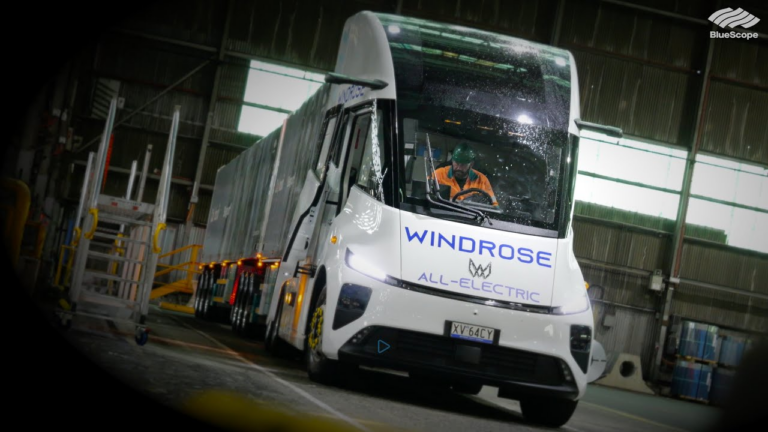
Australia’s commercial long-haul electric freight era opened today — not with a prototype or a pilot program, but with a truck manifest. Two Windrose E700 electric prime movers have cleared customs in Melbourne, confirmed by New Energy Transport (NET) co-founder Daniel Bleakley via LinkedIn, marking the first electric semi-trucks ever sold in Australia. The trucks will enter daily revenue-earning freight operations on the Sydney–Canberra corridor within weeks, each powered by a 705 kilowatt-hour lithium iron phosphate battery capable of completing the 460-kilometer (286-mile) run on a single charge.
“In a few weeks these trucks will go into full-time operation with two of our foundation customers, running daily heavy road freight from Sydney to Canberra without using a drop of diesel,” Bleakley wrote.
For a country that imports 87 percent of its diesel — the highest proportion of any nation on earth, according to the Institute for Energy Economics and Financial Analysis — the arrival of two commercially operational long-haul electric trucks is not a niche technology story. It is an energy security story. At their peak in early April 2026, diesel prices in Australia tripled from start-of-year levels as Middle East conflict disrupted the Strait of Hormuz. Australia carries only approximately 30 days of diesel in strategic stockpile. Against that backdrop, a truck that replaces diesel entirely — on routes that carry significant commercial tonnage — is solving a structural vulnerability, not just an operating cost line.
From Proof-of-Concept to Revenue Operations
The E700 is not new to Australian roads. What is new today is its commercial status. Windrose and NET have been conducting trials since late 2024, when a pre-production unit drove from Melbourne to Sydney on the Hume Highway and completed what was at the time Australia’s largest single public fast charge — 501 kilowatt-hours at an Evie Networks station at Sutton Forest in New South Wales.
In March 2026, NET and logistics partner ANC completed what the company described as Australia’s first end-to-end all-electric inter-city freight delivery, using a Windrose prime mover to haul a bulk load of Who Gives A Crap toilet paper from a Sydney distribution center to Canberra — 460 kilometers (286 miles) on a single charge, arriving 25 minutes faster than a diesel truck making the same run. “This delivery ushers in a new era for Australian road freight,” NET’s Bleakley said at the time.
That run also produced the 84 percent energy cost reduction figure that has since become the headline comparison. NET reported that operating the Windrose prime mover on the route cost 84 percent less in energy than an equivalent diesel truck covering the same kilometers. In a separate trial conducted with poultry logistics firm Multiquip, NET completed a 480-kilometer (298-mile) return trip from Picton to the Hunter Valley on a single charge, hauling 36 tonnes. David Muir, a 30-year diesel veteran from Multiquip, said the electric truck was light-years ahead on uphill performance and saved approximately 20 minutes per direction compared to diesel.
The production units now in Melbourne are the first trucks Windrose has sold — not lent, not demo’d — to an Australian operator.
Why Electric Torque Changes the Freight Equation
The 25-minute time saving and the uphill performance advantage are not marketing claims. They are an expression of a fundamental engineering difference between electric and combustion drivetrains.
A diesel engine builds torque across an RPM band. At low revolutions — climbing a grade under load — it operates outside its efficiency window and loses speed. An electric motor produces its peak torque from 0 RPM and sustains it continuously regardless of road gradient. On the Skyline and Governess hills near Goulburn, where diesel trucks characteristically slow, the Windrose maintained highway speed throughout, including those hills. The mechanical physics of the electric powertrain are not dependent on the throttle position or the grade — they are inherent to how electric motors work.
The E700 is built around an 800-volt electrical architecture — a design choice that enables the truck’s 860 kilowatt fast-charging capability. Higher system voltage means the same power can be delivered at lower current, reducing heat in cables and enabling faster energy transfer without thermal limits. At 860 kilowatts of charging power, the E700’s 705 kilowatt-hour battery can be substantially recharged in approximately one hour — the same rest period required by Australian heavy vehicle legislation after 5.5 hours of driving. The charging time fits inside the regulation window; the regulation window becomes the refueling window.
The peak output of 1,045 kilowatts — approximately 1,400 horsepower — exceeds most diesel prime movers in the same weight class and enables full B-double rated operation.
The Battery Chemistry Behind Commercial Viability
Windrose chose lithium iron phosphate (LFP) chemistry for the E700, and the choice reflects how commercial freight operators actually use equipment.
LFP batteries use a lithium iron phosphate cathode in a crystal structure that is unusually stable under thermal and electrical stress. They do not reach thermal runaway until approximately 270 degrees Celsius (518 degrees Fahrenheit), compared to approximately 210 degrees Celsius (410°F) for the nickel manganese cobalt (NMC) chemistry used in many passenger EVs. They support deep discharge cycling — from 0 to 100 percent of capacity — without the accelerated degradation that limits NMC batteries’ usable life. The US Department of Energy has documented LFP battery cycle lives of up to 6,000–7,000 full cycles, equivalent to ten or more years of daily commercial use.
For a freight operator running a prime mover on the same corridor every day — charging overnight from near-zero, departing at capacity — LFP’s resistance to degradation is not a technical footnote. It is what makes the ten-year ownership economics work. According to NET’s operational estimates, a diesel prime mover accrues approximately A$2 million (approximately US$1.25 million) in fuel costs over a decade of comparable operation; an E700 replaces most of that expenditure with electricity, at costs 84 percent lower per kilometer on the Sydney–Canberra route.
The upfront capital cost of an E700 is approximately A$450,000–A$500,000 (approximately US$281,000–US$313,000), roughly double the acquisition cost of a comparable diesel prime mover at approximately A$250,000 (approximately US$156,000). The economics converge over the asset’s life, but the upfront gap remains the primary structural barrier for smaller independent operators who cannot access fleet financing.
How NET Plans to Support the Fleet
The two trucks now in Melbourne will serve NET’s first foundation customers on the Sydney–Canberra route. The company has a target of 20 Windrose prime movers operational by the end of 2026, with corridors extending to Newcastle and Wollongong.
To support operations ahead of its permanent depot, NET has established a rapid deployment site at Wilton, south-west of Sydney. The facility runs ten eLumina DS400 charging units — 400-kilowatt skid-mounted modules manufactured by the Gold Coast-based battery company eLumina — drawing from a 1.3-megavolt-ampere grid connection. The modular setup supports up to 20 trucks simultaneously and is designed to be relocated, enabling NET to extend coverage toward Yass and the Griffith and Wagga Wagga food bowl regions as routes expand.
A permanent depot with capacity for 50 trucks is targeted for Wilton by the end of 2027, with an eventual target of more than 20 charging sites along the eastern seaboard by 2031, a fleet of up to 2,000 trucks, and estimated carbon savings of one million tonnes of CO₂-equivalent per year.
The federal government’s Investor Front Door program has listed the Wilton depot as a project of national significance. The Clean Energy Finance Corporation has structured a separate financing arrangement with Volvo Group Australia — a A$70 million facility — to reduce leasing costs across the broader electric truck sector in Australia.
What Is Next for Windrose: The Mega E960
Windrose founder and CEO Wen Han has confirmed the company is developing a third-generation model, the Mega E960, which will use an aluminium body, a 940-kilowatt-hour lithium manganese iron phosphate (LMFP) battery, and a claimed range of 960 kilometers (597 miles) under full load.
LMFP is a variant of LFP in which manganese partially replaces iron in the cathode structure, raising the operating voltage slightly and improving energy density without sacrificing the fundamental thermal stability advantage of the phosphate bond. The result is a larger effective range per kilogram of battery.
At 960 kilometers (597 miles), the Mega E960 would exceed the Tesla Semi Long Range at 805 kilometers (500 miles), the Volvo FH Aero at 700 kilometers (435 miles), and the Mercedes eActros 600 at 500 kilometers (311 miles). First deliveries are targeted for 2028.
What Australia Needs to Know About the Maker
Windrose is Belgian-headquartered — the company is registered in Antwerp and recently demonstrated the E700 at the Port of Antwerp-Bruges — but it was founded in China, its research and development is conducted in China, its manufacturing is in China, and its investors include Chinese state-owned funds alongside international venture capital.
This matters under Chinese law. China’s National Intelligence Law (2017), Article 7, requires that all organizations and citizens must support, assist, and cooperate with national intelligence work — a legal obligation confirmed by the law’s published text. The Data Security Law (2021) and Cybersecurity Law (2017) add data localization and government-access provisions. These obligations apply to Chinese-origin companies regardless of where they are incorporated or where their servers are located. The Belgian headquarters does not remove Windrose’s Chinese legal obligations; it changes where the company’s European sales staff sit.
The E700 is a commercial freight vehicle, not a consumer smartphone, and the data it transmits is telematics — route telemetry, charging logs, maintenance data — rather than the biometric and personal communications data that Australian regulators have flagged as concerning in passenger-class Chinese EVs. Australia’s cybersecurity regulations on connected vehicles lag behind those of its security partners, as Liberal MP Mary Aldred noted in May 2026, with the Australian Signals Directorate issuing general warnings about data collection in Chinese-made connected vehicles.
Freight operators procuring the E700 should be aware of what the truck’s connectivity collects, where telematics data is transmitted, and what legal obligations the manufacturer is subject to in the event of a government intelligence request. Windrose has not published an independent third-party security audit of its data-handling practices for the Australian market. The absence of such an audit is itself information a procurement officer should weigh.
This is not a reason to decline adoption. The energy security case for reducing diesel dependency is compelling, and the E700’s performance on Australian routes has been independently observed across multiple operators. It is a reason to procure with appropriate telematics governance — network segmentation, contractual data-handling clauses, and awareness of what the truck’s cellular modem is reporting and to whom.
How Does Electric Freight Actually Save 84 Percent?
The figure sounds large. The arithmetic is not complicated. Road diesel in Australia peaked above A$3.00 per liter (approximately US$1.88 per liter) in April 2026 as Middle East supply disruptions cascaded through Asian refinery markets. A prime mover on the Sydney–Canberra corridor burns approximately 45–55 liters per 100 kilometers at highway load. The Windrose E700 consumes approximately 120–140 kilowatt-hours per 100 kilometers under comparable load. At Australian commercial electricity rates, the energy cost per kilometer for the electric truck is substantially lower than the diesel cost — and that gap has widened significantly as diesel prices surged while electricity remained broadly stable.
The 84 percent figure is NET’s reported operational result from the March 2026 delivery, comparing the actual energy costs of the Windrose prime mover against the fuel costs of a diesel truck on the same route. It is a real-world measurement, not a manufacturer specification.
Can Electric Trucks Replace Diesel for All Australian Freight?
Not yet — and understanding why requires mapping the constraint onto the geography.
The Sydney–Canberra run (460 kilometers / 286 miles) sits comfortably inside the E700’s verified 600-kilometer-plus real-world range. The Hume Highway corridor, connecting Sydney to Melbourne over approximately 870 kilometers (541 miles), requires at least one charging stop in the electric scenario. With a 400-kilowatt depot charger, that stop adds approximately one hour to the journey — which overlaps with the mandatory driver rest break, meaning no net time penalty if the route schedule incorporates the rest stop at a charging location.
Beyond 870 kilometers, the calculus changes. The eastern seaboard’s longer routes — Darwin, Broome, the Western Australian mining corridors — remain beyond current infrastructure coverage. The charging network that NET is building is concentrated on the NSW coastal and tablelands corridors. Electrifying the full Australian freight task would require a nationally coordinated charging infrastructure program that does not yet exist. The Australia Logistics Council has noted that the country remains a “diesel truck-dominated system” with approximately 800,000 diesel trucks operating versus only around 1,000 electric.
Smart Energy Council CEO John Grimes has captured the international context: “In 2025, China sold more electric trucks in one year than Australia’s entire diesel fleet — that’s the pace of change.” The question is not whether electric long-haul freight can work in Australia. Today’s delivery confirms it can. The question is how quickly the charging infrastructure that enables the full-network transition can be built — and who funds it.
Frequently Asked Questions
How does the Windrose E700’s 84 percent energy cost saving actually work?
The saving comes from two compounding factors. First, electricity is substantially cheaper per unit of energy than road diesel, which in Australia peaked above A$3.00 per liter in 2026. Second, electric motors are considerably more efficient than diesel engines — a prime mover burns diesel even on downhills and flat sections where an electric truck regenerates energy. The 84 percent figure was recorded by NET on the Sydney–Canberra route in March 2026, comparing the actual energy cost of the Windrose E700 against the fuel cost of a diesel truck covering the same 460 kilometers (286 miles).
What is LFP battery technology, and why does Windrose use it instead of the chemistry in most passenger EVs?
LFP stands for lithium iron phosphate, a battery chemistry that trades slightly lower energy density for significantly better thermal stability, longer cycle life, and lower cost. LFP batteries can sustain 6,000–7,000 full charge-discharge cycles — approximately a decade of daily commercial use — before significant degradation, compared to 3,000–5,000 cycles for nickel manganese cobalt (NMC) batteries found in many passenger cars. For a freight operator running a prime mover every day and charging from near-zero nightly, LFP’s resistance to degradation is what makes the long-term economics work. The thermal stability advantage also reduces fire risk in commercial depot environments.
Windrose is a Chinese-origin company. What data does the truck collect, and what obligations does Windrose have under Chinese law?
The E700 is a connected commercial vehicle that transmits telematics data — route information, charging logs, vehicle health data — to Windrose’s systems. China’s National Intelligence Law (2017), Article 7, requires all organizations and citizens to support and cooperate with national intelligence work, a legal obligation that applies to Chinese-origin companies regardless of where they are incorporated. Windrose has not published an independent third-party audit of its data-handling practices for Australian commercial customers. Operators should assess telematics data flows, consider network segmentation of the truck’s cellular connection, and include contractual data-handling provisions in procurement agreements. The energy security and economic case for the E700 is strong; procuring it with informed telematics governance is the appropriate response to the legal framework, not rejecting it outright.
When will electric freight trucks be available across all major Australian routes?
The Sydney–Canberra corridor is operational now. The Hume Highway corridor (Sydney–Melbourne, approximately 870 km / 541 miles) is operationally feasible with a single charging stop aligned with mandatory driver rest breaks. NET is building toward 20 trucks operational by end-2026, a 50-truck depot at Wilton by end-2027, and a 20-plus site national charging network by 2031. Longer routes — cross-continental corridors in Western Australia, the Northern Territory, and Queensland — remain constrained by the absence of fast-charging infrastructure at suitable intervals. National electrification of Australia’s approximately 800,000-truck diesel fleet is a multi-decade infrastructure program, not a product launch. Today’s two trucks are the beginning of that transition on the routes where it is already commercially viable.