HomeAuto Inuit Kayakers Crossed 1,200 Miles to Seed Orkney Myth That Drives The Incomer
Inuit Kayakers Crossed 1,200 Miles to Seed Orkney Myth That Drives The Incomer
September 10, 2026:
Focusfeatures.com
The monster at the center of a celebrated Scottish comedy currently playing in UK cinemas is almost certainly not a monster at all. In Louis Paxton’s debut feature The Incomer — Sundance NEXT Innovator Award winner, 93% Certified Fresh on Rotten Tomatoes, and set to open in US theaters on September 25 — the Finman who haunts the Orkney siblings is drawn from one of the most scientifically interesting mythologies in the British Isles, one whose origin may lie in something far stranger and more specific than magic: Inuit kayakers who crossed more than 1,200 miles of open North Atlantic roughly three centuries ago. The full account of those crossings and their folkloric legacy is documented in the SNR Mariners’ Mirror Podcast, in a dedicated episode featuring Norman Rogers, author of Searching for the Finmen.
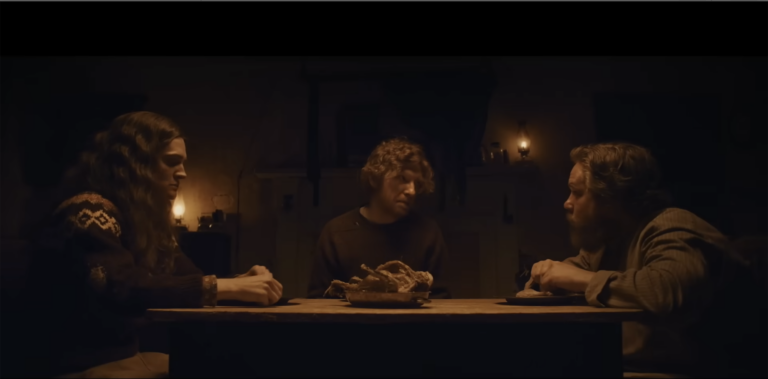
The film follows Isla (Gayle Rankin) and Sandy (Grant O’Rourke), siblings who have lived in complete isolation on a remote Orkney isle for 30 years since their parents disappeared. They survive by hunting seabirds, retelling the stories of their ancestors, and defending their island against all outsiders — including, above all, the Finman (John Hannah), a gaunt, gloomy sea-sorcerer who visits Isla at the shoreline and beckons her toward the waves. Their hermetically sealed world fractures when Daniel (Domhnall Gleeson), an awkward mainland council worker armed with veganism, internet wizardry, and government paperwork, arrives to evacuate them under orders from his formidable boss Roz (Michelle Gomez).
Critics have described the film — which holds a 93% Certified Fresh score — as “about being isolated for so long that you forget how to want things, to the point that when desire actually shows itself, it can’t help but manifest malformed.” That description from Slant Magazine’s Justin Clark is more precise than it might first appear. The psychology, anthropology, folklore, physics, and political history that the film draws from are all grounded in documented real-world frameworks — and some of those frameworks run considerably deeper than the film’s deadpan comedy suggests.
What Exactly Was the Finman?
The Finfolk of Orkney and Shetland mythology are described as amphibious sorcerous shapeshifters from the underwater palace of Finfolkaheem — a place imagined as lit by bioluminescent sea creatures and decorated with swaying curtains of multi-colored seaweed. The Finman specifically is tall, thin, and gloomy-faced, credited with the ability to row from Norway to Orkney in seven oar-strokes, make his vessel invisible, and create fleets of phantom boats. As Wikipedia’s Finfolk article records, he is also obsessed with silver, will abduct unsuspecting humans from shorelines, and abhors the sign of the Christian cross.
These attributes read now as supernatural. But the scholarly case for where they came from is grounded in documented historical events.
The first mention of “Finnmen” in print appeared in a 1693 Edinburgh publication: A Description of the Isles of Orkney, by the Reverend James Wallace of Kirkwall. Jonathan Westaway’s Finnmen essay at Public Domain Review documents how, between roughly 1682 and 1701, multiple documented sightings around the Northern Isles described lone figures in extraordinarily small, low, fast watercraft whose paddlers wore what appeared to be sealed leather clothing. They fled when islanders gave chase. They appeared to vanish under waves and resurface. Their vessels required no sail.
Modern scholarship — including peer-reviewed work by Jonathan Westaway of the University of Central Lancashire — has identified these figures as almost certainly Inuit kayakers. The qajaq (kayak) of Inuit design is a skin-on-frame craft with a cockpit that can be sealed around the paddler’s torso, allowing it to be rolled and resurface as if the boat had “disappeared.” Its low silhouette and speed were without European parallel. Its paddler’s appearance — unfamiliar complexion, sealed leather garment, extraordinary boat-handling — fed precisely into what became the Finman legend. Norman Rogers, author of Searching for the Finmen and an experienced kayaker, has confirmed that the clerical descriptions — boats made of leather, paddler wearing a coat attached to the cockpit, performing Eskimo rolls — leave no room for doubt. His full analysis is in the SNR Mariners’ Mirror Podcast.
A group of Inuit hunters, possibly blown south by severe climatic conditions at the end of the 17th century’s Little Ice Age, may have crossed over 1,200 miles (1,931 km) of open ocean from Greenland to the Northern Isles. The Scotsman’s investigation of this hypothesis notes that the Inuit culture at the time had no written contact with Northern Europe; the Northern Isles had no framework for understanding what they were seeing. So the encounter was encoded in the framework that did exist: mythology.
The Finman’s seven-stroke row from Norway to Orkney is a mythological encoding of genuine Inuit long-distance open-water navigation capability, which was vastly superior to anything Northern Isles fishermen possessed. The silver obsession may encode real trade encounters. The abduction narrative encodes real coastal fears: on islands dependent on shoreline work, the sea did take people, and a mythological agent of abduction rationalizes otherwise inexplicable disappearances.
In John Hannah’s hands in Paxton’s film, the Finman functions as Isla’s unconscious — the part of her already half-drawn by desire away from the island’s rules. That this psychologically precise deployment of an ancient mythological figure turns out to have begun with a group of actual people crossing an actual ocean is one of the more remarkable things about The Incomer‘s folkloric substrate.
The Real St Kilda Behind the Fictional Island
Paxton has confirmed in interviews that the film draws directly on his fascination with St Kilda — the real historical antecedent for Isla and Sandy’s world. The Scotsman’s EIFF interview with Paxton makes clear how precise the parallel is.
St Kilda, an archipelago 40 miles (64 km) west of the Outer Hebrides, had been continuously inhabited for roughly 4,000 years. Its community survived through a seabird-based subsistence economy; census records document that each islander consumed approximately 36 eggs and 18 seabirds daily — a collective requirement of some 3,240 eggs and 1,620 birds each day. The Scotsman’s St Kilda record preserves these figures. The primary prey species were gannets (known in Scots as “solan geese”), large seabirds whose colonies clustered on remote, dangerous sea stacks. Hunting them required deep ecological knowledge — of tidal patterns, cliff topography, seasonal migration routes — transmitted across generations through oral tradition.
By 1930, the St Kilda population had declined to 36 islanders: 13 men, 10 women, 8 girls, and 5 boys. On 10 May 1930, 20 of them petitioned the Secretary of State for Scotland for evacuation. On 29 August 1930, HMS Harebell carried the final inhabitants away from an island that had been continuously occupied since the Bronze Age. The National Trust for Scotland holds the authoritative public record of these events.
The parallel with the film is structurally exact and structurally inverted. Isla and Sandy refuse to leave; the St Kildans petitioned to go. But the mechanism is identical: a government apparatus arrives with the authority to relocate a small island community under the stated rationale of welfare. And the psychological literature on forced relocation of island communities — even requested ones — consistently describes a grief pattern analogous to bereavement. Islanders who had never felled a tree were resettled in forested landscapes in Morvern, Argyll. The mainland was unrecognizable. The pace was alien. The ecology of their knowledge system had no outlet.
Isla and Sandy’s island sustains only two people — a population so minimal that their ecological footprint would be sustainable almost indefinitely, provided seabird colonies remained stable. In this sense, the film’s premise is more scientifically sound than most post-apocalyptic survivalist fiction: two humans living off a functioning seabird colony in a North Atlantic archipelago is a genuinely viable long-term configuration.
How Isolation Rewires the Brain
The film’s central comedy engine — two adults who cannot process the concept of avocados, veganism, or the internet, and who respond to a man with a clipboard as an existential threat — is not mere eccentricity. It maps onto documented cognitive neuroscience.
Research using UK Biobank imaging data from approximately 40,000 participants has established that perceived social isolation produces measurable changes in brain structure and function centered specifically on the default mode network — the brain’s self-referential processing system, which overlaps substantially with what researchers call the “social brain.” This is documented in a 2020 Nature Communications study by Spreng et al. at McGill University. The loneliness-linked neurobiological signature also includes elevated activation of visual attention and limbic systems associated with hypervigilance — the brain becomes, structurally, a threat-detection sentry.
That is precisely Isla and Sandy’s operational mode. Trained since childhood to identify and repel “incomers,” they are running a threat-detection program with no capacity to distinguish a genuine danger from a mild council worker with paprika-flavored hummus. Their cognitive response to Daniel is not stupidity — it is the predictable output of a threat-detection architecture that has only ever been calibrated to one category of outsider.
The film also maps, more subtly, onto the crucial psychological distinction between isolation and loneliness. Research consistently shows that individuals with a genuine preference for solitude do not develop the same pathological profiles as people who experience isolation as deprivation. Isla and Sandy function because they are not lonely: they have each other and a mythological world they inhabit entirely. The tragedy — gently embedded in the film’s comedy — is that the preference for solitude, when inherited rather than chosen, forecloses the capacity to choose otherwise. The desire that “manifests malformed” in Isla is the leakage of a suppressed capacity for wanting that the island system has no outlet for. The Finman, the creature who beckons her toward the sea, is not supernatural. He is neurological.
Tír na nÓg and the Physics of Subjective Time
Multiple critics have drawn a comparison between the film’s island and Tír na nÓg — the Irish mythological realm of eternal youth, in which the hunter Oisín is lured by the beautiful Niamh to a place where what feels like three years turns out to be 300 on the mortal earth. The Michigan Daily’s Sundance review was among the first to note this parallel. When Oisín finally returns and his feet touch Irish soil, three centuries of accumulated time collapse onto him instantly.
The comparison is structurally exact — and there is real physics behind it.
Modern neuroscience recognizes that subjective time — the felt passage of duration — is calibrated primarily by novelty and information processing. When an environment contains no new information, psychological time slows. When it contains dense novelty, subjective time feels compressed (which is why childhood summers seem to last forever: every experience is genuinely new). Isla and Sandy, in an environment that has not changed in 30 years, may genuinely experience something like temporal encapsulation: the island feels outside ordinary time because, informationally, it is.
Daniel’s arrival introduces information at a rate the island has never experienced. This is why his presence feels catastrophically destabilizing to the siblings: he is introducing thermodynamic disorder into a closed system — an island that has maintained informational equilibrium for three decades — and the system cannot absorb the input at normal rate.
The Fata Morgana optical phenomenon provides an additional real-world physics mechanism for the mythology the film inhabits. A Fata Morgana is a complex superior mirage occurring when a warm air mass sits above a colder layer near the sea surface, bending light rays in ways that make distant landmasses, ships, and islands appear suspended above the horizon or to vanish and reappear. The phenomenon is pronounced in cold North Atlantic coastal environments — precisely Orkney — and would have been observed by islanders with no framework for optical physics as recently as the 20th century. The vanishing enchanted islands of Orkney mythology (Hildaland, the summer home of the Finfolk, which could appear and disappear at will) have a plausible atmospheric explanation.
The island of The Incomer is, scientifically, a Tír na nÓg structure: a place that is outside time not through magic but through information deprivation and the atmospheric physics of the North Atlantic.
Where Was It Filmed, and How Does That Square Out?
The film was shot in Caithness in northeast Scotland over 28 days in summer 2025. Caithness doubled for Orkney — Paxton confirmed he scouted locations in Orkney itself but could not secure the necessary coastal cliff permissions. The BFI interview with Paxton establishes that Paxton, who spent childhood summers in Orkney (his grandfather was from St Margaret’s Hope and his mother’s family is from the islands), was drawing on deep personal geography. Costume and set designer Selina Wagner also grew up on Orkney, lending the production a specific textural intimacy with the islands’ visual culture.
For American audiences attending the September 25 opening, Caithness — where the actual filming occurred — is roughly equivalent in latitude to southern Alaska. The North Atlantic light, the cliff topography, and the windswept barrenness are not stage-dressed. That landscape, as Paxton has observed, generates its mythology naturally.
What the Ending Really Argues About Wildlife Conservation
Multiple reviews of The Incomer note that the film’s resolution involves the siblings’ island being designated a wildlife reserve. This ending has been read as bittersweet — a preservation of the ecology that Isla and Sandy were already sustaining. But it enacts, with remarkable precision, the central contested question of 21st-century conservation biology.
The debate between “fortress conservation” — protecting biodiversity by removing or excluding human communities from ecologically significant territories — and indigenous-led or community-based conservation has intensified substantially in recent years. An estimated 136 million people have been displaced in the process of formally establishing protected areas globally. A 2020 Mongabay Rights Resources Initiative report documented this figure alongside evidence that exclusionary conservation produces persistent equity harms. A 2026 perspective in Nature identified exclusionary conservation as producing persistent racial and equity harms, while evidence increasingly supports the case that indigenous-governed territories often match or exceed state-protected areas in biodiversity outcomes.
Isla and Sandy’s subsistence hunting of seabirds was itself a form of wildlife management: regulated hunting maintains population balance and keeps predator-prey relationships functional within a closed island system. Their ecological footprint, for two adults, was minimal and sustainable. The conversion of their island to a formally state-managed wildlife reserve achieves similar ecological outcomes through entirely different political means — but it destroys something the state-protected version cannot replicate: the human relationship with the landscape that generated the Finman mythology in the first place.
A wildlife reserve has no Finfolk. The preservation of the ecological system destroys the cultural system that was inseparable from it. A 2007 paper in PLOS Biology titled “The Costs of Exclusion: Recognizing a Role for Local Communities in Biodiversity Conservation” argued this exact point nearly two decades ago.
This is the film’s most quietly devastating scientific observation, and it does not require the word “conservation” to make it. The Incomer arrives at the conclusion that indigenous-led conservation scholars have been arguing for decades: that the human cultural relationship with a landscape and the landscape’s biodiversity are not separable, and that “protecting” the one by removing the other is a paradox dressed as a solution.
What Paxton Said About All This
Paxton, in interviews with the BFI and with The Scotsman around the Edinburgh International Film Festival opening, has described the film as “a story about identity and the stories we tell, to one another and to ourselves, inspired by the magical and mysterious history of our remote isles.” He drew explicitly on his interest in maritime history and the Finfolk tradition. He has also confirmed that he was drawing on the St Kilda story when constructing the film’s evacuation plot. The Scotsman’s full interview covers both threads in detail.
He did not describe the film as a conservation biology argument, a neuroscience case study, or a Fata Morgana physics demonstration. He did not need to. The disciplines are embedded in the story by virtue of where the story is set, what its characters believe, and what the government’s decision to turn their island into a reserve actually means in the vocabulary of 21st-century land ethics. The scientific frameworks arrived on their own, summoned by the specificity of Paxton’s setting.
The Incomer opens in US theaters September 25, 2026. It is currently playing in UK and Irish cinemas. No streaming or VOD release date has been announced.
Frequently Asked Questions
Is the Finman in The Incomer based on a real mythology, and does that mythology have a real origin?
Yes to both. The Finfolk — including the Finman — are genuine pre-Christian creatures from Orkney and Shetland folklore, documented extensively by ethnographer Ernest Marwick in The Folklore of Orkney and Shetland (1975). The mythology’s likely origin is specific: between 1682 and 1701, multiple clergymen in the Northern Isles documented sightings of lone figures in small, sealed, extraordinarily fast leather boats. Modern scholarship — including peer-reviewed work by Jonathan Westaway at the University of Central Lancashire — has identified these figures as Inuit kayakers, probably drifted or blown southward from Greenland, whose qajaq technology was unlike anything in the Northern Isles’ experience. The boat’s ability to seal around the paddler and roll under a wave and resurface gave rise directly to the Finman’s ability to “disappear” at sea. The full scholarly account is available in Westaway’s Finnmen Legends essay.
What does real neuroscience say about what 30 years of isolation does to a person?
Research using brain imaging data from approximately 40,000 participants has established that perceived social isolation produces measurable structural and functional changes in the default mode network — the brain’s self-referential processing system. The isolated brain also shows elevated activity in visual attention and threat-detection systems, producing the hypervigilance that Isla and Sandy display throughout the film. Crucially, there is a documented distinction between chosen solitude (not pathological) and inherited isolation (which forecloses the capacity to choose otherwise). Sandy and Isla’s “malformed desire” — the phrase Slant Magazine critic Justin Clark used — is the predicted output of this neuroscience: suppressed wanting leaking through a system that has had no outlet for it. The underlying study is Spreng et al., Nature Communications, 2020.
What is the real historical precedent for the film’s evacuation plot?
The most direct antecedent is the 1930 evacuation of St Kilda, the Scottish archipelago 40 miles (64 km) west of the Outer Hebrides that had been continuously inhabited for approximately 4,000 years. Director Louis Paxton has confirmed in interviews that the St Kilda story was a conscious influence. The 36 St Kildans — who sustained themselves primarily through seabird hunting, exactly as Isla and Sandy do — petitioned the Secretary of State for Scotland for evacuation on 10 May 1930, after their population had declined to unsustainable levels. HMS Harebell evacuated the final islanders on 29 August 1930. The film inverts the story’s direction of agency (Isla and Sandy refuse to leave) while preserving its central question: what destroys an island community — isolation, or contact with the mainland? The National Trust for Scotland’s account remains the authoritative record.
What does the wildlife reserve ending actually argue about conservation science?
The conversion of the siblings’ island to a wildlife reserve enacts one of the most contested questions in 21st-century conservation biology: whether “protecting” a landscape by removing its human inhabitants is ecologically sound. Conservation scholars distinguish between “fortress conservation” — state-managed exclusion of human communities — and indigenous-led or community-based models that recognize human cultural practice and biodiversity as co-constituted. An estimated 136 million people have been displaced globally in the creation of protected areas. Isla and Sandy’s subsistence seabird hunting was itself a form of population management that maintained ecological balance. The reserve preserves the birds; it erases the human relationship that generated Finman mythology in the first place. The film inadvertently arrives at the conclusion that conservation biologists have been arguing for decades: the cultural system and the ecological system are not separable. See the Mongabay RRI conservation report and the 2026 Nature perspective on conservation equity for the scholarly background.