HomeAuto Pilatus PC-7 MKX Completes First Flight: Student Pilots Will Start, Not End, on Glass
Pilatus PC-7 MKX Completes First Flight: Student Pilots Will Start, Not End, on Glass
September 9, 2026:
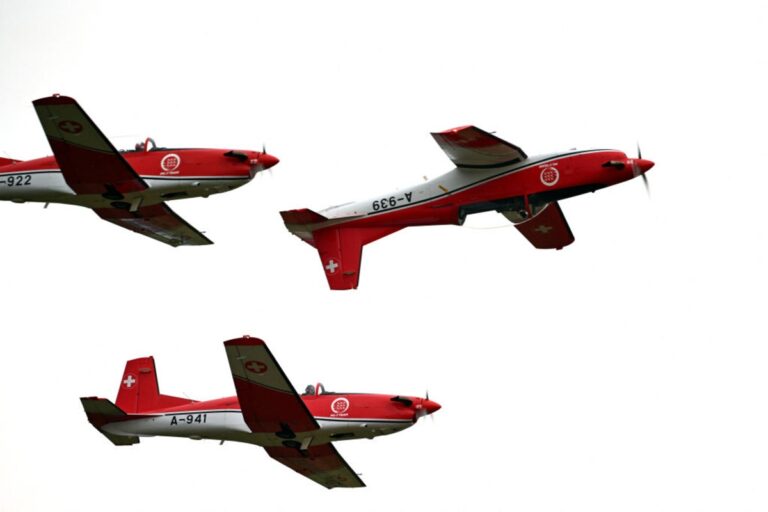
Pilots perform on Pilatus PC-7 aircrafts during the Antidotum airshow in Leszno, Greater Poland region, on June 21, 2024. SERGEI GAPON/AFP via Getty Images
The first production Pilatus PC-7 MKX destined for the Royal Netherlands Air Force left the ground at Stans, Switzerland on September 7, 2026 — the opening flight of a training aircraft that will expose military pilot candidates to a full glass-cockpit environment from their very first lesson, rather than the final one. Three NATO air forces have already committed to 48 of the type, and Pilatus now has manufacturing proof that the program is moving from contract to cockpit.
The aircraft lifted off from Pilatus’s facility in the Swiss Alps. Militär Aktuell’s first Dutch PC-7 MKX report confirms the flight took place fewer than seven months after production formally commenced at the same site on February 23, 2026. It will now undergo a program of ground and flight testing before deliveries are scheduled to the Netherlands beginning in May 2027.
What Makes the PC-7 MKX Different From Every Trainer That Came Before
The short answer is the cockpit. Traditional basic trainers — including the 13 Pilatus PC-7 Turbo-Trainers the Netherlands has flown since 1988 — present student pilots with analog instruments and a relatively simple avionics environment. The established philosophy held that beginners should master the fundamentals on forgiving, low-complexity equipment before encountering the glass displays of operational aircraft. The PC-7 MKX inverts that sequence.
At the heart of the new aircraft’s cockpit sits the Garmin G3000 PRIME avionics suite — and this specific installation is the first military integration of the G3000 with custom military-grade user-defined displays. Three high-definition multifunction screens replace analog instrumentation entirely. The large Primary Flight Display allows selection of multiple flight modes, while the two flanking screens can show a moving map for navigation, a Flight Management System readout, and an Engine Indicating and Crew Alerting System — the same categories of information a student will encounter in an F-35 cockpit years later.
The engine is a Pratt & Whitney Canada PT6A-25C producing 700 shaft horsepower — deliberately derated from the PT6A family’s higher-rated variants. That derating is not a limitation; it is an economic design choice. Reduced power output translates directly to reduced engine wear, lower fuel consumption per hour, and lower per-flight operating cost, while still delivering a maximum cruise speed of 465 km/h (289 mph), a rate of climb of 815 metres per minute (2,675 ft/min), and an aerobatic envelope of +7.0g / −3.5g — sufficient to introduce student pilots to a meaningful range of manoeuvre before they transition to jets. The PT6A family is the most produced turboprop engine in aviation history, with more than 60,000 units built since 1964 — a reliability record that cuts maintenance uncertainty for operators.
Martin-Baker ejection seats are fitted as standard — the PC-7 MKX is the only aircraft in its training class to include them, according to Pilatus.
A Training Ecosystem, Not Just an Aircraft
The cockpit is one piece of a larger pedagogical system. Pilatus markets the PC-7 MKX as a component of its Training Management System — a ground-to-air infrastructure that combines mission planning software, debriefing tools with performance analytics, full-flight simulators, and a ground-based training suite using augmented reality, virtual reality, and mixed reality technologies.
The Dutch contract signed in February 2025 covers eight aircraft, four full-flight simulators, and a comprehensive ground-based training suite — delivered as an integrated package with a separate five-year maintenance support agreement. The simulators are deliberately central to the design: Pilatus says their enlarged role is what allows fewer airframes to produce the same number of trained pilots at lower per-hour cost.
What separates this arrangement from conventional pilot training is where in the pipeline the advanced tools appear. Mission Planning and Mission Debriefing capabilities — data-driven pre-flight analysis and structured post-flight performance review — have traditionally been reserved for advanced and operational conversion training, when students have already mastered basic aircraft control. Pilatus is introducing them at the basic stage. The pedagogical argument is that students trained from day one to think in terms of mission data and performance feedback develop the situational-awareness habits that operational aircraft demand, rather than having to unlearn simpler analytical patterns when those tools finally appear in advanced training. The Dutch fleet is planned to fly 2,150 hours per year, with an additional 500 simulator hours, together capable of supporting up to 60 student pilots annually through Elementary Military Pilot Training (EMVO). These pilots are being prepared specifically for future assignments to the F-35A Lightning II, transport aircraft, or rotary-wing platforms — and the earlier they encounter the information architecture of those aircraft, the less cognitive adjustment they need to make when they reach them.
Thales was selected in March 2026 to supply the radio management system for European PC-7 MKX fleets — a system designed to adapt across scenarios from basic training to tactical operations and to function in complex electromagnetic environments. Thales acquired Cobham Aerospace Communications in 2024 to strengthen its cockpit connectivity and secure communications portfolio.
How the Netherlands Became the Launch Customer
The Royal Netherlands Air Force and Pilatus share a relationship stretching back nearly four decades. The RNLAF received its 13 PC-7 Turbo-Trainers in 1988, and those aircraft trained generations of Dutch military pilots at Woensdrecht Air Base in the south of the Netherlands. With the original fleet nearing the end of its operational life, the Dutch Ministry of Defence launched a competitive tender through its Material & IT Command procurement authority, known as COMMIT.
In February 2025, that process concluded with Pilatus as the winner. The Royal Netherlands Air Force became the MKX’s global launch customer, giving Pilatus both an order and a commercially significant endorsement: a NATO air force with a long Pilatus history chose to renew that partnership for what the Dutch Ministry of Defence described as another 30 years.
Markus Bucher, CEO of Pilatus, framed it in explicitly forward-looking terms: the deal, he said, would “set a new standard that other air forces will seek to follow.”
At a ceremony marking the production start ceremony on February 23, 2026, Lieutenant General André Steur, Commander of the Royal Netherlands Air and Space Force, and Brigadier General Stefan Linders, Director of Projects at COMMIT, jointly signed the fuselage of the first aircraft — a longstanding RNLAF tradition symbolizing the formal handover of a program from procurement to manufacturing.
Why Glass-Cockpit Training From Day One Works
The cognitive argument for native-digital training rests on transfer of training theory: skills learned in an environment that closely resembles the target environment transfer more efficiently than skills learned in an environment that must then be unlearned. A student pilot who spends 200 hours building instrument-scan habits on analog gauges must, when transitioning to a glass cockpit, suppress those habits and build new ones. A student who acquires the initial habit in a glass-cockpit environment has one fewer cognitive rebuild to perform later in the pipeline. The G3000 PRIME’s military user-defined displays can be configured to mirror the specific information architecture of the downstream aircraft — the F-35, in the Dutch case — giving students a spatial familiarity with data presentation that analog training cannot replicate.
Three Nations In, with More Watching
France was next to sign. In early 2025, the French procurement agency Direction Générale de l’Armement selected the PC-7 MKX under a program named “Mentor 2,” awarding a Mentor 2 training contract to Babcock International France Aviation. The French Air and Space Force will receive 22 aircraft, with deliveries beginning in 2027. The French specification includes a head-up display — an additional feature that Pilatus says will deliver a high degree of cockpit commonality between the PC-7 MKX and the PC-21 trainers France already operates at Base Aérienne 709 in Cognac-Châteaubernard.
Belgium followed in November 2025. The Belgian government approved a Belgian 20-year service contract covering 18 PC-7 MKX aircraft, new and upgraded infrastructure at Bevekom/Beauvechain Air Force Base, and comprehensive in-service support — delivered in partnership with Belgian industrial partners Sabena Engineering and AG Real Estate. The Belgian budget for the contract is set at approximately €40 million per year (approximately $46.5 million USD), with the industrial partners assuming all fixed and variable operating costs and risks. The Belgian Air Force will use the MKX to replace its Marchetti SF-260 trainers — some of which have been in service for 55 years. Training on the new type is scheduled to begin in 2028, once the infrastructure and simulators have been delivered and instructors have been familiarized with the system.
Together, the three contracts represent 48 aircraft across France, the Netherlands, and Belgium — a commercially significant production run for a newly certificated type, and a validation of Pilatus’s bet that a comprehensively modernized basic training ecosystem would resonate across European NATO defense budgets.
Pilatus’s Broader Position
The MKX program arrives at a moment of heightened European focus on defense capability. Across NATO, member states are reassessing training pipelines against the backdrop of fifth-generation platforms, increasing operational tempo, and a growing awareness that the quality of the pilot pipeline ultimately determines operational readiness — not just the number of aircraft on the ramp.
For Pilatus, the commercial case is equally compelling. The company reported a 10.5% increase in total sales to SFr 1.63 billion (approximately $2.02 billion USD) in 2024, with order intake surging 44.9% to SFr 2.19 billion (approximately $2.71 billion USD) — a sign that its combined civil and military portfolio is finding strong market traction even in a constrained supply-chain environment. The Pilatus 2024 financial results reflect a company with SFr 2.91 billion in its order book at year-end. The PC-7 MKX’s three-nation NATO foothold positions the company as a credible alternative to larger defense primes in the training-system segment — not on the strength of aircraft unit sales alone, but on the strength of integrated long-term service contracts that lock in revenue across 17- and 20-year horizons.
For the Netherlands, the maiden flight of the aircraft bearing Lieutenant General Steur’s signature is tangible proof that a procurement the Ministry of Defence described as a generational investment is on schedule. The first deliveries are expected in May 2027, with the full complement of eight aircraft and four simulators complete by September 2027.
Frequently Asked Questions
What is the Garmin G3000 PRIME, and why does it matter for military training?
The Garmin G3000 is an integrated avionics suite originally designed for high-performance civil turbine aircraft. The “PRIME” variant, as integrated in the PC-7 MKX, adds custom military user-defined displays — making this the first time the G3000 has been configured with screens that can mirror the specific information architecture of military operational aircraft, including fifth-generation fighters. For training purposes, this means a student pilot’s first exposure to how an aircraft presents navigation, engine, and systems data happens in the same spatial layout they will encounter years later in an F-35 or transport — compressing the cognitive adjustment required at each pipeline transition.
Why does Pilatus use a deliberately derated engine in the PC-7 MKX?
The PT6A-25C is rated at 700 shaft horsepower in this application, which is lower than many of its sibling variants in the same engine family. The derating is intentional: lower power output means lower turbine temperatures, reduced wear per flight hour, lower fuel consumption, and significantly lower per-hour operating cost — all important for a training aircraft that will accumulate thousands of hours per year across its 30-year certified life. The performance envelope remains sufficient for the aerobatic training the aircraft is designed for, including the +7.0g / −3.5g load limits required for military basic training.
How does the Pilatus Training Management System change how student pilots are assessed?
Traditional military pilot training introduces Mission Planning tools — structured pre-flight analysis — and Mission Debriefing tools — post-flight data review with performance metrics — only at the advanced training stage, once students have mastered basic aircraft control. Pilatus’s Training Management System deploys both capabilities at the basic training level. The practical effect is that student pilots begin building the data-driven situational-awareness habits that operational flying demands from their first training sorties, rather than acquiring simpler analytical patterns that must later be replaced.
Why are three NATO countries choosing the PC-7 MKX at the same time?
The Netherlands signed first in February 2025, followed by France (early 2025) and Belgium (November 2025). All three are replacing aging fleets that have served for decades — the RNLAF’s PC-7s since 1988, Belgium’s SF-260s for roughly 55 years — and all three are feeding into F-35 and multi-role pilot pipelines that require students to be comfortable with advanced avionics from an early stage. The convergence reflects a broader NATO trend: as fifth-generation aircraft proliferate across European air forces, the basic training stage is being redesigned around the assumption that students will eventually fly complex digital aircraft, not as an advanced pipeline outcome but as the baseline expectation.