HomeAuto AR Glasses Waveguide Weight Cut 75%: Beijing Startup Raises $15M for Silicon Carbide Chips
AR Glasses Waveguide Weight Cut 75%: Beijing Startup Raises $15M for Silicon Carbide Chips
September 8, 2026:
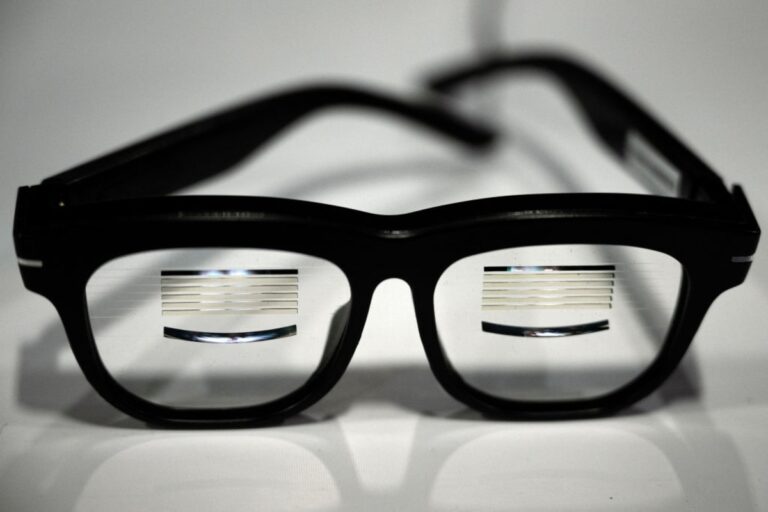
AR glasses from LetinAR are seen during CES Unveiled at the Mandalay Bay Convention Center a pre-show for this weeks Consumer Electronics Show January 7, 2024, in Las Vegas, Nevada. BRENDAN SMIALOWSKI/AFP via Getty Images
The single biggest reason AR glasses still feel like science projects is an optical problem that predates the devices themselves. Glass-based waveguides — the thin lenses that route light from a tiny projector to your eye — weigh between 10 and 15 grams (0.35 to 0.53 oz), sit 2 to 3 millimeters (0.08 to 0.12 inches) thick, and create vivid rainbow-colored halos in your peripheral vision whenever ambient light hits them. Fix those three things simultaneously, and the path to genuinely wearable AR glasses opens up. A Beijing-based startup thinks it has that fix — and it just raised over 100 million yuan (approximately $15 million USD) to build the factory.
Avalon Holdings (Beijing) Co., Ltd., announced a Series B financing round this week, led by returning backer Plum Ventures and joined by two new government-linked investors: Deyang State-owned Capital and Ningbo State-owned Capital. The company, founded in 2017 by Xu Peipei — a Peking University PhD and former Huawei executive — will use the proceeds to expand its production base in Deyang, Sichuan province and advance a next-generation optical waveguide chip it claims outperforms the dominant industry design on every key metric.
To understand what Avalon is building, it helps to understand what it is competing against. Most AR waveguides on the market use surface relief grating (SRG) technology: microscopic nanostructures etched into glass that steer light from a projector into the wearer’s eye via total internal reflection. SRG is established and manufacturable, but it carries a set of physics-rooted limitations that scale with the material itself, not the engineering. The core constraint is the refractive index of glass. Conventional high-index glass waveguide materials top out at a refractive index of roughly 2.0, which limits the theoretical field of view for a single-layer full-color waveguide to about 35 degrees.
How Bad Is the Current Hardware, Really?
To reach full color display, manufacturers have historically stacked multiple waveguide layers — one per color channel — which multiplies the weight and manufacturing complexity. That layering is also where rainbow artifacts come from: ambient light diffracts off the grating structures at angles that put colored halos directly in the wearer’s sight line. Meta described the user experience gap vividly when it unveiled its Orion AR glasses prototype in 2024, which used silicon carbide waveguides rather than glass. Optical Scientist Pasqual Rivera wrote in a company blog post, cited by Road to VR: wearing glasses with glass-based waveguides and plates felt like being in a disco, with rainbows everywhere — the silicon carbide version, Rivera said, was a total game changer.
Why Silicon Carbide Changes the Physics
Silicon carbide (SiC) is a compound semiconductor with a refractive index of approximately 2.65 — meaningfully higher than the best available optical glass. That difference is not marginal. Researchers at Westlake University demonstrated in a 2025 paper in the journal eLight that the theoretical field-of-view limit for a single-layer SiC waveguide is 80 degrees, compared to 35 degrees for glass at equivalent index. The same single-layer SiC waveguide achieved rainbow-artifact-free full-color display while weighing just 3.795 grams (0.13 oz) and measuring 0.75 millimeters (0.03 inches) thick — compared to conventional glass waveguides weighing 10 to 15 grams (0.35 to 0.53 oz) at 2 to 3 millimeters (0.08 to 0.12 inches).
The physics explanation for the artifact suppression is straightforward: SiC’s higher refractive index allows smaller grating periods in the waveguide nanostructure. Smaller periods push ambient light diffraction to steeper angles, directing the diffracted rays outside the wearer’s eye-box entirely rather than into it. The result is a full-color display operating within a single SiC layer, with no stacking required and no rainbow halo.
The problem is that SiC is genuinely difficult to manufacture in optical-grade form. Meta was explicit about this when describing Orion’s economics: the prototype cost roughly $10,000 per pair, with the SiC waveguide lenses as the single most expensive component. Meta’s Reality Labs Research Science Director Barry Silverstein described the situation in March 2025: suppliers are excited by the new opportunity of manufacturing optical-grade silicon carbide, after all, each waveguide lens represents a large amount of material relative to an electronic chip, and all of their existing capabilities apply to this new space.
Silverstein also noted the path forward on costs: suppliers moving from four-inch to eight-inch SiC wafers, with some working toward 12-inch wafers, each step yielding exponentially more waveguide pairs per production run. That is the economic logic Avalon is betting on.
How Avalon’s Approach Is Different
Avalon’s specific technical route — what it calls MGW, or Metasurface Grating Waveguide — takes SiC further by applying a metasurface optical architecture rather than conventional SRG grating. Where SRG etchings guide light at the surface of a conventional substrate, a metasurface uses subwavelength-scale resonators (structures smaller than the wavelength of light) to control the phase, amplitude, and polarization of light directly. The result is a more precise optical element that can achieve the same waveguiding and pupil-expansion functions with lower chromatic dispersion.
The strategic distinction, however, is manufacturing. Avalon produces its MGW chips using standard semiconductor wafer fabrication processes — the same toolchain of electron beam lithography, ion-coupled plasma etching, and yield-optimization procedures used to manufacture logic chips. This matters because it means Avalon is not building a bespoke optical manufacturing capability from scratch. It is applying a proven industrial infrastructure to a new material application. Xu told Hard Krypton (the investment reporting arm of 36Kr) that the company could not find any usable waveguide products when surveying the market, so it decided to develop its own solution.
To enable rapid design iteration, Avalon in 2023 acquired an electron beam lithography machine sourced from the Netherlands — equipment it says very few Chinese startups own — allowing R&D cycles measured in days rather than months.
Independent research validates the economic trajectory. Researchers at Westlake University estimated in their 2025 eLight paper that producing SiC waveguide units using 8-inch wafer runs at 5,000 units per month would yield a per-unit cost of approximately 900 yuan (roughly $134 USD); scaling to 20,000 units per month would bring the cost down to approximately 651 yuan (roughly $97 USD). That range is not yet at parity with glass SRG on a commodity basis, but it represents a credible path given semiconductor-industry wafer-scaling economics.
Avalon claims its chip already delivers optical efficiency more than three times that of conventional SRG optics and a field of view exceeding 50 degrees in standard configuration — with a single layer of its silicon carbide material achieving over 70 degrees. These performance claims come from company statements to 36Kr and have not been independently validated by a named third party. Competitor Goeroptics, at SPIE AR/VR/MR 2026 in January, separately debuted its F50Se SiC optical module — a 50-degree FOV full-color silicon carbide optical module using ion beam etching rather than semiconductor-process nanoimprint lithography — confirming that multiple Chinese optical makers are converging on the same material.
Can SiC Challenge the Established Suppliers?
The comparison point at CES 2026 was stark. Lumus — the Israeli company whose geometric waveguide supplies Meta’s Ray-Ban Display Glasses — announced what it called the “world’s first” geometric waveguide to exceed a 70-degree field of view, using its proprietary glass architecture rather than silicon carbide. That claim came with an asterisk: Lumus achieved 70 degrees with glass by advancing its geometric reflective waveguide design, which is a fundamentally different approach to light guiding than diffractive optics.
Lumus supplies Meta’s current Ray-Ban Display Glasses, and TrendForce data shows how consequential that relationship is: after an unexpectedly strong consumer response, Meta revised its Lumus waveguide orders upward by 87.5%, from roughly 80,000 units to approximately 150,000 units, within six months of launch. TrendForce now projects global AR glasses shipments will reach approximately 950,000 units in 2026, up 53 percent year-over-year, making 2026 the first year the category approaches the million-unit threshold.
At that scale, the supply constraints are real. Meta reportedly paused or delayed rolling out Ray-Ban Display Glasses to several international markets due to supply limitations — a signal that optical component capacity, not consumer demand, is the binding constraint on category growth right now.
This is the market window Avalon is targeting. Rather than competing head-to-head with Lumus for Meta’s specific components, Avalon is positioning its chip as an open supply-chain option for any AR glasses manufacturer globally. Xu told 36Kr that the company sells waveguide components to any AR glasses manufacturer globally. The complete-machine business — Avalon’s S-series enterprise AR glasses, deployed in China’s power sector including State Grid, and in law enforcement — serves as both revenue validation and a product testbed for the optics.
The company’s 8-inch SiC grating waveguide production line is currently under construction at its Deyang, Sichuan facility. It is expected to reach operational status in 2027, at which point it is projected to achieve an annual capacity of one million units. Avalon reported approximately 70 million yuan in revenue for 2025 (approximately $10 million USD), and targets roughly 150 million yuan (approximately $22 million USD) in 2026 and approximately 500 million yuan (approximately $74 million USD) by 2028.
What the State-Owned Investors Signal
Plum Ventures’ continued backing is notable: the firm explicitly cited process maturity, mass production yield, and customer implementation as having exceeded expectations since its prior investment. But the composition of the new investors is at least as revealing.
Deyang State-owned Capital and Ningbo State-owned Capital are government-linked investment vehicles, not independent VC firms. Deyang’s participation comes with a stated industrial-policy objective: Deyang State-owned Capital described the investment as not only financial support but also industrial collaboration, with a goal of promoting optoelectronic chip production lines to take root in Deyang.
This arrangement is common in China’s technology development model, where local government capital is used to anchor manufacturing capacity in specific cities. For international buyers evaluating Avalon’s chip as a component source, it matters: state-linked investment is both a resource and a constraint. Building a semiconductor-grade optical fab takes roughly two to two and a half years from groundbreaking to output, capital costs are steep, and the Deyang government effectively becomes a structural stakeholder.
Data-Sharing Legal Obligations for an Authoritarian-Jurisdiction Supplier
AR component buyers and device manufacturers considering Avalon as a supplier should understand the legal framework governing the company’s operations. As a Chinese-headquartered company, Avalon is subject to China’s National Intelligence Law (2017), which states in Article 7 that all organizations and citizens shall support, assist, and cooperate with national intelligence efforts in accordance with law. This obligation applies regardless of where the company operates, who its investors are, or what its stated privacy policy says. China’s Data Security Law (2021) and Cybersecurity Law (2017) further require data localization and create government-access obligations for covered data.
For a chip supplier, the immediate data-security implications are more limited than for a networked consumer device. A waveguide chip does not transmit user data. But Avalon also operates an XR cloud platform, and its enterprise AR glasses are deployed with law enforcement and in critical infrastructure — State Grid is a named customer. Buyers sourcing chips from Avalon for products that connect to cloud services should evaluate those relationships under the full legal framework, not only the chip’s optical specifications.
It is also worth noting that Avalon’s existing law enforcement deployment in China represents a specific government-use-case relationship that prospective international partners should factor into any due-diligence analysis.
Why Xu Is Predicting the Consumer Inflection Point Lands in 2027
Xu Peipei has been direct about what he sees coming. He told 36Kr that he believes the inflection point will definitely come in 2027: in terms of product form, the weight of glasses will be reduced to the 30-gram level, no different from myopia glasses, and the wearing experience will be acceptable to the public.
Minsheng Securities, in a March 2025 research report cited by Yicai Global, independently agreed that SiC-based optical waveguides represent the enabler for AR glasses’ transition to a mainstream platform — specifically because of SiC’s ability to address the weight, heat dissipation, and field-of-view limitations that have kept the category in enterprise niches.
There is a real performance verification gap to note: Avalon’s specific performance claims — tripled efficiency, FOV above 70 degrees in a single layer, 60 percent cost reduction versus the industry average — come from the company’s own statements to a single media outlet. No independent auditor has yet published a comparative test of Avalon’s chips against glass-SRG or Lumus-style reflective waveguides. The Westlake paper validates the SiC physics independently, but it covers a different implementation (NIL-to-lift-off on 4-inch wafers) than Avalon’s claimed semiconductor-process approach. Until Avalon’s 8-inch production line is operational and its chips are in the hands of third-party OEMs, investors and buyers should treat the performance numbers as design targets, not audited results.
What is independently verifiable is the direction: SiC is the material that Meta, Westlake researchers, Goeroptics, and now Avalon all agree unlocks the next hardware generation. The question is who builds the cost-effective supply chain first.
Currency conversions in this article are approximate and based on exchange rates as of September 7, 2026.
Frequently Asked Questions
Why do AR glasses still have such a small field of view?
The physical limit comes from the refractive index of the waveguide material. Conventional glass waveguides top out at a refractive index of about 2.0, which caps the theoretical single-layer field of view at roughly 35 degrees. To go wider, manufacturers have historically stacked multiple waveguide layers — which adds weight, cost, and the rainbow artifacts viewers sometimes see. Silicon carbide has a refractive index of approximately 2.65, which pushes the theoretical FOV limit to 80 degrees in a single layer, without the stacking. That is the core physics advantage Avalon and other SiC waveguide makers are exploiting.
Why couldn’t Meta just manufacture silicon carbide waveguides at scale for Orion?
Meta was explicit that Orion required roughly $10,000 per pair to produce, with the SiC waveguides as the most expensive component. The challenge is that optical-grade SiC is fundamentally different from the electronic-grade SiC used in EV inverter chips — manufacturers cannot repurpose that surplus. Producing optical-grade SiC requires separate crystal growth and fabrication processes, and as of 2025, no commercial-scale supply chain existed for it. Avalon’s bet is that applying standard semiconductor wafer-fabrication equipment and processes to SiC can bring costs down along the same trajectory that drove logic-chip costs from thousands to dollars per unit over decades.
What does it mean that Avalon’s new investors include state-owned capital?
Deyang State-owned Capital and Ningbo State-owned Capital are government-linked investment vehicles, not independent VC firms. Deyang explicitly described its investment as industrial collaboration, linking Avalon’s factory to a regional government objective of anchoring optoelectronic manufacturing in Deyang, Sichuan. Additionally, as a Chinese company, Avalon is subject to China’s National Intelligence Law (2017), which legally requires all organizations to cooperate with government intelligence requests. This does not make Avalon’s chips dangerous to use, but it is a material fact for international buyers doing supplier due diligence, particularly for products that incorporate cloud connectivity or that collect usage data.
How does Avalon’s claimed performance compare to what independent researchers have found?
The physics directionally matches. Researchers at Westlake University published a peer-reviewed 2025 paper in eLight demonstrating a SiC diffractive waveguide achieving a 30.82-degree FOV with luminous efficiency of 1,238 nit per lumen — a 72 percent improvement over conventional full-color AR glasses at 720 nit per lumen — in a monolithic chip weighing 3.795 grams. Avalon claims significantly higher specs (FOV exceeding 50 degrees, single-layer FOV over 70 degrees), but those figures come from the company’s own statements to one outlet and have not been independently validated. Buyers should note the gap between what independent researchers have demonstrated with SiC and what Avalon specifically claims for its MGW design until third-party testing is available.