HomeAuto Hadestown Streams Now: Neuroscience, Ecology, and Political Economy Behind Mitchell’s Musical
Hadestown Streams Now: Neuroscience, Ecology, and Political Economy Behind Mitchell’s Musical
September 8, 2026:
Hadestown.com
Hadestown is not just emotionally true. It is scientifically accurate in ways that explain why a show about ancient Greek gods hits harder than nearly anything else on a Broadway stage — and why the film version, now streaming on Amazon Prime Video, Apple TV, and Fandango at Home after grossing more than $20 million at the domestic box office, broke Hamilton’s box office record to become the highest-grossing live-capture musical in history. Anaïs Mitchell’s folk-jazz retelling of Orpheus and Eurydice is built on four conceptual pillars — the neuroscience of musical persuasion, the ecology encoded in the Persephone myth, the political economy of an extractive factory-state, and the cognitive science explaining why certain stories survive for 2,500 years — and each of those pillars holds because the underlying science is real. The deeper argument binding all four is the same: that art transmits knowledge that formal systems fail to preserve, not despite bypassing reason, but because of it.
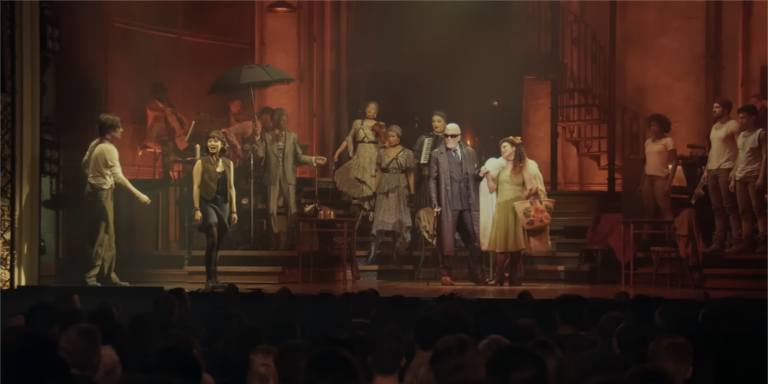
The film, directed by Brett Sullivan and recorded at London’s Lyric Theatre during a 2025 run featuring the original Broadway principals — Reeve Carney, Eva Noblezada, Patrick Page, Amber Gray, and André De Shields — is available August 25 on VOD now for $24.99 digital purchase and $19.99 for a 48-hour rental. A DVD and Blu-ray release is scheduled for October 20, 2026, with a UK theatrical release set for October 13 through Trafalgar Releasing. A new principal cast — musician Kayko as Orpheus, Yellowjackets star Jasmin Savoy Brown as Eurydice, two-time Tony winner Norbert Leo Butz as Hermes, Tony nominee Amber Iman as Persephone, and Tony honoree Ben Davis as Hades — new Broadway principal cast began performances at Broadway’s Walter Kerr Theatre on September 1, keeping the show, now in its eighth consecutive year, available to see live in New York.
What follows is a guide to what Hadestown already knows about the world — decoded through the academic disciplines the show is quietly, rigorously drawing on.
Orpheus and the Science of Acoustic Override
In the Greek myth and in Mitchell’s retelling, Orpheus does not argue with Hades. He sings. This distinction — between rational persuasion and acoustic persuasion — is the most scientifically precise move the show makes.
Psychoacoustics, the scientific study of how acoustic signals become subjective experience, has established that music reaches the limbic system — the amygdala, hippocampus, and nucleus accumbens — before conscious interpretation begins. A landmark study by Salimpoor and colleagues at McGill University’s Montreal Neurological Institute, published in Nature Neuroscience in 2011, used a novel combination of positron emission tomography (PET) and functional magnetic resonance imaging (fMRI) to measure dopamine release during music listening. The finding was specific and anatomically remarkable: the brain releases dopamine at peak musical pleasure through a two-stage process, with the caudate nucleus active during the anticipation buildup and the nucleus accumbens delivering the release at the moment of peak pleasure itself. This is the same reward pathway the brain deploys for food and survival-essential rewards.
The implication, translated into the logic of the Orpheus myth, is this: music attacks a different cognitive target than argument. Rational resistance lives in the prefrontal cortex. Music bypasses it and goes directly to the limbic system — the older, deeper architecture that governs emotion, reward, memory, and attachment. Hades can suppress what he thinks. He cannot suppress what his caudate nucleus anticipates and his nucleus accumbens releases.
A related phenomenon, neural entrainment, describes the tendency of the brain’s own oscillations to synchronize with rhythmic external stimuli. Live music produces synchronized emotional responses across multiple listeners simultaneously. The Fates in Hadestown, who in the myth govern destiny through sheer inevitability, are momentarily stilled by Orpheus’s singing — a plausible dramatic metaphor for music’s documented capacity to interrupt habitual cognitive loops and induce an openness to alternatives. Neurologic Music Therapy, now a clinical discipline used in Parkinson’s rehabilitation, traumatic brain injury recovery, and stroke care, exploits this mechanism directly: Rhythmic Auditory Stimulation has been confirmed to modulate motor cortex activity in ways that bypass voluntary control.
Orpheus does not win an argument by being right. He wins by delivering a signal that Hades’ prefrontal defenses are not designed to block. This is why Hades is persuadable: not because he is weak, but because his defenses are rational, and music is not.
Persephone’s Ecology: A Climate System Encoded in Marriage
The second conceptual pillar is ecological, and it is where the show’s formal architecture does its most interesting structural work.
The Persephone myth seasonal change model was the ancient Greeks’ primary explanatory model for seasonal change. Persephone, goddess of spring, spends a portion of each year in the underworld with her husband Hades; when she dwells above with her mother Demeter, the earth is fertile and growing; when she descends, Demeter’s grief renders the earth barren. This is typically understood as a model for the northern-European pattern of productive summer followed by dead winter. But scholars of the Eleusinian Mysteries secret religious rites — the secret religious rites built around this myth and practiced near Athens for nearly two thousand years — have noted that the Mediterranean climate the myth was actually encoding is almost the inverse: in Greece and much of the eastern Mediterranean, crops cannot grow during summer heat that exceeds roughly 24 degrees Celsius (75 degrees Fahrenheit), and rain virtually ceases from May through September. The “death” of the earth in the Mediterranean context was summer drought, not winter cold. Persephone’s descent maps to the scorching, rainless season; her return maps to the cool, wet autumn and winter when grain could actually grow.
Mitchell and director Rachel Chavkin deliberately destabilize this cycle. In Hadestown, the Hades-Persephone marriage is fractured, and the consequence is not seasonal variation but climatic decompensation: the world above alternates between endless winter and scorching, rainless summer, with no functional growing season in between. In an interview from 2019, Chavkin described the climate dimension explicitly, saying the world of the musical was shaped by “a world that is out of balance, where it is either freezing or blazing hot, where food becomes scarcer.”
A 2025 paper in Green Letters: Studies in Ecocriticism argued that Hadestown develops what its authors call a “recursive dramaturgy” — the show’s revolving stage, cyclical structure, and Hermes’ repeated retelling of the same story are formal arguments about feedback loops. Climate catastrophe, in this reading, is not a sudden event but a self-reinforcing system; the show’s form enacts that structure rather than merely describing it.
More precisely: in the fictional universe of Hadestown, the Hades-Persephone relationship functions as an analogue to a planetary feedback loop. The disruption is always political. Hades does not cause climate failure by accident; he causes it by calling Persephone home early — a unilateral sovereign decision to withdraw a shared ecological resource from circulation for private benefit. This maps onto what economists call carbon lock-in: the situation in which communities are economically dependent on fossil fuel extraction that is simultaneously making those communities unlivable. Eurydice, who descends to Hadestown because the world above has become incompatible with survival, is in the behavioral profile that climate scientists use to describe contemporary climate migration — not a dramatic single event, but slow-onset livability decline.
The Eleusinian Mysteries themselves — the secret rites that transmitted this ecological knowledge for two millennia — were, in contemporary academic terms, a form of ecological epistemology: knowledge about seasonal and agricultural systems preserved and transmitted through embodied ritual practice rather than written documentation. They outlasted almost every political institution of ancient Greece. The show is continuing that transmission.
Why We Build the Wall: The Political Economy of Hadestown
The third pillar is political, and the most directly contemporary. Mitchell’s most audacious reimagining is not mythological but economic: she transplants Hades from the underworld of theological imagination into the underworld of industrial capitalism. Hadestown is a mining and manufacturing operation. It runs on fossil fuels, exploits cheap labor, enforces its perimeter with a wall, and sustains worker loyalty through a combination of debt, induced forgetting, and fear-based propaganda.
The company-town model Hadestown encodes was historically documented throughout the 19th and early 20th centuries in the United States — in the Pullman railroad car company’s purpose-built town in Illinois, in the coal towns of Appalachia, and in the plantation-adjacent agricultural economies of the South. The common mechanism was the truck system: workers paid in company scrip redeemable only at company stores, making it structurally impossible to save money, accumulate resources, or leave. This is precisely what Eurydice signs up for when she contracts with Hades: warmth and food in exchange for labor and memory, in a system designed to prevent exit.
The “forgetting” Hades induces in his workers — they lose memory of the world above — maps onto what the psychological and sociological literature documents as the cognitive consequence of long-term labor exploitation: the erosion of workers’ capacity to conceptualize alternatives. A person who cannot remember freedom cannot organize toward it. Manufacturing workers’ consent through fear of what lies outside the wall — “the enemy,” which turns out, under examination in the song “Why We Build the Wall,” to be poverty itself — is what political economists call manufactured consent — a concept Herman and Chomsky described as a system in which a population is persuaded to protect and perpetuate the conditions of its own exploitation through a fear-driven narrative about external threat.
Orpheus’s descent into Hadestown, read through this framework, is not primarily a rescue mission. It is an epistemological disruption. His song reminds the workers of the world above — restoring their imaginative capacity for alternatives. This is why Hades, even when personally moved by the song, ultimately must still set Orpheus up to fail: an artist who restores the imagination of the exploited is more structurally dangerous to a control system than any frontal confrontation. The mechanism of control depends on a closed information environment. Orpheus opens it.
Cultural commentator Bridget Read noted in Vogue in 2019 that Hadestown is explicitly “an argument for collective bargaining,” with the word “poverty” deployed more times than she had ever heard it before in the vicinity of Times Square.
What Hermes Knows: Narrative Transmission as a Form of Knowledge
The fourth pillar is epistemological and the most philosophically dense: why does Hermes insist on telling the story again even when he knows it ends in tragedy?
The Orpheus myth has been retold continuously for 2,500 years. Ovid devoted sections of the Metamorphoses to it in the 1st century AD. Monteverdi’s L’Orfeo of 1607, considered one of the oldest surviving operas, retells it. Gluck’s 18th-century Orfeo ed Euridice, Cocteau’s 1950 film Orphée, and now Hadestown all extend the chain. This is not historical accident.
Cognitive scientists studying narrative transmission have proposed that stories survive across generations when they encode emotionally resonant patterns that provide adaptive value: warnings about catastrophic doubt, models for courage under futility, frameworks for processing grief and loss that cannot be argued away with facts alone. The Orpheus myth endures because it compresses, in concentrated form, several of the most universally experienced conditions of human life: the love that survives death, the doubt that destroys the thing it doubts, the power of aesthetic expression to move what seemed immovable, and the tragedy of an ending that was almost — almost — different. Hermes’ repeated insistence on telling the sad story again is not nostalgia. It is the show’s description of how oral tradition and cultural memory actually work: they preserve not historical facts but emotional and philosophical truths across time.
The ancient Greek philosophical tradition had a version of this insight too. Pythagoras proposed that the cosmos itself was organized according to musical ratios — what later became known as music of the spheres — and that harmony in the mathematical sense was the underlying structure of reality. Orpheus’s song, in this cosmological frame, is not metaphorical but literal: a recalibration of the world’s harmonic constants. To write a song that restores spring is to understand what spring actually is.
The Meta-Argument: Art as Durable Knowledge Transmission
This is the meta-argument that Hadestown makes through all four of its conceptual pillars at once: that symbolic and aesthetic systems — songs, myths, stories, rituals — can encode and transmit complex knowledge about the world more durably than purely factual systems, precisely because they move the limbic system and not just the cortex. The Eleusinian Mysteries transmitted two millennia of ecological knowledge about seasonal cycles not through textbooks but through ritual performance. The Orpheus myth transmitted a theory of aesthetic persuasion through storytelling across 2,500 years. Hadestown is continuing both.
The show offers a further claim: that knowing the story ends badly is not a reason to stop telling it. It is, Hermes argues, the entire point of telling it. The audience who watches Orpheus turn and doom Eurydice in the final minutes does not gain information. They gain something the cortex cannot manufacture on its own — the felt understanding that doubt is the thing that undoes the work, that fear of not-knowing is more dangerous than not-knowing, that one more moment of trust was all it would have taken. That is not a moral lesson. It is a neurological one, delivered by the only system capable of transmitting it.
What to Watch For
If you’re watching the Hadestown film now on VOD, two specific moments are worth holding in mind through these frameworks. The first is the transition between “Epic I” — Orpheus’s unfinished song, sketched out in fragments — and “Epic III” — the completed version he sings to Hades. What changes is not the notes but the commitment: the song is finished because Orpheus stops protecting himself against the possibility of failure. The dopamine response Salimpoor’s team measured is to precisely that kind of harmonic resolution — the arrival of something that was anticipated through uncertainty.
The second is “Why We Build the Wall,” which the workers sing to Hades’s evident satisfaction. Listen for the moment when the answer to “Why do we build the wall?” reveals itself: not to protect against external enemies, but because poverty is the enemy, and poverty is what the workers have if they leave. The wall is not protection against the outside. It is the inside’s way of ensuring the outside remains terrifying.
Both of those moments work emotionally because they work scientifically. That is what makes Hadestown a show that rewards rewatching — and what makes the pro-shot film, now that it is permanently available at home, worth pausing and replaying.
The original cast album, which won the 2020 Grammy Award for Best Musical Theater Album, is available on major streaming platforms. Hadestown continues at Broadway’s Walter Kerr Theatre, 219 West 48th Street, New York.
Frequently Asked Questions
What is Hadestown actually about, and what makes it scientifically interesting?
Hadestown retells two Greek myths — Orpheus and Eurydice, and Hades and Persephone — reimagined as a Depression-era industrial allegory. Orpheus is a poor musician trying to rescue his fiancée from Hades’ underground factory-city. Mitchell’s genius is that every major dramatic device in the show encodes a real-world framework: Orpheus’s song works because music bypasses rational defenses by targeting the dopamine system directly (as confirmed in a 2011 McGill University study in Nature Neuroscience); Persephone’s fractured relationship with Hades maps the show’s climate catastrophe onto a real model of ecological feedback loops; Hades’ wall is a historically documented political-economy mechanism for manufactured consent; and Hermes’ insistence on retelling a tragedy is a description of how oral cultures actually preserve complex knowledge across centuries. The show is emotionally devastating and also, quietly, accurate.
Where can I watch the Hadestown film?
The Hadestown pro-shot film — recorded at London’s Lyric Theatre with the original Broadway principal cast — is currently available August 25 on VOD to rent ($19.99 for 48 hours) or buy ($24.99) on Amazon Prime Video, Apple TV, and Fandango at Home. A DVD and Blu-ray release is scheduled for October 20, 2026. The film will also have a UK theatrical release on October 13, 2026. It grossed $20.26 million domestically in its initial theatrical run, breaking Hamilton’s record as the highest-grossing live-capture musical film.
Why does Orpheus’s song actually move Hades — what is the real-world mechanism?
Neuroscience provides a specific answer. Music reaches the limbic system — including the amygdala and nucleus accumbens — before conscious interpretation begins. The Salimpoor and colleagues at McGill 2011 study at McGill showed that emotionally powerful music triggers dopamine release through the same reward pathway the brain uses for food and survival. This means music bypasses the prefrontal cortex where rational resistance lives. Hades’ defenses are cognitive; Orpheus is not attacking cognition. He is delivering an acoustic signal that Hades’ brain is neurologically designed to respond to. The myth got this right before neuroscience could prove it.
What does Hadestown say about climate change, and is the Persephone myth actually about ecology?
Yes — the original Persephone myth was the ancient Greeks’ explanatory model for the Mediterranean climate, in which summer drought (not winter cold) caused crops to fail. Scholars of the Eleusinian Mysteries, the secret religious rites built around this myth that were practiced for nearly two thousand years, describe them as a form of ecological epistemology: knowledge about agricultural and seasonal systems transmitted through ritual rather than text. Mitchell and Chavkin explicitly designed Hadestown’s broken Persephone-Hades marriage as an allegory for climate feedback-loop failure, with Chavkin describing the climate dimension in a 2019 interview — Hades unilaterally withdrawing a shared ecological resource from circulation for private benefit, which is the structural logic of carbon lock-in in economies dependent on fossil fuel extraction.