HomeAuto Nuri Rocket Goes Private October 7: Hanwha Commands First-Ever Korean Launch
Nuri Rocket Goes Private October 7: Hanwha Commands First-Ever Korean Launch
September 8, 2026:
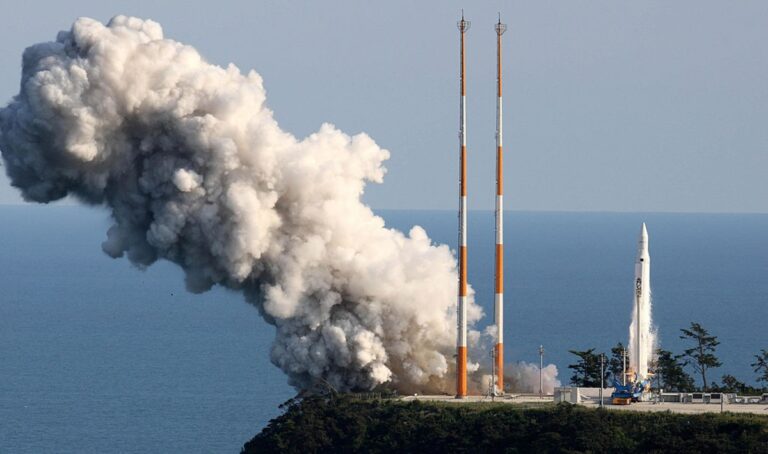
JUNG YEON-JE/AFP via Getty Images
South Korea’s homegrown Nuri rocket is scheduled to lift off from the Naro Space Center on October 7, 2026, carrying 15 satellites into a 500-kilometer (311-mile) sun-synchronous orbit — the largest payload manifest in the program’s five-year history. The launch will be the first time a private company, Hanwha Aerospace, holds end-to-end operational command of the vehicle: not merely assembly lead, as in the fourth flight, but full authority over the entire launch process. KASA confirmed October 7 launch date That transition, which South Korea has been building toward since the government began transferring Nuri technology to Hanwha in mid-2025, will on October 7 become the live operational test of whether Seoul’s space privatization model actually works. Nuri technology transfer agreement
Korea AeroSpace Administration (KASA) locked in the date at its inaugural launch management committee meeting on August 27 in Sacheon, South Gyeongsang Province. KASA confirmed that the launch window on October 7 will run from 12:23 p.m. to 1:23 p.m. Korea Standard Time (11:23 p.m. to 12:23 a.m. ET on October 6), with weather and space conditions expected to be favorable and no anticipated collision risks in the target orbital shell. Backup launch window October 8 runs from October 8 through October 14 in the event of delays. On September 3, KASA conducted a KASA joint launch safety drill at Naro Space Center, involving 12 organizations — government agencies, the military, police, and local governments — in preparation for the flight.
Flight 5 is the moment Hanwha either demonstrates that capability or exposes the gaps in it.
From Assembly to Authority: What Changed Between Flights Four and Five
The distinction between the fourth and fifth Nuri flights is not in the rocket hardware — the vehicle is the same 47.2-meter three-stage launch vehicle that flew in November 2025. The distinction is institutional. In the fourth launch, Hanwha Aerospace assembled the rocket and managed manufacturing logistics; the Korea Aerospace Research Institute (KARI) retained authority over launch operations. For the fifth launch, Hanwha holds both. KASA’s role shifts from operational leadership to supervision and advisory oversight. Hanwha Aerospace assembly lead Flight 4
That shift matters for a reason that goes beyond symbolism. South Korea’s stated ambition is to conduct at least one Nuri launch per year beginning in 2032 and eventually reach four launches annually. Annual launch cadence expansion plan Achieving four launches per year is not compatible with a model where a government research institute retains operational decision authority for every flight. Only a commercially capable operator — one that can plan, assemble, verify, and launch without needing KARI engineers in the chain of command for every step — can sustain that cadence. KASA administrator Oh Tae-seog said the new space era “is led by the private sector and driven by commercial viability,” and that Korea needs to “move quickly” to secure a competitive position. Oh Tae-seog private sector quote
What the Rocket Carries — and Why the Orbit Was Chosen
The primary payload consists of five satellites designated NEONSAT-2 through 6 — South Korea’s first mass-produced Earth observation satellites, built by the KAIST SaTReC NEONSAT program using commercial off-the-shelf components rather than the custom space-grade hardware that previous Korean government satellites used. Alongside them fly 10 CubeSats: one designed to verify domestically developed components, two selected through a competitive CubeSat program, and seven chosen through an open public call. 15-satellite launch manifest confirmed
Each of the five NEONSAT cluster satellites carries an electro-optical camera capable of resolving ground features at 1-meter black-and-white resolution camera and 4 meters (13.1 feet) in color, operating from low Earth orbit. The cameras require daylight and clear skies to function — they are not all-weather sensors. This optical constraint is precisely why the orbit selection is technically specific.
KASA placed the fifth Nuri mission in a 500-kilometer (311-mile) sun-synchronous orbit precession rate — lower than the 600-kilometer to 800-kilometer (373-mile to 497-mile) orbits used in earlier Nuri missions. In a sun-synchronous orbit, the spacecraft’s orbital plane precesses at the same rate as Earth’s revolution around the sun, ensuring the satellite passes over any given point on the ground at the same local solar time every day. For an electro-optical camera constellation, this property is not optional — it is operationally essential. Analysts comparing images of the Korean Peninsula taken on different days must see the same sun angle in each image; otherwise shadows fall differently and change detection becomes unreliable. The specific choice of 500 kilometers puts the cameras in a morning illumination window over the peninsula while maintaining the 1-meter resolution the camera specification requires. At higher altitudes, the ground swath widens but resolution degrades.
The full NEONSAT constellation — all 10 satellites including the second batch of five to be launched in 2027 — will be capable of more than three daily passes over the Korean Peninsula. The program represents a ₩231.4 billion program investment — approximately $169 million USD — begun in 2020, with an eight-year completion target.
How a Thruster Shortage Exposed a Global Supply Chain Fracture
The October 7 date is the third scheduled launch date for the fifth Nuri flight. The mission was originally planned for June 2026, slipped to August, and then slipped again after engineers at KASA and the KAIST Satellite Technology Research Center identified thrusters on some of the nanosatellite payloads as underperforming against mission specifications. Thruster delay pushed to October
Thrusters are the critical subsystem for satellites designed to fly in formation. They provide the precisely controlled impulse that keeps each spacecraft in its assigned orbital slot relative to the others — the geometric spacing that allows the cluster to function as a coordinated imaging system rather than five independent satellites. Without reliably performing thrusters, the formation degrades, orbital separations drift, and the constellation loses the systematic daily coverage it was designed to provide.
“There were some areas where the thrusters’ performance fell short of expectations,” said Kim Jin-hee, director-general of the Satellite Directorate at KASA. “We have completed the necessary improvements to enhance stability.” Kim Jin-hee thruster replacement quote Kim confirmed that the team replaced the underperforming units with new ones from the same manufacturer and then ran the full verification testing battery from the beginning — because mass-production processes introduce batch-level variability that the original qualification testing does not fully capture.
The delay is not a uniquely Korean problem. The global market for small-satellite propulsion has been under structural strain since 2022, when Russian export restrictions following the invasion of Ukraine removed EDB Fakel — historically one of the largest electric propulsion thruster producers by volume — from Western and allied procurement channels. The US Space Development Agency’s Proliferated Warfighter Space Architecture constellation encountered documented propulsion delivery delays for the same structural reason. American SAR satellite operator Capella Space reported maintaining three to five satellites’ worth of propulsion inventory on a continuous basis simply to guard against lead-time uncertainty. KASA’s experience with NEONSAT confirms that the bottleneck now affects allied-nation government programs operating at the nanosatellite scale.
Kim Jin-hee noted the broader tension this creates for programs shifting to commercial manufacturing methods: “Recently, as we have adopted mass production methods used by private companies, some areas require additional verification.” Mass production additional verification is the core engineering tradeoff of COTS manufacturing at government scale — cheaper, faster, but exposed to supply chains shared with commercial operators globally, where a shortage hits government programs just as hard as private constellations.
Does Nuri Have to Reach Four Launches Per Year?
South Korea’s target cadence — one launch per year by 2032, four annually eventually — exists because the government has committed to something that requires it: the K-LEO plan. K-LEO national broadband plan ratified Ratified in July 2026, K-LEO is South Korea’s program to deploy a national low-Earth orbit communications network — described domestically as a “Korean-style Starlink” — by 2035. The program’s three constellation-size scenarios range from 128 satellites to 512 satellites, with total investment estimated between ₩3.9 trillion (approximately $2.8 billion USD) and ₩14.2 trillion (approximately $10.4 billion USD), depending on which scale is selected. Mass satellite production capability is targeted for development by 2030. Full network completion is set for 2035.
Building a network of hundreds of satellites within a decade requires a launch cadence that no government-operated program can sustain, because government launch programs are not designed to absorb the pace. Four launches per year of Nuri — or its successor, the KSLV-III, planned for a maiden flight in the early 2030s — requires a commercially managed operation with the flexibility to schedule, manifest, and execute missions on a commercial timeline. That is what the Flight 5 authority transfer is designed to establish as the baseline.
The NEONSAT program is the proof-of-concept. Five government Earth observation satellites built with commercial manufacturing methods, flying on a commercially operated rocket, form the first real-world test of whether the two transitions — commercial satellite production and commercial launch operations — can work simultaneously. A successful Flight 5 and healthy on-orbit performance from NEONSAT-2 through 6 would confirm that both halves of the model hold. A failure in either half would require re-evaluation before the K-LEO scale-up begins.
What Is Sun-Synchronous Orbit, and Why Does It Matter for Imaging?
For readers unfamiliar with orbital mechanics, sun-synchronous orbit is a specific type of polar orbit engineered so that the satellite’s orbital plane precesses around the Earth at the same rate Earth orbits the sun — roughly one degree per day. The effect is that the satellite always crosses the equator at the same local solar time. For a morning-pass SSO at 500 kilometers (311 miles), this means the satellite sees the Korean Peninsula at the same sun angle every morning, enabling direct day-to-day comparison of images for tasks like infrastructure monitoring, vessel tracking, and post-disaster damage assessment.
The alternative — placing Earth observation satellites in non-sun-synchronous orbits — produces imagery at varying sun angles that is significantly harder to analyze automatically. Commercial constellations from Planet Labs, Maxar, and Airbus Defence and Space all operate in SSO for this reason. South Korea chose the same architecture for NEONSAT not because it was required to, but because consistent illumination is operationally superior for the national security and disaster response missions the constellation is designed to support.
Nuri’s Third Stage and the Orbital Insertion Burn
The Nuri rocket carries the full propulsive load across three stages. The first stage clusters four KRE-075 first stage engines, each generating approximately 75 tonnes (165,000 pounds-force) of thrust at sea level — a combined 300 tonnes (661,000 pounds-force) that lifts the 200-tonne stack off the pad and through the lower atmosphere in 127 seconds. A single vacuum-optimized KRE-075 powers the second stage, delivering approximately 78 tonnes (172,000 pounds-force) of thrust through the upper atmosphere during a 148-second burn; the wider nozzle geometry recovers specific impulse in near-vacuum that would be wasted at lower altitudes. The third stage uses a smaller KRE-007 third stage engine burn producing 7 tonnes (15,400 pounds-force) of thrust for the 498-second orbital insertion burn that precisely places payloads into the target orbit. Both engine types run on LOX (liquid oxygen) and Jet A-1 — a conventional aviation kerosene. All-domestic propulsion no foreign engine distinguishes Nuri from its predecessor, the Naro-1, which used a Russian-built first stage.
In the Flight 5 configuration targeting 500-kilometer SSO, Nuri’s current Nuri rated payload to SSO is adequate for the 15-satellite manifest. The five NEONSAT cluster satellites collectively weigh approximately 500 kilograms (1,100 pounds) at launch; the 10 CubeSats add modest additional mass. Total payload remains within Nuri’s rated capacity of approximately 1.9 tonnes (4,200 pounds) to 700-kilometer SSO — and somewhat more to the shallower 500-kilometer target altitude, where capacity reaches approximately 2.2 tonnes.
HD Hyundai Heavy, KASA, and the Multi-Company Stack
While Hanwha Aerospace receives attention as Nuri’s operational lead, the launch operation involves multiple companies in distinct roles. HD Hyundai Heavy launchpad operations continue at Naro Space Center — a responsibility that did not transfer to Hanwha in the technology handover. KASA retains the supervisory and program-management role formerly held more directly by KARI. KAIST’s Satellite Technology Research Center owns and operates the NEONSAT satellites.
The multi-company structure reflects South Korea’s deliberate choice to distribute the space industrial ecosystem rather than consolidating it under a single prime contractor. The Hanwha Group, which has committed to investing approximately ₩55 trillion aerospace investment plan — approximately $40 billion USD — in aerospace and artificial intelligence through 2040, is building toward a vertically integrated capability — launch vehicles, satellites, and orbital data processing — but Flight 5 is not yet that integrated future. It is the transition milestone between the government-built past and the commercially operated future.
(Exchange rate as of September 7, 2026; conversions are approximate.)
Frequently Asked Questions
What specifically is different about Hanwha Aerospace’s role in the fifth Nuri launch compared to the fourth?
In the fourth launch (November 2025), Hanwha Aerospace led the manufacturing and assembly of the rocket — the physical integration of stages and components — but the Korea Aerospace Research Institute retained operational command over launch activities. For the fifth launch, Hanwha holds end-to-end operational authority: it runs the preparation sequence, the countdown, and the launch process itself, with KASA in an advisory and supervisory capacity rather than a directing one. The practical difference is whether a private company’s engineers make the final calls or whether government scientists do. Flight 5 is the first time private engineers lead.
What happened to the NEONSAT thrusters, and what does the fix actually mean for the satellites’ on-orbit performance?
Engineers found that some nanosatellite thrusters were producing less thrust or lower specific impulse than the mission specification required. The shortfall matters because formation-flying satellites need reliable propulsion to maintain their assigned orbital slot within the cluster — if a thruster underperforms over time, the satellite drifts from its position and the constellation’s imaging geometry degrades. The fix was to replace the underperforming units with new ones from the same manufacturer, then rerun the full verification test sequence on the updated assemblies. The satellites that cleared the August pre-shipment review have passed that re-verification. Whether the replacement units perform as specified in the actual space environment — radiation, thermal cycling, vacuum — will only be confirmed after the satellites are on orbit. Thruster underperformance replacement verification
How does the NEONSAT constellation improve on South Korea’s existing satellite surveillance capability?
South Korea’s existing civil satellite resources provide infrequent optical imaging that depends on weather and daylight. The NEONSAT constellation will, once complete at 10 satellites by 2027, image the Korean Peninsula more than three daily overflights at 1-meter resolution in black-and-white — enabling day-to-day change detection for infrastructure monitoring, maritime tracking, and natural disaster response. This is complementary to, but distinct from, South Korea’s 425 Project military SAR constellation, which uses radar imaging to see through clouds and at night. NEONSAT is a civil program; the 425 Project is a defense program. Neither replaces the other.
Can Hanwha Aerospace realistically reach four Nuri launches per year, and what does that actually require?
Four launches per year requires more than an operational team and a commercial contract — it requires a customer base that extends beyond the Korean government. Government anchor missions (NEONSAT, K-LEO deployment, future reconnaissance satellites) could support perhaps one or two launches per year. To reach four, Hanwha would need to compete for commercial payloads from international satellite operators. Nuri’s estimated $30 million per launch is competitive with some light-lift alternatives, but the rocket lacks a flight record as a commercial launch service and currently has no publicly announced foreign commercial customers. The block buy contract that KASA plans to establish beginning in 2029 would secure Korean government cadence; building beyond that toward four annual launches is a commercial sales challenge that Flight 5 alone cannot resolve.