HomeAuto Project Zenith Brings Local 30B AI to Windows: Dense Models Remain Bottleneck
Project Zenith Brings Local 30B AI to Windows: Dense Models Remain Bottleneck
September 7, 2026:
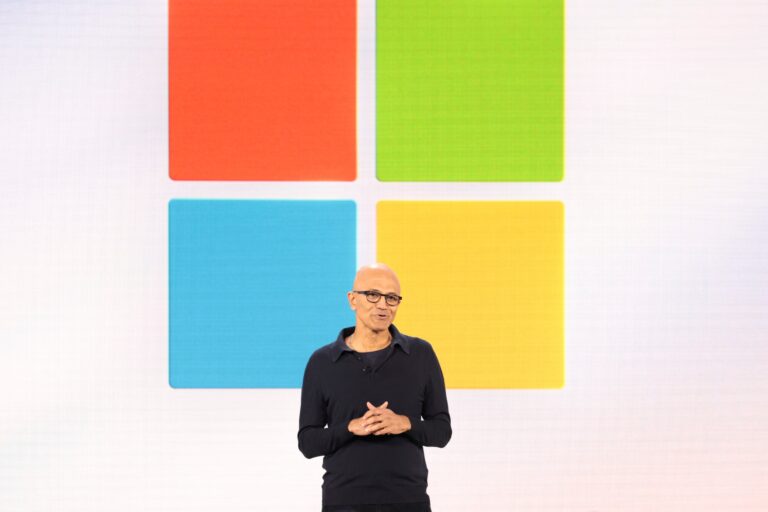
Microsoft Chairman and Chief Executive Officer Satya Nadella speaks during the Microsoft May 20 Briefing event at Microsoft in Redmond, Washington, on May 20, 2024. JASON REDMOND/AFP via Getty Images
Microsoft on September 4, 2026, gave Project Zenith its official name and a hardware floor — and buried the one technical detail that determines whether a $3,699 workstation will actually deliver on its promise. Project Zenith will run AI models with more than 30 billion parameters locally, without metered cloud charges, Logan Iyer, Microsoft’s corporate vice president for Windows Platform and Developer, wrote in the announcement. What Iyer did not say: that figure describes capacity, not speed — and speed depends entirely on whether the model is dense or sparse.
The first qualifying hardware, Lenovo’s ThinkCentre X Ultra compact desktop (1.6 liters, or about 0.42 gallons), ships in November 2026 starting at $3,699. It is built by a company subject to China’s National Intelligence Law — a condition that applies permanently, regardless of where the device is sold or used, and that enterprise buyers must weigh before deploying it on development machines handling proprietary code or AI model weights. A full privacy risk assessment appears below.
Microsoft stated its goal explicitly: developers should be able to “run 30B+ parameter models locally and unmetered,” reducing reliance on metered cloud tokens. Whether that promise delivers working performance depends on a technical detail the announcement omitted entirely.
Why Model Architecture Is the Number You Need Before Buying
The 30B+ parameter claim is accurate but incomplete. Unified memory architecture — the design that lets the CPU and GPU share a single pool of RAM rather than splitting into separate banks — makes it physically possible to load a 30-billion-parameter model onto a machine that costs roughly the same as a high-end laptop. That is genuinely new for Windows-based hardware; until the AMD Ryzen AI Halo platform, getting a 30B model onto a single Windows machine required either an enterprise GPU card exceeding $10,000 or cloud infrastructure.
But holding a model in memory is not the same as running it quickly. According to Implicator.ai’s inference analysis, inference speed on these machines is bandwidth-bound, not compute-bound: the hardware can only generate new tokens as fast as it can stream model weights from memory to its compute units. The Ryzen AI Max+ 395 chip at the center of this hardware class delivers approximately 256 GB/s of memory bandwidth. Apple’s Mac Studio M3 Ultra delivers roughly 800 GB/s — about three times faster. Community benchmarks compiled through August 29, 2026, put the real-world consequence in plain numbers: on a dense 70-billion-parameter model at 4-bit quantization, a Ryzen AI Max+ 395 system generates approximately five tokens per second, per benchmark data from Implicator.ai.
Five tokens per second is not a usable coding assistant for most developers. It approaches usability only when a specific class of models — mixture-of-experts (MoE) architectures — is running instead.
A mixture-of-experts model stores all its parameters in memory but routes each token through only a small subset of specialized sub-networks, keeping most of the model dormant per step. The result is that a 30B MoE model with only 3 billion active parameters per token generates roughly 70 to 100 tokens per second on the same hardware — a working speed, confirmed in benchmark reporting. Models like Qwen3-30B-A3B (3B active parameters) and GPT-OSS 120B (a larger MoE model) measured approximately 34 and 39 tokens per second respectively in Halo vs DGX Spark benchmarks.
The practical takeaway: a developer whose primary coding assistant runs on a dense model (including some Llama, Gemma, and Mistral variants) should check the tokens-per-second figure for their specific model on 256 GB/s hardware before treating Project Zenith as a viable cloud-replacement. A developer primarily using MoE models (Qwen3, Mixtral-class, or comparable architectures) will find the hardware genuinely useful. Microsoft’s September 4 announcement named neither model category nor any performance figure.
What Project Zenith Actually Is
Project Zenith is not a new edition of Windows. It is a factory-applied software configuration that ships pre-loaded on hardware that clears Microsoft’s minimum spec: at least 64 GB of unified memory and at least 250 GB/s of memory bandwidth. The distinction matters practically — Microsoft is not shipping a different OS, but rather a specific starting state.
Out of the box, a Project Zenith device arrives with Visual Studio Code and Windows Terminal pinned to the taskbar, alongside GitHub Copilot, PowerToys, Git, Python 3.14+, Node.js 24+ via NVM, WSL 2 with Ubuntu, .NET 10, and the WinAppCLI toolchain. File Explorer is configured to show file extensions, hidden files, and the full path in the title bar. Long-path support is enabled. Start menu tips, recently used files, sync-provider notifications, and account prompts are disabled. Agent-security features previewed at Build 2026 — OS-enforced identity verification and Microsoft Execution Containers (MXC) for agentic workload isolation — ship enabled from first boot.
Developers who prefer their own toolchain can apply the same configuration to an existing Windows 11 machine through Microsoft’s publicly available Windows Developer Configuration script on GitHub. The hardware floor still applies — local 30B inference still requires 64 GB+ unified memory.
Skeptics Have a Point
Paul Thurrott, a 30-year Windows analyst, tested the public configuration behind Project Zenith and called it a curious miscalculation. His core argument: developers already have custom configurations they prefer, and any developer buying one of these machines will spend time reconfiguring it after unboxing — potentially undoing some of what Microsoft pre-set. He proposed a more useful alternative: “make Windows Backup truly useful” so developers could snapshot and restore their own preferred configurations across machines.
His experience testing the public configuration was specific: “I had to wipe the PC I tried this on, it was maddening.” Sean Endicott of Windows Central offered a more neutral take, noting that preinstalled tools that developers value would read as bloat for general users. The tension is real. A preconfigured environment is a reasonable starting baseline. Whether it matches any individual developer’s actual workflow depends on that developer.
Microsoft’s stated rationale is that Project Zenith reflects feedback from developers about what they want Windows to do better, and that the configuration will evolve alongside developers and the community that builds on it.
Economics of the Hardware: Why the Token Cost Argument Is Genuine
The argument for paying $3,699 for local inference capacity is not trivial, even with the model-architecture caveat. Ryan Shrout, founder of Signal65 Research, notes that agentic AI fundamentally changes the token math: “Autonomous agents will run continuously and consume orders of magnitude more tokens than chat” — his Signal65 Research token analysis puts it at roughly four to 15 times more than conversational AI usage, “and trending well beyond that.”
For a development team running agentic coding assistants throughout the workday, cloud inference costs can scale rapidly at per-token pricing. A machine that eliminates those recurring charges during prototyping and development pays back against its purchase price at a rate that depends on actual token consumption — a figure only the buyer’s own cloud billing history can establish.
The First Hardware: Lenovo ThinkCentre X Ultra at IFA
The initial wave of Project Zenith devices runs on AMD’s Ryzen AI Halo platform, which combines CPU, GPU, and NPU compute in a shared unified memory pool. AMD formally unveiled its own Ryzen AI Halo mini-PC at IFA 2026 in Berlin on September 4; pricing was not disclosed for AMD’s device.
The first confirmed Project Zenith machine is the Lenovo ThinkCentre X Ultra, announced at IFA 2026 on September 3. The 1.6-liter (0.42-gallon) compact desktop is built around the AMD Ryzen AI Max+ PRO 495 — a 16-core Zen 5 processor paired with a Radeon 8065S integrated GPU carrying approximately 55 TOPS of neural processing capability — and supports up to 128 GB of LPDDR5X unified memory. Lenovo will ship it in November 2026 starting at $3,699.
For teams that need more memory headroom, Lenovo has engineered a four-unit clustering capability: up to four ThinkCentre X Ultra units can be linked, pooling up to 512 GB of combined memory and approximately 524 total TOPS of AI compute — enabling inference on very large models including Meta’s Llama 4 Maverick locally, without rack-mounted server infrastructure. The effective interconnect bandwidth between units has not been disclosed, which limits verification of how well distributed inference actually performs across the cluster.
Nvidia’s DGX Spark offers 273 GB/s of bandwidth, marginally above the Zenith minimum floor, and is available now at $4,699 — up from its October 2025 launch price of $3,999 after memory supply constraints drove a price increase in February 2026. Microsoft said additional OEM and silicon partners will follow; Nvidia’s RTX Spark platform is widely expected to join the ecosystem.
What Competitive Benchmarks Actually Show
Independent benchmarks provide context that vendor announcements omit. LTT Labs benchmark results (reported by Gigazine, July 2026) measured token generation performance on Ryzen AI Max+ 395 hardware against a Mac Studio M3 Ultra: on dense models including Gemma 4, the Mac Studio M3 Ultra generated tokens approximately two to three times faster than the AMD system, attributable to its roughly 800 GB/s of memory bandwidth versus the Ryzen AI Max+ 395’s approximately 256 GB/s.
On the positive side, AMD’s own benchmark figures against Nvidia’s DGX Spark put the Ryzen AI Halo at roughly 7% more tokens per second on GPT-OSS 120B (a MoE model) and 12% more on Qwen 3.5 122B — though AMD’s benchmarks should be treated as vendor claims requiring independent validation. Shrout noted that on MoE model inference, AMD’s figures “need independent validation before anyone treats them as settled.”
The broader competitive picture: Mac Studio offers superior raw bandwidth and a mature local-inference toolchain through MLX and Metal; DGX Spark offers the full CUDA ecosystem and stronger prompt-processing performance for prefill-heavy agentic workflows; Project Zenith hardware occupies the middle ground — more open and configurable than Apple, less tied to CUDA than Nvidia, and now carrying a factory-applied developer configuration that makes first boot faster, if not necessarily better.
What Lenovo’s Chinese Ownership Means for Developer Security
The ThinkCentre X Ultra is made by Lenovo, whose headquarters are in Beijing and whose majority shareholder is Lenovo’s parent company Legend Holdings — a Chinese entity whose largest shareholder is the Chinese Academy of Sciences, a state institution.
This is not a contested claim about Lenovo’s intentions. It is a fixed legal condition: China’s National Intelligence Law (2017), Article 7, requires that “all organizations and citizens shall support, assist, and cooperate with national intelligence efforts in accordance with law.” That obligation applies to Lenovo as a Chinese organization, regardless of any Western subsidiary structure, privacy policy language, or where the device is physically sold. China’s Cybersecurity Law (2017) additionally mandates cooperation with security inspections.
For a developer workstation running proprietary code, AI model weights, or sensitive client data, the categories that matter include:
Usage telemetry collected by Lenovo Vantage software
Any AI inference query content captured by telemetry pipelines
Network configuration data (relevant for enterprise deployments)
Biometric authentication data if fingerprint hardware is used
No independent security audit of the ThinkCentre X Ultra specifically has been published — the device was announced on September 3, 2026, making such an audit impossible at this time. Buyers should note this gap explicitly before enterprise procurement decisions. Lenovo’s broader hardware history includes a classified-network ban by US, UK, Australian, Canadian, and New Zealand intelligence agencies in the mid-2000s, a 2015 Superfish adware incident that led to an FTC complaint settled in 2018, and a 2026 class action lawsuit alleging Lenovo’s ad-tech infrastructure enabled bulk transfers of sensitive personal identifiers to China under the DOJ’s Bulk Sensitive Data Transfer Rule. Lenovo has denied these claims and says it takes data security seriously.
Mitigation steps available to buyers include disabling or uninstalling Lenovo Vantage and reviewing BIOS telemetry settings; enterprise deployments can add network segmentation. None of these steps removes the structural legal exposure created by Article 7 of China’s National Intelligence Law. Buyers who need to work with classified, export-controlled, or commercially sensitive material should consult their security teams before acquisition.
Several US states have declared Lenovo a prohibited supplier; the House Select Committee 2023 letter to the US Navy Exchange urged removal of Lenovo hardware from US military retail outlets.
Is This Why Microsoft Made the Configuration Open Source?
One underreported dimension of Project Zenith is that the entire Windows configuration it embeds is publicly available. Microsoft published the Windows Developer Configuration script on GitHub, letting any developer apply the same tools and settings to an existing Windows 11 machine through winget. A required restart is needed when WSL is enabled.
This means the Project Zenith experience does not require a new PC — it requires new hardware specs (64 GB unified memory, 250 GB/s bandwidth). For a developer who already owns a qualifying machine (a Ryzen AI Max+-equipped system purchased earlier in 2026, for instance), the software layer is available today.
What the Partnership Ecosystem Still Needs
Project Zenith currently has one confirmed hardware maker (Lenovo) and one silicon platform (AMD Ryzen AI Halo). Microsoft said additional OEM and silicon partners will arrive in the coming months; Nvidia’s RTX Spark ecosystem is the most widely anticipated addition. Until that broader catalog exists, a developer who wants Project Zenith hardware faces a constrained set of choices.
The strategic logic is clear: as frontier AI model providers increase per-token costs, and as agentic coding assistants move from conversation-based to continuous long-running workflows, the economics of local inference improve. Microsoft’s bet is that developers will pay a workstation premium to own their inference capacity rather than rent it. Whether the hardware catalog builds fast enough to validate that bet depends on how quickly AMD, Nvidia, and their OEM partners can populate the 64 GB+ unified-memory tier with competitive options.
Is Zenith Worth Buying Right Now?
The decision framework for a developer or engineering manager considering Project Zenith hardware:
Performance check first: Identify the specific model (or model family) you plan to run most heavily. If it is a MoE architecture — Qwen3 series, Mixtral variants, GPT-OSS class — qualifying hardware will generate 70 to 100 tokens per second. If it is a dense model — Llama 3 70B, Gemma 4 27B, comparable architectures — expect fewer than ten tokens per second on 256 GB/s hardware. Match the model to the machine before committing.
Cloud billing check second: Pull your team’s actual cloud inference spend for agentic coding workflows over the past 30 days. If it is near or above $100/month per developer, the payback period on a $3,699 machine becomes measurable. If it is well below that, the hardware purchase does not close on economics alone.
Security check third: If your team’s work involves proprietary code, trade secrets, or regulated data, consult your security team about Lenovo’s Chinese ownership and the National Intelligence Law obligations described above before purchasing. No published independent security audit of the ThinkCentre X Ultra yet exists.
Catalog patience as an option: If the Nvidia RTX Spark ecosystem joins Project Zenith in the coming months as expected, the hardware choices will widen. A developer who can wait 30 to 90 days may have more options before committing.
Frequently Asked Questions
What exactly is Project Zenith — is it a new version of Windows?
Project Zenith is not a separate Windows edition or product line. It is a factory-applied software configuration that ships pre-loaded on qualifying hardware: machines with at least 64 GB of unified memory and 250 GB/s of memory bandwidth. The configuration installs a standard set of developer tools (VS Code, GitHub Copilot, Python, Node, WSL, and others), applies a series of developer-friendly File Explorer and Start menu settings, and ships with Microsoft’s agentic security features (Microsoft Execution Containers) enabled. Developers can also apply the same configuration to any existing Windows 11 machine through a freely available Windows Developer Configuration script on GitHub, provided the underlying hardware meets the memory and bandwidth floor.
Can a Project Zenith machine really run a 30B AI model at useful speeds?
It depends on the model’s architecture. A 30B mixture-of-experts model — one that activates only a fraction of its parameters per token — will generate roughly 70 to 100 tokens per second on qualifying hardware, according to benchmark data on Zenith hardware. A dense 30B model (all parameters activated per step) is significantly slower, and a dense 70B model at 4-bit quantization generates approximately five tokens per second on the current AMD Ryzen AI Max+ 395 hardware that powers the first Zenith devices. That is an important distinction Microsoft’s announcement did not make. Developers should verify the specific model family and its architecture before treating Project Zenith hardware as a viable replacement for cloud-tier inference.
What is the privacy and security risk of buying a Lenovo ThinkCentre X Ultra?
Lenovo is a Chinese-owned company subject to China’s National Intelligence Law (2017), Article 7, which legally requires the company to cooperate with government intelligence requests. This obligation is permanent and applies regardless of where a device is sold or Lenovo’s stated privacy policies. No independent security audit of the ThinkCentre X Ultra exists as of this writing (the device was announced September 3, 2026). Developers working with proprietary code, AI model weights, or regulated data should assess this risk with their security teams. Enterprise buyers should also note that multiple US states have designated Lenovo a prohibited supplier, and the House Select Committee 2023 letter urged removal of Lenovo hardware from military retail channels. Practical mitigation steps include network segmentation and disabling Lenovo telemetry software, but none remove the underlying legal obligation.
How does Project Zenith hardware compare to the Mac Studio or Nvidia DGX Spark?
Each platform has a structural advantage in one area. Apple’s Mac Studio M3 Ultra offers approximately 800 GB/s of memory bandwidth — three times the Ryzen AI Max+ 395’s roughly 256 GB/s — which translates to two to three times faster token generation on dense models in independent benchmarks. Nvidia’s DGX Spark carries the full CUDA software ecosystem and generates tokens at roughly 39 tok/s on the GPT-OSS 120B MoE model versus AMD’s approximately 34 tok/s, while also outperforming AMD roughly five to one on prompt processing (prefill) for large-context agentic workflows according to Halo vs DGX Spark benchmarks. Project Zenith hardware offers the most open configuration — Windows and Linux supported, ROCm software stack available — at a starting price ($3,699) roughly comparable to the DGX Spark ($4,699 as of February 2026). The right choice depends on model architecture, software ecosystem requirements, and security posture, not price alone.