HomeAuto Riot Labels League of Legends MMO ‘Grail Quest’; WoW Veterans Fill Senior Roles
Riot Labels League of Legends MMO ‘Grail Quest’; WoW Veterans Fill Senior Roles
September 7, 2026:
Riotgames.com
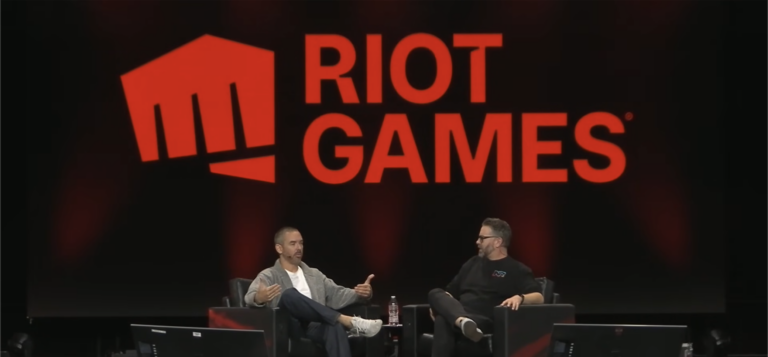
Riot Games co-founder Marc Merrill stepped onto the PAX West 2026 main stage in Seattle last Friday and gave the gaming world something it has rarely gotten from Riot in the six years since the League of Legends MMO was announced: an unguarded account of what the studio actually thinks it is attempting — and what it thinks could go wrong. In a candid career retrospective with Marc Merrill’s PAX West keynote alongside Kinda Funny’s Greg Miller, Merrill revealed that Riot internally calls the project “the Grail” — a joke that isn’t entirely a joke, because the full metaphor includes knights who don’t make it.
“You know, many a brave knight are going to die on the Grail quest,” Merrill told the crowd. “But it’s the Grail, so let’s go.” The clip Riot posted to social media on September 5 — captioned simply, “So about that MMO we’re building…” — instantly dominated the weekend’s gaming conversation, according to Inven Global’s coverage of the session.
Those words land differently in September 2026 than they might have at any earlier point in this project’s history. Two weeks before Merrill took the PAX West stage, Riot announced it was ending active development of 2XKO — its League of Legends-branded tag-team fighter — just seven months after the game’s January 2026 launch on PC, PlayStation 5, and Xbox Series X/S. The studio cited “no meaningful, sustained change” in the game’s trajectory after Riot cut roughly 80 people — close to half the global staff — in February 2026. The Runeterra MMO now carries a weight 2XKO never had: it is the clearest measure of whether Riot can successfully launch a new live-service product outside its two flagship titles.
“Many a Brave Knight Are Going to Die”
Merrill did not arrive at PAX West 2026 with a trailer, a title, or a release date. He said Riot already knows players’ MMO hopes for a living version of Runeterra — the challenge now is purely one of execution.
“We know what players’ hopes and dreams are,” Merrill said. “It’s just on us, as a team and people — can we succeed in the execution? What a worthy quest.” He explained that the studio jokingly refers to the project as its internal “Grail,” a shorthand that captures both the prize and the danger. The mindset, he said, is genuinely difficult to cultivate at scale — but that Riot is “doing a reasonable job” of maintaining it, and that “the future is incredibly bright.”
The Grail metaphor is precise in ways that flattering metaphors usually are not. No other genre in gaming carries quite the same ratio of legendary success stories to expensive failures. World of Warcraft, Final Fantasy XIV, Old School RuneScape, EVE Online, and Guild Wars 2 represent the genre’s pinnacle — and below them sits an enormous catalog of failures that spent years in development and died within months of launch, from Warhammer Online to WildStar to New World. Even Final Fantasy XIV had to shut down its original version, rebuild entirely, and relaunch as A Realm Reborn in 2013 before becoming the success it is today. The comparison Merrill is reaching for acknowledges that history directly.
Riot’s Answer: Hire the People Who Already Did It
Since the March 2024 development reset — when Merrill acknowledged the original vision “wasn’t different enough from what you can play today” and announced the project would go dark — Riot has quietly assembled one of the most experienced MMORPG development rosters in the industry, drawing systematically from World of Warcraft’s alumni.
The pattern is deliberate. Former WoW lead producer Raymond Bartos joined as senior game producer on the MMO team in January 2026. Former WoW lead combat designer Brian Holinka — who spent over a decade at Blizzard and oversaw class design and combat systems through multiple expansions, including Dragonflight’s talent tree overhaul — joined as principal game designer on June 1, 2026. Before coming to Riot, Holinka had spent time at Fantastic Pixel Castle, the studio founded by Greg Street — the same executive who originally led the Runeterra MMO project before departing in March 2023. Former Blizzard lead software engineer Orlando Salvatore was already on board as an engineering manager before either of those hires.
Three former Blizzard MMO leads sitting in senior seats on this team no longer looks like a coincidence. It looks like a strategy: Riot is buying institutional knowledge that has already survived the specific failure modes that define this genre — the ones where a promising MMO disintegrates under the engineering and design weight of delivering persistent-world gameplay at scale.
What Building a Next-Generation MMORPG Actually Requires
The specific difficulty Merrill is describing has a technical foundation that the Grail metaphor, however evocative, does not explain. Building an MMORPG that is “a significant evolution of the genre” — the phrase Merrill has used to describe Riot’s ambition — means solving a set of architectural and design problems that existing successful MMOs have each resolved in ways that are now visibly dated.
The Runeterra MMO has confirmed two design commitments that separate it from the WoW-era template: a persistent sandbox world and action-based third-person combat, as opposed to the tab-targeting system that WoW popularized. Both choices are more technically demanding than the alternative. Tab-targeting abstracts away player positioning, reducing server-side computation for large encounters. Action combat — the kind Riot has built into League of Legends for 15 years — requires real-time hitbox validation, collision detection, and input latency management for potentially hundreds of players in a single zone simultaneously. Riot is not simply building a WoW clone in Runeterra’s art style; it is attempting a persistent open world that operates with the mechanical fidelity of an action game.
The business model adds another layer of complexity. Greg Street, before his 2023 departure, indicated that pay-to-play or subscription monetization was unlikely — consistent with Riot’s established free-to-play cosmetic model. At MMO scale, that means long-term revenue depends entirely on retaining players and converting their engagement into cosmetic spending, with no guaranteed monthly subscription income as a floor. World of Warcraft’s subscription model, whatever its creative constraints, provided Blizzard with predictable revenue that sustained years of post-launch development. Riot does not plan to have that buffer.
Holinka’s specific background is relevant here: his expertise in WoW’s class design and PvP systems is directly applicable to the hardest unsolved design question in action-combat MMOs, which is how to balance player-versus-player content across a broad roster of character archetypes at scale. That problem has destroyed or severely damaged multiple MMO launches. Having someone who navigated it for over a decade, across multiple expansions, suggests Riot understands that the genre’s execution risks are not merely about world-building or art direction.
Context: What 2XKO Changed
Merrill’s optimism at PAX West cannot be fully understood without the August 20 announcement. The 2XKO shutdown is not simply a data point about one game’s performance — it is a public demonstration of how quickly a Riot live-service product can lose the runway it needs to mature. Seven months from launch to development-ending is a short window by any measure, and Riot’s acknowledgment that “no meaningful, sustained change” in trajectory justified ending investment reflects a level of financial discipline that the MMO community will watch apply to the Runeterra project. The official Riot announcement made the studio’s reasoning explicit.
That shadow is part of why Merrill’s Grail framing resonates beyond mere humility. A studio that was willing to acknowledge 2XKO’s failure publicly and wind it down is the same studio asking the League of Legends community to trust a project that has been in some form of development since 2016 — with no title, no screenshots, and no gameplay footage officially released as of mid-2026. The trust Riot is asking for is significant. The Grail metaphor, read generously, is Riot pre-registering that it understands this.
The studio’s behavior during 2026 offers two additional data points on its seriousness. In April, Merrill confirmed publicly that Riot had explored the Intrepid discussions — a potential investment in or acquisition of Intrepid Studios, the developer behind Ashes of Creation — before deciding against it. The fact that Riot looked at Riot’s $500 million acquisition offer for another MMO before concluding it would rather build its own suggests a studio thinking about the genre systemically, not just the Runeterra IP. And the Holinka hire in June followed the Bartos hire in January — a hiring cadence that suggests an accelerating second phase of development following the 2024 reset.
When Could This Actually Release?
Merrill has indicated, as of 2026, that the game is expected to release before 2030. Wikipedia’s 2028–2029 release estimate — which, if accurate, means the project is somewhere in a multi-year development phase following the 2024 reset. No official title has been announced. No gameplay footage, screenshots, trailers, or MMO-exclusive artwork have been officially released or leaked as of the time of this writing.
That level of information control is consistent with Merrill’s 2024 announcement that the project would “go dark” for several years, with the rationale that silence creates space for the team to focus. What PAX West offered was not a break from that silence so much as a rare statement of intent from the person responsible for the project: Riot knows the prize, it knows the risk, and it intends to pursue both.
Whether Riot can reach the Grail is a question that will not be answered at a convention keynote. What is clear is that the studio is no longer treating the project as a distant aspiration. The hiring, the candor, and the willingness to call the project both a worthy quest and a potential graveyard for brave knights signal a studio that has made its peace with the genre’s difficulty — and decided to enter it anyway with some of the most experienced people available.
Frequently Asked Questions
Is the League of Legends MMO still in active development as of September 2026?
Yes. Marc Merrill confirmed the project is continuing during his September 4 PAX West keynote, and multiple new hires since early 2026 — including former World of Warcraft lead combat designer Brian Holinka (June 2026) and former WoW lead producer Raymond Bartos (January 2026) — point to active staffing. Merrill has stated the game is expected to release before 2030, with the 2028–2029 release window cited in industry reporting. No gameplay footage, screenshots, or official title have been announced as of this writing.
Why did Riot call it a “Grail quest” — and is that a warning sign?
The Grail metaphor captures both the appeal and the danger: the Grail is the ultimate prize, but the quest for it historically ends badly for most of the knights who attempt it. Merrill used it as a frank acknowledgment that the MMORPG genre has one of the highest failure rates in gaming — most attempts either cancel during development, fail at launch, or shut down within a year. The FFXIV precedent shows that even a failed launch can be recovered from with enough investment and patience, but that required Square Enix’s willingness to effectively rebuild the entire game. Riot’s use of the metaphor suggests the studio is not underestimating what it is trying to do — which is, arguably, the correct mindset for a project at this scale and risk level. The MMORPG genre’s failure history, from WildStar to New World, makes the metaphor more than rhetorical.
What happened to 2XKO, and does it affect the MMO’s future?
Riot announced on August 20, 2026, that it would end active development of 2XKO — its tag-team fighting game — in December 2026, just seven months after the game’s January 2026 full launch. The studio cited consistent data showing no sustained improvement in player retention or new-player acquisition. 2XKO’s shutdown does not directly determine the MMO’s fate — the two projects are entirely separate teams and genres — but it does establish that Riot will terminate a live-service product that fails to find its audience, even within months of launch. That context makes the Grail framing more than rhetorical: Riot is openly acknowledging that the MMO is a risk the studio is choosing to take, not one it is unaware of. The 2XKO development wind-down timeline and refund details are documented at TechTimes.
What does the WoW veterans hiring pattern mean for how the MMO will play?
Riot has recruited three former World of Warcraft developers into senior roles on the Runeterra MMO: Brian Holinka (lead combat designer), Raymond Bartos (lead producer), and Orlando Salvatore (lead software engineer). Holinka’s specific background — PvP systems and class design across multiple WoW expansions — is directly relevant to one of the hardest unsolved problems in action-combat MMO design: how to balance a large roster of character classes in player-versus-player content at scale. That problem has contributed to the failure or degradation of multiple MMO launches. Hiring the person who managed it for over a decade at WoW suggests Riot is approaching the MMO’s hardest design problems with institutional knowledge, not just ambition. The Holinka hire as principal designer was widely covered by the MMORPG community as a significant signal of the team’s direction.