September 6, 2026:


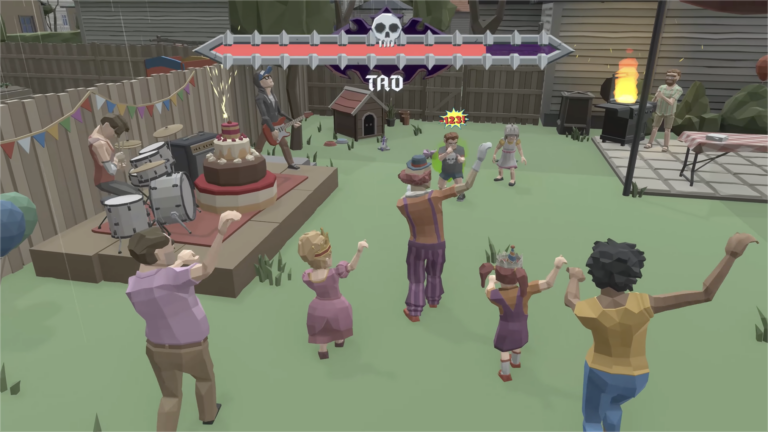
Mad Herons, a debut indie studio built from Los Angeles’ improv comedy scene, unveiled Send In The Clown on September 4, 2026 at The MIX Fall Showcase in Seattle — and the game’s central mechanic turns out to be exactly what you would expect from a team of comedians: every social choice you make becomes your arsenal. The one-hour comedy RPG casts you as Pockets, described by the developers as “history’s least-appreciated clown,” and asks you to save a 12-year-old’s birthday party from her power-hungry little brother — not with swords, but with balloon animals, water flowers, and genuine human connection.
The studio’s founders — Jacques Mouledoux, Karen Park, and Nick Park — are veterans of LA’s improv scene. Their team also includes a former writer on Nickelodeon’s iCarly, a former SpaceX engineer, and a university professor. The collaborators on the project include Tyler Hutchison, director of Dream Daddy: A Dad Dating Simulator, and voice actress Courtney Vineys, who voiced Dusa in Hades and Aphrodite in Hades and Hades II.
In improv comedy, “yes-and” is the foundational principle: you accept whatever your scene partner offers and build on it. Send In The Clown encodes this as a mechanical system. Every guest at Miranda’s party has a problem. You say yes to their problem, play a minigame or make a dialogue choice, and they become your ally. Then, in the game’s final RPG battle against the bratty and apparently inexhaustible Tad, your assembled allies fight alongside you — using abilities shaped by the specific relationship you built.
If you taught the single dad at the party to dance in a Guitar Hero-style rhythm minigame, he leads a dance-troupe charge into battle. If you gave the exhausted mom a break from parenting by shepherding her through Uncharted-style quick-time events, she can distract Tad by flirting with Pockets at a critical moment. The guest roster is your party roster, your social capital is your combat resource, and there is no separating the comedy from the fight.
This is not incidental to the game’s structure — it is the structure. Mad Herons has built a system in which narrative choice and mechanical consequence are the same thing, presented in the vocabulary of a birthday party.
The game began as a prototype that Mouledoux, Nick Park, and Conner McCabe built during the 2024 Global Game Jam, whose theme that year was “Make Me Laugh.” That alignment — a clown comedy game, built in 48 hours, under a “make me laugh” directive — is either deliberate or the best possible happy accident of game-jam history. The prototype grew over two years as Mad Herons formed around it, eventually expanding into the full one-hour experience being shown at The MIX.
The game debuted at The MIX Fall Showcase, a PAX West–adjacent in-person indie event held September 4, 2026 in Seattle, Washington, with a press hour from 6:00 PM to 7:00 PM PT and expanded public admission through 11:00 PM PT. Send In The Clown was one of roughly 52 games featured at the showcase. The game is now wishlisting on Steam ahead of a planned 2026 launch.
Send In The Clown runs on three interlocking design layers inside its one-hour window.
The first is ability progression. Pockets earns experience points and levels up, gaining a repertoire of clown skills that range from spraying a water flower to twisting balloon animals to managing what the Steam page calls “piles of questionable hot dogs.” These abilities do more than entertain guests — they interact with hidden elements of the party environment, unlocking new areas and encounters.
The second is the relationship graph. Every guest is a small puzzle: complete a minigame on their behalf, make the right dialogue choice, solve whatever micro-crisis they’re dealing with, and they become a party member in both the social and mechanical sense. The minigames pull from gaming’s collective memory with cheerful shamelessness — a rhythm game modeled on Guitar Hero, quick-time events in the vein of Uncharted, and a shoot-’em-up called America Shoots Guns At The World that riffs on Space Invaders.
The third is the final confrontation. Tad, Miranda’s brother, is staging a hostile party takeover. Stopping him requires an RPG battle in which your recruited allies each contribute a character-specific special move. The choices you made across the preceding hour determine who shows up and what they can do. A friend you did not bother to make simply does not appear.
Send In The Clown‘s Steam page carries a note the developers chose to include alongside the system requirements: “No artificial intelligence, or intelligence of any kind, was used in the making of this game.”
The statement lands differently in 2026 than it might have two years ago. By 2025, an estimated 22 percent of games released on Steam disclosed AI-generated content, a figure that game industry analysts projected would rise further into 2026. The Indie Game Awards’ December 2025 controversy over Clair Obscur: Expedition 33 elevated the AI content question into a visible fault line in the indie community.
Against that backdrop, the statement reads less like a legal disclosure and more like a values position from a team that has spent a significant amount of their own time building something by hand.
Pockets is not a gifted clown ascending to greatness. He is bad at his job in the way that makes for good comedy — underestimated, overlooked, hired for a party that immediately becomes a war zone, armed only with water flowers and the ability to make balloon animals. Miranda’s brother Tad wants the party to be his, and his campaign to seize it will not stop until Pockets defeats him in what the Steam page describes as an “epic final RPG battle.”
The game runs warm throughout — closer to the cheerful chaos of a well-written sitcom than to comedy games that use “dark beneath the surface” as their main move. The absurdity here is straightforward: a suburban birthday party, an unremarkable clown, a genuinely threatening eight-year-old (or thereabouts), and a collection of adults who somehow need a clown to solve their problems. The specific detail that cements the tone is that Pockets can defeat Tad by calling in a single dad who performs a fully choreographed dance-troupe attack because you took the time to teach him the Electric Slide.
Mad Herons has positioned the game around multiple playthroughs — different guests befriended, different allies in the final battle, different comedy emergent from the same party. Given the one-hour runtime, multiple runs are reasonable without the investment a longer game would require.
Tyler Hutchison, whose Dream Daddy work brought visible inclusivity and emotional specificity to an ostensibly absurd premise, contributed Pockets’ facial animations — a detail that suggests the character’s expressiveness received professional attention. Courtney Vineys, who voiced Dusa in Hades and Aphrodite in Hades and Hades II, appears in the cast alongside a broader ensemble of improv comedians.
Yes. Mad Herons confirmed a native Linux build as part of the launch plan. The Steam page lists a Linux version with the same minimum requirements as the Windows build — Intel Core i5 and an Nvidia GTX 460 with Vulkan 1.2 support. Steam Deck compatibility has not been formally confirmed.
Send In The Clown is planned for release on Windows, macOS, and Linux via Steam later in 2026. No specific release date has been announced. The game is available to wishlist now at app ID 3766220, and additional information is available at the studio’s official site, sendintheclown.org.
Players guide Pockets the clown through a birthday party, completing minigames, solving puzzles, and making dialogue choices to befriend every guest. Those friendships carry directly into the game’s final RPG battle: allies you recruited during the party fight alongside you using character-specific special moves shaped by how you helped them. The entire game — social layer and combat layer — is designed to take about one hour, with different guest combinations encouraging additional playthroughs.
The game was made by Mad Herons, a Los Angeles indie studio founded by improv comedy veterans Jacques Mouledoux, Karen Park, and Nick Park. The team also includes a former writer on Nickelodeon’s iCarly (original series), a former SpaceX engineer, and a university professor. The game originated at the 2024 Global Game Jam under the theme “Make Me Laugh” and grew into a full release over two years. Collaborators on the project include Tyler Hutchison, director of Dream Daddy: A Dad Dating Simulator, and voice actress Courtney Vineys (Hades, Hades II).
Mad Herons included the statement “No artificial intelligence, or intelligence of any kind, was used in the making of this game” directly on the Steam product page — a joke phrasing, but also a substantive disclosure. It means the game’s art, writing, voice performances, animation, and code were produced without generative AI tools. In a year when roughly one in five Steam releases discloses AI-generated content, the statement functions both as a comedic bit and as a meaningful signal about how the game was made.
The connection runs deeper than the team’s background. Improv comedy’s core principle — “yes-and,” in which you accept what your scene partner offers and build on it — is the mechanical logic of Send In The Clown‘s guest relationship system. You accept each guest’s problem, solve it, and they join your ensemble. The ensemble you build is then your literal combat team in the final battle. The game does not separate the comedy from the strategy: the relationships you form during the jokes are the resources you use to win.