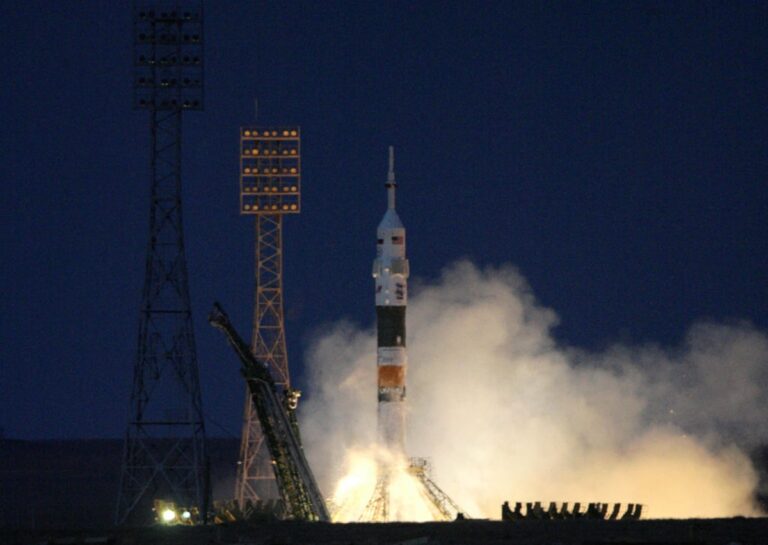
September 5, 2026:


Russia’s Progress MS-35 cargo spacecraft will lift off Tuesday, September 9, from the Baikonur Cosmodrome in Kazakhstan, carrying more than 5,700 pounds (about 2,600 kg) of food, fuel, water, and equipment to the seven-person Expedition 75 crew aboard the International Space Station. The mission also closes the book on the Soyuz-2.1a rocket’s more than decade-long run as the exclusive launch vehicle for Progress MS resupply missions. The next cargo ship in line, Progress MS-36, is confirmed by tracking data to fly on the upgraded Soyuz-2.1b variant for the first time in ISS history, making Tuesday’s flight the last of the familiar pairing.
Liftoff is currently scheduled for approximately 12:10 p.m. ET (16:10 UTC). If the two-day free-flight rendezvous proceeds normally, Progress MS-35 will dock automatically at the zenith (space-facing) port of the Poisk module on the Russian segment of the ISS at approximately 2:37 p.m. ET on Friday, September 11, per the NASA and SpacePolicyOnline event schedule.
To make room for the incoming cargo ship, Roscosmos plans to undock Progress MS-33 — the 94th Progress mission to the ISS, which has been berthed at the Poisk zenith port since late March — on Sunday, September 7. The spacecraft will be loaded with waste before departure and will burn up on reentry, as all Progress vehicles do.
The Expedition 75 crew that will receive the delivery is led by Commander Jessica Meir of NASA, alongside flight engineers Jack Hathaway (NASA), Sophie Adenot (ESA), Andrey Fedyaev (Roscosmos), Anil Menon (NASA), Pyotr Dubrov (Roscosmos), and Anna Kikina (Roscosmos). Expedition 75 officially began on July 26, 2026, and is expected to continue into spring 2027. The crew is currently conducting research into in-space manufacturing, bioprinting of human tissue, and augmented-reality methods for crew health monitoring.
Before Progress MS-35 arrives, the station’s orbit will have been set at the right altitude. Northrop Grumman’s Cygnus NG-24 spacecraft — the S.S. Steven R. Nagel, berthed at the station’s Unity nadir port since April — has the capability to perform ISS reboost maneuvers, and orbit-raising is standard preparation ahead of visiting vehicle arrivals.
Every Progress MS cargo mission since the series launched its inaugural flight in December 2015 has ridden to orbit on a Soyuz-2.1a — more than two dozen consecutive flights over more than a decade. The 2.1a variant stands 46.3 meters tall (152 feet) and delivers approximately 7 metric tons (15,400 lbs) to low Earth orbit from Baikonur’s Site 31/6 launch pad. It uses a digital flight control system introduced on the Soyuz-2 family that allows launches from fixed platforms — a key enabling feature for the precise orbital phasing that ISS docking requires.
Progress MS-35 itself carries a total launch mass of 7,280 kg (16,050 lbs). The pressurized cargo module will deliver dry goods — food, clothing, personal supplies, and spare hardware for station maintenance — while a dedicated propellant module carries fuel for ISS reboost and attitude control maneuvers. Separate tanks supply water for drinking and hygiene, and pressurized containers replenish onboard atmospheric gases.
Following separation from the Soyuz third stage around nine minutes after liftoff, the spacecraft will spend approximately two days in free flight, gradually phasing its orbit upward from a lower initial trajectory to match the ISS’s altitude of roughly 420 kilometers (261 miles). Mission controllers at the Korolyov flight control center near Moscow will monitor the Kurs-NA radar-guided terminal approach sequence before automated docking completes.
This is the third Roscosmos resupply mission to the ISS in 2026, following Progress MS-33 in March and Progress MS-34 in April. Both of those missions also flew on the Soyuz-2.1a, as confirmed by launch pad records from Site 31/6.
Progress MS-36, currently scheduled to launch on November 24, is expected to mark a genuine technical transition: the first time Roscosmos has used the Soyuz-2.1b variant for an ISS cargo delivery mission, according to tracking data from SpaceLaunchNow reflecting a vehicle assignment update recorded on June 8, 2026.
The 2.1b is not a new rocket — it debuted on December 27, 2006, and has compiled a strong track record on satellites and planetary missions — but it has never been paired with a Progress spacecraft for an ISS mission. The upgrade that distinguishes it from the 2.1a is its third-stage engine: the RD-0124, which replaces the older RD-0110.
The difference matters in engineering terms. The RD-0110 on the 2.1a operates in an open-cycle turbopump arrangement and delivers a vacuum-specific impulse of approximately 326 seconds. The RD-0124 on the 2.1b uses a staged combustion cycle — routing oxygen-rich gas through the turbopump before injecting it into the combustion chambers — and achieves a specific impulse of 359 seconds. Specific impulse is a measure of fuel efficiency: a higher figure means the engine extracts more thrust per kilogram of propellant burned. That 33-second improvement in specific impulse translates directly into payload capacity, lifting the 2.1b’s LEO ceiling from the 2.1a’s approximately 7 metric tons (15,400 lbs) to approximately 8.2 metric tons (18,100 lbs) from Baikonur.
Roscosmos has not publicly explained why the 2.1b transition was applied to MS-36 specifically, though the variant has a long history of flying higher-value payloads — GLONASS navigation satellites, scientific probes, and commercial constellation batches — where its additional margin was worth using. Applying that margin to ISS cargo logistics likely increases scheduling flexibility and could, in principle, allow heavier or differently configured manifests on future flights.
MS-35’s launch also continues what has been a noteworthy operational recovery for Russia’s ISS logistics program. In late November 2025, the mobile service platform at Launch Site 31/6 collapsed into the flame trench during the crewed Soyuz MS-28 launch, temporarily rendering Russia’s only active ISS launch facility unusable. Roscosmos told NASA that repairs would take at least four months.
Progress MS-33, originally scheduled for December 2025, was delayed until March 22, 2026 — the first Russian cargo mission to the ISS in more than six months. Even that return flight encountered a complication: a Kurs rendezvous antenna failed to deploy after orbital insertion, requiring the ISS crew to use the TORU backup manual control system to complete docking.
With MS-34 following in April and now MS-35 set for September, the pace of Russian ISS logistics appears to have normalized. Roscosmos is also investing in longer-term launch infrastructure: in April 2026, Roscosmos General Director Dmitry Bakanov announced Vostochny pad upgrades for ISS resupply flights — a move aimed at reducing long-term dependence on the Baikonur lease.
NASA will provide live coverage of both the launch and the docking. Launch commentary will begin at noon ET on September 9, with liftoff expected at approximately 12:10 p.m. ET. Docking coverage will begin at 1:45 p.m. ET on September 11. Both events will stream via NASA+, NASA’s YouTube channel, and NASA’s account on X. The streams will also be available on Discovery+ and Amazon Prime Video.
Progress MS-35 is expected to remain docked at the Poisk module for several months before undocking with collected waste and reentering the atmosphere for a destructive burnup, with a planned deorbit around early 2027.
The Progress is an uncrewed, expendable cargo vehicle derived directly from the Soyuz spacecraft — essentially the same three-module architecture (pressurized cabin, propellant compartment, service module) with the Soyuz’s descent module removed and replaced with an additional cargo bay. It cannot return to Earth and is designed to burn up on reentry after it is loaded with waste and undocked. The MS (“modified spacecraft”) series, introduced in 2015, added a new Kurs-NA radar rendezvous system, improved micrometeorite shielding, and digital telemetry upgrades over earlier Progress variants.
The Soyuz-2.1b’s third-stage engine (the RD-0124) produces a specific impulse of 359 seconds in vacuum, compared to 326 seconds for the Soyuz-2.1a’s RD-0110. That roughly 10% efficiency gain raises the rocket’s cargo capacity to low Earth orbit from about 7 metric tons (15,400 lbs) to 8.2 metric tons (18,100 lbs), giving Roscosmos more flexibility in what it can pack onto future ISS cargo runs. The 2.1b has never before been used for a Progress ISS mission; Progress MS-36 in November 2026 is expected to be the first.
In late November 2025, the mobile service platform at Site 31/6 — Russia’s primary ISS launch pad at Baikonur — collapsed into the flame trench during the crewed Soyuz MS-28 launch. Roscosmos suspended ISS launches for more than three months while repairs were completed. The pad returned to service for Progress MS-33 in March 2026, which became the first Russian cargo launch to the ISS in over six months. Progress MS-35 will be the third consecutive flight from the restored pad.
Yes. NASA is planning live launch coverage starting at noon ET on September 9, with liftoff at approximately 12:10 p.m. ET. Docking coverage will begin at 1:45 p.m. ET on September 11. Both streams will be available on NASA+, NASA’s YouTube channel, NASA’s account on X, Discovery+, and Amazon Prime Video.