September 5, 2026:


A propulsion failure in the SpaceX Crew Dragon Grace has pushed Crew-13’s planned launch date off the calendar indefinitely, grounding a four-person international crew — including the first Canadian to fly under NASA’s Commercial Crew Program — weeks before what would have been a historic September 12 liftoff from Cape Canaveral Space Force Station in Florida. NASA confirmed the delay on August 29 after an oxidizer leak was detected in Dragon Grace’s propulsion system during standard prelaunch processing.
Joint NASA and SpaceX engineering teams are conducting diagnostic tests and rework before a new launch date will be announced, the agency said. NASA Administrator Jared Isaacman, speaking at the Nancy Grace Roman Space Telescope launch the following day, said the repair could take two to four weeks — a timeline that shifts the earliest realistic window for liftoff toward late September or early October 2026.
The propellant that failed to stay contained is nitrogen tetroxide (NTO), the oxidizer half of Dragon’s Draco thruster system. Crew Dragon carries 18 Draco thrusters — each producing 400 Newtons (90 pounds-force) of thrust — that use NTO paired with monomethylhydrazine (MMH) as the fuel. The two chemicals ignite spontaneously the moment they make contact, a property called hypergolicity, which is why Dragon needs no separate ignition system for orbital maneuvering, ISS docking, and attitude control.
That reliability is also what makes an NTO leak a serious engineering event. Nitrogen tetroxide is one of the most corrosive oxidizers in use today: it attacks metal seals, degrades polymer components, and — under the right conditions — can cause titanium to ignite in an NTO-rich environment.
SpaceX learned exactly how dangerous that combination can be in April 2019, when an NTO leak caused the company’s Crew Dragon test vehicle to explode during a ground abort-thruster test at Cape Canaveral. Engineers determined that a leaky check valve allowed NTO to flow backward into the helium pressurization system, where it contacted titanium components. The capsule was destroyed. SpaceX subsequently replaced check valves with burst disks to prevent NTO backflow before the vehicle could fly humans.
The 2026 issue appears to be a distinct manifestation: an oxidizer leak in the propulsion system itself, rather than pressurization-line ingress. But the underlying material challenge is the same — NTO’s behavior under real-world prelaunch conditions continues to demand exacting engineering attention. The two-to-four-week repair timeline Isaacman described is consistent with the work required to isolate a leak source, assess whether seals or valves need replacement, conduct rework, and retest propellant loading under pressure.
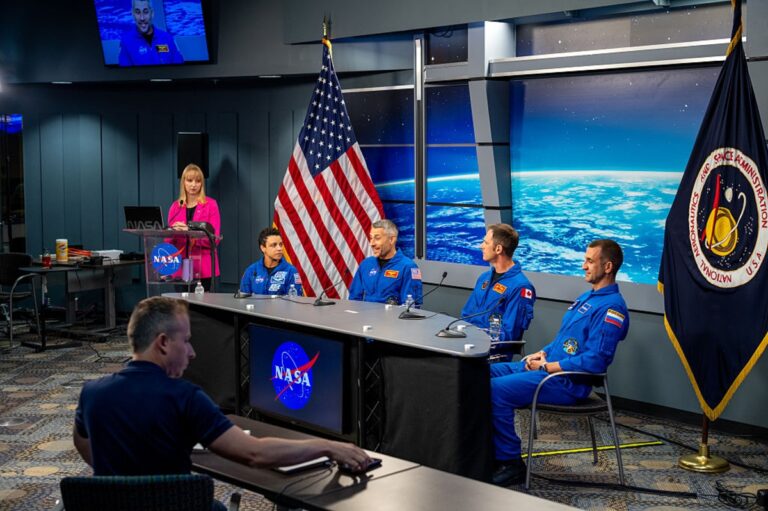
The four crew members set to fly Crew-13 carry a roster of historic firsts that makes the delay particularly conspicuous.
Commander Jessica Watkins, a geologist who previously spent 170 days on the ISS during the Crew-4 mission in 2022, would become the first NASA astronaut to fly aboard a SpaceX Crew Dragon twice — a milestone that also makes her the most experienced active NASA Dragon flier. Watkins earned her doctorate in geology from UCLA, where her dissertation focused on large landslide mechanisms on Mars and Earth, and was a science team member for NASA’s Curiosity rover.
Pilot Luke Delaney, a former naval aviator who flew missions across the Asia-Pacific region and later served as a research pilot at Langley, is heading to orbit for the first time.
Mission Specialist Joshua Kutryk of the Canadian Space Agency carries perhaps the most historically resonant milestone in this crew. A colonel in the Royal Canadian Air Force, Kutryk holds four advanced degrees — including a master’s in space studies from Embry-Riddle Aeronautical University, a master’s in flight test engineering from the US Air Force’s Air University, and a master’s in defense studies from the Royal Military College of Canada — and logged more than 4,000 flying hours on more than 40 aircraft types as a CF-18 fighter pilot and experimental test pilot before being selected as a CSA astronaut in 2017. He will be the first Canadian in Commercial Crew and the fourth Canadian to serve on an ISS crew overall. The mission also carries a personal dimension: Kutryk’s third child is expected to be born while he is aboard the station — a circumstance with precedent in NASA’s history but no less significant for it.
Kutryk was originally assigned to Boeing’s troubled Starliner capsule before being moved to Dragon after Starliner’s recurring propulsion and technical problems left it without an operational crewed-flight capability.
Mission Specialist Sergey Teteryatnikov of Roscosmos, a naval engineer with a background in ship power plants and undersea vessel propulsion systems who became a test cosmonaut in 2023, will also be making his spaceflight debut.
The crew’s science agenda, planned for a seven-month stay supporting Expedition 75/76, includes research aimed at improving treatments for heart disease and Parkinson’s disease through the study of human stem cell-derived tissues in microgravity — an environment that may enable larger and better-structured protein crystals and more viable cell cultures than Earth-based labs can produce. Microgravity is also expected to accelerate stem cell maturation processes in ways that have potential therapeutic implications for cardiac and neurological disease. They are also slated to conduct crop production experiments relevant to deep-space missions and to investigate blood flow abnormalities observed in astronauts during extended microgravity stays. More on the Crew-13 science program is available on NASA’s mission blog.
Crew Dragon Grace (serial number C213) is the fifth and final Dragon 2 spacecraft that SpaceX built — the company is winding down Dragon production in favor of Starship for future crew missions. Grace made its maiden flight on Axiom Mission 4 from June 25 to July 15, 2025. Crew-13 would be its second crewed mission.
The Falcon 9 Block 5 booster assigned to carry Grace to orbit, designated B1101.3, previously flew the Crew-12 mission in February 2026 — this flight would mark its third use.
Crew-13 is the 13th operational flight under NASA’s Commercial Crew Program, which has transported astronauts to and from the ISS aboard Dragon since November 2020. The mission was originally scheduled for November 2026 before NASA moved the launch date forward to September to increase the frequency of US crew rotation missions — a decision that made the delay more operationally significant, as it reduces the buffer before the next scheduled handover on the station.
Before the delay, mission managers described several notable hardware firsts that remain in the mission plan for whenever launch eventually takes place.
SpaceX’s upgraded pressure suits — featuring design adjustments that account for spinal lengthening that occurs in microgravity — were scheduled for a “test drive” at the pad in the first week of August. Dragon Grace also carries updated metal covers for its Draco abort thrusters, replacing the carbon fiber panels used on earlier Dragon missions.
Perhaps the most visible logistical change for launch day involves evacuation: should the crew need to exit the pad area before liftoff, SpaceX will transport them in Tesla Cybertrucks for the first time, replacing the Mine-Resistant Ambush Protected vehicles previously used. NASA’s deputy Commercial Crew program manager Richard Jones confirmed that certification included verifying that crew members in full pressure suits, wearing gloves, could operate the trucks and exit them under flight conditions.
As of September 4, 2026, no new launch date has been set. Isaacman’s estimate of two to four weeks for the repair places the earliest realistic window in the last week of September, assuming engineers confirm the failure source quickly and rework proceeds without complications. Launch windows from Cape Canaveral to the ISS at the station’s 51.63-degree inclination repeat roughly every 24 hours, giving mission planners flexibility once the spacecraft is cleared.
NASA will announce a new target date once the engineering assessment and any rework are complete. Interested viewers can follow updates through the NASA commercial crew blog and the @NASASpaceOps account.
NASA and SpaceX detected a nitrogen tetroxide (NTO) oxidizer leak in Crew Dragon Grace’s propulsion system during standard prelaunch processing at Cape Canaveral. NTO is one half of Dragon’s hypergolic thruster propellant — it ignites spontaneously on contact with the fuel, monomethylhydrazine — and its extreme corrosiveness makes any leak a mandatory hold. Engineering teams are conducting additional testing and rework before a new launch date can be announced per NASA.
No new launch date has been announced as of September 4, 2026. NASA Administrator Jared Isaacman said the repair could take weeks, placing the earliest realistic window in late September or early October 2026.
Joshua Kutryk is a colonel in the Royal Canadian Air Force and a veteran experimental test pilot selected as a Canadian Space Agency astronaut in 2017. He will be the first Canadian to fly under NASA’s Commercial Crew Program — the public-private transportation system that has rotated astronauts to the ISS since 2020 — and only the fourth Canadian to serve on the station overall. He was originally assigned to Boeing’s Starliner before being reassigned to SpaceX Dragon after Starliner’s ongoing technical difficulties.
Yes. In April 2019, an NTO leak caused Dragon’s abort thruster system to catastrophically fail during a ground test, destroying the uncrewed capsule. Engineers traced the failure to a leaky check valve destroying titanium components that allowed NTO to enter the helium pressurization lines, where it caused titanium ignition. SpaceX subsequently redesigned the propulsion architecture, replacing check valves with burst disks. The 2026 leak appears to be a different type of failure, but the same corrosive oxidizer is involved — which is why the delay triggers a full engineering review rather than a simple patch.