HomeAuto Ryugu Salt Crystals Locked Nitrogen Into Life’s Building Blocks 4.6 Billion Years Ago
Ryugu Salt Crystals Locked Nitrogen Into Life’s Building Blocks 4.6 Billion Years Ago
September 5, 2026:
Global.jaxa.jp
A study published in Nature Astronomy has found the most direct geochemical evidence yet that Ryugu’s parent body functioned as a prebiotic chemistry reactor — not simply because it contained the right molecules, but because a specific physical process concentrated those molecules in exactly the environment needed to link them into longer, more complex chains. The mechanism: ancient salt-rich brines, evaporating or freezing in the asteroid’s interior billions of years ago, trapped ammonia and cyanide-related species in the same crystal lattice as sodium carbonate, preserving a snapshot of the chemistry that may have preceded life. Matsumoto and colleagues confirmed brine-linked nitrogen co-location in Ryugu grains using three complementary analytical methods.
Lead author Toru Matsumoto of Kyoto University and colleagues from the Hayabusa2 Initial Analysis Team examined grains from the approximately 5.4 grams (0.19 ounces) of Ryugu regolith returned to Earth in December 2020. The analysis, combining infrared spectroscopy, X-ray spectroscopy, and electron microscopy, identified three distinct classes of nitrogen-bearing compounds: ammonium-bearing phyllosilicates (layered clay minerals with the ammonium ion NH₄⁺ locked into their crystal structure), species containing the C≡N triple bond (a functional group associated with cyanide chemistry and the synthesis of nitrile compounds), and sodium nitrate (NaNO₃). All three were found in close spatial association with sodium carbonate, a salt whose presence in Ryugu was established by Matsumoto’s own team in an earlier study. That 2024 Nature Astronomy paper confirmed sodium carbonates in Ryugu as evidence of ancient saline water. The 2026 paper is the direct sequel: the 2024 work confirmed the salt record; the 2026 work places the nitrogen chemistry inside it.
Why Ancient Asteroid Salt Crystals Matter for Life’s Origins
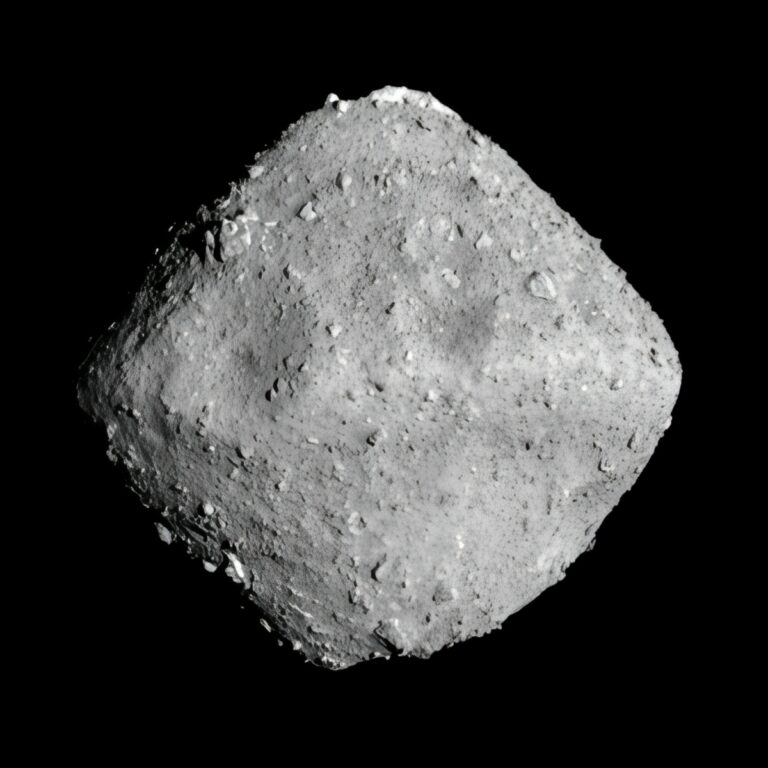
Ryugu is a C-type (carbonaceous) near-Earth asteroid roughly 900 meters (0.56 miles) across — one of the most primitive and chemically unmodified object types in the solar system. Because Japan’s Hayabusa2 spacecraft collected its samples directly from Ryugu’s surface and subsurface in 2019 and then sealed them for return to Earth, they avoided the terrestrial contamination that compromises every meteorite that falls through Earth’s atmosphere and lies on the ground absorbing moisture and biological organics. That contamination-free status is what makes Ryugu findings uniquely trustworthy: a molecule found in a Ryugu grain is a molecule that formed in space. ISAS confirmed Ryugu sample recovery and contamination controls in December 2020.
Since the samples arrived, the Hayabusa2 Initial Analysis Team has been documenting Ryugu’s molecular inventory in layers. Earlier analyses detected thousands of distinct organic molecules — amino acids, aromatic hydrocarbons, carboxylic acids, nitrogen-containing cyclic compounds, and amines — all confirmed in JAXA’s Ryugu organic analysis. In March 2026, a separate team led by Dr. Toshiki Koga of the Japan Agency for Marine-Earth Science and Technology published a companion study confirming all five nucleobases in Ryugu samples. Those five nucleobases — adenine, guanine, cytosine, thymine, and uracil — are the informational units of DNA and RNA; finding every one of them on a single asteroid means Ryugu carried every molecular “letter” needed to write the genetic code.
What was missing from that inventory was a coherent physical mechanism explaining how those diverse molecules could have concentrated, reacted with one another, and potentially polymerized into larger structures inside the asteroid. The new Matsumoto 2026 study supplies that mechanism.
How Brine Chemistry Concentrated Life’s Ingredients
The key to the new finding lies in the phase diagram of water. When liquid water in a rock-and-mineral system becomes progressively more concentrated in dissolved salts — either by evaporation into a vacuum or by freezing out as pure ice — the remaining brine becomes increasingly chemically active. Less-soluble minerals precipitate out first. Sodium carbonate, the dominant salt identified in Ryugu’s 2024 study, is exactly that kind of mineral: it crystallizes from alkaline brine when the brine’s concentration crosses a threshold, leaving behind an even more concentrated solution rich in whatever other ions remain dissolved.
In Ryugu’s parent body 4.6 billion years ago, the Matsumoto team argues, ammonium ions (NH₄⁺) and C≡N-bearing molecular species dissolved in the brine underwent exactly this fate. Researchers found that nitrogen locked in salt matrices as the brine’s water disappeared and sodium carbonate precipitated. The ammonium became concentrated enough to substitute for potassium ions inside the crystal lattice of phyllosilicate clay minerals, permanently locking it in place. The electron microscope confirmed it: nitrogen species are spatially co-located with the sodium carbonate grains, not scattered randomly through the mineral matrix.
“We suggest that reactive ammonia and C≡N-bearing species were accreted during parent-body formation and persisted until aqueous activity ceased, serving as sustained nitrogen sources for prebiotic organic synthesis,” the team wrote in the 2026 paper. The phrase “dehydration-driven polymerization” appears in the paper’s key implication: as the brine dried, conditions became favorable for small molecular building blocks — amino acids, nitrogen bases — to chain together into longer structures. That is the mechanism by which proteins and RNA are believed to have first formed under prebiotic conditions.
Ammonium Clays Across the Solar System
The significance of the ammonium phyllosilicate finding in Ryugu was simultaneously reinforced by a May 2026 study in Nature Communications, led by researchers at the Institut d’Astrophysique Spatiale (IAS) in France. That team identified ammonium phyllosilicates in Bennu samples as well, from material returned by NASA’s OSIRIS-REx mission. The two asteroids originated from different parent bodies and were sampled by different spacecraft, yet their ammonium phyllosilicate grains show “highly similar near-infrared spectral profiles in both collections, pointing to a generic formation process across this class of primitive objects.” In other words, the brine-nitrogen-salt chemistry is not a Ryugu peculiarity — it appears to be a standard feature of how C-type carbonaceous asteroids process their nitrogen inventories.
From Ryugu to Ceres and Beyond
One of the broader implications in the 2026 paper reaches past the asteroid belt entirely. Ceres, the dwarf planet that orbits in the main belt and is the largest object between Mars and Jupiter, hosts extensive ammoniated minerals on its surface and shows evidence of past cryovolcanism — eruptions of water-brine mixtures rather than silicate magma. NASA’s Dawn spacecraft confirmed that Ceres’s brightest spots are sodium carbonate, thought to have risen from a subsurface brine reservoir. The Matsumoto team draws an explicit parallel: “subsurface brines concentrated during cryovolcanic activity on ammonium- and salt-rich icy bodies such as Ceres may have provided favourable environments for nitrogen-related organic reactions.”
The analogy extends further. Saturn’s moon Enceladus has ammonia and sodium carbonate in its geyser plumes. Jupiter’s moon Europa has a suspected salt-rich subsurface ocean. If the Ryugu model holds, those icy moons are not exotic candidates for life’s chemistry — they are environments that may operate by the same geochemical playbook that Ryugu’s parent body did 4.6 billion years ago, just in a colder and more extended form.
What Does This Mean for Life on Earth?
Organic molecules are the building blocks of all known forms of life and can be made by chemical reactions that do not involve biology — a process called abiotic synthesis. NASA has confirmed Ryugu’s organic-rich prebiotic inventory in its initial analysis. The Ryugu sample program is, study by study, demonstrating that abiotic synthesis in asteroid parent bodies produced not just individual molecular classes but a coherent geochemical environment in which multiple classes could concentrate and interact together. The archive now encompasses: amino acids (protein monomers), all five nucleobases (the genetic code letters), diverse nitrogen compounds (electron microscopy confirmed), and the salty, concentrating, drying brines (now geochemically established as the physical stage on which those compounds were brought together).
Whether that chemistry, delivered to early Earth by asteroid impacts, actually sparked life’s origin is a question the samples alone cannot answer. But they are making the asteroid delivery hypothesis look considerably less like an assumption and considerably more like a documented chain of chemistry. A correlation between the ratio of nucleobases in Ryugu’s samples and the concentration of ammonia was noted in the Koga 2026 study, with one researcher observing that “this finding may point to a previously unrecognized pathway for nucleobase formation in early Solar System materials.” That pathway now has a confirmed geochemical record of nucleobase formation behind it.
What Comes Next for Asteroid Science
The Hayabusa2 initial analysis program is ongoing, with many sample fractions still under study. The spacecraft itself — now operating under the extended mission designation Hayabusa2# (pronounced “Hayabusa2 Sharp”) — completed a high-speed flyby of the near-Earth asteroid (98943) Torifune on July 5, 2026. JAXA and DLR confirmed Hayabusa2 Sharp’s Torifune flyby, reporting the probe passed within approximately 800 meters of the asteroid’s center at roughly 5 kilometers per second (18,000 miles per hour). Hayabusa2# is now en route toward a 2031 rendezvous with asteroid 1998 KY26.
NASA’s OSIRIS-APEX spacecraft, repurposed from the OSIRIS-REx mission that delivered the Bennu samples, is heading for the near-Earth asteroid Apophis, timed for that asteroid’s unusually close Earth approach in 2029. Together, these missions will keep expanding the comparative dataset of pristine carbonaceous asteroid material — and each new sample set is a new opportunity to test whether the brine-concentration chemistry that Matsumoto’s team identified in Ryugu is as universal as the ammonium phyllosilicate findings already suggest.
For now, what the September 2026 findings establish is this: an ancient asteroid, unremarkable in size and dark as asphalt, once had liquid water flowing through its interior, processed that water into concentrated salt brines, concentrated nitrogen compounds in those brines, and then locked them into its mineral matrix so effectively that they survived 4.6 billion years of space. That is not speculation about life’s origins — it is documented chemistry, read from a few hundred milligrams of rock collected from the void.
Frequently Asked Questions
What specifically did Ryugu’s new nitrogen finding reveal?
The Matsumoto et al. 2026 study used infrared spectroscopy, X-ray spectroscopy, and electron microscopy to confirm that ammonium-bearing clay minerals, C≡N-bearing chemical species, and sodium nitrate in Ryugu’s grains are all spatially co-located with sodium carbonate — a salt deposited during the final stages of liquid water activity on Ryugu’s parent body. The significance is not just that nitrogen compounds exist in Ryugu (that was already known) but that they are physically embedded in the same crystal record as the salt precipitation event. This links the nitrogen chemistry to a specific, late-stage geochemical process: the concentration and drying of ancient brines.
How does asteroid brine chemistry relate to how life might have started?
One of the leading hypotheses for how biological polymers (proteins, RNA) first formed is dehydration-driven polymerization — small molecules like amino acids and nucleobases link together into longer chains when water is removed from the system. Concentrated, evaporating brines are exactly the kind of environment that drives this process: as the water disappears, the dissolved molecules are forced closer together and the chemistry becomes more reactive. Finding that Ryugu’s late-stage brines concentrated both nitrogen-bearing compounds and the mineral salts that mark water’s disappearance is evidence that precisely this kind of environment existed inside primitive asteroids — and that asteroids may have delivered it, already processed, to the early Earth.
Is this finding unique to Ryugu, or does it apply to other asteroids?
The pattern appears to extend beyond Ryugu. A companion study published in Nature Communications in May 2026 found the same class of ammonium-bearing phyllosilicates in samples from asteroid Bennu, returned by NASA’s OSIRIS-REx mission. The two asteroids came from different parent bodies and were studied by independent teams, yet showed near-identical spectral signatures — suggesting the brine-nitrogen-salt chemistry is a generic feature of primitive carbonaceous asteroids, not a Ryugu peculiarity. The new findings also connect to the chemistry of Ceres’s bright brine deposits and icy moons in the outer solar system, suggesting a solar system-wide playbook for nitrogen enrichment via brine concentration.
What is the significance of the Hayabusa2 samples being “pristine”?
Meteorites — chunks of asteroid that fall to Earth — are exposed to the atmosphere, absorb moisture, and pick up organic contamination from Earth’s biology. That contamination always leaves room for doubt about whether detected organic molecules are truly extraterrestrial. Hayabusa2 collected Ryugu’s material directly in space and sealed it before return, with samples handled in clean rooms under inert nitrogen gas. This eliminates the contamination problem entirely. Every molecule detected in a Ryugu grain was formed in space and preserved for 4.6 billion years — making these among the most scientifically trustworthy organic chemistry samples ever studied.