Delta Rebuilds Quake Movement Physics for Speedrunners: No Combat, Pure Speed

September 4, 2026:

Delta Rebuilds Quake Movement Physics for Speedrunners: No Combat, Pure Speed
DELTA
Store.steampowered.com 0xc3pti0n

The movement community does not need enemies. For the players who spent years learning to rocket-jump across Quake maps at speeds the engine was never supposed to allow, the opponent was always the physics model — and the only real rival was the ghost of their last run. Delta, a first-person movement platformer from two-person indie team 0xc3pti0n and Ri, is built on that exact premise. Its free demo arrived on Steam in May 2026, passed 20,000 wishlists during the June 2026 Steam Next Fest window, and has been drawing comparisons to Defrag — the Quake III mod that proved, more than two decades ago, that a first-person game about movement could sustain an entire community without a single kill.

What CPM Physics Actually Are — and Why They Change Everything

Most modern first-person shooters give every player identical movement: a fixed run speed, limited air control, and a predictable jump arc. That design choice is deliberate — it eliminates a skill gap that most players find frustrating to learn and rewards positioning and aim over locomotion. Challenge ProMode (CPM) physics, originally developed for the Quake III Arena mod scene in 1999 by a team led by Richard “Hoony” Sandlant, make the opposite choice.

Under CPM rules, players can exceed their base running speed by combining mouse movement with directional key inputs while airborne — a technique called strafe jumping. Holding a strafe key while moving the mouse in the same direction adds velocity components that compound across successive jumps, allowing skilled players to reach over 600 units per second. Air control — the ability to redirect that momentum mid-air without losing speed — comes from holding the forward key alone, which activates a different acceleration mode borrowed from QuakeWorld. The result is a physics model with two distinct aerial locomotion systems operating simultaneously, each triggered by different input combinations. Ramp sliding converts vertical impact momentum into forward speed. Rocket jumping uses explosion knockback to launch the player upward. Plasma boosting in Delta adds a weapon-based velocity technique unique to the game’s design.

None of this is accessible from the first minute. The Steam community discussion for Delta includes a thread titled “Cool but seems intentionally complicated,” where one player described the tutorial as “like handing the player a text book and telling them to read it.” That critique is accurate — and it is the same critique that has followed every CPM-based game since 1999. The reason CPM communities thrive despite the learning curve is not that the mechanics become easy. It is that they become legible: players can watch a run, identify exactly what a faster runner did differently, and practice that specific technique in isolation until it becomes automatic. The knowledge is transferable in ways that feel mechanical and learnable rather than reflexive and arbitrary.

Defrag’s Commercial Successor

DeFRaG, a Quake III mod first released in 2004, stripped arena combat entirely and replaced it with a pure movement sandbox: specialized maps, a timer, and the CPM physics model. Players ran courses — some requiring dozens of techniques in sequence, others testing a single corner-jump to its limit — and uploaded demo files for others to study frame by frame.

Delta is the closest commercial equivalent that the movement genre has yet produced. It eliminates enemies entirely, offers a Ghost and Replay System that allows players to download world-record demos and study them to the individual frame, and builds its map design around the same principle that sustained Defrag communities for decades: every surface is a problem to be solved, and solving it faster is always possible. The developers describe the game plainly: “This is movement as a discipline. It’s not about style points. It’s about speed, flow, and intent. Every surface is an opportunity. Every mistake is yours.”

The Ghost and Replay System is not incidental to this. Frame-accurate timing — where runs are measured against individual rendered frames rather than wall-clock seconds — combined with downloadable demo files creates the same infrastructure that made Defrag a lasting community: not a leaderboard, but a shared archive of technique, executable by anyone with the patience to learn it. Delta‘s full release, still planned for sometime in 2026 without a specific date confirmed, will inherit that ecosystem regardless of how many maps the developers ship.

What Is the Story Behind the Speed

Beneath the mechanical precision, Delta carries an atmospheric layer that sets it apart from Defrag’s pure minimalism. The game’s tagline — “And somewhere ahead, the one you lost is still waiting” — introduces a presence the developers describe as “glitched, unreachable, but not gone.” A player who pushes deep into the game’s systems begins following a signal: a trace, a ghost, something that sits at the intersection of a personal loss and the act of chasing a perfect run.

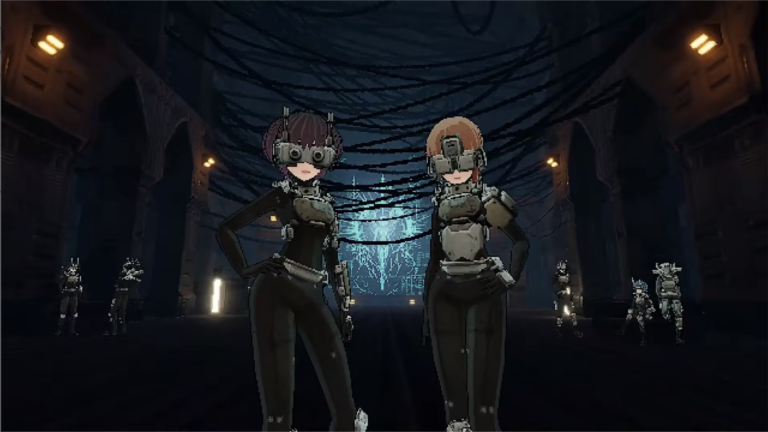
The setting is cyberpunk-gothic: low-polygon architecture in dark, abstract spaces tagged on Steam as Cyberpunk, Gothic, Dark, Atmospheric, and Abstract. The protagonist is a runner in a system that has not forgotten someone. The central dramatic question is whether the ghost is real, a metaphor, or the game itself asking what you’re running toward when you optimize a line that no one else has tried. One specific detail: the demo includes a map called Nexus — a dynamic acoustic environment with portal-based sound design that changes as players move through it — alongside an area called Outskirts that received dedicated respawn volumes and decal improvements in the June patch. That level of granularity in a demo suggests a team that cares about the spaces as spaces, not just as obstacle courses. The game operates in a register that is melancholic and technically precise simultaneously — rare in any genre, stranger still in one that measures success in milliseconds.

Minimal Hardware, Maximum Speed Ceiling

Delta is designed to run on hardware that is several years old, which is consistent with the design philosophy: low-polygon geometry and minimal spectacle in service of uninterrupted frame pacing. The minimum specification requires a GTX 960 graphics card and an Intel Core i5-7400 processor, with 2 GB of RAM and 2 GB of storage. The recommended configuration — a GTX 1660 Ti and a Ryzen 5 3600 — represents midrange hardware from 2019 and 2021, respectively. The game supports both Windows 10 and Ubuntu, and weighs 2 GB installed.

The performance-first approach has a precedent the Niche Gamer article about the game noted: F-Zero X for the Nintendo 64 ran at a stable 60 frames per second in 1998 by eliminating visual complexity in favor of frame consistency. Delta makes the same trade.

What the AI Texture Disclosure Means for a Two-Person Team

Delta’s Steam store page carries a disclosure that reads: “Some of the game textures generated with AI assisted tools.” Under Steam’s updated 2026 disclosure rules — which Valve clarified in January 2026 and which now distinguish between developer tools that never reach players and AI-generated content that appears in the game — this disclosure is mandatory and appropriate for player-facing assets.

The disclosure generated a Steam Community thread in August 2026 that accumulated 69 upvotes with the text: “Another great idea spoiled by GenAI.” The sentiment is common. Across Steam as of early 2026, more than 4,300 games carry AI content disclosures — a figure representing a 4,750% increase since the system launched in 2023 — and the community response has been consistently negative for visible creative content. Background textures, which Delta‘s disclosure specifically covers, tend to receive less hostility than AI-generated character art or cutscenes, but the reaction still exists.

For a two-person team building a technically demanding engine with CPM physics, a replay system, and online leaderboard infrastructure, the choice to use AI-assisted texture generation for background assets is a resource allocation decision. Whether that decision is compatible with a community that prizes craft is a question each player can answer by downloading the demo. The physics — which are entirely human-authored — are what the community will ultimately judge the game on.

Does It Work to Try the Demo

The demo is free on Steam with no account purchase required. It includes a tutorial that players have described as comprehensive to the point of overwhelming: long text explanations before players can move, a dense introduction to techniques that CPM veterans will recognize immediately and newcomers may find exhausting. The community feedback on this structure has been direct, and the developers have been receptive — patch v0.6.7, released in June 2026 alongside the Next Fest campaign, included a 0trace strafe tutorial dialogue and multiple quality-of-life improvements. More patches followed, each addressing specific friction points identified in community discussion.

Online PvP and Steam Leaderboards are live in the demo. Players can compete for top spots on global and friends-only boards, download world-record run files, and race their own ghosts. Multiplayer allows players to share maps together and teach each other techniques — the same collaborative knowledge-transfer dynamic that sustained the DeFRaG and CPMA communities for over twenty years. The full release date within 2026 has not been announced.


Frequently Asked Questions

What does CPM physics mean and how is Delta different from other movement games?

CPM (Challenge ProMode) is a physics model developed for the Quake III Arena competitive mod scene in 1999 that allows players to exceed their base running speed through airborne directional inputs and compound momentum. Delta uses this system as its entire design foundation — there are no enemies, no health bars, and no combat. Every map is a movement course measured by frame-accurate timing. This places it closer to DeFRaG (the Quake III pure movement mod) than to Ultrakill or Ghostrunner, which combine movement with combat. If you have never strafe-jumped before, the demo’s tutorial is long and demands patience. If you have, you will recognize every technique within the first minute.

Is the free demo enough to know whether Delta is worth wishlisting?

Yes. The demo includes several maps, the full Ghost and Replay System, online leaderboards, and multiplayer. It represents the complete movement model — what the full game adds is more maps and, presumably, the ghost narrative. The physics feel the same in the demo as they will in the release. If the movement discipline connects in the first hour, the game is for you. If the tutorial reads as a wall of text with no immediate payoff, it may not be.

What is the ghost narrative in Delta actually about?

The game does not fully answer this in the demo. What it establishes is a runner in a cyberpunk-gothic system who begins following a signal — “a trace, a ghost: glitched, unreachable, but not gone.” The tagline is “And somewhere ahead, the one you lost is still waiting.” Whether this resolves into a story about loss, about the impossibility of perfect runs, or something stranger is unresolved. The developers have kept the narrative dimension deliberately sparse, letting the atmospheric maps and the act of chasing a ghost run carry the emotional weight. That the mystery is unresolved is part of the design.

Does Delta’s AI texture disclosure mean the game’s visuals were not made by humans?

No. The disclosure covers some background textures specifically — not character models, level geometry, or the game’s visual direction. The low-polygon aesthetic and the architectural spaces are human-designed. Under Steam’s 2026 disclosure framework, which distinguishes player-facing generated assets from developer tools, this disclosure is proactive and compliant. Whether that distinction matters to a given player depends on their personal position on AI tools in game development — the demo makes the answer available for inspection before any purchase decision is required.

Source link