HomeAuto Saturn South Pole Decagon Confirmed: Gas Giants May Grow Polygons at Both Poles
Saturn South Pole Decagon Confirmed: Gas Giants May Grow Polygons at Both Poles
September 4, 2026:
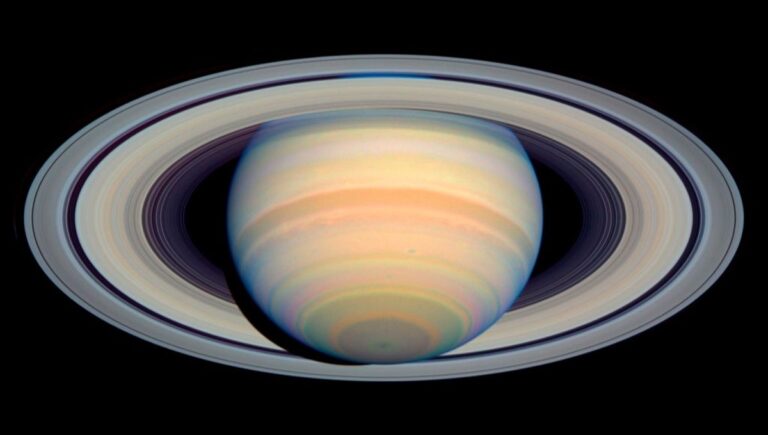
This image of Saturn obtained 14 September, 2003, shows the planet’s rings when they were at a maximum tilt of 26 degrees toward Earth. NASA/AFP via Getty Images
Saturn now has two geometric giants anchoring its poles — and two amateur astronomers spotted the new one before the world’s premier space telescope could confirm it.
An international team led by Agustín Sánchez-Lavega of the University of the Basque Country in Bilbao, Spain, published findings on September 2, 2026, in the journal Science Advances documenting the first confirmed detection of a ten-sided atmospheric wave — a decagon — encircling Saturn’s south pole. The discovery, announced the same day by NASA, marks the first time any large, regular-sided jet-stream pattern has been detected at Saturn’s southern pole — and it upends the longstanding assumption that the planet’s famous north-polar hexagon was a one-of-a-kind phenomenon.
“We’ve never seen anything quite like this in Saturn’s southern hemisphere,” said Amy Simon, study co-author and principal investigator of NASA’s Outer Planet Atmospheres Legacy program at NASA’s Goddard Space Flight Center in Greenbelt, Maryland. “The northern hexagon has been there every time we’ve looked for more than 40 years. This feature is different — it appears to be strengthening, giving us the rare opportunity to watch a giant atmospheric pattern develop.”
The team plans to follow the decagon with both Hubble and NASA’s James Webb Space Telescope to determine how it formed, how long it will last, and what it reveals about the way giant planet atmospheres organize themselves — not only on Saturn, but potentially across the outer solar system.
How Two Backyard Astronomers Beat Hubble to the Discovery
The decagon did not begin with space-telescope data. It began with crowd-sourced images from ground-based observers around the world.
Sánchez-Lavega’s university manages the Planetary Virtual Observatory Laboratory, a website that accepts ground-based images of solar system planets contributed by observers worldwide. It was in those submissions, first in 2024, that Sánchez-Lavega and amateur astronomers Trevor Barry of the Broken Hill Observatory in Australia and Jean-Paul Oger of the Association Française d’Astronomie in Paris noticed a subtle undulating band along Saturn’s southern pole. Additional ground-based imagery in 2025 hinted even more strongly at a decagonal outline.
That ground-level signal prompted a systematic look at Hubble’s archive. Hubble’s position above Earth’s atmosphere eliminates the blurring that degrades ground-based long-exposure imaging, and its Wide Field Camera 3 can photograph Saturn across multiple wavelength bands in a single observing session — a capability that proved critical, as different wavelengths penetrate to different depths in the planet’s atmosphere. By reassembling Hubble observations from 2023 onward — taken annually as part of the OPAL program, which has surveyed the outer planets every year for more than a decade — the team traced the decagon’s emergence in reverse. The 2023 and 2024 images showed the structure’s vertices with weaker contrast and softer edges; by the August–September 2025 Hubble observations, the ten-sided outline had sharpened into an unmistakable pattern.
“Given Saturn’s symmetry in its north-south jet stream system, we have been searching for a counterpart to Saturn’s northern hexagon on the south pole in Hubble images since 1990,” Sánchez-Lavega told NASA. “Images from NASA’s Cassini spacecraft, which orbited Saturn between 2004 and 2017, showed no inkling of a long-lived formation, either. The Hubble data confirmed the feature’s presence back to 2023.”
What Is a Decagon Doing in Saturn’s Atmosphere?
The short answer is that Saturn’s atmosphere is a machine for making jet streams — and jet streams on giant planets, under the right conditions, can meander into geometrically precise polygons.
Saturn’s rotation is extraordinarily fast: a single Saturnian day lasts only about 10.7 hours. That rapid spin drives the Coriolis force to route atmospheric flow into discrete latitudinal bands rather than allowing gas to travel freely from equator to pole. The result is a system of alternating jet streams — some eastward, some westward — stacked like rings around the planet.
Normally these jets follow smooth circular paths. But under certain conditions, a jet stream can settle into a wave-mode where it traces a path of sharp, roughly equal straight sides rather than a circle. These structures are a class of phenomenon called Rossby waves — named after Swedish-American meteorologist Carl-Gustaf Arvid Rossby, who identified them in Earth’s atmosphere in 1939. Rossby waves arise from potential vorticity conservation in rotating fluids. Rossby waves are inertial waves that arise from the conservation of potential vorticity in rotating fluids. In planetary atmospheres they are a natural consequence of how the Coriolis effect changes with latitude, and they have been observed in the atmospheres and oceans of multiple planets.
Saturn’s north-pole hexagon is widely interpreted as a Rossby wave “trapped” inside its jet stream. The decagon appears to work the same way, riding within one of Saturn’s powerful eastward jet streams at planetographic latitudes 58°S to 63°S — but with one critical difference: while the hexagon is stationary relative to Saturn’s interior rotation, the decagon drifts eastward at approximately 2.5 meters per second (about 5.6 miles per hour) relative to Saturn’s radio-rotation period, according to the EPSC 2026 conference abstract by Sánchez-Lavega et al. That eastward drift suggests the two features are not identical dynamically — the decagon may be coupled to different atmospheric layers or subject to seasonal forcing that the hexagon is not.
Wanying Kang, a planetary scientist at MIT who was not involved in the study, noted that seeing a jet on Saturn is expected given the planet’s size and rotation speed, but that the decagon’s angular geometry is what makes it scientifically striking. “There’s something intriguing to learn, perhaps about the planet’s deeper atmosphere,” Kang told Science News.
The researchers cannot yet fully explain why the decagon formed now. They suggest that perturbations from a nearby storm may have triggered the wave pattern. An observational gap complicates the timeline: Saturn’s south pole was not in view from Earth from roughly 2012 to 2023, and no spacecraft has been posted at Saturn since Cassini ended its mission in 2017. The decagon could have begun forming at any point in that window and remained undetected.
Saturn’s South-Pole Decagon vs. the North-Pole Hexagon: Key Differences
Feature
North Pole Hexagon
South Pole Decagon
Sides
6
10
First detected
1980–81 (Voyager)
2023–25 (Hubble/ground)
Latitude
~77°N to 78°N
~58°S to 63°S
Drift
Stationary in longitude
Eastward at ~2.5 m/s (~5.6 mph)
Side length
~14,500 km (~9,000 miles) each
Over 16,700 km (~10,400 miles) each
Jet speed
~100 m/s (~224 mph)
Not yet measured independently
Status
Stable for 45+ years
Actively evolving and strengthening
Vertical extent
Multi-layer
Multi-layer (confirmed by multi-wavelength Hubble imaging)
Saturn’s hexagon has been a fixture at the north pole since at least 1980, when Voyager 1 first imaged it — and it remained essentially unchanged through Cassini’s entire 13-year mission. Each of its six sides stretches roughly 14,500 km (about 9,000 miles) — approximately 2,000 km (1,240 miles) longer than Earth’s diameter — and the jet stream tracing it moves at about 100 meters per second (around 224 miles per hour). The hexagon is so large that four Earths could fit inside it.
The decagon, by contrast, is younger and changing. Its sides appear to be even longer than the hexagon’s — over 16,700 km (approximately 10,400 miles) each — though precise measurements from the published data are still being analyzed. More importantly, the sharpening of its vertices from 2023 to 2025 in Hubble images indicates it is still in formation, not yet in the long-lived stable state the hexagon appears to have occupied for decades.
That dynamism is exactly what makes it scientifically valuable. “The northern hexagon has been there every time we’ve looked,” Simon told the NASA announcement. “This feature is different — it appears to be strengthening.” Seeing a geometrical atmospheric structure form in near-real time, rather than discovering it already ancient and frozen in place, gives researchers the opportunity to test theories about what drives polygonal wave patterns and how they lock in.
Does Saturn’s Weather Relate to Earth’s?
The implication of the decagon extends well beyond Saturn.
The Rossby waves that underpin Saturn’s hexagon and potentially its decagon are the same class of wave that governs large-scale weather patterns on Earth. On Earth, these giant jet-stream meanders are the atmospheric currents of the middle and upper atmosphere that steer weather systems across entire continents. Their amplification and stagnation have been linked to extreme weather episodes including prolonged heat waves, floods, and drought patterns. Studying how Rossby waves behave in Saturn’s simpler, more symmetric atmosphere — where there are no land masses to complicate the flow — provides planetary scientists with a clean laboratory for testing wave dynamics that also operate, in more complex form, on Earth.
“Future observations also could help scientists determine what drives the wave, what it reveals about the atmospheric dynamics of giant planets throughout the solar system, and how they may relate to those we see here on Earth,” stated NASA’s official decagon announcement.
What This Means for Other Giant Planets
The most consequential implication of the decagon may not be what it says about Saturn — but what it says about every rapidly rotating gas giant.
Before this discovery, the hexagon was routinely described in scientific literature and public reporting as having “no similar structure at Saturn’s south pole” — and by extension was treated as an idiosyncratic feature of the planet’s northern dynamics. That framing is now obsolete. Saturn has two geometric polar waves, at both poles, produced by the same class of physical mechanism but with different side counts, different drift dynamics, and apparently different formation histories.
If polygonal jet-stream patterns can form at both poles of Saturn under a range of conditions, the logical next question is: where else might they exist? Jupiter, Uranus, and Neptune are all rapidly rotating gas or ice giants with their own systems of jet streams. None has been observed to have a fixed polygon at its poles — but Cassini’s orbital surveillance of Saturn is far more thorough than anything yet performed at the other outer planets. “This discovery suggests that the hexagon is not as extraordinary as previously thought,” Sánchez-Lavega told Science News. If the mechanism is reproducible — and the decagon is strong evidence that it is — systematic searches at Jupiter’s poles, at Uranus’s poles, and at Neptune’s poles are now scientifically motivated in a way they were not before September 2, 2026.
What Happens Next
The study’s findings will be presented as an oral talk at the Europlanet Science Congress 2026 on September 7, 2026, putting the decagon before the broader planetary science community for scrutiny and discussion. Hubble is already scheduled to observe Saturn again later in September 2026, and those observations will help establish whether the decagon’s sharpening trend has continued. The team also intends to enlist the James Webb Space Telescope — which can observe Saturn’s atmosphere in infrared wavelengths that Hubble’s optical instruments cannot reach — to probe the decagon’s vertical structure, temperature profile, and composition. Computer modeling is also planned to test candidate formation mechanisms, including the nearby-storm-perturbation hypothesis.
“When we started the OPAL program, we expected compelling surprises, but we didn’t know what to expect specifically,” said Mike Wong, study co-author at the University of California, Berkeley. “A lot of the discoveries we see coming from OPAL are not just based on one observation, but on years and years of data. Regular observations over time are enabling a lot of new findings.”
Whether the south-pole decagon eventually stabilizes into a long-lived feature like the hexagon — or fades — the window of its active formation is scientifically irreplaceable. Saturn is showing researchers something they have never seen before: not just a second geometric storm, but a geometric storm in the act of becoming.
Frequently Asked Questions
What is the Saturn south-pole decagon, and how does it compare to the hexagon?
The decagon is a ten-sided atmospheric wave recently confirmed at Saturn’s south pole, sitting within one of the planet’s powerful eastward jet streams at latitudes 58°S to 63°S. Like Saturn’s famous north-pole hexagon, it is a large-scale Rossby wave that forces a jet stream to travel in a polygonal path rather than a smooth circle. The key differences: the hexagon has six sides, has been stable for at least 45 years, and is stationary relative to Saturn’s interior rotation. The decagon has ten sides, appears to have formed recently (with Hubble detecting it as far back as 2023 and it still sharpening), and drifts eastward at about 2.5 meters per second (roughly 5.6 miles per hour). Each side of the decagon appears to be even longer than the hexagon’s 14,500 km (9,000-mile) sides.
How did Hubble and amateur astronomers work together to find the decagon?
The discovery pipeline ran in two stages. Amateur astronomers Trevor Barry in Australia and Jean-Paul Oger in France, submitting images to the Planetary Virtual Observatory Laboratory (PVOL) — a crowd-sourcing platform managed by the University of the Basque Country — first noticed a subtle undulating band near Saturn’s south pole in 2024 ground-based images. That ground-level signal prompted lead author Agustín Sánchez-Lavega’s team to look systematically at Hubble’s OPAL archive, where they found early hints of the structure dating back to 2023. Hubble’s Wide Field Camera 3 — photographing Saturn in multiple wavelength bands from above Earth’s atmosphere — then provided the sharpness and multi-altitude coverage needed to confirm the decagon’s ten-sided shape and its vertical extent through multiple atmospheric layers. Barry and Oger are credited as co-authors on the published Science Advances paper.
Why didn’t Cassini detect this during its 13-year mission at Saturn?
Cassini orbited Saturn from 2004 to 2017 and mapped the planet in unprecedented detail — but there is no confirmed sign of the decagon in its imagery. The most likely explanation is timing: the decagon appears to have begun forming after Cassini ended its mission. Saturn’s south pole was also partly turned away from easy observation geometry during portions of Cassini’s mission due to the planet’s seasonal axial tilt. Additionally, after Cassini’s intentional de-orbit in September 2017, Saturn’s south pole drifted out of convenient view from Earth until around 2023 — precisely when Hubble’s first hints of the decagon begin to appear. The gap between Cassini’s end and the decagon’s emergence underscores the importance of continuous monitoring programs like OPAL.
Could other planets — Jupiter, Uranus, or Neptune — have similar geometric polar features?
Quite possibly. The physical mechanism that appears to produce polygonal jet-stream patterns — a Rossby wave trapped within a fast-moving jet — is not specific to Saturn. Jupiter, Uranus, and Neptune are all rapidly rotating gas or ice giants with their own layered jet-stream systems. Before the decagon, Saturn’s north-pole hexagon was routinely described as having no equivalent on the south pole, let alone on other planets. Now that Saturn has two polygon patterns at both poles, produced by the same class of mechanism, the scientific case for systematic searches of polar jet-stream geometry on the other outer planets is stronger than it has ever been. No dedicated close-up spacecraft is currently monitoring Jupiter’s poles at the level of detail Cassini provided at Saturn, and no craft has ever entered orbit around Uranus or Neptune.
The paper “A decagon wave around Saturn’s south pole” by Agustín Sánchez-Lavega et al. is published in Science Advances (DOI: 10.1126/sciadv.aee4251). The research involves collaborators from the University of the Basque Country (UPV/EHU), NASA Goddard Space Flight Center, UC Berkeley, NASA JPL, the University of Leicester, Universitat Politècnica de Catalunya, and amateur astronomers affiliated with Broken Hill Observatory (Australia) and the Association Française d’Astronomie.
Image credit: NASA, ESA, STScI, Agustín Sánchez-Lavega (UPV), Amy Simon (NASA-GSFC), Michael Wong (UC Berkeley); Image Processing: Alyssa Pagan.