HomeAuto Air India Easy Connect Adds Ahmedabad as Third Spoke in 67-Day Hub Push After Gulf Crisis
Air India Easy Connect Adds Ahmedabad as Third Spoke in 67-Day Hub Push After Gulf Crisis
September 3, 2026:
Airindia.com
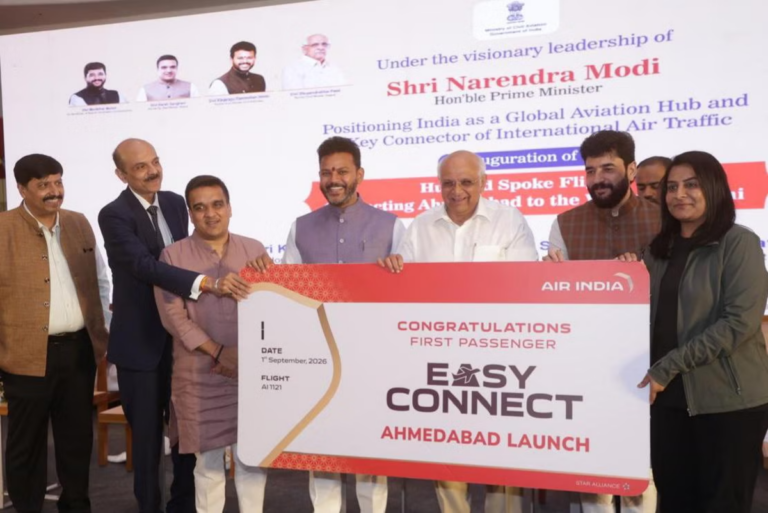
India’s Ministry of Civil Aviation launched hub-and-spoke international operations from Sardar Vallabhbhai Patel (SVPI) International Airport in Ahmedabad on September 1, 2026, adding Gujarat’s commercial capital as the third spoke in a network designed to recapture the approximately 17 million Indian international connecting passengers who currently route through foreign hubs each year — and to hedge against the geopolitical vulnerability that the Iran war’s 2026 airspace crisis made starkly visible. The launch followed Varanasi on June 25 and Amritsar on July 28, bringing the live network to three cities in just over ten weeks.
What Changed on September 1
Union Civil Aviation Minister Ram Mohan Naidu and Gujarat Chief Minister Bhupendrabhai Patel inaugurated the service at Ahmedabad’s SVPI terminal, which handled 13.4 million passengers in fiscal year 2024–25 and is operated by Adani Airport Holdings Limited. Jeet Adani, Director of Adani Airport Holdings, was present at the ceremony.
Air India designated two daily Ahmedabad–Delhi flights as Easy Connect services:
Flight AI1121, departing Ahmedabad at 8:15 p.m. and arriving in Delhi at 10:00 p.m., launched September 1
Flight AI1117, departing Ahmedabad at 8:25 a.m. and arriving in Delhi at 10:15 a.m., launched September 2
Together, the two flights provide onward connections to 26 international destinations within four hours of arriving at Delhi’s Indira Gandhi International Airport. The morning AI1117 service connects passengers to Shanghai, Kathmandu, Dubai, Amsterdam, Manila, Paris, Frankfurt, Vienna, London, Milan, Phuket, Kuala Lumpur, Riyadh, Copenhagen, Rome, and Zurich, among others. The evening AI1121 links to Singapore, Seoul, Bangkok, Hanoi, Toronto, Sydney, and London. Air India has indicated it will soon introduce inbound Easy Connect operations from Ahmedabad, enabling passengers arriving internationally in Delhi to transfer onward to Ahmedabad without repeating domestic check-in procedures.
How the System Actually Works — and Where It Differs From Everything Else
India’s Easy Connect model is not simply a codeshare or an interline agreement. It is a six-layer information architecture that transforms a domestic departure into an international one at the point of origin, before the passenger ever boards a plane.
At SVPI, an international traveler bound for, say, Paris completes all pre-departure formalities — check-in, baggage drop, security screening, customs, and immigration — before boarding what is technically a domestic flight to Delhi. Their luggage is tagged through to Charles de Gaulle. They receive two boarding passes: one marked “D” for the domestic Ahmedabad–Delhi leg, and one marked “I” for the international Delhi–Paris sector. On arriving in Delhi, they transit the hub as an international passenger, moving directly to the international departure gate without repeating any of those steps.
This is a meaningful departure from how hub connections have historically worked in India and from most international hub systems. The United States operates pre-clearance programs at airports in Canada, Ireland, and several Caribbean territories, but those clear passengers for arrival in the US. India’s model runs in the other direction: it clears departing passengers at the domestic origin airport for international transit, a structural innovation that requires the Bureau of Immigration to staff and operate clearance facilities at smaller, non-traditional international points.
The information architecture required to make this work ties together at least six layers in near real-time: the originating airport’s check-in and reservation systems; the Bureau of Immigration’s passenger databases for real-time clearance; Air India’s Departure Control System for dual boarding pass issuance; the ground handling systems at Delhi for airside baggage transfer without passenger intervention; the DigiYatra biometric identity layer for transit corridor access at the hub; and the onward airline systems to coordinate connections within the four-hour window.
DigiYatra — India’s Aadhaar-linked biometric boarding program, launched in December 2022 and made mandatory for international transit at Delhi, Mumbai, Bengaluru, and Hyderabad from June 1, 2026 — is the identity backbone of Easy Connect. Indian passport holders on Easy Connect flights must enroll before departure, uploading an Aadhaar-verified selfie and boarding pass to the DigiYatra application. At the hub, facial recognition cameras verify their identity at biometric e-gates in the dedicated international transit corridor. This eliminates repeated boarding pass scans and document checks across transfer checkpoints, but it also introduces a friction point: passengers who have not enrolled, are not tech-savvy, or are traveling from areas with lower digital literacy face a barrier that has no airport-floor workaround. Web check-in is also currently unavailable at spoke airports, and customs declarations cannot be completed there.
Why Gulf Route Risk Accelerated This Timeline
The strategic logic behind India’s hub-and-spoke push is not new — the National Civil Aviation Policy 2016 set out a long-term goal of positioning Delhi as a global aviation hub by 2047. What changed in 2026 was urgency.
When hostilities related to the Iran conflict disrupted Gulf airspace beginning February 28, 2026, Dubai International Airport — the world’s busiest international airport for passenger traffic and India’s single largest aviation connection — recorded a 20.6 percent decline in passengers in the first quarter of 2026 compared to the prior year. Yet India remained Dubai’s top source market even during that disruption, with 2.5 million passengers transiting through the airport in the period. The disruption made visible what the aviation strategy documents had been saying for years: approximately 85 percent of India’s 20 million annual connecting international passengers transit through foreign hubs, not Indian ones.
India’s hub-and-spoke acceleration follows directly from that exposure. The government’s framing since April 2026 has emphasized an “aviation sovereignty” model — retaining transit traffic domestically rather than ceding it to Gulf, European, or Asian mega-hubs. Naidu, who spoke at the World Economic Forum in Davos in January 2026 on topics including Sustainable Aviation Fuel and autonomous mobility, has been the political driver of the rollout timeline, publicly committing to integrating six additional spoke cities within six weeks of the Varanasi launch. The minister confirmed the rapid pace at the Varanasi inauguration. The system went from Varanasi to Amritsar to Ahmedabad in 67 days.
Gujarat’s Case: Diaspora, Commerce, and the Commonwealth Games
Ahmedabad’s inclusion reflects a specific set of factors that made it an early priority rather than simply the next city in alphabetical order. The minister noted at the ceremony that approximately 16 million passengers traveled from Ahmedabad to Delhi last year specifically to board international flights. Gujarat is home to one of India’s largest globally connected diaspora communities, with strong family and entrepreneurial ties to the United States, United Kingdom, and Australia. The state is also a dominant player in textiles, pharmaceuticals, diamonds, and engineering exports, meaning that improved international connectivity has direct cargo and business travel implications beyond passenger convenience.
P. Balaji, Group Head for Governance, Risk, Compliance and Corporate Affairs at Air India, noted that the launch addressed a longstanding friction for Gujarat-based international travelers: services simplify Gujarat travelers’ journeys by enabling through check-in, immigration clearance at the point of departure, and seamless transfers through Delhi.
The minister also cited Ahmedabad’s preparations to host the 2030 Commonwealth Games as an additional reason to bring the city into the Easy Connect network ahead of other pipeline cities.
What the System Has to Prove at Scale
The Ministry of Civil Aviation has identified 22 additional spoke airports for phased integration: Cochin, Goa (Dabolim), Bhubaneswar, Guwahati, Chandigarh, Lucknow, Surat, Pune, Thiruvananthapuram, Coimbatore, Kannur, Nagpur, Tiruchirappalli, Bagdogra, Vijayawada, Jaipur, Madurai, Mangaluru, Patna, Bhogapuram, Bhopal, and Calicut. Ministry teams completed site visits to the first 11 of those airports to assess infrastructure, staffing, and systems readiness before the Ahmedabad launch.
The constraint the draft underplays is digital infrastructure heterogeneity. The six-layer information architecture that coordinates immigration clearance, dual boarding pass issuance, through-tagging, and biometric transit processing works at Varanasi, Amritsar, and Ahmedabad — three airports where operational coordination was stress-tested over ten weeks. Whether the same integration can be reliably replicated at all 22 remaining pipeline airports, which range from large metros like Pune and Jaipur to smaller international facilities like Bagdogra and Calicut, is the open question the next phase of the rollout must answer.
Air India is currently the only carrier operating Easy Connect services; IndiGo, India’s largest airline by fleet and passenger volume, has not publicly announced participation in the hub-and-spoke program. The strategy becomes substantially more powerful if other carriers adopt the standard operating procedure, but that expansion has not been confirmed.
Is the 2030 Hub Goal Achievable?
The government’s International Aviation Hub Strategy, grounded in the National Civil Aviation Policy 2016, targets first-preference status for Indian travelers connecting internationally by 2030, and leading global aviation hub status by 2047. Ministry studies project that aviation hub development could generate approximately 400,000 direct and indirect jobs and add around $30 billion to India’s GDP by 2030. The cumulative impact by 2047 is projected at approximately 16 million jobs and a contribution of around $1.4 trillion to the national economy. According to ICAO data, aviation spending generates more than three times that value in broader economic activity and supports more than six times as many jobs in connected industries.
Air India’s June 2026 on-time performance data adds credibility to the hub ambition: according to Cirium’s June 2026 on-time performance report, the airline ranked fourth globally in on-time arrivals, with an 86.85 percent on-time arrival rate across 15,135 flights, outperforming Singapore Airlines and Emirates. Competing for transit traffic requires not just the right protocol but operational reliability that makes the four-hour connection window trustworthy.
The cargo dimension is also in motion: the Ministry has indicated plans to digitize approval processes and remove re-screening requirements for transshipment cargo, addressing a parallel bottleneck that has constrained India’s logistics competitiveness alongside its passenger hub ambitions.
Whether India can execute the 25-airport buildout fast enough, persuade additional carriers to join, and demonstrate the technology layer’s reliability across airports with varying digital maturity will determine how much of that 17-million-passenger opportunity actually shifts from Dubai and Singapore to Delhi.
Currency conversions are approximate based on prevailing rates at time of publication.
Frequently Asked Questions
What is Air India’s Easy Connect service, and how does it change my travel experience from Ahmedabad?
Easy Connect allows travelers departing from Ahmedabad to complete all international travel formalities — check-in, baggage drop, security, customs, and immigration — at SVPI before boarding a domestic flight to Delhi. At Delhi, they transit directly to their international connection as an international passenger, without repeating any of those steps or collecting and rechecking their luggage. The two daily Easy Connect flights from Ahmedabad (AI1121 in the evening and AI1117 in the morning) provide connections to 26 international destinations within four hours of arriving in Delhi.
Why is India accelerating this program so quickly in 2026?
The Iran war’s airspace disruptions, which began February 28, 2026, temporarily cut Dubai International Airport’s passenger traffic by 20.6 percent in the first quarter of the year — even as India remained Dubai’s single largest source market. Because approximately 85 percent of India’s 20 million annual international connecting passengers currently transit through foreign hubs like Dubai, Singapore, and London, the disruption exposed India’s structural dependence on Gulf airspace. The Ministry of Civil Aviation publicly framed the accelerated hub-and-spoke rollout — Varanasi, Amritsar, and Ahmedabad in 67 days — as part of a broader aviation sovereignty strategy to retain connecting traffic within India.
What do Easy Connect passengers need to do before traveling — and are there any current limitations?
Indian passport holders using Easy Connect must enroll in DigiYatra, India’s biometric boarding program, before departure — uploading an Aadhaar-verified selfie and their boarding pass to the DigiYatra application. Web check-in is currently unavailable at spoke airports like Ahmedabad, and customs declarations cannot be completed there either. Passengers should also allow extra time at SVPI for immigration processing, as the procedures are being handled at a domestic airport facility rather than a dedicated international terminal. Air India has indicated it will introduce inbound Easy Connect operations — allowing passengers arriving internationally in Delhi to transfer to Ahmedabad — in the coming weeks.
Can India realistically compete with Dubai and Singapore as transit hubs by 2030?
The government’s projections — 400,000 jobs and $30 billion in GDP impact by 2030 — assume the program scales to all 25 intended spoke airports and that the 17 million passengers currently transiting Gulf and European hubs begin routing through Delhi instead. The limiting factors are the digital infrastructure heterogeneity across the 22 pipeline airports, Air India’s current status as the sole carrier operating Easy Connect (IndiGo has not joined), the mandatory DigiYatra enrollment barrier for less tech-savvy travelers, and the four-hour connection window at Delhi that must be operationally reliable to be competitive with the seamless transit experience Dubai and Singapore have spent decades engineering.