September 2, 2026:


Genie Boy Games revealed Sweetheart at Future Games Show Live on August 26, 2026, and nothing else from the show’s Gamescom slate had quite the same specific cultural target. The game’s premise — survive the end of a 15-year toxic relationship with a childhood sweetheart who has become a global pop star and now mutates into a spider-monster hunting you through a warping Hollywood Hills mansion — sounds like provocation. It is. But the design beneath the pitch follows a logic that a 2026 paper in the Proceedings of the CHI Conference on Human Factors in Computing Systems can actually explain. That CHI 2026 horror games study found first-person psychological horror games are most effective at generating genuine mental health awareness when their mechanics allow players to experience a character’s emotional and psychological state directly — not simply observe it. That is exactly what Sweetheart was built to do.
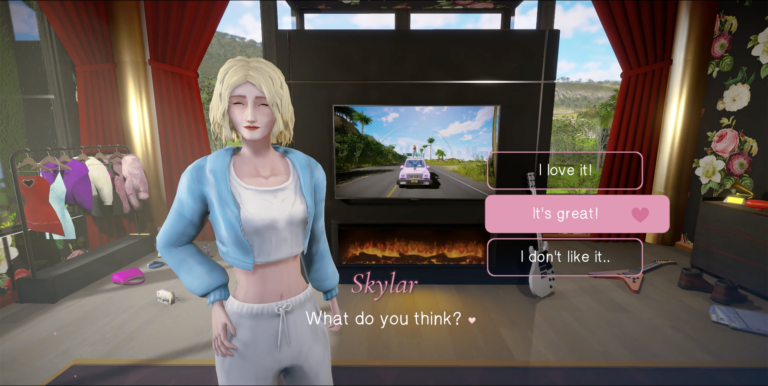
You play as Gabe — the “largely invisible boyfriend” of Skylar Maxine, an A-list pop icon who, years before she was a star, was simply the girl Gabe fell for at 12. Sweetheart is described as a “dating/breakup/existential crisis simulator,” but that framing understates what the game structurally asks of the player. When Gabe decides he can no longer stay in the relationship, the Hollywood Hills mansion the couple shares begins to warp — shifting rooms, ruined memories bleeding into the architecture, and liminal spaces opening between the real and the psychological. Skylar herself mutates into a spider-like creature that stalks Gabe through the labyrinthine ruins of what their life together used to be.
Players navigate that collapsing space in first person, with haptic feedback on controllers transmitting every cautious step as physical sensation. The game’s original soundtrack consists of Skylar Maxine’s in-universe pop discography — the music of the celebrity, playing as the texture of the horror. Multiple endings await, shaped by a dialogue-heavy structure and over three hours of narrative content spanning comedy, body horror, and coming-of-age tragedy.
Genie Boy Games is a Los Angeles-based studio helmed by Ben Escobar, a filmmaker who spent a decade in film before translating that work into interactive narrative. The studio’s founding thesis — “Playing video games is how we learned to tell stories” — shaped T.W.I.R.L., the studio’s debut horror game. T.W.I.R.L. on Steam ratings show 83% positive reviews from players since the game launched August 19, 2026, for $5.99. The Outerhaven T.W.I.R.L. empathy review described it as an “empathy machine” in the Roger Ebert sense — placing players inside a perspective rather than asking them to observe one. That game — a P.T.-inspired loop through a 2006 childhood home, following a boy carrying a secret he was told never to share — covered territory related to Sweetheart’s: shame, identity formation, and the psychological weight of things kept hidden. Sweetheart scales that ambition considerably.
Escobar’s Sweetheart announcement statement addressed the game’s cultural scope directly. “It’s hard not to want to be like the perfect couples we see on TV,” he said in the announcement press release. “Sweetheart shapeshifts these thoughts into a surreal tragedy that examines the early 2000s era as major networks turned children into stars, and the intense fallout of humanity it may have left in its wake. Between the horror and comedic elements lies an authentic, meaningful tale revolving around the stigma of mental illness, the gray areas of dependent identities, and ultimately overcoming abuse in a relationship.”
That is a substantial brief. It is also a documented reality.
The early-2000s entertainment machine that Sweetheart targets was not metaphorically harmful to the children it manufactured into stars — it was specifically and documentably harmful. The 2024 Investigation Discovery docuseries Quiet on Set: The Dark Side of Kids TV spent five episodes establishing the abuse at Nickelodeon’s most-watched shows of that era, including the sexual abuse of a 15-year-old actor by dialogue coach Brian Peck. The Brian Peck conviction details are documented: he was sentenced to 16 months in prison. The series earned Primetime Emmy nominations. Former child star Cole Sprouse stated fame’s psychological cost in a widely shared interview: “Fame is a trauma.” Alyson Stoner, a Disney Channel mainstay of the same era, described her childhood on set as harrowing in Stoner’s Toddler to Trainwreck essay.
Skylar Maxine is not any one of these people. She is an amalgam — described in Sweetheart’s Skylar Maxine character description as “equal parts Hannah Montana and Marilyn Monroe” — and as a composite, she is more useful than a direct portrait would be. The game is not interested in relitigating a specific celebrity’s public breakdown. It is interested in what that breakdown looks like from inside the relationship of someone who watched it happen up close over 15 years. Gabe is not a biographer or a tabloid reader. He lived there.
The spider-monster is not incidental. Body horror’s core function in feminist film theory — as developed by Barbara Creed in The Monstrous-Feminine: Film, Feminism, Psychoanalysis and grounded in Julia Kristeva’s theory of abjection — is to externalize internal psychological states as physical transformation. The genre consistently encodes what culture cannot say plainly: that femininity, when it escapes the container that structure built for it, becomes monstrous in the eyes of those the structure served. When Skylar loses Gabe — and specifically when she faces the shattering of a relationship that appears to have functioned as an identity anchor — she does not mourn. She mutates.
This matters because it is not arbitrary. Psychological research on what clinicians call “codependency” — a construct describing relationships in which one person’s identity becomes organized entirely around another, so that the relationship’s end registers not as a loss but as an annihilation — maps closely onto Skylar’s fictional trajectory. Escobar names this directly in his design statement: “the gray areas of dependent identities.” The spider is what that gray area looks like when it has nowhere left to go.
The CHI ’26 paper that grounds Sweetheart‘s design most cleanly interviewed players of psychological horror games including Alan Wake 2 and Senua’s Saga: Hellblade II, finding that player reflection on real-world mental health was most likely to emerge when the game’s mechanics allowed players to experience characters’ mental states through gameplay — not merely witness them. The CHI 2026 horror game research named embodiment as the key variable: whether the player was inside the character’s perspective, translating the character’s fear, shame, or grief into physical action, or whether they were observing from outside.
Sweetheart is built for the inside. First-person camera. Haptic feedback that makes Gabe’s nervousness tactile. A shifting physical environment that externalizes his psychological state rather than narrating it. An in-universe pop soundtrack that recontextualizes Skylar’s glamour as something players must navigate while fleeing her. The game is not going to tell players that toxic relationships are harmful. It is going to make them feel what it costs to leave one, room by room.
Sweetheart carries explicit mature content warnings that are worth taking seriously rather than treating as fine print: strong language, emotional and psychological abuse, references to suicidal ideation and self-harm, violence, blood, body horror, and suicide. Sweetheart’s Steam mature content warnings document all of this explicitly. Genie Boy Games has been transparent about this, framing the mature themes as structural to the story’s examination of abuse and mental health — not as shock value. The content warnings are not a liability hedge. They are a description of what the game is about.
A reader who has lived through a relationship that matches any part of Skylar and Gabe’s dynamic — fifteen years, a shared hometown left behind, identities that formed inside rather than alongside the relationship — should go in with full awareness of what they are walking into. The game appears designed to be worth that encounter. Whether it delivers on that ambition will only be known when it ships.
Sweetheart will launch in 2027 for Windows PC, macOS, and Linux via Steam, as well as PlayStation 5, Xbox Series X|S, and Nintendo Switch. The Sweetheart Steam wishlist page is live now.
Sweetheart’s minimum system requirements are modest — an Intel Core i5-4460 or AMD equivalent, 8GB of RAM, and an NVIDIA GTX 960 — a deliberate choice consistent with the retro visual aesthetic Genie Boy Games developed for T.W.I.R.L. The game will feature full controller support with haptic feedback, motion capture, and voice acting throughout its 3-plus hours of narrative.
The game is described as a first-person walking simulator and survival horror hybrid, which places it closer to P.T. and Mouthwashing than to jump-scare-driven games. The horror appears to operate through environmental transformation — rooms that shift and warp as memories bleed into the physical space — and through Skylar’s spider-like form hunting Gabe through increasingly surreal architecture. Genie Boy Games’ prior title T.W.I.R.L. also used T.W.I.R.L.’s P.T.-inspired Steam page as a reference point — P.T.-inspired looping corridors and haptic feedback — and earned praise specifically for its psychological dread rather than conventional scares.
Research published at the 2026 CHI horror game research found that psychological horror games generate genuine mental health reflection most effectively when their mechanics allow players to experience the character’s psychological state directly — rather than observe it from outside. Sweetheart‘s first-person design, haptic feedback, and environmental embodiment of Gabe’s emotional experience are precisely the mechanics the research identified as effective. The studio explicitly states that “overcoming abuse in a relationship” is among the game’s central themes, and Escobar has described the game’s ambition as producing “an authentic, meaningful tale revolving around the stigma of mental illness.” Whether the execution delivers is not yet verifiable, but the design intention is grounded in more than generic horror premises.
The record is extensive and documented. The Quiet on Set Nickelodeon documentary documented abuse of child actors at Nickelodeon spanning two decades, including the conviction of a Nickelodeon dialogue coach on charges of lewd acts with a minor. More broadly, former child stars from Disney Channel and Nickelodeon have publicly described the lasting psychological harm of the era: eating disorders, substance abuse, anxiety, and identity crises traceable to the structural conditions under which they worked as minors. Cole Sprouse said it directly: “Fame is a trauma.” Sweetheart’s Skylar Maxine is not a documentary portrait of any one person. She is the fictional space in which that structural harm is made playable.
T.W.I.R.L. is Genie Boy Games’ debut horror game, released August 19, 2026, on Steam for $5.99. It follows a nine-year-old boy performing a secret late-night ritual through a 2006 childhood home, using P.T.-inspired looping corridors and haptic feedback to make the player experience his shame and concealment as physical tension. It earned Very Positive reviews from 83% of Steam user reviewers. Outerhaven’s T.W.I.R.L. review findings described it as an “empathy machine” in the Roger Ebert sense — placing players inside a perspective rather than asking them to observe one. Sweetheart extends that approach from a single child’s secret to the full architecture of a 15-year relationship’s collapse.