HomeAuto Wall Street Enters September With 57% Hike Odds, $90 Oil, and Double-Digit Gains
Wall Street Enters September With 57% Hike Odds, $90 Oil, and Double-Digit Gains
September 1, 2026:
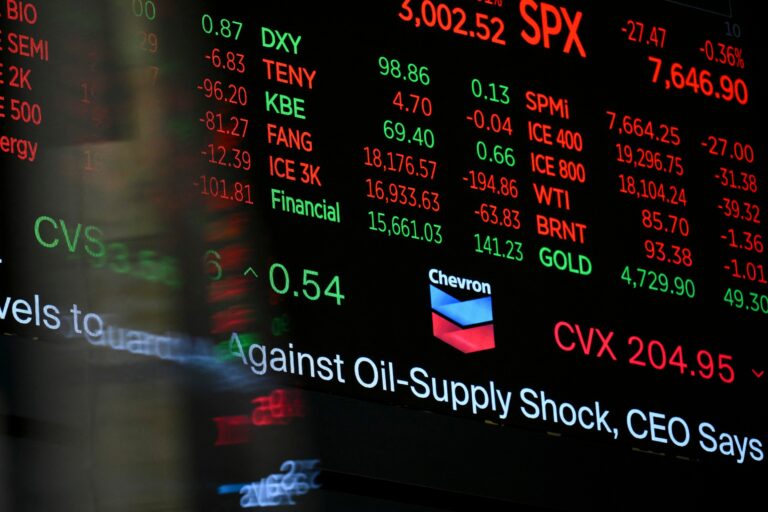
A Chevron signage is displayed on a digital screen at the New York Stock Exchange (NYSE) during morning trading on August 24, 2026 in New York City. ANGELA WEISS/AFP via Getty Images
Wall Street closed out August with double-digit year-to-date gains and a biotech breakthrough that rewrote investor expectations for an entire disease category — then walked into September carrying a convergence of headwinds that made Tuesday’s cautious open feel inevitable. Federal Reserve Chair Kevin Warsh’s Jackson Hole speech on August 28 pushed September rate-hike odds above 57%, Middle East hostilities re-escalated over the weekend sending crude oil back toward $90 per barrel, and September began its September 1 market open under the weight of what 75 years of market data call the calendar’s most reliably difficult month. For variable-rate borrowers — the holders of credit cards, home equity lines of credit, and adjustable-rate mortgages — the September 16 Federal Open Market Committee decision is now a live event that could raise their costs within days of a vote.
The Dow Jones Industrial Average shed 374 points, or 0.7%, to close at 53,185.90, with the majority of its 30 components finishing in negative territory. The Nasdaq Composite slipped 0.1% to 26,370.89, while the S&P 500 declined 0.3% to settle at 7,686.14. Dow futures had foreshadowed the weakness before the open, with contracts off approximately 0.5%, S&P 500 futures down roughly 0.6%, and Nasdaq-100 contracts falling about 1% before Tuesday’s bell.
Despite Tuesday’s stumble, the picture for August remains constructive. The S&P 500 advanced 2.6% over the month, while the Nasdaq Composite rose 3.9%, according to August 2026 LSEG performance data.
Warsh’s Three Weeks of September: What Variable-Rate Borrowers Face Before the Vote
The dominant force weighing on investor sentiment at the start of September is the Federal Reserve — specifically, the hawkish address Warsh delivered at the annual Jackson Hole Economic Policy Symposium in Wyoming on August 28. Warsh reaffirmed the Fed’s commitment to its 2% PCE inflation target and stated plainly that elevated prices remain the central bank’s primary focus. His most market-moving language came in a single conditional: “We must be confident that underlying inflation is moving to our objective, clearly and at sufficient speed. Otherwise, we have work to do.” Traders and economists interpreted “sufficient speed” as the clearest public signal yet that a rate hike before year-end is not hypothetical, as documented in Warsh’s Jackson Hole keynote remarks. By midday on August 28, September hike odds on CME FedWatch had jumped from roughly 35% before the speech to more than 55%. As of Tuesday’s open, those odds sat at approximately 57–60%, according to the CME FedWatch September hike probability tracker.
For anyone carrying a variable-rate balance, the math is direct. The prime rate currently sits at 6.75%, according to the Federal Reserve H.15 Selected Interest Rates, and a 25-basis-point September hike would push it to 7.00% within days of the September 16 vote. For a credit card at the US average APR — roughly prime plus 15 percentage points — every $10,000 in outstanding balance would cost approximately $25 more per year after a single quarter-point increase. A $100,000 home equity line of credit would add roughly $250 per year.
The bond market’s response to the Jackson Hole speech carried a second, less-discussed signal: the 30-year Treasury yield was roughly flat or down slightly after Warsh’s hawkish address, while the 2-year yield climbed sharply to approximately 4.30%, a pattern confirmed by Treasury yields after Jackson Hole. That divergence — short rates up, long rates roughly flat — is what bond professionals call a flattening. It is not a technical abstraction. It means the market interpreted a September hike as likely to restore the Fed’s inflation-fighting credibility over the long run, reducing the risk premium investors demand to hold 30-year bonds. The practical implication: fixed-rate mortgages may not worsen as dramatically as a hawkish headline suggests. The 30-year fixed mortgage averaged 6.66% as of August 27, according to the Freddie Mac mortgage rate survey. It may not rise significantly if the 30-year Treasury holds near current levels — because the bond market has already priced in the credibility effect of the hike itself.
Warsh’s stance places the Fed in pointed conflict with the White House. President Trump has repeatedly and publicly called for lower rates. At Jackson Hole, Warsh explicitly walked back any suggestion that AI-driven productivity gains or balance sheet reductions warrant easier policy, as detailed in Warsh’s six monetary policy principles. He stated that his newly formed task force on AI, productivity, and jobs — co-led by venture capitalist Marc Andreessen, Stanford economist Charles Jones, and Microsoft executive Asha Sharma — will have no bearing on current rate-setting.
Deutsche Bank noted that the speech “surprised us in its specificity about the economy and outlook and with its lean in a decidedly hawkish direction,” and maintained its forecast for two rate hikes totaling 50 basis points in 2026, per the Deutsche Bank’s Jackson Hole analyst roundup. Nomura flagged that “the sensitivity to near-term inflation data is high,” signaling that the upcoming data calendar carries outsized weight.
What September’s Data Calendar Will Decide
Investors face a week of economic releases that could materially shift September rate-hike expectations in either direction. Tuesday’s Job Openings and Labor Turnover Survey (JOLTS) for July kicks off the sequence, followed by ISM and S&P Global manufacturing surveys. August CPI is expected around September 10. These data points are all listed on the September economic data calendar.
But the decisive moment is Friday’s August nonfarm payrolls report — the last major data release before the September 16 FOMC decision. The Dow Jones consensus forecast calls for roughly 53,000 jobs added in August, with the unemployment rate holding at 4.1%. Other forecasters are more cautious: Barclays expects approximately 25,000 new payrolls, per a Barclays’ 25,000-job August forecast cited by Kiplinger — strikingly weak. The range of estimates spans 25,000 to 58,000, a gap wide enough to shift rate-hike odds by ten percentage points or more.
One structural constraint on Warsh’s room to maneuver: July’s payrolls came in at negative 23,000, a surprise contraction. Bloomberg Economics’ Anna Wong observed on August 29 that “there is no modern Fed era precedent of Fed hiking after two negative payrolls prints,” as noted in the Anna Wong payrolls precedent tweet republished in full by ZeroHedge. A weak August number — particularly if it prints negative again — could make a September hike politically and institutionally untenable even for a Fed chair who signaled one was coming.
Adam Turnquist, chief technical strategist at LPL Financial, noted that September has historically reached its intramonth high around the 11th trading day — which would fall near September 12 or 13 this year — before weakening into month-end, as detailed in an LPL Financial September seasonal analysis. The September 16 FOMC meeting therefore lands near the calendar’s historical inflection point. A hike confirmed by strong jobs data could amplify the historical seasonal weakness; a hold could provide an unexpected tailwind.
Earnings season continues at a modest pace this week, with results expected from Dell Technologies and Palo Alto Networks, offering a window into enterprise technology demand and cloud spending trends.
Geopolitical Sparks Send Oil Higher
Compounding the Fed-related anxiety on Tuesday was a re-escalation of Middle East hostilities over the weekend. The United States carried out strikes on an Iranian island in the Strait of Hormuz on Sunday, and Tehran retaliated quickly by attacking US military targets in the region, according to an AFP report on Iran strikes confirmed by Yahoo Finance. President Trump told reporters Monday: “We’re going to hit them hard. There will be a response.” Brent crude futures traded near $90 per barrel by Tuesday morning — a level that, if sustained, adds to the inflationary pressure Warsh cited as the primary justification for his hawkish posture.
Energy stocks were among the session’s few outperformers. The energy sector had already surged approximately 6.9% in August alone, bringing its cumulative gain since June to more than 20%, according to energy sector August performance data from LSEG.
European markets also registered the pressure. The regional Stoxx 600 index fell in mid-morning European trade, though energy and oil stocks on that index bucked the trend.
August’s Star: What Moderna’s Historic Surge Actually Means
While September opened with caution, August’s defining story was Moderna’s 176.97% single-session gain on August 19 — the largest single-day advance in the company’s history, and one of the most dramatic single-day moves for any large-cap stock in recent years, as covered by BioPharma Dive’s Moderna analysis. The company’s market capitalization jumped from approximately $25 billion to roughly $69 billion in a single session.
The catalyst was substantive: on August 19, Moderna and Merck announced that their personalized mRNA cancer vaccine, intismeran autogene, had met both its primary endpoint of recurrence-free survival and a key secondary endpoint of distant metastasis-free survival in INTerpath-001, a randomized, double-blind Phase 3 trial enrolling 1,137 patients with high-risk resected melanoma, per the Moderna Merck Phase 3 announcement. It is the first positive Phase 3 result for any individualized neoantigen therapy and for any mRNA-based cancer treatment.
The day after, Moderna’s stock pulled back approximately 20% as investors took profits and reassessed the valuation. The stock closed August up roughly 150% from its July levels — still among the S&P 500’s best single-month performances in years. For the month, that gain cemented Moderna’s position as the index’s top performer in August by a wide margin.
Why such a violent repricing? Moderna entered the announcement carrying serious pipeline overhangs, including a $950 million patent litigation settlement paid in July 2026 and a norovirus program that failed its Phase 3 interim bar. Investors had heavily shorted the stock, with short interest estimated at approximately 13.5% of the free float. When the Phase 3 result confirmed that the mRNA platform can be directed against individual patients’ tumors at clinical scale, short sellers were forced to cover — amplifying the underlying price move.
The commercial implications are substantial but not yet resolved. William Blair analyst Myles Minter projected that Moderna’s 50% revenue share on intismeran could yield peak annual melanoma sales of $5.4 billion, though that estimate is speculative until pricing, insurance coverage, and market-access decisions are made, per BioPharma Dive’s Moderna analyst projections. The cost of the pembrolizumab component of the regimen alone — which carries a Keytruda 400mg list price of approximately $24,544 per dose — makes the full combination one of the most expensive adjuvant regimens in oncology. Adding bespoke per-patient mRNA manufacturing will increase that cost further. Neither Merck nor Moderna has announced a price for intismeran. According to Moderna intismeran regulatory filing plans, analysts estimate potential US FDA approval as early as mid-2027.
For Merck, the timing carries strategic weight beyond melanoma. Keytruda — pembrolizumab — faces the loss of key patents later this decade. An approved adjuvant combination with intismeran, requiring both drugs together, extends the franchise’s clinical differentiation and potentially delays the margin pressure that biosimilar competition will otherwise bring. Q2 2026 Keytruda sales reached $8.4 billion, up 4% year over year.
Roche and BioNTech are also developing personalized mRNA cancer vaccines with similar mechanisms, underscoring a broader wave of investment in oncology mRNA applications. Whether intismeran works as effectively in cancer types with lower tumor mutational burden — pancreatic, colorectal, gastric — than it does in the UV-damage-rich environment of melanoma remains the field’s defining open question.
Software’s Comeback: Why IGV’s Best Month in Years Still Faces September Headwinds
Beyond Moderna, August was defined by a broad and meaningful recovery in the software sector — a corner of the market that had sold off sharply in the first half of 2026.
The S&P 500 Software and Services industry group surged 13.1% in August, according to software sector August 2026 performance data from LSEG, building on a momentum shift that began in June. For the third quarter so far, the group is up approximately 27–28% — a striking reversal of the roughly 20% decline the sector posted in the first six months of the year. The iShares Expanded Tech-Software ETF (IGV) surged more than 16% in the month, while the iShares Semiconductor ETF (SOXX) finished up only about 1% — a divergence that extended sharply in the final two weeks of August as chipmakers gave back earlier gains while software kept climbing.
The Atlassian (TEAM) shares nearly doubled in August — their best month on record. Palantir Technologies rose more than 50%. Salesforce surged roughly 40%, its best August in recent memory, following a quarterly earnings report that showed revenue up 11% year over year to $11.35 billion — exceeding analyst estimates — and adjusted earnings per share of $5.90, per the Salesforce Q2 2026 earnings report. Salesforce CEO Marc Benioff responded directly to fears that generative AI would cannibalize enterprise software revenue: “This is not the SaaSpocalypse. We’ve been hearing about this for two quarters, these dire predictions about the end of software, but none of them have come true for us.”
All 13 software companies within the S&P 500 that reported results in August exceeded earnings expectations, with an average beat of 10%, according to NAI500 software sector valuation analysis citing Morgan Stanley analysis published August 20. The S&P 500’s forward price-to-earnings ratio declined to roughly 19.7 from approximately 22.2 at year-end 2025, as earnings estimates have risen faster than share prices — a configuration analysts characterize as earnings-driven, rather than multiple-expansion, in nature.
History offers a cautionary note specific to software’s August surge. Analysis of the 12 strongest prior August rallies in software found that the sector historically held up through approximately September 15, with a median gain of about 1%, before weakening meaningfully through month-end. Semiconductors, in that same historical pattern, were already down roughly 1% by September 15, then slid another 3.5% through month-end. Twelve observations make a small sample, but the direction aligns with the broader September seasonal pattern.
Nvidia, the world’s largest company by market capitalization, gained 8.6% in August following strong quarterly results, extending the semiconductor sector’s 2026 run. The PHLX Semiconductor Index is now up approximately 63% for the year.
In total, 23 stocks in the S&P 500 posted gains of 20% or more in August, and approximately 86 companies recorded gains of at least 10%, according to LSEG data published by Memesita.
Why Is September Historically Bad for Stocks?
September is the only calendar month that carries a negative average return across nearly all long-run data sets. Since 1950, the S&P 500 has declined an average of 0.6% in September and posted positive returns in only 45% of those years, according to LPL Financial’s LPL Financial September seasonal analysis. Over the past decade, the data is harsher: the S&P 500 ETF (SPY) has averaged a decline of approximately 1.6% in September, with a 50% win rate, according to September SPY seasonality 10-year data from Seeking Alpha. The weakness has historically concentrated in the month’s second half, after a tendency to hold or edge modestly higher through September 11–13.
Several theories exist for the pattern — institutional portfolio rebalancing, managers returning from August vacations, tax-loss harvesting — though none has been definitively established as causal. What is established: the combination of seasonal weakness, above-57% Fed hike odds, and Middle East energy risk creates a backdrop that raises the potential cost of any negative catalyst that emerges in the next three weeks.
Payrolls Friday, CPI September 10, FOMC September 16: Three Dates That Settle September
Markets face a loaded data week that could materially shift expectations in either direction before September 16.
The JOLTS report on Tuesday — covering July job openings — will be read for signals on labor market tightness. ISM and S&P Global manufacturing surveys will follow through Wednesday. August CPI is expected around September 10. And Friday’s August employment report, scheduled for release at 8:30 a.m. ET on September 4, will effectively serve as the deciding vote on whether the Fed hikes in September.
If payrolls print near the Dow Jones consensus of approximately 53,000, the case for a hike remains intact. If they print near Barclays’ estimate of 25,000, or if a second consecutive negative print materializes, Bloomberg Economics’ Anna Wong’s observation carries weight: no modern Fed chair has hiked after two consecutive negative payrolls prints.
Warsh has made clear he will not pre-announce what data would move the needle. His closing words at Jackson Hole function as the clearest available summary: a commitment to the discipline of fighting inflation, not to any particular decision about when or by how much.
For investors, the September setup is not uniformly bearish. Software sector valuations remain below their 10-year average price-to-earnings multiple, according to analysis from NAI500 and Morgan Stanley. The Salesforce forward price-to-earnings ratio near 14 times — well below its 10-year average of roughly 43 times — may represent an earnings-driven valuation opportunity regardless of what the Fed does. And if the September hike, should it come, confirms the flattening signal the bond market sent after Jackson Hole, long-duration assets including fixed-rate real estate may weather the month better than the headline rate-hike narrative suggests.
The underlying picture — double-digit year-to-date gains for major indices, rising earnings estimates, a software sector in structural recovery, and the mRNA cancer vaccine platform now proven at Phase 3 scale — offers the context for what has remained a resilient, if volatile, market in 2026. Whether September adds to that record or breaks from it will be decided largely in the next four trading days.
Frequently Asked Questions
Will the Fed actually raise interest rates on September 16, 2026?
As of Tuesday’s trading, CME FedWatch placed the probability of a September hike at approximately 57–60%, up sharply from roughly 35% before Warsh’s Jackson Hole speech on August 28. That makes a hike slightly more likely than a hold — but the decisive variable is Friday’s August payrolls report. Bloomberg Economics has noted there is no modern Fed precedent for hiking after two consecutive negative payrolls prints, and July’s report already came in at negative 23,000. If August is also negative, or significantly below expectations, the calculus shifts rapidly toward a hold.
Why is September historically the worst month for the stock market?
Since 1950, the S&P 500 has declined an average of 0.6% in September and finished higher in only 45% of those years — the weakest record of any calendar month by both measures, according to LPL Financial data. The exact causes are debated: institutional portfolio rebalancing after August’s thin-volume summer, managers returning from vacation with fresh sell orders, and tax-loss harvesting are the most common explanations — though none is definitively proven as causal. What is well established is that the weakness tends to concentrate in September’s second half, and that the September 16 FOMC meeting date falls near the historical intramonth high.
How does Moderna’s cancer vaccine breakthrough affect patients today?
The August 19 announcement confirmed that intismeran autogene, Moderna and Merck’s personalized mRNA cancer vaccine, met both its primary and key secondary endpoints in a 1,137-patient Phase 3 trial for high-risk resected melanoma — the first such win for any individualized neoantigen therapy. The companies have said they will engage with regulators globally on filing submissions; with Breakthrough Therapy Designation already in place from the FDA, expedited US review is available. Analysts estimate potential FDA approval as early as mid-2027, pending the full data presentation. Pricing has not been announced, but the pembrolizumab component alone carries a list price of roughly $24,544 per dose — making affordability and insurance coverage key unknowns for patient access.
What should variable-rate borrowers do before September 16?
A September hike would push the prime rate from 6.75% to 7.00% within days of the vote, directly raising costs on any variable-rate balance — credit cards, home equity lines of credit (HELOCs), and adjustable-rate mortgages past their initial fixed period. If you are carrying a significant variable-rate balance and have the ability to lock in a fixed-rate alternative — a balance-transfer card, a fixed personal loan, or a HELOC-to-fixed-rate refinance — the next two weeks represent the last window before a potential rate increase takes effect. Fixed-rate mortgage shoppers, however, face a different signal: the 30-year Treasury yield was roughly flat or down slightly after the hawkish Jackson Hole speech, and the 30-year fixed mortgage rate may not worsen significantly even if the Fed hikes on September 16, because the bond market has already priced in the credibility benefit of that hike over the long run.