HomeAuto Flying Carpets and Folklore PhDs: 1001 Threads of Mizan Is Not Like Other Debuts
Flying Carpets and Folklore PhDs: 1001 Threads of Mizan Is Not Like Other Debuts
September 1, 2026:
Mbcgamestudio.com
With the Gamescom 2026 show floor now closed, the dust has settled on one of the week’s most unexpected conversations: 1001 Threads of Mizan, the debut title from MBC Game Studio, is the first AAA co-op action-adventure ever built from the ground up around the mythology of One Thousand and One Nights — and the hands-on critics who played the pre-alpha demo largely impressed critics. The game was revealed at Opening Night Live on August 25 and playable on the show floor through August 30, drawing attention not only for its flying carpet combat system but for something that has rarely been said about a new studio’s debut: its folklore research team includes a UCLA professor who was literally teaching university courses on One Thousand and One Nights when MBC Game Studio recruited him, and a head of folklore with a master’s degree from UC Berkeley who is embedded in the game development team.
That is not a side note. For a genre defined by European mythology, Norse fantasy, and Japanese folklore, a AAA studio deploying the same institutional rigor around Arabic storytelling that a university literature department would represent something genuinely new in how the industry treats non-Western source material.
What MBC Game Studio Is, and Who Is Behind It
MBC Game Studio is a newly formed developer backed by Saudi Arabia’s MBC Group, which is majority-owned by PIF (54%), Saudi Arabia’s sovereign wealth fund. The gaming community has not been uniformly welcoming of PIF-backed studios — the fund’s investments in entertainment are widely discussed as “sportswashing” by critics, and gaming forums responded with a split between enthusiasm for the setting and skepticism about the ownership chain. That context matters, and it will not be papered over here: PIF is Saudi Arabia’s primary vehicle for international investment and is chaired by Crown Prince Mohammed bin Salman, whose government has been documented for human rights violations.
What can be said separately, and fairly, is that the studio MBC has built around this game is a genuinely international operation. The leadership team — CEO Daniel Engelhardt (formerly of Lionsgate Games), COO Trevor Williams, Creative Director Lars Bonde, and Game Director Scott Lussier — recruited from BioWare, Bungie, Hi-Rez, Ubisoft Montréal, and others, and assembled a team from 18 different countries. Engelhardt confirmed the studio used Unreal Engine and has a policy against generative AI in the game’s development.
The studio launched in 2023 and spent its first year in quiet development, building what it calls a “publishing-in-house” model where the development and marketing teams work in close parallel rather than as separate functions — an unusual structural choice for a debut studio that reflects lessons learned from IP adaptations that typically go wrong when developers and publishers operate in silos.
What the Story Is Actually About
The premise of 1001 Threads of Mizan is worth spelling out clearly, because the game does something more considered than simply transplanting heroes into an “Arabian Nights” aesthetic. The world of Mizan was once a shared civilization built by both humans and jinn — supernatural beings from Islamic and pre-Islamic Arabian tradition, inhabiting a parallel realm, neither simply good nor evil. The literary collection itself spans centuries of oral and written transmission. The two civilizations built “Mizancraft,” a technology that blurred the line between human ingenuity and jinn flame. When war and betrayal split the worlds apart, the jinn were driven out of the human realm by the human king who once called the jinn king brother.
Now, the exiled Jinn King — consumed by vengeance — is thinning the barrier between realms and unleashing lesser jinn into the physical world. Three unlikely heroes are summoned by Shahrazad, the legendary storyweaver of One Thousand and One Nights herself: Yusra, the Relic Hunter, a semi-ranged fighter whose magic longbow does its best work at distance; Malik, the Warrior, a close-range tank who absorbs punishment and returns it at close quarters; and Sufyan, the Pirate, whose agile swordwork and area-sweeping whip blade made him the immediate critic favorite in most hands-on reviews. Their job is to rediscover the lost power of the Mizan before the Jinn King can tear the worlds apart.
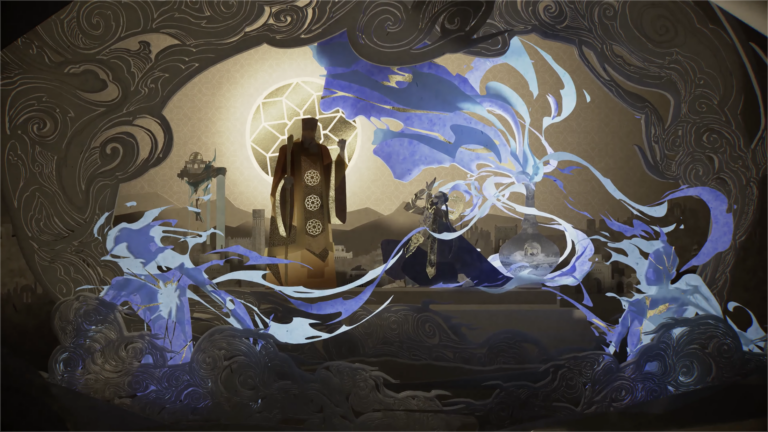
The tone is not horror or grim fantasy — it is the warm, myth-drenched register of grand Arabic oral storytelling, filtered through the voice of Shahrazad herself, who narrates the world-building rather than leaving it to expository dialogue between characters. The analogy Engelhardt used to describe the opening is revealing: he compared the initial trailer narration to “the start of a Disney ride” in terms of its capacity to create immediate imaginative immersion. The visual design leans heavily into Islamic Golden Age architecture, vast desert landscapes, and the kind of scale that makes colossal jinn creatures feel genuinely imposing rather than merely large.
The central dramatic question is not who will win — it is whether the breach between worlds can be healed rather than simply sealed. That is the kind of question that comes from literary historians who know what the mythology is actually about, not from game designers who Googled “Arabian Nights aesthetic.”
How the Flying Carpet System Actually Works
The flying carpet is not a power-up, a limited ability, or a zone-specific mechanic. It is, as one preview put it, as fundamental to movement as walking in 1001 Threads of Mizan. Summoned with a single button press at any time, the carpet transitions players from ground to air seamlessly, changing the dimensional footprint of combat from two-dimensional positioning to full three-dimensional maneuvering.
The design decision that makes this work is that aerial combat and ground combat are equally effective. Players deal the same damage, execute the same combos, and apply the same pressure on enemies whether they are standing on the ground or soaring thirty meters above the battlefield. This rules out the most common failure mode for games with a flight mechanic: the situation where flight is only useful for traversal and players return to ground for all meaningful combat because the air is tactically inert.
In the boss fights, the carpet becomes the entire design language. Reviewers who played the Gamescom demo encountered two boss battles in the playable slice. The primary boss, the colossal Jinn Nazjush, required players to attack its armored surface while avoiding objects hurled at them — a process that demanded constant aerial repositioning, diving to strike its 11 exposed eyes, then retreating via carpet before the damage phase ended. The verticality transforms what is abstractly “standard boss fight stuff” into something with different spatial dynamics, because the threat space extends above and around the player rather than only in front of them.
Game Director Scott Lussier cited Destiny’s raid bosses as a north star for complexity — the target level of coordination the studio wants its harder boss fights to require. But where Destiny raids require six players operating a coordinated machinery, 1001 Threads of Mizan caps at three, which means the coordination load per player is higher and the fights are designed to remain meaningful in solo play. Lussier noted that at higher difficulty settings, the game may withhold visual guidance cues — such as the indicator flagging Nazjush’s eyes as the target during the damage phase — forcing players to read the encounter themselves.
What Critics Actually Said: Strengths and Genuine Rough Edges
The carpet combat drew near-universal praise. The ground combat drew more varied responses.
GameSpot’s Phil Owen described the overall experience as something that borrows from Borderlands in its three-hero structure, from Shadow of the Colossus and Destiny’s raids for its boss design, and from Final Fantasy’s “magical technology” aesthetic — but puts those pieces together in a way that does not feel like any of them, primarily because of the carpet. PCGamesN’s Tom Hopkins called the carpet boss fights the game’s standout element, describing the experience of circling a colossal creature on a flying carpet, picking attack windows between projectile barrages, as genuinely distinctive.
The criticisms are specific and worth naming clearly:
Yusra’s balance needs work. As the ranged character, her magic longbow defines her archetype — but the pre-alpha build left her melee attacks significantly underpowered relative to Sufyan and Malik. At the combat pace of the demo, players frequently fell back on melee regardless of character, which makes Yusra feel like a liability rather than a tactical option in mixed encounters.
The dodge mechanics need tightening. AllKeyShop’s Daniel Burrows called evasion “unintuitive and less effective,” reporting that unresponsive dodge controls caused unnecessary damage throughout the preview session. This is the most significant systemic issue in the pre-alpha, because a combat system built around aerial repositioning requires evasion to feel tight.
The boss arenas look like a different game. PCGamesN noted that the boss battle arenas are visually noticeably lower quality than the open-world environments — filled with sand plumes and visual noise that obscure the level of detail present elsewhere.
Story pacing was slow. AllKeyShop found the story presentation pacing sluggish, though this is the most forgivable note given that the demo was pre-alpha and was likely not representing the final narrative flow.
All four criticisms are development-stage notes. None touches the core design decisions: the carpet system’s integration into boss combat, the hero trio structure, or the cultural authenticity infrastructure. The studio has time. What it showed at Gamescom was not a finished game; it was evidence of a design direction that has a legitimate basis for the ambitions it claims.
Why the Scholarly Infrastructure Is the Story
The single most distinctive thing about 1001 Threads of Mizan is not the flying carpet, though the carpet is what players will remember first. It is that among the studio’s earliest hires were a UCLA literature professor who was actively teaching university courses on One Thousand and One Nights when MBC Game Studio recruited him, and a folklore expert whose graduate work at UC Berkeley focused on the region’s literary traditions. The studio’s CEO confirmed that literary historians are ingrained in development from the studio’s founding — not added later for credibility.
These are not external consultants brought in to rubber-stamp design decisions. They are embedded in the team, shaping mechanics, world-building, narrative, art direction, and more — present from the founding of the studio, not added later for credibility. The result of that embedding is visible in specific design choices: the choice not to adapt Aladdin, Sinbad, or Ali Baba (characters who came from Antoine Galland’s 18th-century French additions, not from Arabic manuscripts); the framing of One Thousand and One Nights not as a single story but as a living oral tradition to be drawn on broadly; and the use of Shahrazad as narrator rather than a character, preserving her role as the collection’s structural voice rather than reducing her to a quest-giver. These choices are documented in Gamescom coverage of the studio’s approach.
CEO Engelhardt framed the intent plainly: he told Variety the studio treated the source material as “a launching off pad, not just we’re only going to tell the story of ‘1,001 Arabian Nights,’ but it’s a chance to tap into Arabic folklore more broadly.” That orientation — treating the source material as a tradition to draw from rather than a brand to exploit — is what distinguishes this from the Orientalist aesthetic treatments that prior games have applied to the region.
Platforms, Release Window, and How to Follow the Game
1001 Threads of Mizan is planned for simultaneous launch on PlayStation 5, Xbox Series X|S, Nintendo Switch 2, Steam, and the Epic Games Store — a broad, platform-agnostic release strategy that reflects the studio’s stated commitment to treating this as a global game rather than a regional one. No official release date has been announced. The demo’s level of polish and the studio’s timeline (founded 2023, revealing in 2026 with a pre-alpha demo) makes a 2027 launch window plausible, though the studio has not confirmed this.
Players can sign up for updates and follow development at the official site.
On the PIF Question
The gaming community’s discomfort with PIF-backed studios is not irrational, and this review does not ask readers to set it aside. Saudi Arabia’s Public Investment Fund has committed approximately $37.7 billion in gaming industry investment as part of Crown Prince Mohammed bin Salman’s Vision 2030 economic diversification strategy. The human rights record of the Saudi government — documented by Freedom House, Human Rights Watch, and others — is a legitimate factor for consumers deciding which products to support.
What the game’s merits do not depend on is that context resolving cleanly. 1001 Threads of Mizan is made by a genuinely international team, drawing on a literary tradition that belongs to Arabic-speaking people worldwide, with a level of cultural seriousness that is unusual for the industry. Readers can assess both of those things simultaneously, and they should. The game is not diminished by the ownership chain; it is also not absolved of it.
Frequently Asked Questions
Is 1001 Threads of Mizan co-op only, or can it be played solo?
The game is built for one to three players, and solo is the baseline experience. The difficulty scales upward with additional players — more enemies appear and the coordination demands on each player increase — but the studio has stated explicitly that the narrative experience is designed to work as a genuine single-player game, not a co-op mode with solo play bolted on as an afterthought. Game Director Scott Lussier confirmed that solo is the baseline difficulty, with battles scaling in complexity as players are added.
How does the flying carpet work in combat, and is it required?
The carpet is always available, not locked behind a cooldown or limited resource. It transitions players from ground to air with a single button press and allows full combat from the air with equal effectiveness to ground combat. The boss fights in the Gamescom demo were designed specifically around carpet mobility — players circled colossal creatures aerially, striking exposed weak points from above while dodging projectiles. While ground combat is possible throughout, the carpet is integrated into the game’s core loop rather than being an optional feature.
Why did MBC Game Studio choose One Thousand and One Nights as its first IP?
CEO Daniel Engelhardt explained the choice as a search for mythology with global reach and untapped depth. The studio’s team noted that no prior AAA game had used One Thousand and One Nights as its primary cultural foundation — the Prince of Persia and Assassin’s Creed series drew on adjacent settings but not this specific literary tradition. The studio’s approach was to hire folklore experts and literary historians before most of the design team, embedding scholarly knowledge from founding rather than bringing in consultants after the game was already built.
What are the biggest concerns from the Gamescom hands-on preview?
The two most substantive critiques from multiple outlets are the dodge mechanics (described as unintuitive and unresponsive by AllKeyShop) and Yusra’s melee damage being underpowered relative to her archetype as a ranged fighter. Both are mechanical balance and input-feel issues that are addressable during development. Neither touches the game’s core design direction. The game carries a pre-alpha label, which means significant time remains before release. PCGamesN and AllKeyShop both noted balance and evasion as the primary areas requiring attention before launch.