HomeAuto Iceland Rejects EU Referendum Talks: Fishing Rights Defeat NATO Security Arguments
Iceland Rejects EU Referendum Talks: Fishing Rights Defeat NATO Security Arguments
August 30, 2026:
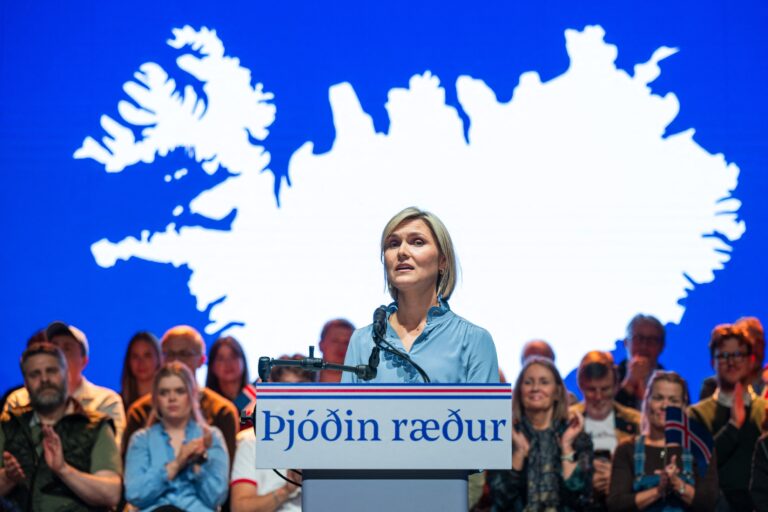
Iceland Prime Minister Kristrun Frostadottir participates in a listening session on the upcoming referendum on August 26, 2026 in Reykjavik, Iceland. Jonathan NACKSTRAND/AFP via Getty Images
In a vote that defied geopolitical logic, Iceland on Saturday chose its fishing industry over its mortgage rates, its kronar over the euro, and its 200-nautical-mile exclusive economic zone over a seat in the European Parliament. The result was 52.5% No to 47.5% Yes, closing, at least until 2028, one of the most consequential strategic questions in the North Atlantic: whether the nation straddling the GIUK gap would finally anchor itself to the European Union.
Iceland’s national broadcaster RÚV declared the No camp’s victory in the early hours of Sunday August 30, stating: “It is now clear that Iceland has voted to reject the resumption of accession talks with the European Union.” One of the country’s six constituencies was still confirming its final tally, but the arithmetic was no longer close enough to matter. Prime Minister Kristrún Frostadóttir — who had staked her government’s credibility on the vote and called it a “now or never” moment — acknowledged a narrow but decisive loss.
Why Iceland’s Geographic Position Made This Vote Matter Far Beyond Reykjavík
The island nation of roughly 390,000 people sits astride one of the most militarily significant stretches of ocean on Earth. The GIUK gap — the corridor of open water running between Greenland, Iceland, and the United Kingdom — is the route through which Russia’s Northern Fleet must transit to reach the North Atlantic open ocean.
NATO has described Iceland’s role in monitoring this chokepoint as essential to alliance situational awareness. When NATO’s Military Committee visited Iceland in June 2026, its deputy chair, Lt. Gen. Winston P. Brooks, called the country — and specifically its location at the heart of the GIUK gap — the “eyes and ears of NATO.” Iceland maintains four radar sites, a control center, and the Keflavík air base, where allied aircraft rotate to police Icelandic airspace.
Iceland is a founding NATO member — it signed the 1949 Washington Treaty — but has never maintained a standing military. Its security has been guaranteed primarily by a bilateral defense agreement with the United States signed in 1951. That arrangement has come under strain in the current geopolitical environment. U.S. President Donald Trump, who has repeatedly suggested the United States should acquire or control neighboring Greenland, confused Iceland with Greenland during his 2026 address at Davos — a slip that Icelandic officials treated as a signal that traditional American security guarantees could not be taken for granted.
Had Iceland’s referendum produced a Yes vote, Brussels would have gained formal institutional authority over a nation positioned at one of the alliance’s critical northern chokepoints — extending EU governance, defense cooperation frameworks, and information-security infrastructure into the subarctic North Atlantic for the first time. The No vote means NATO’s Keflavík infrastructure and the GIUK monitoring network remain outside EU jurisdiction. Iceland will continue to cooperate with the EU on security matters through non-membership channels, including the existing Iceland-EU security partnership, but it will do so as an observer rather than a participant.
What Was on the Ballot — and What Was Not
Saturday’s question was deliberately and legally narrow: “Should negotiations on Iceland’s membership in the European Union start again?” — Já (Yes) or Nei (No). Icelanders were not voting on EU membership itself. Under Icelandic law, any accession agreement that emerged from negotiations would have required a second referendum, potentially as early as 2028. The vote was really a decision about whether Iceland wanted to find out what a deal might look like.
That framing made the No result all the more significant. Even the prospect of opening a door was rejected. Iceland’s parliament formally approved the referendum in May 2026, after Frostadóttir — who leads a center-left coalition of the Social Democratic Alliance, the Liberal Reform Party, and the People’s Party — took office in December 2024 promising to put the question to a public vote.
The referendum was non-binding under Icelandic law, but Frostadóttir’s government had pledged to respect the outcome. It has now committed to not resuming accession negotiations for the remainder of its term, which runs to 2028. The government indicated it will also refer to parliament the question of whether to formally withdraw Iceland’s dormant EU membership application — submitted in 2009 and technically still active, though shelved in 2013 when a Eurosceptic coalition took power.
How Iceland’s Fishing Industry Vetoed the European Dream
In the small fishing town of Siglufjörður on Iceland’s north coast, anti-EU flags were raised across the community before the vote. In Grundarfjörður — a town of roughly 800 people — Arnar Kristjánsson, third-generation owner of G.RUN, the settlement’s largest employer, put the No camp’s case in simple terms: “The big companies in Europe will swallow up all these small companies, and for small towns like this, there will be no more fish production.”
Those fears were structural, not merely sentimental. Marine products account for roughly 40% of goods exports in Iceland. The fishing industry contributed approximately 8% of gross domestic product directly in 2024, and considerably more indirectly through processing, logistics, and coastal community employment.
The European Union’s Common Fisheries Policy — the regulatory framework that distributes fishing quotas among member states and opens EU waters to a common fleet — has been the central veto point in Iceland’s EU relationship since accession talks first began in 2010. The CFP determines when, where, and how much fish any nation’s vessels may catch within EU-governed waters. Its quota system is built on historical fishing patterns, which Iceland’s opponents of EU membership argue would disadvantage the country by opening its exclusive economic zone to foreign fleets that have not historically operated there.
EU officials signaled unusual flexibility on this point. European Commissioner for Fisheries Costas Kadis indicated this spring that fisheries exemptions for Iceland were potentially available. Enlargement Commissioner Marta Kos wrote on Bluesky that accession negotiations “always reflect the specific realities of each candidate country.” But for the No campaign — anchored in fishing communities that have watched decades of negotiated EU fisheries exemptions erode in other contexts — Brussels’s flexibility pledges were insufficient and unenforceable in advance.
Arnar Atlason, head of Tor fish processors, represented the more moderate industry view: he believed Iceland should at least have entered negotiations to test how generous Brussels might be. He was in the minority.
The geographic breakdown of the results confirmed the industry’s decisive influence. Reykjavík North voted 57.5% Yes; Reykjavík South, 54.5% Yes. Constituency results by district showed the Northwest returning 62.9% No; the Northeast, 61.2% No; the South constituency, 60.5% No. Urban Iceland wanted to negotiate. Coastal and rural Iceland — the communities whose livelihoods depend on exclusive control of Icelandic waters — said no.
Economic Arguments That Failed to Move the Needle
The Yes camp’s case rested on numbers that, in other political environments, might have been dispositive.
Iceland’s central bank rate stands at 8.00%, compared with the European Central Bank’s 2.25% — a gap of more than five and a half percentage points. Icelandic mortgage rates run approximately 9% — roughly five percentage points above rates in the eurozone, according to Oxford Economics. For young Icelanders in Reykjavík, the practical consequence is a generation unable to achieve homeownership without carrying punishing debt costs. A Reykjavík teacher and acting director named Úlfhildur Harne, 35, put it plainly: “For young people, the main issue is the mortgage rate. We work and work but some of us are never able to own a flat by ourselves.”
A May 2026 report by Iceland’s Ministry of Finance and Economic Affairs concluded that maintaining the krona outweighs benefits — that adopting the euro, possible only through EU membership, could reduce interest rates and transaction costs for Icelandic households.
Grocery prices in Iceland run roughly 55% above EU averages. The EU is Iceland’s dominant trading partner, absorbing approximately 66.5% of Icelandic exports in 2025.
None of it was enough. Vilhjálmur Hilmarsson, chief economist at Viska, one of Iceland’s largest labor unions, acknowledged the limits of the economic argument: EU membership “could become a catalyst to a more healthy economy,” he said, but “would not solve Iceland’s structural faults.” The No camp’s counter-argument — that Iceland’s remarkable economic recovery from the catastrophic 2008 banking collapse was itself a product of independent monetary policy, the devalued krona, and a tourism boom enabled by distance from EU monetary constraints — was hard to dismiss in communities that had lived through it. By 2025, Iceland had swung from a major net borrower before the crash to a net lender nation, with net foreign assets worth approximately 46% of GDP.
What Does Iceland Actually Lose by Staying Out?
The answer is: the right to vote on the rules it already follows.
Iceland is not leaving Europe. The country remains a full participant in the European Economic Area (EEA), which extends the EU’s single market to Iceland, Liechtenstein, and Norway. It remains part of the passport-free Schengen Area. Its goods, services, capital, and workers move under EU-derived rules. Approximately 9,000 EU legal acts currently apply in Iceland.
But Iceland adopts those rules without any vote on how they are made. That democratic gap — the central argument the Yes camp made throughout the campaign — remains unresolved. Frostadóttir described it repeatedly: Iceland is a rule-taker, not a rule-maker. Every regulation that originates in Brussels and filters into the EEA applies to Icelandic businesses and citizens, but no Icelandic minister sits in the Council of the EU, and no Icelandic MEP votes in the European Parliament. The No vote prolongs this situation for at least another political cycle.
For Norway, watching from across the North Sea, the result removes one source of pressure — for now. If Iceland had voted Yes and begun accession negotiations, the EEA would have been reduced to a bilateral arrangement between the EU and Norway (with the microstate Liechtenstein as a technical third party). That concentration would have made Norway’s own EEA non-membership position increasingly indefensible. Norwegian Foreign Minister Espen Barth Eide told parliament in May: “If Iceland should become a member of the EU, the balance of power between the parties to the EEA Agreement — originally 12 countries to 7 — will become 28 to 2.” The No result preserves the current three-way EEA arrangement and, with it, Norway’s ability to point to Iceland as a comparable country making the same choice.
How the Night Unfolded
Polling stations opened at 9:00am local Iceland time (5:00am ET) on Saturday, August 29. They closed at 10:00pm local time (6:00pm ET), at which point the complex logistics of Iceland’s referendum — transporting ballots from remote coastal towns and highland settlements by plane, boat, and road across six voting districts — began in earnest. Election officials had warned that a reliable result might not arrive until Sunday midday.
The early count, drawn heavily from Reykjavík, showed the Yes camp comfortably ahead: from 87,000 of 270,000 ballots counted first, approximately 51.2% supported reopening talks. Supporters at Yes-campaign watch parties allowed themselves cautious optimism.
Then, as rural and coastal constituencies began reporting after midnight, the picture shifted sharply. Fishing communities where opposition to EU quota-sharing runs deep delivered No majorities above 60% in several districts. By the early hours of Sunday morning, the national tally had narrowed to a near-even split. The No camp edged ahead around 7:00am CET and never fully lost the lead again.
RÚV declared the No result at approximately 10:09am CET (4:09am ET) on Sunday: “It is now clear that Iceland has voted to reject the resumption of accession talks with the European Union.”
Frostadóttir, Foreign Minister Þorgerður Katrín Gunnarsdóttir, and Minister of Education and Children Inga Sæland are scheduled to hold a joint press conference at 3:00pm CET (9:00am ET) on Sunday, August 30, at which the coalition leaders will address the result and take questions.
Frostadóttir’s Gamble and the Road Ahead
The result is a significant personal setback for Frostadóttir, 38, an economist and former Morgan Stanley analyst who became Iceland’s prime minister in December 2024. She had framed the referendum as a moment Iceland could not afford to postpone — the convergence of a more volatile international climate, Russian submarine activity in the GIUK gap, Trump’s Arctic saber-rattling, and persistently painful domestic interest rates pressing Iceland toward EU membership in ways that might not recur.
After casting her ballot in Reykjavík on Saturday, she was measured but candid: “This is a great day, we’ve been waiting for this for years to be able to have a vote.” After the result, she said: “This has been a tight race, extremely exciting. The campaign has lifted discussions about the EU, about Iceland’s place in the world, about our general geopolitical situation and status, to a higher level.”
Technically, the debate is not permanently over. But politically, analysts had warned before the vote that a No result would not merely defer negotiations — it would hand anti-EU forces a demoralizing victory that could suppress the question for years. The EU debate had been dormant between 2013 and 2024. A second dormancy period, arriving as the Frostadóttir coalition absorbs a stinging defeat, may last longer.
For the European Union, the result is a setback to its enlargement narrative at a moment when Brussels has been trying to signal that expansion remains achievable and desirable. Iceland would have been the first net-contributor state admitted in roughly 30 years — since Austria and Sweden joined in 1995 — and by some measures would have been the third richest member per capita. Its rejection signals that even wealthy, already-integrated, Schengen-member nations with strong economic arguments for joining will refuse when a single sector’s sovereignty is genuinely at stake.
Frequently Asked Questions
Why did Iceland vote No to EU membership talks when its mortgage rates are so high?
The referendum result exposed a fundamental asymmetry in Iceland’s political geography: the roughly 52% who voted No are disproportionately concentrated in rural fishing communities where the EU’s Common Fisheries Policy is understood as an existential threat to local economies. The fishing industry accounts for roughly 40% of Iceland’s goods exports and directly supports coastal towns with few economic alternatives. Urban Icelanders — particularly renters and young professionals in Reykjavík who stand to benefit most from lower eurozone interest rates — voted strongly Yes, but their numbers were insufficient to override rural turnout. Iceland’s fisheries veto operated twice in EU history: it contributed to the suspension of accession talks in 2013, and it has now also blocked reopening them.
What is the GIUK gap and why does Iceland’s vote matter for NATO?
The GIUK gap — the maritime corridor between Greenland, Iceland, and the United Kingdom — is the principal route through which Russia’s Northern Fleet must transit to enter the North Atlantic. Monitoring and controlling this corridor is a foundational element of NATO’s northern defense architecture. Iceland, as a founding NATO member without a standing army, contributes four radar sites, the Keflavík air base, and maritime surveillance infrastructure that NATO’s Military Committee has described as essential to the alliance’s northern situational awareness. Iceland’s No leaves GIUK gap outside EU governance frameworks and means Brussels’s Arctic strategy — which had placed Icelandic accession as a key objective for extending EU reach into the subarctic — cannot advance through the accession track.
What actually changes for Icelanders after this vote?
In the immediate term: very little. Iceland remains a full participant in the European Economic Area, adopting EU single-market rules; it remains part of the Schengen passport-free zone; its NATO membership is unchanged. What the No vote preserves — and what its critics say is an untenable long-term arrangement — is the EEA’s democratic paradox: Iceland will continue to implement approximately 9,000 EU legal acts with no vote on how those rules are made. The Frostadóttir government will not resume EU talks for the remainder of its term, which runs to 2028, and will consult parliament on whether to formally withdraw Iceland’s dormant membership application. The country’s 8% central bank rate, its volatile krona, and its grocery prices running roughly 55% above EU averages will not be altered by the vote outcome.
Will Iceland ever join the EU?
History suggests the question tends to return rather than disappear. Iceland applied in 2009, suspended talks in 2013, revived the debate under a new government in 2024, and has now voted No in 2026 — all within a single generation of political life. The economic arguments for membership — interest rate convergence, currency stability, single-market voice — have not changed. What has changed is that the political moment Frostadóttir identified as uniquely propitious has now passed, and the pro-EU camp must absorb a defeat. Whether a future government seeks another referendum, and whether fisheries exemptions ever become credible enough to shift coastal opinion, will shape Iceland’s EU future — or confirm 2026 as simply the latest chapter in one of Europe’s longest-running political debates.