HomeAuto Space Startup Funding Hits Record $20.3B in 2026; Orbital Compute Leads Surge
Space Startup Funding Hits Record $20.3B in 2026; Orbital Compute Leads Surge
August 30, 2026:
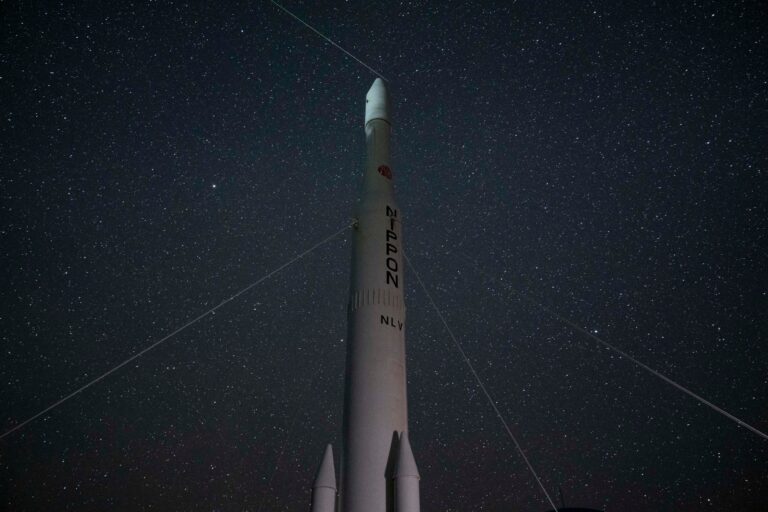
A perseid meteor streaks across the night sky above a rocket model at the Tanegashima Space Center during the Perseid meteor shower in Minamitane, Kagoshima prefecture on August 14, 2026. Yuichi YAMAZAKI/AFP via Getty Images
Global private startup investment in space and satellite companies reached $20.3 billion in 2026 with four months still remaining in the year — the highest annual total Crunchbase has ever recorded for the sector, according to a Crunchbase sector snapshot Thursday. The milestone is worth understanding precisely: that $20.3 billion covers seed-through-growth-stage rounds raised by space and satellite startups — it is private venture and growth capital, counted separately from SpaceX’s landmark June public offering, which raised approximately $75 billion in public markets. Both flows are historically significant; collapsing them obscures the more durable signal, which is that the private startup layer of the space economy is hitting record investment levels on its own merits, independent of the SpaceX halo.
The proximate cause of the surge is not hard to identify. When SpaceX priced its shares at $135 each on June 12, 2026, Nasdaq debut — the largest initial public offering in the history of U.S. public markets — it demonstrated to institutional capital that a space company could sustain a $1.77 trillion valuation and attract genuine investor demand, not just promotional enthusiasm. But Space Capital’s Q2 2026 quarterly analysis frames the development with care: “the space economy has entered a new era,” the firm wrote in its Q2 2026 space report, and “capital is flowing at unprecedented scale.” The question the data raises — and that the individual deal records answer — is what exactly investors think they are buying. The answer, increasingly, is not just launch services and satellite broadband. It is orbit itself, recast as compute infrastructure.
The Goldman Sachs Global Institute report, titled “The Second Space Age” and published August 13, 2026, frames the structural shift in terms investors can act on: space is becoming a new industrial economy pillar, the bank wrote, and companies controlling launch, manufacturing, orbital infrastructure, and space-derived data stand to capture “disproportionate value” as the industry matures. The report projects the global space economy will reach $1.8 trillion by 2035, up from approximately $626 billion in 2025. Elon Musk, responding to the Goldman projection on X, called that estimate too conservative and predicted far larger growth.
Orbit as the New Data Center: Why Capital Followed the Physics
SpaceX unveiled its AI1 satellite on June 8, 2026, just days before its Nasdaq debut. The design — 70 meters (230 feet) tip-to-tip, wider than a Boeing 747 — is built to deliver 150 kilowatts of peak compute and 120 kilowatts average from low Earth orbit. SpaceX’s Q2 2026 earnings call, the company’s first as a public entity, confirmed that AI1 satellites will use NVIDIA Rubin GPUs and Vera CPUs for the compute payload. The satellite is not a communications relay. It is, as SpaceX described it, the first generation of an orbital data center — a solar-powered server rack designed to run AI inference workloads from space.
The engineering logic behind the concept is specific enough to evaluate. Terrestrial data centers face two large and inelastic cost inputs: electricity and cooling. A hyperscale facility may consume hundreds of megawatts from a regional power grid, require millions of gallons of water annually for evaporative cooling, and demand years of permitting before a single rack goes online. An AI1 satellite in low Earth orbit, orbiting at roughly 550 kilometers (342 miles) altitude, receives direct sunlight during approximately 60% of each orbital pass — unblocked, unmetered, and requiring no grid connection. Waste heat radiates directly into the vacuum, eliminating water, refrigerant, chiller infrastructure, and cooling tower costs entirely, as an AI1 technical feasibility breakdown details.
SpaceX is not the only company pursuing this architecture. At least eight companies have now built or are building orbital compute hardware. Three already operated hardware in orbit as of mid-2026. SpaceX filed a Federal Communications Commission application in January 2026 seeking authority to operate one million satellite data centers in low Earth orbit — a megaconstellation filing that implies an orbital grid of compute capacity with no earthly analog. Google has conducted orbital compute experiments in partnership with Planet Labs. The startup Aetherflux, Lonestar, and OrbitsEdge are each advancing distinct technical paths.
K2 Space and the $15M Satellite That Changes the Math
The most technically significant single financing event in the private startup layer — beyond Anduril’s sheer size — was K2 Space’s $500 million Series D, which closed at $6.8 billion valuation on July 30, 2026. The round, co-led by Kleiner Perkins and ICONIQ, with participation from CapitalG (Alphabet’s venture arm), Lightspeed, Altimeter, Spark Capital, Sands Capital, ARK Invest, and T. Rowe Price, arrived four months after K2’s Gravitas satellite put a 20-kilowatt Hall-effect thruster into low Earth orbit — the most powerful such thruster ever operated on an orbital mission, running at 4.4 times the power of the prior record set by an Aerojet BPT-4000 thruster aboard an Advanced Extremely High Frequency military satellite in 2010.
A Hall-effect thruster ionizes propellant — krypton in Gravitas’s case — inside a crossed magnetic field and accelerates those ions electrically to produce thrust. The defining advantage over chemical rockets is specific impulse: where a conventional rocket expends propellant at roughly 300–450 seconds of specific impulse, a Hall thruster achieves 1,500 seconds or more. That ratio translates directly into economics: a satellite that needs less propellant to maneuver can carry more payload. For K2’s Gravitas, the 20-kilowatt thruster enables the satellite to raise its own orbit from low Earth orbit to medium Earth orbit — thousands of kilometers higher — entirely under electric propulsion, with no additional launch vehicle required. That self-orbit-raising maneuver completes in under 90 days. More importantly for constellation economics, four Gravitas satellites can launch together on a single SpaceX Falcon 9 rideshare and then independently navigate to different medium-orbit slots — four satellites per launch instead of one.
The economic model beneath all of this is 85% vertical integration. K2 builds its own flight software, avionics, propulsion systems, power systems, and solar arrays at a 180,000-square-foot (16,723-square-meter) factory in Torrance, California — eliminating the markup layers of an aerospace supply chain that was never designed to serve high-power satellites at constellation scale. The result, the company says, is a Mega-class satellite bus at under $15 million per unit with lead times under three months, compared to approximately $100 million and multiple years for a comparably capable satellite built through traditional procurement. “Every important mission in space comes back to power and mass,” said Lucas Oliveira, a principal at Kleiner Perkins. “K2 recognized that before anyone else.”
K2’s backlog of more than $1 billion in signed contracts mirrors its total capital raised — a symmetry that reflects three programs. SES, one of the world’s largest commercial satellite operators, contracted K2 for meoSphere satellites in March 2026, covering an initial 28 units for its planned medium-Earth-orbit broadband network. The constellation, designed to orbit at approximately 8,000 kilometers (4,971 miles) altitude, is intended to deliver Ka-band broadband at up to one gigabit per second per satellite, with optical inter-satellite links at up to 100 gigabits per second. Separately, K2 announced in May 2026 a role as satellite bus supplier for Anduril’s Golden Dome interceptor program within the missile defense initiative. And in June 2026, K2 was selected as the bus provider for the Space Force Protected Tactical Satcom-Global program — its first formal Pentagon program of record.
CEO Karan Kunjur has identified hyperscalers as a primary target market for K2’s next-generation Giga platform, which is expected to generate 100 kilowatts of onboard power when it enters service in 2028. At that power level, a single satellite becomes capable of supporting a small orbital data center node — the same compute category that SpaceX, Google, and at least six other companies are racing toward. K2 is not building its own constellation. It is building the buses that other companies’ constellations will use.
What investors have not yet seen is production at scale. K2’s Trinity mission, expected in Q2 2027, will fly multiple satellites simultaneously to low Earth orbit, medium Earth orbit, and geostationary orbit — the first real test of whether K2’s manufacturing processes are as repeatable as its capital raise assumes. SpaceNews noted in its Series D coverage that K2 must demonstrate repeatable manufacturing and meet delivery schedules for customers with multiyear programs. OneWeb’s production ramp with Airbus exposed supply-chain gaps invisible at prototype scale; K2 faces the same organizational test, at lower volume but with equivalent stakes.
Where the Money Flows: Defense, China, and Exits
U.S. startups captured approximately $12.7 billion — more than 63% of global funding — while China-based companies accounted for just over 20% of funding, and European firms approximately 10%. The largest single private round went to Anduril Industries, the defense technology company, which raised $5 billion Series H in May 2026 — though Anduril’s space and satellite work represents one division within a broader defense portfolio rather than a pure-play space business. J.P. Morgan Private Bank noted in its own space economy analysis that space tech ranked as the second-leading segment within defense-tech venture capital activity in the first quarter of 2026, accounting for $2.7 billion across 40 deals.
Shanghai-based Yuanxin Satellite, the company operating the Qianfan satellite constellation marketed as SpaceSail, closed approximately $1 billion in August 2026. The raise’s structure tells the more important story: all external investors combined were capped at 20% of post-raise equity, no foreign capital was permitted to participate, and Shanghai Alliance Investment holds 49.9% — Shanghai’s municipal government investment arm. This is not a commercial startup. It is state infrastructure capital, deployed to preserve International Telecommunication Union spectrum rights for a planned 15,000-satellite constellation that Starlink would otherwise occupy. SpaceSail generated $28,000 in 2025 revenue, consistent with pre-commercial infrastructure spending rather than a functioning business.
Two additional space companies went public in 2026. York Space Systems, a Denver-based satellite manufacturer backed by private equity, debuted on NYSE under YSS on January 29, 2026, raising $629 million at a $4.75 billion valuation. Its shares fell sharply from their opening price of $38 — dropping to approximately $26 within days — and Goldman Sachs later cut its YSS price target 50%, pointing to mixed first-quarter earnings, cost overruns on legacy programs, and concerns about the transition from prototype to production-rate output. HawkEye 360, a Herndon, Virginia signals intelligence company that sells radio frequency detection and geolocation data to U.S. and allied defense customers, priced its IPO at $26 per share in May 2026 raising $416 million, and surged 31% on its first day of trading. Its shares subsequently declined from that first-day closing price of $34.
On the merger-and-acquisition side, Voyager Technologies completed its acquisition of Astrobotic Technology — the Pittsburgh-based commercial lunar lander developer — in July 2026 for up to approximately $300 million in a combination of cash and stock, following a June deal announcement. The deal gave Voyager control of Astrobotic’s Peregrine and Griffin lunar lander programs and its LunaGrid solar power distribution system, transforming Voyager into what it called a full-stack lunar infrastructure provider. York Space Systems separately announced a $355 million deal to acquire All.Space, a satellite communications terminal provider, and completed two additional acquisitions of venture-backed companies — satellite propulsion developer Orbion Space Technology and solar energy startup Solestial — for undisclosed amounts.
The consolidation pattern reflects a sector entering its maturation phase: well-capitalized companies are beginning to acquire specialized capabilities, and the definition of “a space company” is expanding to encompass propulsion, ground terminals, compute, AI, and lunar surface infrastructure simultaneously.
Is the Economics of Orbit Proven?
The orbital data center thesis is the most exciting — and least proven — element of the 2026 space capital story. SpaceX will not have prototype AI1 satellites in orbit until 2027 at earliest, and a commercial constellation at meaningful scale is further out still. Even the most aggressive independent analyst projections show space-based compute handling single-digit AI workload percentage before 2035. Terrestrial infrastructure spending will continue growing regardless of what happens in orbit.
The economics that make orbital data centers theoretically attractive — free cooling, always-on solar, no land or grid constraints — require a cost structure that a $75 billion IPO and a 4.4x thruster record do not by themselves validate. SpaceX’s anchor compute customers — Anthropic, paying an estimated $1.25 billion per month for xAI data center capacity, and Google, paying an estimated $920 million per month — are currently paying for ground-based infrastructure, not orbital. The orbital version of that service has not been priced, benchmarked, or demonstrated at commercial scale.
SpaceX generated $7.81 billion in Q2 2026 revenue up 92% — with $4.3 billion from its Connectivity segment (Starlink) and $2.6 billion from its AI segment. Starlink remains the only division generating operating-level profits: in 2025, it produced $11.4 billion in revenue and operating income at 39% margins, demonstrating that at least one part of the orbital economy has crossed from thesis to commercial reality. Whether orbital compute will do the same — and on what timeline — is the question the next several years of launches and contracts will begin to answer.
SpaceX shares traded at approximately $140 as of August 28, 2026, roughly 4% above the $135 initial offering price but well below the $225 intraday high reached in the weeks following the debut. York Space Systems and HawkEye 360 have both traded below their first-day prices since listing. The data suggests that enthusiasm for the space economy is real and broad — but that the public market has already begun distinguishing between companies with proven commercial revenue and companies whose value depends on the orbital data center future arriving on schedule.
Currency conversion note: The SpaceSail raise amount of approximately ¥6.976 billion is equivalent to approximately $1.038 billion USD at the mid-market exchange rate of approximately 6.72 CNY per USD as of August 29, 2026. Conversions are approximate and subject to change.
Frequently Asked Questions
What is an orbital data center, and does one exist today?
An orbital data center is a satellite designed to run computing workloads — AI inference, data processing — in space rather than in a ground-based facility, using solar power for electricity and the thermal vacuum of space for cooling. SpaceX unveiled its AI1 design in June 2026: a 70-meter (230-foot) wingspan satellite rated at 150 kilowatts peak compute using NVIDIA Rubin GPUs. The company filed to build up to one million such satellites. At least three companies operated orbital compute hardware of some kind as of mid-2026, though no commercial service at scale exists yet — SpaceX AI1 prototype launches are expected in early 2027. The economics of space-based compute versus terrestrial data centers have not been independently demonstrated.
What is the difference between the $20.3 billion in space startup funding and the SpaceX IPO?
The $20.3 billion figure reported by Crunchbase covers seed-through-growth-stage private investment rounds raised by space and satellite startups in 2026 — venture capital, growth equity, and strategic investment in private companies. SpaceX’s June 2026 initial public offering, which raised approximately $75 billion (and over $80 billion by some measures that include the overallotment option), was a public market transaction conducted on the Nasdaq stock exchange. The two capital flows are structurally different and counted separately. The $20.3 billion private startup record is significant precisely because it was set without counting the SpaceX IPO proceeds, meaning the sector’s foundational layer of innovation capital is at a record high independent of the SpaceX public offering.
Why did York Space Systems and HawkEye 360 decline after their IPOs if the sector is setting records?
York Space Systems (NYSE: YSS) and HawkEye 360 (NYSE: HAWK) each debuted strongly — YSS opened 11.7% above its $34 IPO price, and HAWK surged 31% on its first day — but both retreated from those initial highs in the following months. In YSS’s case, Goldman Sachs cut its price target by 50% to $14 following mixed first-quarter earnings, cost overruns on legacy programs, and questions about the transition from prototype-scale manufacturing to production rate, as York’s IPO reporting showed. The broader lesson from the 2026 IPO class, including SpaceX’s own correction from its intraday high of $225 to approximately $140, is that the public market is separating companies with demonstrated commercial revenue from those priced on projections. HAWK’s revenue nearly doubled year over year to $117.7 million in 2025 and its first year of net income gives it a clearer near-term story than pure orbital-compute plays.
Does K2 Space’s Hall-effect thruster technology directly enable the orbital compute market?
Yes, indirectly. K2’s 20-kilowatt Hall-effect thruster allows Gravitas-class satellites to raise their own orbits from low Earth orbit to medium Earth orbit using electric propulsion alone, eliminating the need for a dedicated launch to a higher-altitude destination. More importantly, it allows four K2 satellites to launch together on a single Falcon 9 rideshare and then independently navigate to different orbital slots — compressing the per-satellite launch cost significantly. K2’s planned Giga platform, rated at 100 kilowatts in the second half of 2028, will generate enough onboard power to support a small orbital data center node. The company has targeted hyperscalers with Giga platform. K2 is not building its own data center constellation — it is building the satellite buses that other companies’ orbital compute constellations could use.