August 28, 2026:


Warsaw-based indie developer Sonka and publisher Team17 confirmed at the Xbox @ Gamescom Broadcast on August 27, 2026, that psychological survival horror game Holstin will launch in 2027 across platforms covering PlayStation 5, Xbox Series X|S, Nintendo Switch, and PC (Steam, GOG, and Microsoft Store), with day-one availability on Xbox Game Pass. Game Pass subscribers will be able to download the game on launch day at no additional cost. Which tier of Game Pass will include it — Ultimate, PC Game Pass, or lower tiers — has not yet been announced. A playable demo, rated Very Positive by 94% of more than 539 Steam user reviews, is available now at no cost.
The game has been in development since around 2022, when Sonka first revealed it publicly. Ahead of the Gamescom confirmation, Sonka had built substantial community interest through an extended weapons showcase trailer in April 2025, a two-hour demo shadow drop at the Future Games Show in June 2025 that earned the game widespread coverage from horror game media, and a subsequent worldwide publishing deal with Team17. The Gamescom 2026 trailer, released alongside the launch window announcement, is available on YouTube.
Holstin puts players in the role of Tomasz Wolanski, a man who travels to rural lakeside Poland in late November 1992 — specifically to the town of Jeziorne-Kolonia in eastern Poland. The reason he has come is specific and personal: his closest friend, an investigative journalist named Bartek, came here on a story lead and then went silent — his messages becoming increasingly incoherent before contact stopped entirely.
What Tomasz finds is a town in collapse. The streets are coated in spreading, foul slime. The residents who remain are slipping into madness — “not fully turned,” in the game’s language, but no longer entirely coherent. Some of them will share clues and answers to puzzles, but only if Tomasz earns their trust by playing along with their delusions rather than confronting them. The central dramatic question is not merely where Bartek is, but what has taken hold of Jeziorne-Kolonia and why nothing about this town makes rational sense anymore.
Holstin’s emotional register is dread compressed into nostalgia — the tactile, slightly wrong atmosphere of post-Soviet Polish provincial life rendered in hand-drawn pixel art, with the horror living in the people rather than in jump scares. Sanity functions as a fluid status effect, Sonka has confirmed: Tomasz’s grip on reality erodes as the town’s horrors accumulate, and unlike many horror games that reset this meter or treat it as cosmetic, Holstin’s sanity loss carries permanent consequences. Let it deteriorate too far, and the situation does not recover.
The most distinctive engineering element of Holstin is the rendering system Sonka built specifically for it, which they call 2XD Rendering. It is described in Sonka’s press materials as the engine that makes the game’s visual style possible. To understand why this matters, it helps to understand the problem it is solving.
Traditional pixel art games — even the most technically sophisticated ones — face a fundamental constraint: the visual assets are drawn from a fixed perspective, which means the camera cannot move freely. The pixelated appearance of the world is an illusion that only holds from one direction. This is why classic survival horror games like Resident Evil used fixed camera angles: the pre-rendered backgrounds were photographs of diorama models, and they could not rotate.
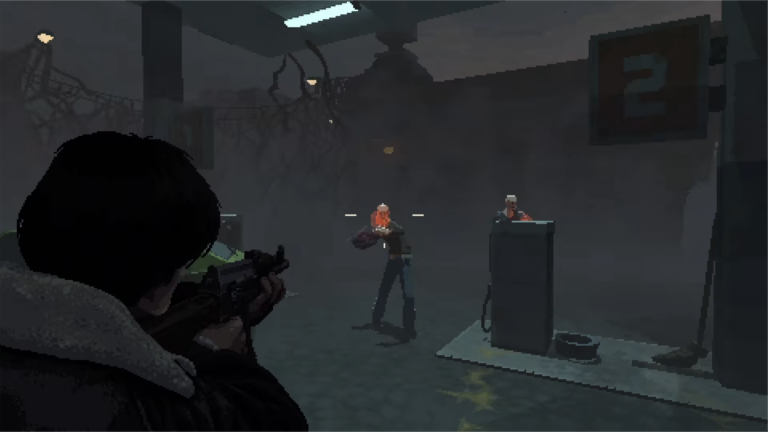
The 2XD approach abandons the sprite-based foundation entirely. Holstin’s world is built from full three-dimensional geometry — actual 3D models and environments constructed as any modern 3D game would be. The pixel art aesthetic that players see is a rendering output: a custom shader and pipeline converts that 3D geometry into a pixelated visual at runtime, preserving the hand-drawn aesthetic while the underlying structure remains genuinely three-dimensional.
This architecture enables two things that are impossible in sprite-based pixel art. First, real-time dynamic lighting: because the scene has actual 3D surfaces with geometric normal information, dynamic light sources can cast shadows from objects, illuminate surfaces based on their angle relative to the light, and produce the kind of tactile shadow-and-highlight interaction that makes Holstin’s screenshots look physically weighty rather than flat. Second, and more unusually, genuinely free camera rotation: because the 3D geometry is always present, the camera can swing to any of eight orientations and the pixel art render remains coherent from all of them. Dominick John, the developer behind a separate indie project called Project Shadowglass — which uses an analogous approach in the Godot engine — described this general tradeoff in a May 2026 technical interview: building from full 3D geometry allows dynamic lighting and real-time shadows to interact with actual surfaces, solving problems that remain intractable in pure 2D sprite-based systems.
The result in Holstin is five functionally distinct playing perspectives that shift seamlessly depending on context: an isometric 3D view for general exploration, an over-the-shoulder third-person perspective when combat begins, first-person for driving sequences, a top-down view for specific exploration sections, and side-scrolling platforming for certain passages. Players can also rotate the camera manually across eight angles at will.
The gameplay consequence that is easy to miss in press materials: enemies behave differently by camera angle depending on which perspective is active when the player encounters them. This is not a cosmetic difference. The three-dimensional scene foundation means sight lines, hitboxes, and potentially AI detection cones are calculated in actual 3D space, which means the same enemy presents differently — and responds differently — depending on whether the player is looking at it from isometric or over-the-shoulder perspective. This is a gameplay mechanic enabled specifically by the engineering choice, not a separate design decision grafted onto a conventional renderer.
Sonka has treated the historical setting with a specificity that goes beyond using the era as visual shorthand for “retro.” Every detail of Jeziorne-Kolonia’s period-specific design — furniture, household appliances, brand signage, architectural style, interior design — has been constructed to evoke early-1990s Polish provincial life. Faded wallpaper. Battered appliances. Vintage advertisements. The town is not nostalgic; it is specific.
The fully voiced cast performs in both Polish and English, letting players experience the story in whichever language they prefer. The soundtrack was composed by Heima, a Polish alternative-rock band that contributed full vocal tracks with lyrics in Polish. Their first single from the score, “Skaza,” is available on major streaming platforms as of this writing.
Sonka S.A. is a Warsaw-based developer and publisher founded in 2017, publicly traded on NewConnect (Poland’s alternative stock exchange, ticker: SOK), and known primarily for console ports and original productions before Holstin. The Team17 partnership — Team17 is a British indie publisher and developer founded in 1990 and based in Wakefield, England, responsible for Worms, Dredge, Hell Let Loose, and Overcooked — gives Holstin a publisher with established horror genre credibility: Team17’s recent horror catalogue includes the WWI survival horror game Conscript (2024) and the psychological deep-sea drama Thalassa: Edge of Abyss (2024).
Yes. A Steam demo has been available since June 2025 and is playable on PC at no cost. It covers the opening segment of the story, including the town’s first streets, the core combat system, environmental puzzle-solving, and interactions with the remaining (partially coherent) residents. As of August 2026, the demo carries a Very Positive rating: 94% positive from more than 539 user reviews.
The demo covers the core mechanics that define the game: the exploration-to-combat camera shift, the scavenging and resource management, the environmental puzzle design, and the NPC conversation system that requires players to enter the delusions of compromised townsfolk rather than challenge them.
Holstin is confirmed for a 2027 launch on PlayStation 5, Xbox Series X|S, Nintendo Switch, and PC via Steam, GOG, and the Microsoft Store. Xbox Game Pass subscribers will have access on launch day at no additional cost, though the specific Game Pass tier has not yet been specified by Sonka or Team17. Xbox Play Anywhere support — which would allow a single purchase to cover both Xbox and PC — has not been confirmed.
2XD Rendering is Sonka’s proprietary engine for Holstin. Rather than building the game from 2D sprites — as traditional pixel art games do — Holstin’s world is built from full three-dimensional geometry, and a custom shader and rendering pipeline converts that 3D output into a pixel art visual at runtime. This approach solves a long-standing problem in pixel art game development: dynamic lighting is impossible in sprite-based systems because flat sprites have no real surface geometry for light to interact with. By retaining 3D geometry underneath the pixel art aesthetic, Holstin can cast real-time shadows, apply dynamic lights that respond to physical surfaces, and rotate the camera to any of eight orientations without breaking the visual coherence. It also enables the game’s angle-dependent enemy behavior, which is calculated in actual three-dimensional space.
Holstin is psychological survival horror in the lineage of Silent Hill and Amnesia rather than jump-scare action horror. The dread is structural: resource scarcity, limited combat effectiveness, deteriorating sanity as a persistent status effect with permanent consequences, and an NPC dialogue system that requires players to inhabit rather than resist the unreality of a town in collapse. Reviewers who played the demo compared it favorably to Signalis and Crow Country — recent pixel art horror games with strong critical reputations — as well as the canonical Resident Evil and Silent Hill. A free demo on Steam, currently rated Very Positive (94% positive from 539 reviews), lets players evaluate the experience directly before any purchase decision.
Yes, and this is a consequence of the game’s engineering rather than a separate design feature. Because Holstin’s world is built from real 3D geometry rather than 2D sprites, enemy sight lines, hitboxes, and spatial awareness are calculated in actual three-dimensional space. Switching from the isometric exploration view to the over-the-shoulder combat perspective changes the geometry of the encounter — which parts of an enemy’s body are exposed, which sight lines are open, and how the AI’s detection cones intersect with the player’s position. Developer and press coverage has confirmed this is an intentional mechanic enabled by the 2XD Rendering architecture.