HomeAuto Mac mini M6 Costs More Because of Alleged Price-Fixing, Federal Lawsuit Claims
Mac mini M6 Costs More Because of Alleged Price-Fixing, Federal Lawsuit Claims
August 28, 2026:
BoliviaInteligente/Unsplash
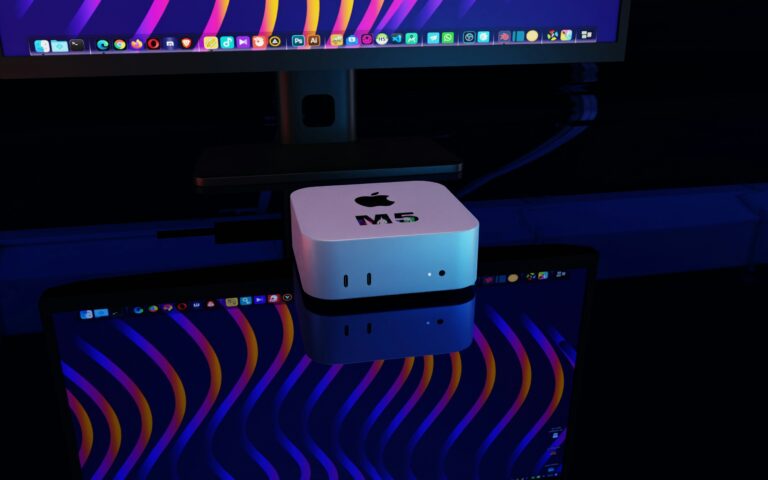
Apple’s new Mac mini M6 went up for pre-order on August 25 at $899 — $300 more than the same machine cost when Apple launched the M4 version in October 2024. The company attributes the increase to an “unprecedented” surge in memory component costs. A federal antitrust lawsuit filed in California two months ago argues the shortage driving those costs was not a market accident.
The case, Garciaguirre v. Samsung Electronics Co., Ltd., case number 3:26-cv-06345, was filed June 25 in the U.S. District Court for the Northern District of California by 17 plaintiffs — a mix of individual consumers and small computer-building businesses. It names Samsung, SK Hynix, and Micron — three companies that together control roughly 90 percent of the global DRAM market — and alleges they coordinated a deliberate restriction of conventional memory supply to inflate prices. The complaint invokes Section 1 of the Sherman Act and alleges the three chipmakers drove commodity DRAM prices up by approximately 700 percent over four years, citing Apple’s Mac and iPad price increases as evidence of downstream harm. Every Mac mini Apple sells at $899 contains the LPDDR5X memory that the lawsuit says became artificially expensive through that alleged scheme.
The allegations are unproven. No motion to dismiss has been filed, no answer has been entered, and no ruling has been issued. The case is at a purely procedural stage: a Case Management Statement is due September 16, and an Initial Case Management Conference is scheduled for September 23 before Judge Noel Wise in San Jose. Micron has denied the allegations, saying it “competes vigorously, fairly and in compliance with all applicable laws” and will defend itself. Samsung and SK Hynix have not publicly commented on the merits.
But the lawsuit’s legal theory matters to anyone considering a Mac mini purchase for a specific reason: if the alleged coordination is proven or settled, the court has authority to order the defendants to cease the supply restriction and restore competitive conditions in the conventional DRAM market — which is the only mechanism currently identified by any analyst or official as capable of actually bringing Mac prices back down.
Mac mini M6: What Buyers Get for $899
The machine Apple announced on August 25 is genuinely a technical achievement. The M6 chip is Apple’s first processor built on TSMC’s 2-nanometer N2 fabrication process — the foundry’s inaugural implementation of gate-all-around nanosheet transistors, which wrap the gate electrode around all four sides of horizontal silicon nanosheet layers rather than three sides as in prior FinFET designs. That full encirclement reduces current leakage and enables higher performance at lower voltages. TSMC rates the N2 process at 10 to 15 percent faster performance at equivalent power, or 25 to 30 percent lower power consumption at equivalent performance, compared to the N3E node used in M5 chips.
Apple’s M6 pairs the new process with architectural changes that compound those gains. The chip carries a 12-core CPU organized in three tiers — two super cores for peak single-threaded throughput, four performance cores for demanding multithreaded work, and six efficiency cores for background tasks — two more total cores than the M5. The GPU also scales to 12 cores, with a Neural Accelerator in every GPU core — a design that Apple previously reserved for higher-tier chips and that is appearing in Mac mini for the first time. Most significantly for AI workloads, the M6 introduces a Dual 16-core Neural Engine: two separate Neural Engine blocks running in parallel, providing 32 neural cores total — double the 16 available in the M5.
Apple’s own testing, conducted on preproduction hardware in July 2026, shows the M6 delivers up to 40 percent faster CPU performance than the M4, and up to 4.8 times faster in LM Studio compared to the M4 Mac mini when processing LLM prompts. For local AI inference — running open-weight language models directly on the machine without a cloud connection — those figures are meaningfully better than what the M4 offered.
The machine supports up to 32GB of unified memory at up to 170 GB/s bandwidth, up from 153 GB/s in the M5. It ships with Wi-Fi 7 and Bluetooth 6, a genlock capability over USB-C for synchronizing camera and display sources (including iPhone 17 Pro, useful for broadcast and studio workflows), and 2.5Gb Ethernet as standard. One connectivity limitation to note before ordering: the base M6 Mac mini ships with Thunderbolt 4 ports running at 40 Gbps — not Thunderbolt 5. The M5 Pro Mac mini configuration, starting at $1,699, carries Thunderbolt 5 at 120 Gbps, which is what enables RDMA-based Thunderbolt clustering of multiple units for distributed AI inference.
Units are scheduled to begin shipping to customers on September 22, 2026, and will arrive with macOS 27 Golden Gate preinstalled.
The Price Story: $599 to $899 in Under Two Years, and Why It May Not Reverse
When Apple launched the M4 Mac mini in October 2024, it started at $599 with 256GB of storage and 16GB of RAM. In June 2026, Apple raised the Mac mini’s starting price to $799 as part of a broader hike across its Mac and iPad lineup, citing component cost increases from the global memory shortage. The M6 model now starts at $899 — $100 more than the M5 that preceded it, and $300 more than the M4 at launch. Apple has also reduced the baseline storage value: the M5 Mac mini at $799 shipped with 512GB of storage; the M6 at $899 ships with only 256GB of base storage.
Upgrade costs compound quickly. Moving the base M6 from 256GB storage to 1TB adds $500, bringing the total to $1,399. Moving to 2TB adds $1,000 to the base price. Adding 32GB of RAM (the maximum the M6 supports) adds $400. A fully configured M6 Mac mini — 32GB RAM and 2TB storage — costs approximately $2,299. The top M5 Pro configuration, with 64GB RAM and 8TB storage, reaches $6,799.
The documented cause of this trajectory is the global DRAM and NAND flash shortage. Industry analysts project combined DRAM and SSD price increases of approximately 130 percent by the end of 2026, driven by AI data center operators consuming the same high-bandwidth memory fabrication lines that produce consumer LPDDR chips. The mechanism is specific: producing one gigabyte of High-Bandwidth Memory (HBM) — the stacked, vertically integrated memory used in AI accelerators like Nvidia’s H100 and B200 — consumes approximately three to four times the wafer fabrication capacity of one gigabyte of conventional LPDDR5X. Every wafer Samsung, SK Hynix, or Micron diverts to HBM removes roughly three to four wafers’ worth of consumer DRAM from global supply.
Samsung held its second-quarter 2026 earnings call on July 30, where executive vice president of memory Jaejune Kim told analysts: “Based on the incoming requests that we have been seeing from the customers, unmet demand from this year is likely to carry over into the following year, contributing to tighter supply conditions going forward. The supply constraints are expected to worsen through 2028, Kim said, becoming even more severe in 2027 than 2026.” In a July 10 Reuters interview on the day SK Hynix debuted on the Nasdaq, CEO Kwak Noh-jung said customer demand is likely to exceed supply capacity “even beyond 2030.” Investment bank Jefferies expects DRAM prices to rise an additional 40 to 50 percent in the third quarter of 2026 and 30 to 40 percent in the fourth, with no meaningful relief before 2028. Samsung and Micron are expanding capacity, but new facilities are not expected to reach volume production before 2027 at the earliest. These are the numbers that determine when Mac prices could fall.
Apple CEO Tim Cook described the situation in a June Wall Street Journal interview as a “hundred-year flood” — something he had never seen in more than 40 years in the industry. Cook stepped down as CEO effective September 1, 2026, succeeded by hardware engineering chief John Ternus.
What a Federal Lawsuit Alleges Apple Buyers Are Actually Paying For
The antitrust suit’s central argument is that the DRAM shortage is not purely a market outcome. The complaint in Garciaguirre v. Samsung alleges that Samsung, SK Hynix, and Micron used the industry’s transition to High-Bandwidth Memory as a pretext to coordinate a deliberate curtailment of conventional DDR3, DDR4, and LPDDR5X production — driving prices up by approximately 700 percent over four years. The named plaintiffs include 14 individuals and three small computer-building businesses; the complaint cites Mac and iPad price increases as explicit evidence of downstream harm. The suit seeks class certification, a court injunction against continued supply restriction, and treble damages.
The case is assigned to Judge Noel Wise in the Northern District of California, docket number 3:26-cv-06345. Plaintiffs are represented by Bathaee Dunne LLP. Defense counsel has appeared — Micron is represented by Rachel Brass of Gibson Dunn — but as of August 8 no substantive motion had been filed.
The lawsuit’s theory faces a documented legal hurdle. A nearly identical 2018 class action, brought by Hagens Berman against the same three defendants on similar parallel-conduct grounds, was dismissed by the district court in 2020 and upheld by the Ninth Circuit in 2022. The appeals court held that the chipmakers’ parallel production cuts were “more likely explained by lawful, unchoreographed free-market behavior” than by an illegal agreement. The current complaint attempts to clear the same legal bar by pointing to the coordinated HBM pivot as the specific “plus factor” that a three-supplier oligopoly’s behavior alone does not explain — arguing that simultaneously redirecting capacity to AI memory while restricting conventional DRAM production constitutes the kind of concerted action Section 1 of the Sherman Act prohibits.
This is not the first time Samsung and SK Hynix have faced criminal DRAM allegations. Both companies pleaded guilty to U.S. Department of Justice price-fixing charges covering the period from 1998 to 2002. Samsung paid $300 million; SK Hynix paid $185 million; several executives served prison sentences. The European Commission levied a separate €331 million fine against the same cartel in 2010. Micron avoided criminal penalties by cooperating with investigators. The current complaint cites this history to establish a pattern of behavior; whether it is sufficient to survive a motion to dismiss in the current case remains to be determined.
Is the Mac mini M6 Worth Buying Now?
For buyers deciding whether to order at $899, the relevant question is not whether the hardware is good — it is — but whether the price reflects a temporary condition or a structural one, and what the lawsuit’s outcome could mean.
On the technology: the M6’s 4x AI performance improvement over the M4 is meaningful for developers running local language models. The dual Neural Engine’s 32 neural cores combined with Neural Accelerators in each GPU core represent a genuine architectural change, not a marketing rename. At 32GB of unified memory, the M6 can run quantized open-weight models up to roughly 20 billion parameters cleanly — covering most of the capable open-weight models in the Llama 4 and Qwen 3 families. Community inference benchmarks on prior Mac mini generations suggest the M6 could exceed 60 tokens per second on a 7B-parameter model, though independent benchmarks on shipping hardware will not be available until units reach reviewers around September 22. If your workload is local AI inference, the M6 at $899 is a meaningful upgrade from the M4 at $599.
For buyers who need more than 32GB — necessary for running 34B-parameter or larger models at common quantization levels — the M5 Pro Mac mini at $1,699 with up to 64GB and Thunderbolt 5 is the correct purchase. The M6’s memory ceiling is a hard architectural limit.
On the price: no analyst forecasts meaningful relief before late 2027 at the earliest, and Samsung itself has projected the shortage will worsen in 2027 before improving. Waiting for prices to fall means waiting at least a year, probably two, potentially more. The antitrust lawsuit could theoretically accelerate normalization if the court grants an injunction — but antitrust litigation on this scale typically moves slowly, and the 2022 Ninth Circuit precedent gives the defendants a strong dismissal argument. Any consumer who purchased electronics containing DRAM since 2022 is a potential class member if the case proceeds, but compensation in class actions of this type typically takes years to materialize and is often modest individually.
The decision for a buyer who needs a Mac now is straightforward: the M6 at $899 is the best compact desktop Apple has ever made for local AI inference, and the price is where it is for reasons that are partly structural (AI demand for memory) and partly contested (alleged coordination). No better price is coming soon.
“Made in America”: With an Asterisk
Apple announced in February 2026 that Mac mini production would begin at a Foxconn facility in Houston, Texas — the first time the computer would be manufactured domestically. Apple opened an Advanced Manufacturing Center on August 13, a 20,000-square-foot training hub on the same Foxconn campus, with Tim Cook and Commerce Secretary Howard Lutnick attending. A newly built 170,000-square-foot section of the Foxconn campus houses the Mac mini assembly line, separate from the training center.
What Apple has not specified is whether units shipping to buyers on September 22 will be assembled in Houston or sourced from existing production in Vietnam and China. The company’s stated timeline is that domestic production will begin “later this year” — the same phrasing used in February’s announcement, before the August launch. The arrangement is funded by Foxconn rather than Apple, which commits to purchasing the output; Apple’s own capital expenditures remain far below those of Amazon, Microsoft, and Google even as it promotes the domestic manufacturing narrative.
Buyers ordering a Mac mini today should assume their unit is assembled in Asia unless Apple specifies otherwise. The domestic production story is real — the Houston facility is operational — but the timeline for it to serve launch-day customers has not been confirmed.
How Much Local AI Can $899 Actually Buy?
The M6’s strongest practical case is for developers, researchers, and technically inclined users who want to run open-weight language models locally — for privacy, for cost, or for latency reasons.
At 32GB of unified memory running at up to 170 GB/s, the M6 can hold a 20-billion-parameter model at 4-bit quantization (roughly 10GB of memory required) with room for context and system overhead. Running inference on models at this size at native INT4 precision — which the M6 supports natively in hardware — eliminates the need for cloud API calls on most practical single-user coding, writing, and analysis tasks. The Dual 16-core Neural Engine handles matrix operations that would previously have required more expensive chips, and the Neural Accelerators in each GPU core add a second path for AI compute that prior Mac mini generations lacked.
The 32GB ceiling matters at the upper end. A Llama 4 Scout at 17 billion parameters runs comfortably in 32GB at 4-bit precision. A Llama 4 Maverick at 400 billion parameters does not — that model requires at minimum 200GB of memory and belongs on the Mac Studio M5 Ultra, which starts at $5,499 and supports up to 512GB. The M6 Mac mini is the right machine for the 7B-to-20B model tier; the M5 Ultra is the machine for frontier-scale inference. Buyers who need the larger tier should not expect the M6 to substitute.
For developers spending $300 to $500 per month on cloud AI API calls, the M6 at $899 can return that investment in as few as two to three months purely on operating cost — at which point the machine effectively pays for itself while the DRAM shortage continues to push cloud API pricing upward alongside hardware prices.
Frequently Asked Questions
Should I buy the Mac mini M6 at $899 now, or wait for prices to drop?
No analyst or manufacturer forecasts meaningful price relief before late 2027 at the earliest, and Samsung’s Q2 2026 earnings call warned the shortage will worsen in 2027 before improving. The federal antitrust lawsuit (Garciaguirre v. Samsung, case 3:26-cv-06345) could theoretically accelerate normalization if a court grants an injunction against continued supply restriction — but antitrust cases typically move slowly, the defendants have a strong precedent in the 2022 Ninth Circuit dismissal of a similar suit, and no ruling is imminent. If you need the machine and the hardware fits your workload, the current price is the foreseeable price. If the M4 Mac mini you already own is adequate, nothing in the near term suggests the upgrade will become cheaper.
What is the DRAM antitrust lawsuit, and could it result in refunds for Mac buyers?
Garciaguirre v. Samsung Electronics was filed June 25, 2026, in federal court in California, alleging that Samsung, SK Hynix, and Micron — which together control roughly 90 percent of global DRAM supply — coordinated a deliberate restriction of conventional memory output while shifting capacity to AI-focused High-Bandwidth Memory. The complaint invokes Section 1 of the Sherman Act and accuses the three chipmakers of driving commodity DRAM prices up approximately 700 percent over four years, citing Apple’s Mac and iPad price increases as evidence of downstream harm. If the case succeeds or settles, any U.S. consumer who purchased products containing DRAM during the relevant period could potentially be included in a class — but antitrust class settlements frequently take years to conclude and individual payouts are often modest. The more immediate remedy the plaintiffs seek is a court injunction requiring the defendants to restore competitive supply conditions, which is the only mechanism identified in the current market that could actually reverse the price trajectory.
What are the real limits of the Mac mini M6 for local AI, and when does it make sense to step up to the M5 Pro or Mac Studio?
The M6 at 32GB of unified memory runs open-weight language models cleanly in the 7-billion to roughly 20-billion parameter range at 4-bit quantization — covering the most capable single-user models in the Llama 4 and Qwen 3 families. Beyond 32GB of model weight in memory, performance degrades as the system begins swapping to SSD storage. Buyers whose target models require more than 32GB — typically models above 34 billion parameters at 4-bit — should configure the M5 Pro Mac mini instead ($1,699 starting, up to 64GB) or step up to the Mac Studio M5 Ultra ($5,499 starting, up to 512GB). The M5 Pro Mac mini also includes Thunderbolt 5 rather than Thunderbolt 4, which matters for RDMA-based clustering of multiple units and for high-bandwidth external storage connections. For users whose workload fits the 7B-to-20B window — which covers the overwhelming majority of single-user coding assistant, writing, and analysis tasks — the M6 at $899 is a capable local inference machine.
When does the Mac mini M6 actually ship, and is there any uncertainty in the September 22 date?
Apple has confirmed September 22, 2026, as the ship date for most Mac mini M6 and Mac Studio configurations. One exception: the Mac Studio with 512GB of unified memory will not be available until late October. Apple’s press release for Mac mini also contains a standard regulatory disclosure: Mac mini delivery is contingent on FCC authorization being completed by the ship date, and if authorization is not finalized in time, orders will be canceled and payments refunded. This is routine language for any new radio-equipped device, but buyers should be aware it exists. Pre-orders are open now at apple.com, Amazon, and Best Buy.