HomeAuto Russia’s Sanctions-Driven Car Shortage Turned Canada Into Organized Crime’s Target
Russia’s Sanctions-Driven Car Shortage Turned Canada Into Organized Crime’s Target
August 28, 2026:
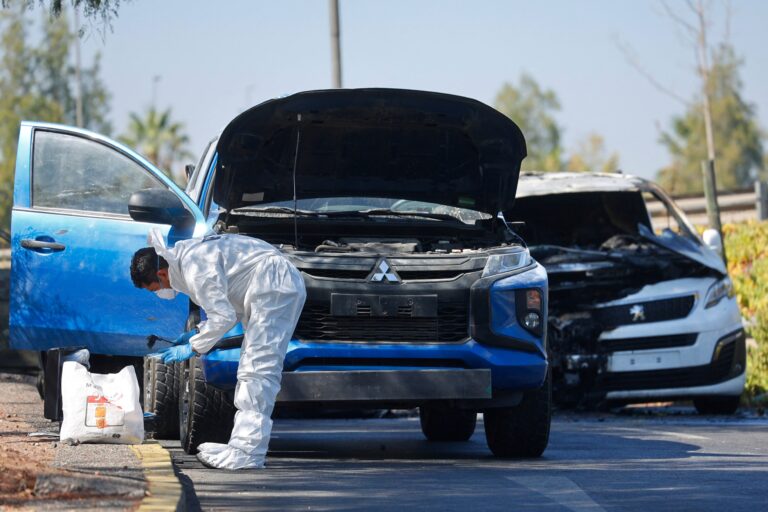
An Investigations Police officer inspects vehicles in the surroundings of the Arturo Merino Benitez International Airport. KARIN POZO/AFP via Getty Images
A New York Times investigation published today draws a direct line between Russia’s Western vehicle import ban and the surge in organized auto theft that has emptied Canadian driveways for the past four years — exposing how a geopolitical decision made in Washington, Brussels, and Ottawa created demand that criminal networks are satisfying one Toyota Tundra at a time. The New York Times investigation documents a transnational pipeline that law enforcement has spent three years building the tools to combat.
The connection is neither coincidental nor subtle. When Russia launched its full-scale invasion of Ukraine in February 2022, Western nations banned exports of vehicles valued above $50,000 to Russia and prompted every major automaker — Mercedes-Benz, Land Rover, BMW, Audi, Porsche — to shutter Russian factories and end shipments. The vehicles that Russian elites and connected officials still wanted were suddenly illegal to obtain through any licit channel. Organized crime built a supply chain to fill that absence, and Canada — with one of the world’s largest per-capita inventories of high-value SUVs and pickup trucks and a major container port handling enormous export volumes — found itself at the center of it.
Russia’s Car Market After Sanctions: A Collapse, Then a Pivot That Left a Gap
The effect on Russia’s automotive sector was immediate and severe. Car sales collapsed 58.8% in 2022, according to the Association of European Businesses, as the industry struggled to source parts and re-establish supply chains after Western suppliers walked away. Domestic production, which had depended on Western components for roughly two-thirds of its inputs, fell to about 32% of pre-war levels that same year.
By 2024, Chinese brands had captured more than 60% of the Russian passenger car market, with manufacturers like Chery, Haval, and Geely rushing in to fill the vacuum left by departing Western and Japanese brands. Total new car sales in Russia recovered to 1.3 million units in 2024 — nearly back to pre-war levels — but the composition had changed entirely.
The gap Chinese brands cannot fill is status. Wealthy Russians and officials with access to foreign currency still want Land Rovers, Dodge Rams, and Ford F-150s: Western-branded trucks and SUVs that signal standing in a society that has watched them vanish from showrooms. That specific demand has no legal outlet. Organized crime stepped in to provide one.
How the Pipeline Works: From a Canadian Driveway to a Russian Road
The criminal supply chain is neither chaotic nor improvised. According to Canadian intelligence reporting and Interpol analysis, vehicles are typically stolen to fulfill pre-existing orders — functioning less like opportunistic theft and more like a bespoke procurement operation. Thieves do not steal what is convenient; they steal what was requested.
The operation follows a documented structure. Facilitators coordinate orders: which makes, models, and quantities to target. Thieves — often younger recruits, sometimes earning $500 to $1,500 per vehicle — execute the theft. Drivers move the vehicle to an export staging area, frequently in the Greater Montreal area. Exporters, often operating through legitimate freight-forwarding companies using fraudulent documentation, load the vehicles into shipping containers alongside ordinary cargo.
The primary documented route from Canada to Russia runs through the United Arab Emirates, with additional documented pathways through Georgia, Kazakhstan, Kyrgyzstan, and Lithuania — countries that have served as established waypoints in Russia’s broader sanctions-evasion network since 2022. The Port of Montreal, one of North America’s largest container terminals, is the main export hub; border officials regularly find stolen vehicles packed into shipping containers alongside furniture or industrial goods, hidden from cursory inspection.
In an August 5, 2026 announcement, the Royal Canadian Mounted Police and Canada Border Services Agency revealed that Project NoCargo recovered 392 stolen vehicles valued at approximately $28 million Canadian (approximately $20.2 million USD) at ports in Halifax, Montreal, Toronto, and Vancouver — the results of an anti-fraud pilot launched in June 2025. CBSA separately intercepted 1,590 stolen vehicles in railyards and ports across Canada in 2025.
Russia Eyes a Legal Workaround for Its Stolen Fleet
A development that draft coverage of this topic has largely missed adds a significant new dimension. In February 2026, Russia’s Interior Ministry submitted a draft regulation to the State Duma that would authorize Russian traffic police to register vehicles listed on international stolen-car databases — provided the stolen-vehicle report originated from a country designated as “unfriendly” to Russia.
Russia’s “unfriendly states” list includes the entire European Union, the United States, the United Kingdom, Canada, and dozens of allied nations — essentially every country that has imposed sanctions on Russia since 2022. If adopted, the regulation would allow vehicles stolen in Canada and registered as wanted in the Interpol database to receive legitimate Russian license plates, removing one of the last legal deterrents discouraging Russian buyers from purchasing obviously stolen Western vehicles. The ministry framed the proposal as protecting Russian citizens who purchased such vehicles “in good faith,” citing Germany’s failure to respond to inquiries about 123 internationally wanted vehicles located in Russia.
For Canadian law enforcement, the proposal represents an escalation: it signals Moscow’s intent to formalize and legitimize the existing black-market pipeline rather than discourage it.
The Technology That Makes Theft Invisible: Relay Attacks and OBD Programmers
The pipeline’s success depends on two interlocking electronic theft techniques that have rendered the door lock — and even the car alarm — almost irrelevant for modern keyless vehicles.
The relay attack exploits a design vulnerability in passive keyless entry (PKE) systems, the technology that lets drivers unlock and start push-button-ignition vehicles without physically pressing a button on their key fob. In a standard relay attack, two thieves work together. One positions a relay device near the victim’s home — close enough to capture the fob’s ambient low-frequency radio signal (typically at 125 kHz) even through a wall. A second device near the parked vehicle receives the amplified signal and presents it to the car, which cannot distinguish between the real fob two meters away and the relayed signal from across the street. The car unlocks and starts. The entire process takes under 30 seconds.
Germany’s automobile club ADAC has run ongoing keyless security tests on more than 850 vehicle models. According to ADAC’s August 2026 update — marking ten years of keyless testing — nearly half of the keyless vehicles in its database can still be opened and driven away using off-the-shelf signal-extension equipment that costs between $100 and $500 and is freely available online. Only a fraction of newer vehicles use Ultra-Wideband (UWB) time-of-flight radio, which measures actual physical distance rather than signal strength and is resistant to relay amplification — but as of 2024, only 6% of new cars had UWB equipped for proximity control.
For vehicles whose owners store key fobs in a Faraday pouch — effectively blocking the signal — thieves use a complementary method: a $60 lock-picking tool to gain access to the cabin, followed by a key programmer plugged into the OBD-II diagnostic port under the steering wheel. The OBD-II port, originally designed to allow mechanics to read fault codes and service data, can be used by specialist programming devices to clone keys, giving the thief a working key for the specific vehicle in minutes. This method works on virtually any push-to-start vehicle regardless of brand.
The practical result: a vehicle theft ring targeting specific makes and models can steal from a Canadian driveway with near-zero physical evidence, no broken windows, no alarm triggers, and no trace left behind — which is exactly what Équité Association means when it describes modern theft rings as “all technology-based.”
What Canadian Owners Are Driving, and Why Criminals Want It
Investigators on both sides of the Atlantic have documented clear targeting patterns. The most commonly stolen vehicles in Canada include the Toyota RAV4, Toyota Tundra, Ford F-150, Dodge Ram, Lexus RX, Toyota Highlander, and Honda CR-V, according to Équité Association’s annual most-stolen vehicles rankings.
For the Russia-bound segment of the pipeline specifically, high-end pickup trucks and Land Rover SUVs are particularly targeted, reflecting a preference for powerful, status-signaling Western vehicles that Chinese manufacturers have not yet replicated. That overlap — between what organized crime can profitably steal in Canada and what Russian buyers will pay a premium for abroad — is not accidental. It is the engine of the entire operation.
Can Canada Fix a Supply-Side Problem With Enforcement Alone?
The headline numbers suggest enforcement efforts are working. Équité Association’s First Half of 2026 Auto Theft Trend Report, released August 11, 2026, recorded 20,759 vehicles stolen between January and June 2026 — a 10.1% decline from the same period in 2025. Alberta saw the steepest drop at 15.1%; Western Canada fell 14.3%; Ontario dropped 8.4%; and Quebec, where the export pipeline is most active, fell 6.4%. The report described trends as moving toward “pre-crisis levels.”
Canada’s investment of $15 million Canadian (approximately $10.8 million USD) in the national auto theft action plan since 2024 funded Project NoCargo, the RCMP-Interpol database integration, and 90 FINTRAC financial intelligence disclosures covering 76,097 suspicious transactions tied to 408 subjects of interest. In February 2024, integration of Canada’s national stolen vehicle database with Interpol’s Stolen Motor Vehicle system enabled real-time international alerts; within the first few months of operation, Interpol detected more than 1,500 Canadian stolen vehicles globally at ports of entry — more than 200 per week — placing Canada among the top 10 source countries out of 137 nations.
But enforcement alone faces a structural limit. An Angus Reid survey commissioned by Équité Association in July 2026 found that nearly 80% of Canadians feel their vehicles are vulnerable to theft — and that public confidence has not recovered alongside the statistics. The survey found nearly 75% of Canadians want mandatory anti-theft technology built into new vehicles, a demand Équité Association has directed specifically at Transport Canada’s Motor Vehicle Safety Regulations.
What no enforcement initiative addresses is the root demand signal. As long as Western sanctions keep luxury vehicles out of Russia legally, the economic incentive for the criminal pipeline persists — even if specific routes are disrupted and specific organizations are dismantled. RCMP Commissioner Duheme’s own statement framing Project NoCargo as requiring “manufacturers, insurance companies, shippers, law enforcement agencies and governments to work together” is an implicit acknowledgment that the problem is multidimensional in ways enforcement alone cannot solve.
What Is ADAC, and Why Does Its Testing Matter?
Why does the relay-attack vulnerability figure keep appearing in news coverage?
ADAC is the Allgemeiner Deutscher Automobil-Club, Germany’s largest automobile club and one of the world’s most credible independent vehicle security testing organizations. Since 2016, ADAC has conducted standardized relay-attack resistance tests on new and recent vehicle models, publishing results that directly inform both consumer decisions and automotive industry security standards. Its dataset now covers more than 850 models — a sample large enough to draw statistically meaningful conclusions about the state of keyless security across the industry. ADAC’s August 2026 ten-year review found that nearly half of tested vehicles remain openable via relay attack; individual model results are searchable on ADAC’s website.
Frequently Asked Questions
Why is Canada specifically targeted rather than other countries with large SUV inventories?
Canada’s vulnerability is geographic, structural, and logistical. It holds one of the world’s largest per-capita inventories of high-value SUVs and pickup trucks — exactly the makes and models in demand as Russia sanctions cut access to Western-branded vehicles. The Port of Montreal, one of North America’s largest container terminals, provides enormous export cover: organized crime can conceal vehicles in shipping containers among legitimate cargo, and the sheer volume of legal traffic makes complete inspection impractical. Canada’s proximity to the Atlantic shipping lanes that connect to European waypoints (UAE, Georgia, Lithuania) used to route goods into Russia is an additional structural advantage for criminal exporters.
Russia’s Interior Ministry proposed in 2026 to let Russia legally register cars stolen in “unfriendly states” — what would that mean for Canada?
If adopted, the draft regulation would allow Russian traffic police to issue legal Russian registration to vehicles flagged as stolen in Interpol’s Stolen Motor Vehicle database — provided the original alert came from a country Moscow designates as “unfriendly,” a list that includes Canada, the US, the EU, and the UK. A Toyota Tundra stolen in Brampton, Ontario and shipped to Moscow could, under this proposal, receive Russian plates and be legally operated there even while recorded as stolen in the Canadian system. It would formalize the existing black-market pipeline, reduce legal risk for Russian buyers, and potentially increase demand for stolen Western vehicles. Canadian and European security experts have described it as a significant escalation.
How do thieves steal modern keyless cars without breaking in, and what can I do about it?
Most modern vehicle thefts in Canada use one of two methods — often in combination. A relay attack uses a pair of signal-amplifying devices to capture the ambient radio signal from a key fob inside a house, then broadcast it to the parked vehicle, which opens and starts as if the key were present. The entire process takes under 30 seconds; the equipment costs $100–$500 online. An OBD-II programmer uses a $60 lock-pick to gain cabin access, then plugs a specialist device into the diagnostic port under the steering wheel to register a blank fob as a valid key. The most effective defenses available today are: storing key fobs in a signal-blocking (Faraday) pouch away from the front door; installing an OBD-II port lock; adding a secondary visible deterrent like a steering wheel lock; and parking in a well-lit, trafficked location. If your vehicle model is specifically listed as high-risk, consult your insurer about GPS tracking. Note that according to ADAC’s most recent testing of more than 850 keyless vehicles, nearly half remain relay-attack-vulnerable — the fix ultimately requires automotive industry action, not just consumer workarounds.
Is the car theft crisis actually getting better?
Marginally, yes — with caveats. Équité Association’s First Half of 2026 report recorded a 10.1% national decline in thefts compared to the same period in 2025, and the 2024 annual figure (approximately 57,000 thefts) was a significant drop from the 2023 peak of over 70,000. Enforcement gains are real: Project NoCargo, Project CHICKADEE, and CBSA port operations have disrupted specific organizations and export routes. But the underlying demand signal — Russia’s sanctions-driven appetite for Western vehicles it cannot legally obtain — has not diminished, and in February 2026 Russia proposed formally legalizing ownership of vehicles stolen in Canada. The trajectory is positive; the structural problem remains.