August 27, 2026:


Norwegian, British, and American forces began deploying today to Jan Mayen — a volcanic Norwegian island roughly 1,000 kilometers (620 miles) from mainland Norway — as Operation Atlantic City opens its ten-day training window through September 4, 2026. The trilateral exercise is the most technically ambitious integration test NATO has attempted from the remote High North outpost: it will link multinational sensors, command-and-control nodes, and precision fires from three separate national architectures into a single, joint kill web. The target the kill web is designed to deny is surface transit through the Greenland-Iceland-United Kingdom Gap — the maritime corridor that separates the Norwegian Sea and the Arctic from the open North Atlantic.
The operation runs concurrently with Northern Viking 26, the seven-nation US Sixth Fleet exercise centered on Iceland, whose opening ceremony took place at Keflavik Air Base on August 18, with training running August 22 through September 3. Together the two exercises span the breadth of the GIUK Gap: Northern Viking covers the Iceland-UK leg from below while Operation Atlantic City pushes the kill web’s northernmost node directly onto Norwegian territory above it.
“We want to prove the Marine Corps’ role as the contact-layer enabler of lethality for the joint and combined force,” said Lt. Col. David Palacio, fires officer for MARFOREUR/AF. “By deploying to Jan Mayen, we are ensuring the Alliance can instantly target and deny adversary freedom of maneuver in highly contested maritime terrain.”
Jan Mayen is sovereign Norwegian territory situated at the northern edge of the GIUK Gap — the maritime chokepoint that NATO has regarded as the decisive passage between the North Atlantic and the Norwegian Sea since the Cold War. Any surface vessel or submarine departing Russian Northern Fleet bases on the Kola Peninsula and attempting to reach the open Atlantic must transit through the gap’s waters. Controlling that transit — or at minimum denying freedom of maneuver within it — is the foundational logic behind NATO’s entire High North posture.
The island sits approximately 1,000 kilometers (620 miles) from mainland Norway, accessible only by air and with no port infrastructure. It is 373 square kilometers of volcanic terrain — roughly 144 square miles — with weather that makes sustained operations challenging under any conditions. Those are not disadvantages for the architecture being tested here; they are features of the problem. If NATO can build a functioning kill-web node from Jan Mayen under operational conditions, it can build one almost anywhere.
“By operating alongside our Allies, we demonstrate that we have both the capability and the will to defend Norwegian territory,” said Vice Admiral Rune Andersen, Commander of Norwegian Joint Headquarters. “This includes the Arctic islands, the High North and our territorial waters.”
The term “kill chain” describes a linear, sequential targeting process: a sensor detects a target, an analyst interprets the data, a commander authorizes action, a fires element executes the shot. If any link in that chain is severed — by jamming, latency, or the death of a relay node — the entire sequence fails. A kill web replaces that single thread with a distributed mesh: any sensor node can cue any shooter in the network simultaneously, creating multiple parallel targeting threads that remain resilient when individual nodes go offline.
Operation Atlantic City is testing whether three nations with different C2 architectures, different sensor suites, and different data-link standards can fuse their feeds quickly enough to generate fire solutions before targets maneuver out of engagement windows. A surface vessel moving at 30 knots covers roughly one kilometer every two minutes. Multi-hop command-and-control latency can add two to five minutes per hop in legacy systems. The kill-web objective is to collapse that cycle toward direct sensor-to-fires cueing under Arctic conditions.
That technical challenge — not the weapons themselves — is what this exercise is designed to stress-test. The guns and rockets work. The question is whether multinational data pipelines can work fast enough and reliably enough to make the network more capable than its individual parts.
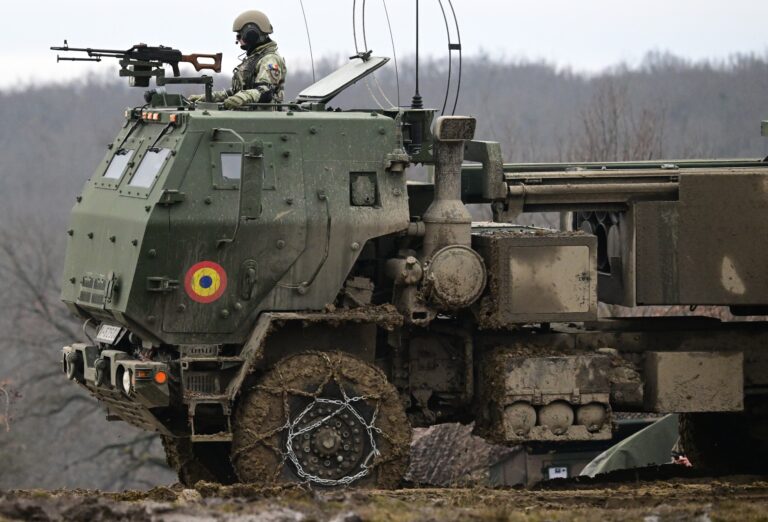
The exercise’s fires backbone is a HIMARS platoon from the 3-197th Field Artillery Regiment, New Hampshire Army National Guard. The M142 High Mobility Artillery Rocket System is the fires workhorse that makes this architecture viable on a remote island with no fixed infrastructure: the launcher is transportable by C-130 tactical airlift aircraft, meaning it can be loaded aboard a tactical transport aircraft and be ready to fire within minutes of landing.
Standard GMLRS rockets — the six-round pod that a HIMARS carries as its primary load — have an effective range of approximately 70 kilometers (43 miles). From Jan Mayen’s position north of the GIUK Gap, that range covers surface vessels transiting Norwegian Sea approach corridors. ATACMS, the longer-range missile in the HIMARS family, extends that coverage to approximately 300 kilometers (186 miles), reaching deep into the Norwegian Sea.
The HIMARS design emphasizes rapid repositioning after firing, reducing exposure to counter-battery fire. This is the core insight of the exercise: the island-fires doctrine the Marine Corps developed for the Pacific against Chinese naval forces — Expeditionary Advanced Base Operations, or EABO — translates directly to the European Arctic theater against Russian surface transit through the GIUK Gap. Operation Atlantic City is the first time that doctrine has been applied in the European theater with the full fires-and-sensor integration package.
Getting forces onto an island with no port and extreme weather requires an airlift architecture capable of operating in austere Arctic conditions. The exercise deploys two airlift assets designed for exactly this mission. A US Air Force Special Operations Command MC-130 will handle the HIMARS rapid insertion. A US Air Forces Europe C-130 provides additional cargo and personnel lift.
The British contribution to the airlift layer comes from the RAF’s LXX Squadron, based at RAF Brize Norton, which operates the A400M Atlas. The A400M first landed on Jan Mayen in September 2025, establishing that the island’s strip can receive the aircraft under operational conditions. Royal Marine Commandos will deploy alongside Norwegian personnel from the Royal Norwegian Navy and Norwegian Home Guard. Elements of US 6th Fleet and Task Force 68 are providing naval support, linking the island-based kill web into the broader maritime picture Northern Viking 26 is developing simultaneously.
“This highlights the ironclad relationships we share with our Norwegian and British Allies,” said Maj. Gen. Daniel Shipley, Commander of MARFOREUR/AF. “By building combat capacity together, we ensure the burden of securing the High North is shared effectively across the Alliance.”
Operation Atlantic City is part of Arctic Sentry, the NATO enhanced vigilance activity for the High North launched on February 11, 2026, by Allied Command Operations under the leadership of Joint Force Command Norfolk. Arctic Sentry folds what had previously been disconnected national exercises — Norway’s Cold Response, Denmark’s Arctic Endurance, and bilateral High North activities — into a single, coordinated operational posture. Cold Response 2026, which ran March 9 through 19 and brought together 32,500 personnel from 14 allied nations, was the first major exercise to run under the Arctic Sentry umbrella.
“Arctic Sentry is our way of synchronizing all Arctic activity conducted by Allies to increase Arctic security, gain the most deterrent effect possible from those activities, and make sure that we have increased our common situational awareness in the Arctic,” said Maj. Gen. Frode Kristoffersen, JFC Norfolk Deputy Chief of Staff.
The name “Atlantic City” comes from a US military base established at Nordlaguna on Jan Mayen during the Second World War, built to support meteorological observations and Allied control of the North Atlantic. The exercise inherits both the name and the strategic logic: Jan Mayen’s value in 1943 and its value in 2026 derive from the same underlying geography — a sovereign piece of Norwegian territory positioned above the gap between the Norwegian Sea and the Atlantic, with direct bearing on who controls that corridor.
Operation Atlantic City is a trilateral military exercise involving Norway, the United Kingdom, and the United States, conducted on and around Jan Mayen island from August 26 through September 4, 2026. The exercise is part of NATO’s Arctic Sentry enhanced vigilance activity for the High North and is designed to test the integration of multinational sensors, command-and-control networks, and precision fires into a joint kill web. The exercise runs concurrently with Northern Viking 26, the US Sixth Fleet exercise centered on Iceland.
The GIUK Gap — named for Greenland, Iceland, and the United Kingdom, whose positions define its boundaries — is the maritime corridor between the Norwegian Sea and the open North Atlantic. Any naval vessel or submarine departing Russian Northern Fleet bases on the Kola Peninsula and attempting to reach the Atlantic must transit through this corridor. NATO has treated the gap as a strategic priority since the Cold War, when the Sound Surveillance System (SOSUS) hydrophone network was deployed across it to track Soviet submarines. Today, with Russian Northern Fleet modernization continuing and Arctic routes becoming more accessible, the gap has regained its place at the center of NATO’s northern flank strategy.
A kill chain is a sequential, linear targeting process: sensor detects a target, data moves to analyst, analyst moves it to command, command authorizes a shot, fires element executes. A kill web replaces that single thread with a distributed network in which any sensor node can cue any shooter simultaneously, creating multiple parallel targeting threads. The advantage is resilience — breaking one link in a kill chain stops the entire sequence, while a kill web continues functioning when individual nodes go offline. The challenge is technical: building a kill web across multiple nations with different data standards, sensor types, and command architectures requires deep interoperability work that exercises like Operation Atlantic City are specifically designed to test.
Norwegian participants include personnel from the Royal Norwegian Navy and the Norwegian Home Guard. The United Kingdom is contributing Royal Marine Commandos and personnel from the RAF’s LXX Squadron, which operates the A400M Atlas from RAF Brize Norton. US participants include Marines from MARFOREUR/AF, II Marine Expeditionary Force, elements of the 10th Marine Regiment, and Marine Air Support Squadron 1. A HIMARS platoon from the 3-197th Field Artillery Regiment of the New Hampshire Army National Guard provides the fires element. A US Air Force Special Operations Command MC-130 and a US Air Forces Europe C-130 provide airlift. Elements of US 6th Fleet and Task Force 68 are providing naval support.
Arctic Sentry is a NATO enhanced vigilance activity launched on February 11, 2026, by Allied Command Operations under the leadership of Joint Force Command Norfolk. It coordinates Allied military activities across the Arctic and High North — exercises, deployments, surveillance, and operations — into a single, coherent operational posture rather than a disconnected series of national drills. JFC Norfolk’s area of responsibility now covers seven of the eight Arctic nations, making it the primary NATO command for the region. Cold Response 2026 (March 9–19), Northern Viking 26, and Operation Atlantic City are all conducted under the Arctic Sentry umbrella.