HomeAuto Canada Counter-Tariffs Hit 700 US Products at Up to 50%; Sept 8 Effective
Canada Counter-Tariffs Hit 700 US Products at Up to 50%; Sept 8 Effective
August 26, 2026:
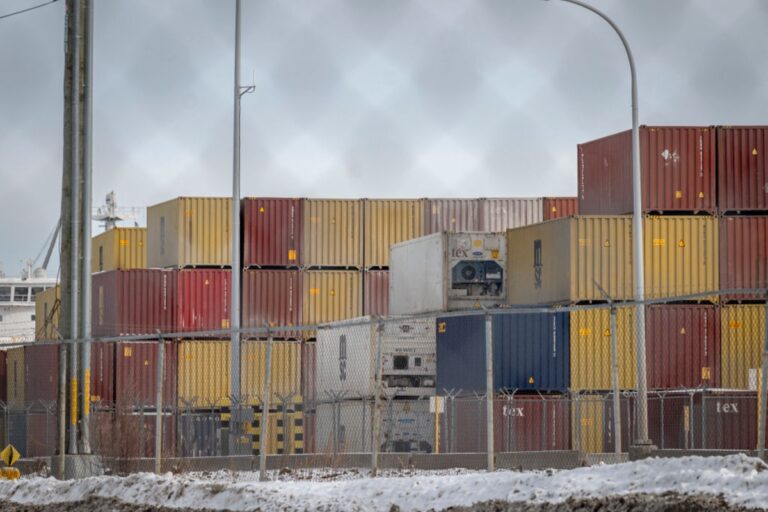
Shipping containers are seen at the Port of Montreal in Montreal, Canada, on February 2, 2025. Canada will hit back at US tariffs with 25 percent levies of its own on select American goods. ANDREJ IVANOV/AFP via Getty Images
Canada formally activated its most sweeping retaliatory trade measures yet on Tuesday, releasing a 700-item counter-tariff list covering C$27.6 billion in U.S. imports (approximately $19.91 billion USD), with duties of 15%, 25%, and 50% set to take effect September 8. Finance Minister François-Philippe Champagne announced the package alongside a C$7.5 billion worker support package (approximately $5.41 billion USD) — the largest single retaliatory move Canada has made since the United States triggered the current conflict in early 2025.
The announcement came three days after trade talks between Ottawa and Washington collapsed on August 22, when the U.S. imposed 50% tariffs on Canada — covering C$27.6 billion in goods — the latest escalation in an 18-month trade war that has already cost Canada tens of thousands of manufacturing jobs. Canada did not pause. “When the United States asked too much and offered too little, we chose to stand up for Canadians,” Champagne said during a press conference in Ottawa.
The September 8 effective date is a real operational deadline for companies on both sides of the border. With no new talks announced and both sides now operating behind mutual 50% tariff walls on targeted goods, the two countries appear to be settling into a sustained economic standoff — one that will be felt in factory floors, freight yards, and grocery aisles on both sides of the world’s longest undefended border.
Tiered Rates Designed to Mirror — and Signal
The counter-tariff architecture is deliberate. Canada matched U.S. tariff rates on a product-by-product basis, imposing 50% duties where the U.S. imposed 50% on equivalent Canadian products, 25% where the U.S. applied 25%, and 15% where the U.S. applied 15%, per the September 8 counter-tariff list.
At the top tier, goods facing the 50% rate include steel and aluminum products — which Ottawa is doubling from prior 25% duties — as well as furniture, clothing, and apparel. These sectors were selected in part because they have readily available domestic alternatives, making it possible to hurt American businesses without forcing Canadian consumers to absorb the full cost, according to Bradley Saunders, North America economist at Capital Economics. In the middle tier, 25% tariffs cover appliances, dairy, fish and seafood, and certain steel and aluminum derivative products. The lightest tier, at 15%, covers electronics and tools.
The list also extends to agricultural equipment, pulp and paper, and plastics — sectors reflecting Canada’s strategic calculation that it can redirect buying toward domestic or third-country suppliers while squeezing American producers of goods with few substitutes, per the Finance Department’s official announcement.
One early indicator of this strategy’s potential: U.S. steel imports to Canada have already fallen approximately 30% since Canada previously imposed a 25% tariff on that sector, according to trade analysts. The new 50% rate is expected to push that figure further.
Protection, Not Revenue — Ottawa’s Stated Goal
A crucial design feature of Tuesday’s counter-tariff package is its stated purpose: Ottawa is explicit that this is a market-protection instrument, not a revenue-generation tool.
“Canada’s counter tariffs are designed primarily to protect Canadian workers and manufacturers harmed by U.S. tariffs by putting them on a better competitive standing against U.S. products in the Canadian market,” the Finance Department’s official announcement stated. The government has also confirmed that it does not expect counter-tariff revenues to cover the full cost of the support programs it is simultaneously launching.
That explicit framing distinguishes this retaliation from a simple tit-for-tat response. Canada is not primarily trying to collect money — it is trying to make American goods more expensive relative to Canadian alternatives inside the Canadian market, reshuffling domestic market share while the bilateral standoff continues. The implication for American exporters of steel, dairy, appliances, and electronics is direct: their competitiveness in one of the United States’ largest export markets will deteriorate on September 8 regardless of what happens in any future negotiations.
C$7.5 Billion for Workers and Businesses — What’s Actually Available
Alongside the tariff list, Ottawa unveiled a C$7.5 billion (approximately $5.41 billion USD) package of worker and business supports, presented as the largest single tranche of such aid since the conflict began.
The package breaks down across five main streams:
Regional Tariff Response Initiative: The government is adding C$1.5 billion (approximately $1.08 billion USD) through Canada’s seven Regional Development Agencies, with the cap on non-repayable contributions raised for qualifying small and medium-sized enterprises.
BDC Pivot to Grow: The Business Development Bank of Canada will add a second C$500 million (approximately $361 million USD) Pivot to Grow liquidity stream, offering working capital loans of $250,000 to C$5 million with interest-only payments over 36 months. The minimum annual revenue threshold has been lowered to C$1 million to expand eligibility.
Canada Strong Diversification Fund: A new C$2 billion (approximately $1.44 billion USD) Canada Strong Diversification Fund will support tariff-affected companies with shovel-ready capital maintenance projects through a fast-track, single-step approval process.
Worker Supports: C$3.5 billion (approximately $2.53 billion USD) in rapid-response worker supports includes extended Employment Insurance flexibilities — the one-week EI waiting period waiver and the extra 20 weeks of benefits for long-tenured workers are extended for another year — and a new Worker Retention and Retraining Program that enables employers to share working hours, with the government compensating workers for the hours not worked.
Large Enterprise Facility: The existing C$10 billion (approximately $7.21 billion USD) Large Enterprise Tariff Loan facility gains expanded loan terms and coverage, with liquidity support extended from 24 to 36 months and maximum loan terms stretched from 10 to 15 years.
The government acknowledged that it does not expect counter-tariff revenues to offset the full cost of these support programs, meaning this package is net spending — fiscal stimulus deployed to cushion the economic impact of a trade war Ottawa did not choose.
Business groups have reacted cautiously. Industry sources described the government’s aid package as “economic chemotherapy” — necessary to manage the symptoms of a damaging situation, but not a cure for the underlying disease.
What Collapsed, and How It Got There
Tuesday’s announcement is the direct consequence of failed negotiations, not a tactical gambit. The talks broke down on August 22, after the United States put forward terms Champagne characterized as “uneconomic, unfair, and ultimately unacceptable.” Prime Minister Mark Carney was more direct: Carney declared Canada “at war” because Canada “got attacked.”
Carney said American negotiators had approached the table with the attitude that Canada is a subsidiary of the United States — something Canada would not accept. In French, he was blunter still, saying the Americans had wanted to destroy Canada’s major industries — autos, steel, aluminum — which was the primary reason Canada walked away from what he called a bad deal, according to French-language remarks reported by France 24.
U.S. Trade Representative Jamieson Greer offered a competing account, saying Washington had extended the best treatment of any major exporter to Canada and that Canada had introduced new demands and reversed prior commitments in the final stretch of talks, according to a statement from the U.S. Trade Representative’s office. The two accounts are irreconcilable.
Complicating the picture: Trump posted on Truth Social claiming the U.S. had lost $60 billion annually to Canada for a decade. Statistics Canada’s annual merchandise trade data shows Canada’s goods surplus with the U.S. was C$81.6 billion for all of 2025 — equivalent to approximately $58.9 billion USD at current exchange rates, roughly consistent with Trump’s figure in U.S. dollar terms, though Canada attributes the gap primarily to energy exports and the deep integration of cross-border supply chains.
Steel’s Particular Vulnerability
No sector illustrates the structural stakes more clearly than steel and aluminum. Canada is the largest U.S. supplier of both metals by a wide margin. In 2024, Canada exported approximately $7.1 billion USD worth of steel and $9.4 billion USD worth of aluminum to the United States, accounting for 23% of steel imports and more than half of U.S. primary aluminum consumption. Roughly 90% of Canada’s steel exports flow to American customers.
The integration runs in both directions. Intermediate goods in sectors like HVAC, automotive, and construction cross the border during production multiple times before reaching their final form, meaning a 50% tariff at the border hits the same raw material more than once over the course of a production cycle. The result is that the nominal 50% tariff rate significantly understates the cumulative cost imposed on manufacturers with integrated cross-border supply chains.
Early 2026 export data had already shown weakness in tariff-exposed manufacturing industries, particularly motor vehicles and parts, steel and aluminum products, and downstream forestry products. The latest escalation on both sides is expected to accelerate those trends.
Analysts at Capital Economics estimate that nearly 90,000 Canadian jobs could be lost if the new round of U.S. tariffs remains in place.
What Canada and the U.S. Are Doing to Each Other’s Consumers
For American consumers, Canada’s new tariffs will raise costs on specific product categories. Goods most directly affected for U.S. households include: steel and aluminum products and anything made from them (appliances, tools, construction materials); dairy and cheese products; electronics and related goods; and seafood. CNN Business analysts reported that steep Canadian tariffs on U.S. goods could weaken demand for American products, potentially causing U.S. employers to cut hours or resort to layoffs.
For Canadian consumers and businesses, the picture is a mirror image. Ottawa has argued that the counter-tariffs were designed to minimize pass-through cost increases for Canadians by targeting goods with domestic alternatives. But business groups responding to Tuesday’s announcement expressed concern that the combination of retaliatory tariffs and the U.S. duties they respond to will raise input costs even for companies benefiting from the market-protection intent.
Looking Longer — Ottawa’s Diversification Bet
The September 8 deadline frames a near-term crisis. But Canada’s broader strategic response to the trade war is playing out over a longer horizon. Prime Minister Carney has stated a goal of doubling Canada’s non-U.S. exports within 10 years. He has traveled to India, Australia, Japan, and China in pursuit of new trade relationships — and the January 2026 preliminary trade agreement with China, struck during Carney’s Beijing visit, is the most significant single piece of trade diversification Canada has achieved since the conflict began.
Many Canadian exporters are already pivoting, with Europe and the Asia-Pacific emerging as the top regions for near-term diversification. Economists at the Fraser Institute and CD Howe Institute have flagged structural headwinds: the “gravity model” of trade means proximity and market size favor the United States over any alternative, and doubling non-U.S. exports from a base of roughly 25% of total trade is a multi-decade project even in favorable conditions.
The counter-tariff announcement does not close that gap. But it signals that Canada’s government has concluded the path to a restored trading relationship runs through demonstrated willingness to impose real costs on American businesses — not through repeated concession offers.
What the September 8 Date Means for Businesses Right Now
The September 8 effective date is a real operational deadline for companies on both sides of the border with exposure to the 700+ product categories. The tariffs take effect at 12:01 a.m. ET on September 8, 2026, with one exception: goods already in transit to Canada on that date are exempt.
For American producers of steel, aluminum, appliances, dairy, electronics, and tools — the sectors most heavily represented in the counter-tariff list — the window before September 8 is the last opportunity to negotiate pricing, confirm order volumes, or explore alternative sales channels in other markets.
For Canadian businesses affected by U.S. tariffs, the C$7.5 billion support is open for applications. Companies can contact Canada’s Regional Development Agencies for non-repayable grant support, apply to the Business Development Bank through its Pivot to Grow program, or explore the new Canada Strong Diversification Fund for capital maintenance projects.
For workers in affected sectors — steel, automotive, forestry, electronics — the extended EI flexibilities mean less financial risk from hours reductions, and the new Worker Retention and Retraining Program means employers have a financial incentive to keep people employed rather than lay them off.
Currency conversions in this article are approximate and based on exchange rates as of August 25, 2026.
Frequently Asked Questions
Which U.S. products will face Canada’s new counter-tariffs starting September 8?
Canada’s counter-tariff list covers over 700 U.S. products across a tiered rate structure: 50% duties apply to steel and aluminum products (doubled from the prior 25% rate), furniture, and clothing and apparel; 25% applies to cheese and dairy products, appliances, fish and seafood, and certain steel and aluminum derivatives; 15% applies to electronics and tools. The list also includes agricultural equipment, pulp and paper, and plastics. Goods already in transit to Canada on September 8 are exempt. The full counter-tariff product list is published by the Canadian Department of Finance.
What financial help is available for Canadian businesses and workers hit by the U.S. tariffs?
The C$7.5 billion (approximately $5.41 billion USD) support package announced August 25 includes several streams: C$1.5 billion through Regional Development Agencies for small and medium-sized enterprises; a new C$500 million BDC Pivot to Grow liquidity stream (interest-only loans from $250,000 to C$5 million, minimum revenue threshold lowered to C$1 million); a C$2 billion Canada Strong Diversification Fund for shovel-ready capital projects; C$3.5 billion in worker supports including extended EI flexibilities and the new Worker Retention and Retraining Program; and expanded terms on the C$10 billion Large Enterprise Tariff Loan facility.
Can Canada and the U.S. still reach a deal before September 8?
No new talks have been announced as of this writing. The talks that collapsed on August 22 were the result of weeks of intensive daily meetings at senior levels. Champagne said the U.S. demanded terms that were “uneconomic, unfair, and ultimately unacceptable,” and Carney characterized the U.S. negotiating stance as treating Canada as a subsidiary. Whether either side will seek to restart talks before September 8 — a window of less than two weeks — is unknown. The tariffs are scheduled to take effect automatically at 12:01 a.m. ET on September 8 without further parliamentary action.
Why is Canada the most affected country in this trade war compared to other U.S. trading partners?
Canada’s economic exposure to the United States is uniquely deep. Canada sends approximately 73 to 75% of its goods exports to the U.S., making it more dependent on a single market than almost any comparable economy, according to Statistics Canada export destination data. Canada is also the United States’ largest supplier of both steel and aluminum — accounting for roughly 23% of U.S. steel imports and more than half of U.S. primary aluminum consumption — meaning the tariff conflict strikes at industries that are structurally essential to both economies simultaneously. The degree of supply chain integration — automotive components crossing the border up to eight times per production cycle — amplifies the cost impact beyond the nominal tariff rate, per Business Data Lab’s 2024 analysis.