HomeAuto VW Workers Ranked Communication Failure Over Jobs; Blume Needs Their Board Votes by September
VW Workers Ranked Communication Failure Over Jobs; Blume Needs Their Board Votes by September
August 25, 2026:
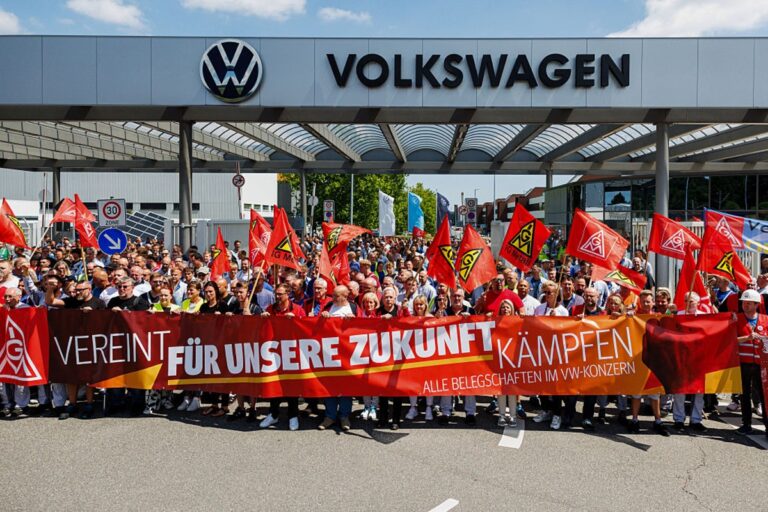
Employees of German car maker Volkswagen (VW) wave flags and display a banner with the lettering ‘To fight united for our future – all workforces across the VW Group’ as they take part in a rally called by German trade union IG Metall to protest against restructuring and mass job cut plans at the VW plant in Zwickau, eastern Germany on July 9, 2026. IG Metall is organising protests by VW workers outside plants across the country on July 9, when the carmaker’s bosses will present the restructuring plans to the supervisory board. Europe’s largest carmaker has come under intense pressure from US tariffs, slimmer profit margins from electric cars and above all intense competition in China, the world’s largest auto market. VW, whose 10 brands range from mass-market Seats to premium Porsches, is already in the process of axing 50,000 jobs in Germany by 2030, including 35,000 at its namesake marque. Jens SCHLÜTER/AFP via Getty Images
An internal survey commissioned by Volkswagen’s powerful works council found that employees ranked the management board’s communication as their number one grievance ahead of the town hall series beginning Tuesday — placing it above concerns about job security or factory closures. The survey, conducted last week through VW’s company intranet, delivered what works council representatives called a damning assessment: that the board had engaged in “disastrous” communication that left employees and their families “unsettled and frightened,” according to the German Press Agency.
The finding matters beyond its headline number. Under Germany’s Codetermination Act of 1976 — the Mitbestimmungsgesetz — companies with more than 2,000 employees must give worker representatives half the seats on the supervisory board that governs major corporate decisions. At Volkswagen specifically, labor’s position is even stronger: employee representatives hold ten of the supervisory board’s twenty seats, and the state government of Lower Saxony — which holds roughly 20% of VW’s ordinary shares and is legally empowered to appoint two additional representatives under the VW Law (Volkswagengesetz) — typically votes in alignment with labor. That alignment produces a de facto majority of twelve of twenty supervisory board members — what automotive expert Stefan Bratzel of the Center of Automotive Management has described in a single word: “blocking power.” The supervisory board is scheduled to reconvene on September 4.
This is not a union making demands from outside a negotiating table. This is the workforce asserting institutional authority over the boardroom — and a CEO who cannot recover his employees’ trust before September 4 cannot pass a restructuring plan.
CEO Faces Workers Tuesday at Nine Extraordinary Meetings Labor Demanded
CEO Oliver Blume and other board members will begin a tour of Volkswagen’s German manufacturing sites this week for nine extraordinary works meetings. The first is scheduled for Tuesday, August 25, at VW’s iconic Wolfsburg headquarters. Meetings at Emden and Zwickau — two of the four factories facing potential closure — are scheduled for Wednesday, August 26. The series will conclude at the Hannover facility on August 31.
These meetings were not management’s initiative. The works council distributed a special edition of its newspaper to the workforce in July, stating that Blume would have to answer directly to staff at meetings scheduled after the summer break. The demand followed the leak of restructuring details to media outlets before employees had been formally briefed — a sequence that labor representatives viewed as a breach of VW’s co-determination culture, in which workers are entitled to be consulted before major decisions are announced publicly.
Works council chair Cavallo — Germany’s most powerful employee-side representative — who holds what Die Tageszeitung and Manager Magazin have described as “probably the most powerful position on the employee side in German industry” — has not softened her language as the town halls approach. She has declared that “the situation has reached a breaking point” and that “the management board’s treatment of the workforce shows an unparalleled lack of respect,” demanding that Blume “at least contain this massive damage.” IG Metall president Christiane Benner, who simultaneously serves as deputy chair of VW’s supervisory board, was equally unequivocal: “Not on our watch.”
What the Survey Actually Found — and Why Communication Beating Job Security Is the Story
Employees responding to the works council’s intranet survey were given the opportunity to express criticism and expectations of Blume and the rest of the board. The result: workers ranked communication above job fears above plant closure fears specifically.
This is counterintuitive only on the surface. Workers at an employer potentially cutting 100,000 positions rating communication more urgently than the cuts themselves reflects a specific kind of institutional distrust: the sense that management is making decisions affecting their futures in private, then telling the media before telling them. That sequence — which is what happened when Manager Magazin reported the 100,000-figure before Blume had presented it to the supervisory board — transforms uncertainty about outcomes into certainty about disrespect.
In an internal post to staff on Sunday, August 24, Blume acknowledged the severity of the situation. “The situation is more than critical,” he wrote, adding that current margins of below 4% were “not sufficient to generate enough funds in the long term for new technologies, new products and our sites.” In a separate Friday memo seen by Reuters, Blume acknowledged four plants — Emden, Hannover, Zwickau, and Neckarsulm — could not be confirmed as having competitive uses through the 2030s, while stressing that no specific closure decision had yet been made.
The gap between what employees can read in the business press and what management has formally communicated internally is the operational definition of the communication crisis the survey surfaced.
How Badly Does VW Need to Cut Costs?
The commercial pressures on Volkswagen are severe, structural, and have been building for years. In a July 2026 memo, Blume described a roughly 20% cost disadvantage against comparable rivals — a figure that drove his “theoretical” calculation that 50,000 additional jobs beyond the 50,000 already committed would be required to close the gap. His most recent communication, the August 21 memo seen by Reuters, went further: overhead costs at VW remain more than 30% higher than those of comparable firms. Volkswagen reported an 11.6% operating result decline to €5.9 billion (approximately $6.9 billion) for the first half of 2026, with its operating margin falling from 4.2% to 3.8%.
The structural causes are well-documented: aggressive Chinese competition entering European markets, falling profits and deliveries in China (where the group’s first-half 2026 deliveries fell approximately 26% year over year), and US import tariffs that Blume has estimated cost VW roughly €5 billion (approximately $5.8 billion) annually.
The capacity data at the specific plants under threat is stark. VW’s German car plants are estimated to operate at 81% of standard capacity in 2026, falling to 73% by the end of the decade. Among the four sites most at risk, Zwickau has the highest 2026 utilization rate at 88% — but that figure is forecast to fall to 42% by 2030. Zwickau was retooled in 2020 as VW’s flagship all-electric vehicle factory, originally intended to support five battery-electric models. Today it produces a single EV model, the ID.3, having shed the expanded portfolio its conversion assumed.
Volkswagen’s shares have lost roughly 60% of their value since Blume became CEO nearly four years ago.
Can Germany’s Codetermination Structure Both Protect and Enable the Restructuring?
What makes this week’s confrontation structurally different from any other major automotive restructuring is the specific legal architecture of German co-determination — a framework enacted in its modern form by the Mitbestimmungsgesetz of 1976, which requires companies with more than 2,000 employees to fill exactly half their supervisory board seats with worker representatives. The law was designed explicitly to ensure that workers participate in decisions about their company’s future — not merely react to them.
At Volkswagen, this structure is reinforced by the Volkswagengesetz — the VW Law, a federal statute dating to 1960 that gives the state of Lower Saxony a statutory veto on major decisions including plant closures, provided it holds at least 15% of the company’s ordinary shares. Lower Saxony currently holds approximately 20%. The practical result is that labor representatives and Lower Saxony together control twelve of the twenty supervisory board seats — a majority that can, and has, blocked management proposals. The supervisory board rejected Blume’s most recent restructuring proposals at its July 2026 meeting.
This is why the communication failure documented by the works council survey is not primarily a public relations problem. It is a governance problem. A CEO who cannot restore basic institutional trust with his workforce before the September 4 supervisory board meeting is a CEO whose restructuring plan cannot proceed — regardless of what the financial case for it looks like.
The framework also shapes what the restructuring can look like in practice. Under the Works Constitution Act (Betriebsverfassungsgesetz), the works council must be consulted before major restructuring actions, and workers can demand a Sozialplan — a social plan providing protections, severance, and transition support — before accepting any redundancies. No compulsory redundancies can proceed without that process.
What Comes Next — and What the “Intelligent Solutions” Alternative Actually Looks Like
Blume has acknowledged the structural bind and has framed alternatives to outright closures as his preferred path. He has described possibilities including converting underused factories to defense production or manufacturing models designed for the Chinese market in Germany — what he calls “intelligent solutions.”
The status of those alternatives is more complicated than the framing suggests. Volkswagen’s Osnabrück factory, which produces the T-Roc Cabriolet until 2027, had been in talks with Israeli state defense company Rafael Advanced Defense Systems for a conversion to military production. Qatar Investment Authority — VW’s third-largest shareholder with roughly 17% of ordinary shares — reportedly vetoed that specific arrangement according to Bloomberg and Carscoops. Volkswagen is continuing to evaluate options for the site, but no binding agreement has been announced. For the four plants specifically named by Blume as lacking confirmed competitive uses through the 2030s, no concrete alternative has been publicly committed.
Under the December 2024 agreement with IG Metall, VW committed to avoiding German plant closures while that contract remains in force. That commitment created the expectation that alternatives would be found — and it is the failure to produce those alternatives that has driven the current standoff.
The underlying capacity arithmetic, however, does not resolve itself through negotiation. A factory forecast at 42% utilization by 2030 is not commercially sustainable regardless of the legal framework protecting it. The question the September 4 supervisory board meeting will ultimately have to confront is whether a restructuring that preserves the legal framework while achieving the financial outcomes is mathematically possible — or whether the co-determination structure’s blocking power will enforce a slower, more costly path to a similar destination.
How Does VW Stack Up Against Its German Automotive Peers?
Volkswagen’s situation is severe, but it is not unique within German automotive manufacturing. Porsche AG — a VW Group subsidiary — reached a deal in July 2026 to cut 9,000 positions (one in five of its workforce) after a 93% operating profit collapse. Mercedes-Benz CEO Ola Källenius noted last month that German operations carry costs approximately 70% higher than at its plants in Hungary. BMW has posted its steepest quarterly profit decline in years. Germany’s automotive association VDA estimates 225,000 jobs could disappear from the broader sector by 2035, on top of approximately 100,000 already lost since 2019.
The pattern is consistent: the German automotive industry’s cost structure was designed around a market environment — stable China growth, low tariffs, delayed EV competition from domestic Chinese manufacturers — that no longer exists. VW’s restructuring crisis is the most visible instance of that structural mismatch, not its cause.
Frequently Asked Questions
Why do VW workers care more about communication than jobs — isn’t the job loss the actual problem?
The survey finding reflects something specific about how institutional trust works in a German co-determination setting. Workers are not unconcerned about their jobs — they are saying that management’s practice of allowing restructuring details to appear in business media before being communicated to employees is itself the more urgent threat. That sequence undermines the co-determination framework that is supposed to give workers a voice before decisions are made. When management communicates through media leaks rather than formal channels, workers lose the ability to participate in the process — which is what German law entitles them to. The communication failure and the governance failure are the same failure.
What is Germany’s Codetermination Act, and why does it specifically matter for VW?
The Mitbestimmungsgesetz of 1976 requires German companies with more than 2,000 employees to give workers exactly half the seats on the supervisory board that governs major corporate decisions — including restructuring plans, plant closures, and strategic investments. At Volkswagen specifically, the Volkswagengesetz (VW Law) additionally gives the state of Lower Saxony a statutory veto over major decisions as long as it holds at least 15% of ordinary shares (currently approximately 20%). Lower Saxony typically votes with labor, creating a de facto twelve-of-twenty majority that can block any restructuring proposal. This is why a management communication failure at VW is not primarily a PR problem — it is a governance problem. Without restoring enough trust to secure labor’s supervisory board cooperation, no restructuring plan can advance.
Will VW definitely close German factories?
No closure decision has been formally announced. Blume has acknowledged that four sites — Emden, Hannover, Zwickau, and Neckarsulm — lack confirmed competitive uses through the 2030s, but has stressed this is an assessment rather than a closure commitment. The December 2024 restructuring agreement with IG Metall included a commitment to avoid German plant closures while the current work contracts are in force, which has led management to explore alternatives including converting sites to defense production or Chinese-market vehicle manufacturing. Neither alternative currently has a binding agreement in place. The September 4 supervisory board reconvene is the next formal decision point.
How many total VW jobs are at risk, and over what timeframe?
Volkswagen has committed to approximately 50,000 job reductions across the group — including at brands like Audi and Porsche — by 2030, as part of the December 2024 agreement with unions. Blume’s July 2026 internal memo indicated that an additional 50,000 positions could be required on top of that total to close what he described as a roughly 20% cost disadvantage against comparable rivals, bringing the potential total to approximately 100,000. More recent reporting on Blume’s August 21 memo indicates overhead costs are “more than 30 percent higher” than comparable companies, suggesting the financial pressure has intensified rather than eased. These figures span the full VW Group — including its roughly 625,000 global employees — not just the German operations at most immediate risk.