HomeAuto Operation Economic Outcast Targets Bank Melli: Digital Assets Added, Chinese Banks Spared
Operation Economic Outcast Targets Bank Melli: Digital Assets Added, Chinese Banks Spared
August 25, 2026:
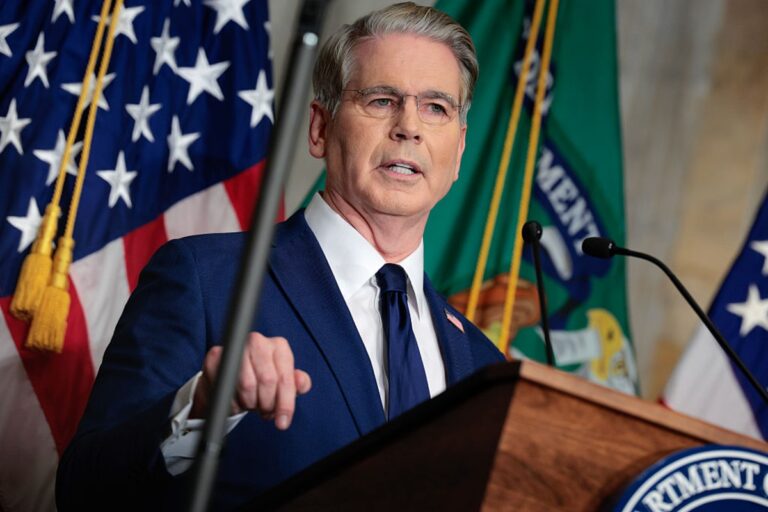
WASHINGTON, DC – AUGUST 24: U.S. Treasury Secretary Scott Bessent announces a new set of sanctions against Iran, describing them as “an economic D-Day”, in the Cash Room at the Treasury Department on August 24, 2026 in Washington, DC. Bessent threatened Iran in an opinion piece in the Financial Times on Sunday with “the single greatest financial offensive ever”, almost six months after the United States and Israel launched a war against Iran in February. Chip Somodevilla/Getty Images
Treasury Secretary Scott Bessent on Monday launched “Operation Economic Outcast,” designating more than 60 entities, individuals, and vessels worldwide, naming Iran’s largest state bank for mandatory shutdown, and expanding secondary sanctions into five specific sectors — including, for the first time, digital assets as a target — in what he called “the single greatest financial offensive ever marshaled against an adversary.” The operation simultaneously suspended several general licenses that had previously permitted limited Iranian transactions, closed what officials called a “zero-leakage” enforcement architecture, and issued new secondary sanctions guidance targeting any entity that pays fees to Iran’s Persian Gulf Strait Authority — the IRGC-backed body that administers Hormuz transit tolls and was itself designated by OFAC earlier in May 2026 — among the primary enforcement targets.
The announcement, made at a press conference in the Treasury Department’s Cash Room, arrived six months after the United States and Israel launched military operations against Iran on February 28, 2026, and one week after the June MOU expired without a successor agreement. The UAE’s decision to suspend all trade and financial transactions with Iran on August 19 — triggered by incoming ballistic missile fire that sent shelter warnings across the country — has already closed one of Tehran’s most important financial back doors, according to Bessent, who described the UAE move as “likely causal.”
What Operation Economic Outcast Actually Designates
The operation targets five sectors Bessent described as Iran’s most vital remaining financial lifelines: digital assets, technology, gold, aviation, and shipping. Each category now carries expanded secondary sanctions risk — meaning any foreign bank, company, or institution facilitating Iranian transactions in those sectors faces exposure to the US dollar-clearing exclusion that makes the Specially Designated Nationals list effectively a global commercial blacklist.
The 60-plus entities designated Monday span Iran’s nuclear and missile technology procurement pipelines, cyber operations infrastructure, and the network of brokers, companies, and tankers — operating across the UAE, Hong Kong, China, Singapore, Switzerland, and Europe — that has been moving oil revenue to the IRGC–Qods Force globally.
The single most pointed designation was aimed at Iran’s Bank Melli. Bessent said the institution, which maintains branches across the Gulf, must be “shuttered and dark.” Bank Melli is Iran’s largest state-owned bank; naming it for shutdown — rather than merely designating individual accounts or transactions — represents an escalation beyond the standard SDN designation framework.
OFAC also suspended several general licenses that had previously authorized certain remittances and Iranian access to US cultural and academic institutions. New guidance issued Monday clarified that shipping companies and insurers that pay PGSA “insurance” fees to transit the strait — insurance against risks Iran itself creates — face secondary sanctions exposure under the expanded architecture.
Digital Assets: The New Sanctions Frontier
The inclusion of digital assets as an explicit secondary sanctions target closes a loophole that critics had identified in the existing Iran sanctions architecture. Over the past six months, Iranian-linked entities have increasingly used cryptocurrency networks to route oil proceeds outside the US dollar system, alongside the parallel yuan-denominated payment network that Beijing has built specifically to reduce reliance on dollar clearing. By naming digital assets as a sanctioned sector, the Treasury is asserting that any crypto exchange, digital wallet service, or blockchain-based transaction platform enabling Iranian oil payments now faces the same SDN exposure as a conventional bank doing the same.
This is the technology policy dimension of Monday’s announcement: the US government formally extended its financial sanctions architecture into the cryptocurrency and digital finance space through this action. It is the first time digital assets have been named as an explicit target category in the Iran secondary sanctions regime.
China in the Crosshairs — and the Structural Paradox
The most consequential question hanging over Monday’s announcement is whether Washington will extend secondary sanctions to major Chinese state-owned banks — the institutions that finance roughly 90% of Iran’s oil exports that flow to China. Bessent declined to name specific Chinese institutions but said “no one is above the reach of U.S. sanctions” when asked directly.
China’s Foreign Ministry spokesperson Lin Jian said sanctions and pressure would not resolve the situation and called for a diplomatic and political solution. Brett Erickson, managing principal of Obsidian Risk Advisors and a sanctions expert in Washington, offered a blunter verdict: the campaign was “not economic D-Day” — “it was something in the middle.” He posed the central enforcement question directly: “If the United States is unwilling to meaningfully target China, can Washington reasonably justify damaging our international relations and global standing, for a strategy with only a farfetched likelihood of achieving victory?”
That question is sharpened by a specific diplomatic calendar constraint: President Trump is scheduled to host Chinese President Xi Jinping at the White House on September 24. Designating Chinese state banks before that meeting risks derailing it at a moment when Washington is also managing China’s rare-earth mineral export restrictions set to take effect in November.
There is a deeper structural paradox that Bessent did not address Monday. The enforcement mechanism behind secondary sanctions is the US dollar’s role as the settlement currency for most global commodity trade — an entity that loses access to dollar clearing loses access to global commerce. But targeting Chinese state banks at scale would create exactly the crisis of confidence in that system that China has been working to preempt, by building the yuan-based Cross-border Interbank Payment System (CIPS) as a dollar-clearing alternative. Maximum enforcement could accelerate the very de-dollarization trend that would, over time, reduce the leverage secondary sanctions derive from dollar primacy. Bessent acknowledged the tension obliquely, asking why he would “blow up the global financial system.”
Iran’s Economy — and Its Staying Power
Iran entered this phase of economic pressure already under severe strain. The rial dropped to approximately 2.02 million to the US dollar on informal currency markets on Monday — where most Iranians transact — compared with the official Central Bank rate of roughly 1.5 million. The gap between those two figures reflects the depth of economic dislocation that six months of war has produced.
The International Monetary Fund forecasts Iran’s GDP contracting more than 5% in 2026, which would be the country’s most severe contraction since the prior era of maximum pressure in 2018–2019. Prices for staple goods have surged significantly. The economic toll has accumulated over years: research by economists Nader Habibi and Mohammad Reza Farzanegan found that Iran’s middle class shrank 28% between 2012 and 2019 as a result of prior sanctions campaigns — a structural weakening that preceded the current conflict.
Yet economic pressure has not yet produced political capitulation. Iran’s Foreign Ministry warned Monday that “any escalation of this situation will undoubtedly bring about consequences,” and Mohsen Rezaei, Iran’s security chief, threatened to target oil-shipping routes out of the Persian Gulf — including the Strait of Hormuz — if regional neighbors joined Washington’s pressure campaign. State media called the sanctions “an implicit admission of the enemy’s humiliating defeat.”
Alan Eyre, a former US diplomat who participated in nuclear negotiations with Iran through 2015, told NPR Monday that Washington has already exhausted the hierarchy of available pressure: “the low-hanging fruit, the mid-hanging fruit, the high-hanging fruit, the tree.” The structural counter — Tehran’s sanctions-evasion architecture of shadow fleet vessels using falsified Automatic Identification System tracking data, ship-to-ship transfers in international waters, and flag-hopping registration changes — has been built over years and will not dissolve in response to a press conference.
Why Oil Prices Fell on the Announcement
In a counterintuitive market response that illustrates the complexity of the moment, oil prices fell sharply after the announcement, reversing a two-week rally that had pushed crude up more than 13%. West Texas Intermediate futures declined about 2.5% to $84.89 per barrel. Brent crude fell a similar amount to $92.06 a barrel.
The move reflected markets’ read that a prolonged economic confrontation — rather than swift military escalation or a rapid deal — is now the most likely near-term scenario. Commonwealth Bank of Australia forecasts Brent trading between $70 and $100 per barrel through the second half of 2026, with prices potentially sliding toward the bottom of that range if Strait of Hormuz flows recover even modestly. The bank estimated that as little as 50% to 60% of pre-war quantities transiting the strait would be enough to revive expectations of an oversupplied global market.
The rally that preceded Monday’s announcement had been fueled by hope that a new deal with Tehran was imminent. When that agreement never materialized and both sides’ rhetoric sharpened last week, Brent had surged back to $94 a barrel — its highest level since the conflict began. Monday’s press conference effectively closed that trade: the administration has chosen the economic lever as its primary instrument of coercion, at least through the November midterm elections.
Is Back-Channel Diplomacy Still Running?
Even as Bessent announced what he characterized as a financial endgame, a parallel diplomatic track was visibly active Monday. Pakistan’s army chief, Field Marshal Asim Munir, arrived in Tehran Monday at the head of an official delegation, with Pakistan’s military describing the trip as “part of Pakistan’s efforts to promote regional peace and stability.” Oman’s foreign minister is scheduled to follow on Tuesday — suggesting that back-channel mediation through the region’s traditional intermediaries continues even as Washington escalates its economic pressure.
The geopolitical backdrop makes the diplomatic picture more complex: whether the sanctions prove a genuine endgame or another turn in a prolonged war of economic attrition may ultimately hinge on the answer to the question Bessent declined to give Monday — whether Chinese state banks will be designated, and whether the September 24 Trump-Xi summit provides the leverage or the constraint that determines that answer.
Bessent acknowledged the limits of his own timeline: “I’m not going to set a timeline, but we do not have infinite patience here.” The “cure period” he described — giving entities time to “remedy bad behavior” before the most severe secondary sanctions are triggered — signals that the campaign is designed for sustained escalation rather than immediate maximum force. Whether that paced approach produces compliance or simply buys Iran’s remaining trade partners time to deepen yuan-denominated workarounds is the central question markets and analysts will be pricing for weeks to come.
Frequently Asked Questions
What is Operation Economic Outcast and what does it specifically do?
Operation Economic Outcast is the Trump administration’s expanded sanctions campaign launched August 24, 2026, targeting Iran’s remaining global financial connections. Specifically, it designated more than 60 entities, individuals, and vessels worldwide; named Iran’s largest state bank, Bank Melli, for mandatory shutdown; expanded secondary sanctions into five sectors (digital assets, technology, gold, aviation, and shipping) including digital assets for the first time; suspended several existing general licenses that had permitted limited Iranian transactions; and issued new guidance clarifying that shipping companies and insurers paying fees to the Persian Gulf Strait Authority — the IRGC-backed body that administers Hormuz transit tolls and was previously designated by OFAC in May 2026 — now face secondary sanctions exposure. Any foreign bank, company, or individual that conducts transactions in those sectors with Iranian-linked parties faces the risk of being cut off from the US dollar clearing system that underlies most global trade.
Will the US actually sanction Chinese banks over Iran oil purchases?
That is the central unanswered question the announcement left open. China purchases roughly 90% of Iran’s oil exports, making Chinese state banks the primary financial channel sustaining Iran’s oil revenue. Bessent said “no one is above the reach of US sanctions” but declined to name specific Chinese institutions or set a deadline. The Trump-Xi White House summit scheduled for September 24 creates a direct diplomatic constraint: sanctioning major Chinese state banks before that meeting risks derailing it, while abstaining from that action raises questions about whether the “total isolation” Bessent described is achievable. Sanctions expert Brett Erickson of Obsidian Risk Advisors said the willingness to target Chinese banks is “the true signal of resolve” in this campaign.
Why did oil prices fall when Iran sanctions tightened?
Markets interpreted Monday’s announcement as confirmation that a prolonged economic confrontation — not an imminent deal or sharp military escalation — is the most likely near-term scenario. A prolonged but uncertain pressure campaign is less bullish for oil than an imminent military escalation or outright Hormuz closure would be. Commonwealth Bank of Australia projects Brent in a $70–$100 range through the second half of 2026, and estimates that even a partial Hormuz recovery to 50–60% of pre-war flow could be sufficient to revive oversupply expectations. The two-week rally that preceded the announcement had been driven by hope for a new diplomatic deal; when that deal did not materialize, oil had already priced in significant geopolitical risk, leaving the announcement itself as a “sell the news” event.
What is the structural weakness in the secondary sanctions strategy?
Secondary sanctions derive their power from the US dollar’s role as the world’s primary trade settlement currency: an entity cut off from dollar clearing is effectively cut off from global commerce. But that leverage depends on the dollar remaining the dominant system. China has been building the yuan-based Cross-border Interbank Payment System (CIPS) specifically to reduce dollar-clearing dependence, and Beijing’s 2021 Blocking Rules formally instruct Chinese companies to ignore US secondary sanctions designations. If the US escalates secondary sanctions aggressively against Chinese state banks, it risks accelerating China’s investment in non-dollar payment infrastructure — potentially reducing the long-term leverage that secondary sanctions derive from dollar primacy. This paradox — that maximum enforcement could degrade the tool for future use — is the structural constraint that no press conference can resolve.