HomeAuto Mobile Home Tornado Alert Says Seek Basement: Millions Have None, NWS Has Different Guidance
Mobile Home Tornado Alert Says Seek Basement: Millions Have None, NWS Has Different Guidance
August 24, 2026:
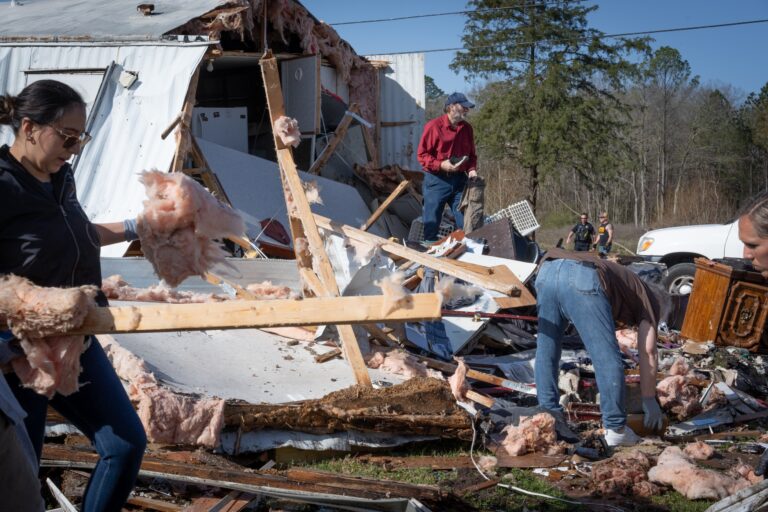
Tim Striegel, in red shirt (center) goes though his damaged belongings while volunteers help him clean up sthe morning after his mobile home was hit by a tornado on March 16, 2025 in Calera, Alabama. Jan Sonnenmair/Getty Images
When a tornado warning alert reached Shantelle Quinones on the evening of August 20, it told her to seek shelter in a basement — and she had nowhere to go. Her mobile home on Halltown Road in Hartly, Delaware, does not have one. So she took her daughter and their two dogs into a bedroom closet and waited while 105-mph (169 km/h) winds tore part of her roof off and dropped it in the front yard. WBOC confirmed her account along with other Kent County survivor stories from the night of August 20.
Quinones and her daughter survived. But her experience illustrates a documented, federally measured gap in tornado shelter equity that emergency alerts cannot close: mobile home residents are fifteen to twenty times more likely to be killed in a tornado than people in permanent homes, and the standard in-storm instruction to seek a basement is structurally impossible for millions of them to follow. The National Weather Service documents this risk explicitly, recommending that mobile home residents evacuate before storms arrive rather than shelter in place. The August 20 outbreak that confirmed at least four tornadoes across Delaware, Pennsylvania, and Maryland — leaving zero deaths or serious injuries despite significant structural destruction — did not change that statistic. It demonstrated it.
What Happened on August 20: Outbreak by the Numbers
The storm system swept through the mid-Atlantic region on the evening of August 20, bringing flash flood warnings, damaging wind gusts topping 60 mph (97 km/h), and a tornado watch covering Delaware, New Jersey, and Pennsylvania through 10 PM ET. At 5:53 PM ET, a tornado was first spotted near Hartly, about 14 miles (23 km) west of Dover. It moved east at roughly 30 mph (48 km/h). Delaware Public Media confirmed the storm timeline and the initial Hartly radar confirmation.
At 6:18 PM ET, the National Weather Service issued a Particularly Dangerous Situation tornado warning for Dover, reporting a confirmed large and extremely dangerous tornado over Dover Speedway. A trained spotter on the ground confirmed a rain-wrapped tornado with flying debris. Dover Mayor Robin Christiansen declared a state of emergency at 6:20 PM ET. The Watchers documented the real-time warning sequence and the spotter confirmation.
By Friday, August 22, the National Weather Service Mount Holly office had confirmed three tornadoes from the outbreak: an EF-1 in Dover with estimated peak winds of 105 mph (169 km/h); an EF-1 near Barclay in Queen Anne’s County, Maryland; and an EF-0 near Downingtown in Chester County, Pennsylvania. Survey teams remained active in the Hartly and Marydel areas of western Kent County, where four additional damage sites had been reported. The NWS Mount Holly Twitter account confirmed all three ratings, and 6abc Philadelphia reported the ongoing surveys.
In Dover itself, the EF-1 struck the Loockerman/Division Street corridor and Route 13 — tearing roofs off the Days Inn and Super Lodge motels, ripping open exterior walls of the Kraft-Heinz manufacturing plant at 1250 W. North St. and overturning tractor-trailers outside the facility, damaging fencing and a scoreboard at Little League fields on Electric Avenue, and snapping power lines across the city. Delaware Business Times confirmed the Kraft-Heinz facility damage with photos from the Dover Fire Department. Dover police reported no injuries from the city’s portion of the damage. CBS Philadelphia reported on Dover cleanup. The state of emergency was lifted Friday morning.
‘I Thought I Had to Say Goodbye’: Surviving Without a Basement
For Quinones, the storm arrived with no warning time to spare. She was sitting on her sofa in Hartly when the alert came through. The instruction to move to a basement registered and then hit a wall: her mobile home has no basement and no interior reinforced room.
She moved to a bedroom closet with her daughter, held her, and waited. The house began to shake. She called her mother and sister in Florida.
“I remember trying to call my mom in Florida, my sister, because I thought I had to say goodbye to them because, well, you could hear outside and the way the house was moving. It was bad,” Quinones told WBOC’s Kyra Ceryanek.
When the shaking stopped, her fiancé looked out a window and saw part of the roof in the front yard. Water was dripping through the walls and pooling on the floor of the hallway and kitchen. Minutes later, a rescue team from the Hartly Volunteer Fire Company knocked on the door and told the family to evacuate.
“It was like it was devastating because I was like, oh my God,” Quinones said. “I mean, it’s hard to see that, but it could have been so much worse. We could have lost our lives. I’m so glad that we are alive.”
Why the Shelter Guidance Fails This Population
Mobile and manufactured homes represent roughly 6% of all housing units in the United States — approximately 8 million homes housing around 20 million people, concentrated in rural and lower-income areas. The American Meteorological Society has documented this population’s outsized vulnerability in an archived policy statement. They are not safe structures during tornadoes, and federal guidance acknowledges this clearly. The National Weather Service and FEMA state explicitly that mobile and manufactured home residents should flee their homes for sturdier shelter before storms with tornadoes arrive — not shelter in place during them. The NWS official guidance page makes this recommendation in unambiguous terms.
The problem is that wireless emergency alerts do not distinguish between what a permanent-home resident and a mobile home resident should do. When an alert says “seek the lowest level of a sturdy building,” it applies equally to a family in a brick ranch house with a basement and a family in a manufactured home in a rural field. For the second family, the instruction has no viable answer.
The federal fatality data is stark. The NWS documents that roughly 72% of all tornado-related deaths occur in homes, and 54% of those housing deaths occur in mobile homes specifically — despite mobile homes making up only 6% of the housing stock. The NWS Shreveport severe weather awareness page confirms those figures in the context of community preparedness planning. A 2018 analysis by researchers Stephen Strader of Villanova University and Walker Ashley of Northern Illinois University, published in Weather, Climate, and Society, found that manufactured homes accounted for 54% of all housing-related tornado deaths from 1985 to 2017 — in a structure type representing 6% of total units. Weather Underground summarized the Strader-Ashley research alongside more recent Alabama case data.
The engineering reason is specific: mobile and manufactured homes rely on over-the-top straps or ground anchors as their primary wind-resistance mechanism. Even HUD Code-compliant anchor systems can fail at EF-1 wind speeds (86–110 mph / 138–177 km/h). The NWS notes that anchor system failures are the primary cause of the majority of fatalities, and that “even well-built manufactured homes can be destroyed if they become airborne.” The NWS manufactured home safety page explains the engineering mechanism in detail. When a roof separates — as happened to Quinones’s home on Halltown Road — the pressure differential inside the structure increases catastrophically, accelerating total failure.
What Happened When the Warning Said ‘Basement’ in Kent County
Nowhere in the August 20 storm was the guidance gap more visible than in western Kent County. John Tinger, Kent County’s chief of public safety, told WBOC that four separate damage areas were reported in the Hartly-Marydel corridor: on Grygo Road, Halltown Road, and two locations near Parker’s Chapel. No injuries were reported in any of those four areas. WBOC’s Kent County survivor coverage documented the full damage picture.
That zero-injury outcome in a rural corridor with confirmed tornado damage is notable. It reflects both rapid emergency response by local volunteer fire companies and the luck-of-the-storm-track. The Hartly Volunteer Fire Company reached Quinones’s home within minutes. Other residents made similar split-second decisions with less structure to work with.
James Rigby, a lifelong Marydel resident, described multiple trees down on his property and said it took six neighbors working together just to remove a single one. He had never seen a storm like it.
“I mean, it just came through and partied the skies and took stuff out and then — no questions — it was the blink of an eye,” Rigby told WBOC. “I mean, you can’t replace a person. So I mean, that’s all that matters to me.”
Is Your Phone App Giving You the Right Instructions? What Mobile Home Residents Should Know Instead
The NWS recommendation for mobile home residents is explicitly different from the in-storm shelter-in-place guidance for the general public. For manufactured and mobile home residents, the NWS recommends identifying a safer nearby structure in advance — a neighbor’s permanent home, a designated community shelter, a church, a school, an arena — and evacuating to it when a tornado watch (not just a warning) is issued for the area. The critical word is “before”: once a tornado warning is active, the window to travel safely may have already closed. The NWS severe weather awareness guide lays out this pre-storm evacuation protocol for this specific population.
Specific guidance from NWS mobile home safety guidance:
Know your shelter destination in advance. Identify a specific building — not a general direction — where you will go when a tornado watch is issued. This requires doing it now, before the next watch is posted.
A tornado watch means conditions are favorable for tornado development. This is the evacuation trigger, not the warning. By the time a warning is issued, a tornado may already be approaching.
If a tornado warning is issued and you cannot reach shelter, the NWS recommends abandoning the mobile home and lying flat in the nearest ditch or low-lying area — covering your head with your hands — rather than staying inside the structure.
The mid-Atlantic is not tornado alley. But it is not tornado-immune, either. The August 20 outbreak — confirmed EF-1 winds in Delaware’s state capital, mobile home roofs on the ground in Hartly, a zero-fatality outcome that depended partly on what direction a storm happened to track — illustrates why pre-storm planning for this population matters every August, not just in spring.
Dover’s Zero-Injury Outcome: What Held
In Dover’s urban damage corridor along Route 13, the result was also zero fatalities and no serious injuries despite significant structural damage to commercial buildings. Councilman David Anderson told Delaware Public Media: “There has not been reported serious injuries or deaths, which is an amazing thing considering the damage done to the Days Inn and Superlodge.” Delaware Public Media covered Dover’s cleanup and response in detail.
That outcome reflects several factors: the tornado struck primarily commercial buildings rather than high-density residential zones; it arrived in the early evening when many businesses had reduced occupancy; Dover Police moved quickly to block roads and direct evacuations; and the Particularly Dangerous Situation warning gave residents several minutes of advance notice.
One long-term Super Lodge resident, Mike Henry, was not in the building when the tornado hit and returned to find portions of the roof missing. The Red Cross provided temporary housing for the week. CBS Philadelphia reported on displaced motel residents.
The August 20 outbreak is part of a summer 2026 pattern of repeated severe weather across the mid-Atlantic, linked to El Niño amplification of stalled jet stream configurations that researchers have documented as nearly three times more common since the 1950s. The Philadelphia area has experienced multiple tornado touchdowns in recent years, including an EF-3 in the Bensalem/Trevose suburbs during a July 2021 outbreak and multiple tornadoes associated with Hurricane Ida’s remnants later that same year.
The NWS has indicated that damage survey teams will continue assessing affected areas to finalize tornado ratings. FOX Weather reported on the ongoing survey efforts and documented the Dover state of emergency in real time.
Frequently Asked Questions
If I live in a mobile home and a tornado warning is issued, what should I do?
The National Weather Service and FEMA are explicit: do not stay in a mobile or manufactured home during a tornado. The recommended action is to identify a safer nearby structure in advance — a permanent home with a basement, a designated community shelter, a church, or a public building — and evacuate to it when a tornado watch is issued, before the warning arrives. If a warning has already been issued and you cannot reach a sturdier building in time, the NWS advises abandoning the mobile home and lying flat in the nearest ditch or low-lying area, covering your head. The structure itself offers very little protection against EF-1 wind speeds of 86–110 mph (138–177 km/h), which the NWS confirms can destroy mobile homes outright.
Why are mobile homes so much more dangerous in tornadoes than regular houses?
Mobile and manufactured homes are not anchored to permanent foundations. Their primary wind-resistance mechanism is a system of straps or ground anchors — which can corrode, be improperly installed, or fail to withstand the uplift forces generated by tornado winds. Once the roof separates, the pressure differential inside the structure rises dramatically, causing catastrophic failure even in homes that were built to HUD Code standards. Researchers Strader and Ashley (Villanova and Northern Illinois universities) found that mobile homes account for 54% of all housing-related tornado deaths between 1985 and 2017 while representing just 6% of housing units — a finding that Weather Underground documented alongside Alabama case evidence, making the per-unit fatality rate roughly fifteen times higher than for permanent homes.
What is an EF-1 tornado and how much damage can it cause?
The Enhanced Fujita Scale rates tornadoes by wind speed ranges inferred from the damage they cause. An EF-1 covers winds of 86–110 mph (138–177 km/h), the second weakest rating. At the high end of that range — 105 mph (169 km/h), which the NWS confirmed for the Dover tornado — an EF-1 can completely destroy mobile homes, overturn heavy trucks and trailers (as occurred at the Kraft-Heinz facility), rip roofing from commercial structures, and snap large trees. The threshold for an EF-2 is 111 mph (179 km/h); the Dover tornado was within 6 mph (10 km/h) of that threshold. For residents of permanent homes with basements, an EF-1 typically causes moderate damage but is survivable in interior shelter. For mobile home residents, it is potentially fatal. The NWS explains EF-1 effects on mobile homes in its official safety guidance.
How should I prepare now, before the next tornado watch is issued in the mid-Atlantic?
Three actions matter most if you live in a mobile or manufactured home: (1) Identify your specific evacuation destination today — a named building within a few minutes’ drive where you will go when a watch (not a warning) is issued. A general plan is not enough; you need a specific address. (2) Sign up for wireless emergency alerts on your phone and ensure they are enabled for tornado watches, not just warnings. (3) Review your evacuation route and how long it takes — realistically — to travel to your shelter destination. The NWS mobile home evacuation guidance makes clear that residents should not wait for a warning; a watch is the signal to move.