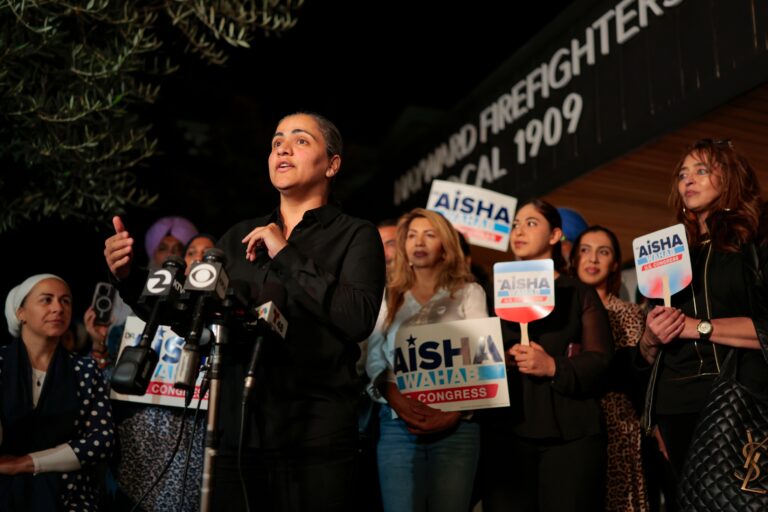
August 24, 2026:


Aisha Wahab, the California state senator who became the first person to write signed AI deepfake and digital identity theft legislation into California law, will now bring that record to Congress — after winning the August 18 runoff for California’s 14th Congressional District and becoming the first Afghan American elected to the U.S. House of Representatives.
The Associated Press called the race for Wahab on August 20, two days after polls closed, once ballots had accumulated far enough to confirm the outcome. With 95 percent of expected votes tallied, Wahab secured 53.1 percent to Melissa Hernandez’s 46.9 percent — a margin that would have appeared comfortable in almost any other Democratic contest, but that represented a significant narrowing from the 20-plus-point leads Wahab had built in two prior rounds of voting.
Her entry into Congress carries a technology policy credential that the mainstream outlets covering the race almost entirely missed: before running for federal office, Wahab authored a three-bill AI Safety Package signed into law by California Gov. Gavin Newsom in 2024. Those laws — targeting non-consensual AI-generated intimate imagery, digital identity theft on social media platforms, and AI-generated child sexual abuse material — addressed some of the most contested questions in U.S. AI policy before any federal legislation on those subjects cleared committee. She is also one of California’s leading legislative voices on algorithm-driven pricing, having passed consumer protection bills tackling hidden algorithmic pricing tactics in 2025.
For most of the campaign, Wahab appeared to be cruising. She had faced Hernandez twice in the preceding two months: first in the June 2 top-two primary for the full two-year term, where she took 38.3 percent to Hernandez’s 17.2 percent, and again in the June 16 special election primary, where she earned 42.8 percent to Hernandez’s 16.8 percent. In both rounds, the gap between the candidates exceeded 20 percentage points.
Then came the money.
The American Israel Public Affairs Committee’s political arm, the United Democracy Project, spent nearly $2.5 million since early August in negative ads and mailers against Wahab, according to Federal Election Commission records. The spending saturated Bay Area television and digital screens in the final weeks of the race. BOLD America, another group that receives funding from AIPAC, spent an additional $1.9 million targeting Wahab, according to CNN — bringing the combined pro-Israel outside spending against her to nearly $4.4 million. Casey Kennedy, co-founder of Track AIPAC, which monitors the organization’s donations, said Hernandez became the top recipient of AIPAC funding in the country during this period.
The combination of AIPAC-funded ads and projected turnout of less than 25 percent in a mid-August special election gave the outside spending an outsized impact on a per-vote basis. On election night, with early returns showing Wahab clinging to a slim advantage, it appeared the race could go either way.
Wahab told local media that the spending had been “obscene and grotesque,” adding that she remained confident voters would see through the ad campaign.
The CA-14 result was one piece of a broader mixed night for the pro-Israel lobbying organization. AIPAC had spent $100 million in 2024 across 389 congressional races and built a track record of defeating progressive incumbents critical of Israel — including Rep. Jamaal Bowman in New York and Rep. Cori Bush in Missouri, where the United Democracy Project poured nearly $9 million to elect St. Louis County Prosecutor Wesley Bell in 2024.
In 2026, the organization’s record has been more complicated. In February, AIPAC spent roughly $2 million to target former Rep. Tom Malinowski in New Jersey’s 11th District — only to help clear the path for progressive activist Analilia Mejia, who said she agreed Israel committed genocide in Gaza, to win the Democratic primary. In March, AIPAC and its affiliates spent more than $5 million to boost Chicago City Treasurer Melissa Conyears-Ervin in the Illinois primary, and she still lost a 13-way contest to State Rep. LaShawn Ford.
Arab American community leaders celebrated the California result as a marker in that broader trend. Mirvette Judeh, president of the Arab American Caucus of California, said that “AIPAC has bit the dust” and called the win a “true progressive victory,” adding that candidates were now surviving AIPAC attacks that might once have proved fatal.
The mainstream political coverage of this race told the story of Wahab’s historic background — the refugee parents, the foster care years, the Afghan American firsts — without mentioning the technology legislation that makes her specifically relevant to TechTimes readers.
Wahab’s three-bill AI Safety Package, all signed into California law and taking effect January 1, 2025, directly addresses questions Congress has yet to resolve at the federal level:
SB 926 (Safeguarding Against Digitized Misrepresentation): Expands California’s revenge porn law to cover AI-generated sexually explicit images distributed with intent to cause serious emotional distress. The bill was sponsored by the Crime Victims Alliance and drew bipartisan support.
SB 981 (Digital Identity Theft Act): Requires social media platforms to create a reporting mechanism for individuals whose AI-generated or digitized intimate imagery appears without their consent.
SB 1381 (AI Child Safety): Ensures that AI-generated imagery depicting minors is covered under California child pornography laws. The legislation was prompted in part by a January 2024 incident in which a sexually explicit deepfake video of Taylor Swift spread to 27 million views on X within 19 hours.
Federal AI legislation addressing deepfakes, non-consensual intimate imagery, and AI-generated CSAM remained stalled as of August 2026, with multiple competing bills in committee and no unified framework. Wahab is now the member of Congress with the most direct track record of actually passing AI safety law — not proposing it.
She also chairs the Senate Business, Professions and Economic Development Committee, where she passed two consumer protection bills in 2025 targeting hidden, unfair, and algorithm-driven pricing tactics — an area that the Federal Trade Commission has flagged as a growing enforcement priority.
The seat Wahab is set to fill opened under circumstances that rattled California’s Democratic establishment. Eric Swalwell had opted not to seek re-election in 2026, choosing instead to run for governor. In April 2026, multiple women leveled allegations of sexual misconduct against him. Amid growing calls for him to withdraw, he suspended his gubernatorial campaign on April 12, announced his resignation from Congress the following day, and officially left office on April 14. Swalwell denied the allegations, but key Democrats quickly condemned him, and he ended a 13-year congressional career.
Wahab’s own biography is distinctly American. Born in Queens, New York, to refugees who fled Afghanistan during the Soviet-Afghan War in the 1980s, she was raised in Fremont, California. She was placed in foster care after her father was murdered and her mother died at an early age — experiences that, she has said, inform her understanding of the struggles many people face silently.
In 2018, she became the first Afghan American woman elected to public office in the United States when she won a seat on the Hayward City Council. She won a state Senate seat in 2022, becoming the first Muslim and Afghan American elected to the California State Senate, and in 2024 was appointed Senate Assistant Majority Leader — another first for an Afghan American and Muslim in the California Legislature.
Once certified, her congressional victory will extend that record of firsts: Wahab will become the first Afghan American to serve in Congress, representing a district with a decades-long history of Afghan immigration.
In a statement following the final tally, Wahab noted her journey “from foster care to Congress” and said she would “fight for this district that raised me.”
The special election victory grants Wahab a congressional seat for just the remaining months of Swalwell’s term. The contest is far from settled.
Wahab and Hernandez will face each other again in November for a full two-year term. The election will use California’s new congressional map, though redistricting impacts to District 14 are described as minor — with one significant exception: due to statewide redistricting, the 14th District will gain roughly 26,000 new voters from Dublin, where Hernandez previously served as mayor. That geographic shift means Hernandez enters the November race with a built-in base of voters who already sent her to higher office — voters not present in the electorate for either of Wahab’s prior victories over her.
Wahab campaigned on making healthcare and childcare more affordable, preventing corporate price-gouging, and protecting safety net programs. She enters November with the advantages of incumbency, a demonstrated ability to withstand an extraordinary outside-spending assault, and the gravitational pull of a historic milestone. Whether that proves decisive against a reconfigured electorate is the question the Bay Area — and the national progressive movement — will be watching.
Progressive advocates have framed Wahab’s win as part of a broader left-wing wave in the 2026 Democratic primaries, arguing that the AIPAC spending model is losing its decisive edge when deployed in districts where the progressive infrastructure has been built up and when the target of the spending is a candidate with deep community ties.
Whether that narrative holds through November will be one of the defining storylines of this election cycle.
Wahab is a 39-year-old California state senator who won the August 18, 2026 special election runoff for California’s 14th Congressional District, becoming the first Afghan American elected to Congress. Before running for federal office, she authored a three-bill AI Safety Package signed into California law in 2024, addressing AI-generated non-consensual intimate imagery, digital identity theft on social media, and AI-generated child sexual abuse material — making her one of the few incoming members of Congress with direct experience passing AI safety legislation rather than merely proposing it.
AIPAC’s political arm, the United Democracy Project, spent nearly $2.5 million in negative ads and mailers against Wahab since early August 2026, per Federal Election Commission records. A second AIPAC-linked group, BOLD America, spent an additional $1.9 million, bringing combined pro-Israel outside spending against her to nearly $4.4 million. It did not work: Wahab won the runoff 53.1 percent to 46.9 percent. The result was one of several 2026 losses for pro-Israel super PACs, which had also failed to elect their preferred candidates in New Jersey and Illinois earlier in the cycle, though they won other races.
United Democracy Project is a super PAC founded by AIPAC in December 2021. Under the Citizens United v. FEC (2010) Supreme Court ruling and the subsequent SpeechNow.org v. FEC decision, super PACs can raise and spend unlimited sums from individuals, corporations, and other organizations for independent expenditures — meaning they can air ads for or against candidates as long as they do not directly coordinate with those campaigns.
Yes — more competitive than the special election result suggests. California’s redistricting will add roughly 26,000 new voters to CD-14 from Dublin, a city where Hernandez previously served as mayor and has a built-in voter base that was not part of the electorate in either of Wahab’s two prior wins over her. Wahab will run with incumbency and name recognition; Hernandez will run with a demographically friendlier map. Outside spending from AIPAC is likely to return at similar or greater scale.