GodsTV Lands Helluva Boss Writers and Brandon Rogers, New Demo Available Now

August 23, 2026:

GodsTV Lands Helluva Boss Writers and Brandon Rogers, New Demo Available Now
Gods. TV
Melbot.es

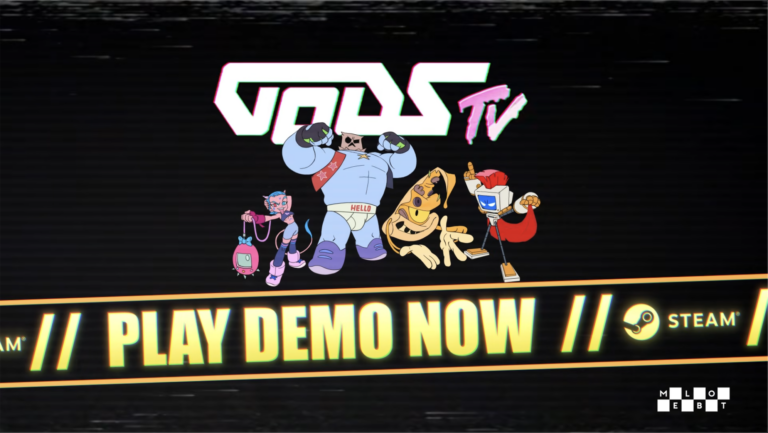
An action roguelite about slaughtering for clout on a reality show run by ancient, ratings-obsessed deities just picked up some of the most recognizable names in indie animation — and the irony is entirely intentional. Melbot Studios dropped a new GodsTV demo on August 18 alongside Kickstarter Update 21, which confirmed that Brandon Rogers (internet comedian and the voice of Blitz0 in the indie animated hit Helluva Boss) leads the game’s voice cast as host character “AG,” and that the writing team includes Adam Neylan and Lyle Rath (Helluva Boss) and Stephen Flowers (Helldivers 2). For fans of that corner of the internet, this is GodsTV hiring the people who already understand exactly what it’s trying to be.

The game is from Melbot Studios, a 17-person Barcelona-based developer whose team carries AAA credits including Rise of the Tomb Raider, Fallout 4, and Apex Legends, and it is co-published by Midwest Games, a Green Bay, Wisconsin publisher known for backing unconventional indie projects.

GodsTV Satirizes Fame Culture — by Using It

The premise of GodsTV is that ancient deities have stopped ruling the cosmos and instead became corporations — the “Gods of the Capitalypse” — who run a combat reality show because they are addicted to ratings. Players compete as mortal Contenders, fighting through wave-based arenas to build a fanbase, earn divine power-ups, and survive long enough to achieve immortality. Fame is the core mechanic: kill stylishly, accumulate “aura,” and the Gods reward you with better weapons and abilities; bore the audience, and you die.

What the draft of this story did not capture is the meta-layer: Melbot is marketing GodsTV using exactly the infrastructure the game satirizes. The writing staff comes from Helluva Boss, which built a fanbase of millions through irreverent animated YouTube content. Brandon Rogers has over 7 million YouTube subscribers and a devoted fandom built on absurdist comedy. The studio has also partnered with Spud Gun Studios — the UK animation house behind Mashed, which has 5 million subscribers and over 2 billion views across YouTube, Snapchat, and TikTok — to co-produce the game’s narrative and a tie-in animated series for YouTube. GodsTV is, structurally, a game about how ratings-hungry entities exploit performers for clout, built by a team that is deliberately harvesting the clout infrastructure of indie animation fandom to reach players. The joke is the marketing.

A Story About Desperate Wannabes in a Divine Game Show

The four playable Contenders in GodsTV are not heroes. They are desperate fame-seekers auditioning for the greatest — and most brutal — television program in the multiverse: the Fame Show Arena, orchestrated by the Gods of the Capitalypse at the edges of what Melbot calls “the Capitalypse” universe. Each character brings a completely different combat style and personality.

The two characters available at Early Access launch are Kinni, a bruiser Stripper whose jiggle-physics-enabled fighting style is a running comedic bit in the studio’s social media presence, and Leetah, a Ninja Popstar voiced by content creator Kaisa Streams. Two additional characters will follow during the Early Access roadmap: Pepperishi, a Pizza Shaman, and V1KTU$, a Gadget Master voiced by Jimmy “Nerdork” Sowell.

The central dramatic question the narrative builds around: can your Contender claw up the Fame Show’s hierarchy, please the increasingly unhinged Gods enough to earn actual immortality, and survive both the combat and the backstage politics? The emotional register is deliberately “zero chill” — a 90s-aesthetic dark comedy that sits somewhere between a Saturday morning cartoon and a punk rock record made by people who have strong opinions about the influencer economy. Brandon Rogers, as host character “AG,” is the precise cultural signifier this tone requires: his entire creative brand is absurdist media criticism delivered at maximum volume.

Between combat runs, players return to the Backstage — a social hub inhabited by recurring NPCs including a shady AI agent offering deals between episodes, a jaded star coach, and a broader cast whose relationships with the player can evolve toward friendship, rivalry, or even romance depending on choices made across multiple runs. This persistent narrative layer separates GodsTV from a pure arena brawler.

How Fame Becomes a Weapon: The Roguelite Architecture

What makes GodsTV mechanically distinct from the genre’s standard formulas is the fame feedback loop at the heart of its run structure. In most roguelites, the core loop is: fight, die, unlock a permanent upgrade, retry. In GodsTV, a second meter operates simultaneously during each fight: the “aura” meter, which fills as players kill stylishly and entertainingly enough to please the in-game audience. Higher aura unlocks divine power-ups that shape the run’s build in real time, meaning the Gods pay attention when — and only when — the performance is worth watching.

This creates a meaningful tension absent from simpler fight-and-loot loops: surviving by hiding or playing defensively is not viable, because a boring performance literally cuts off your upgrade pipeline. The game rewards aggression and spectacle mechanically, not just aesthetically. Every run is implicitly a performance review.

The “Godskins” system adds a further customization layer. These are not purely cosmetic — each Godskin modifies the character’s loadout or playstyle in addition to changing their appearance, so the skin selection shapes build crafting rather than being an afterthought.

The full Early Access roadmap moves from the initial single-player build with two characters toward a co-op experience with all four characters. Melbot coined the term “co-opetitive” to describe what they’re building: a system where co-op players can cooperate on survival but compete over fame acquisition, creating friction within partnerships that mirrors the show’s premise. The game will not include a battle pass or live-service monetization model — Melbot has stated explicitly that the goal is premium experience rather than an ongoing revenue extraction mechanism.

The game is fully playable offline in single-player mode; an internet connection is only needed for co-op.

What the Kickstarter Actually Proved

GodsTV’s Kickstarter campaign ran from July 8 to August 7, 2025 — 30 days — and raised €134,591 from 1,736 backers against a goal of €34,050 (approximately $39,800 USD). That is 395% overfunding. The average pledge was €77.53 (approximately $91 USD) — a number high enough to suggest that a significant portion of backers were not casual one-dollar supporters but fans willing to pay real money before the game existed in a playable public form. The approximately $157,000 USD total raised reflects conversions at the exchange rate at the time of publication.

Kickstarter also designated GodsTV a “Project We Love” — a badge the platform applies editorially to campaigns its team considers standouts, meaningful as a signal even if it doesn’t change the campaign’s mechanics. The average pledge tracked by BackerKit confirms the high per-backer commitment that characterizes a pre-qualified fanbase rather than casual crowdfunding traffic.

What the Kickstarter result actually proved: before a single developer had been hired from the Helluva Boss or Helldivers 2 teams, before the Brandon Rogers deal existed, 1,736 people put nearly $91 each into a game based on a pitch deck and a demo. The talent upgrade announced on August 18 is Melbot converting that audience validation into something more — a recognizable cultural artifact for the corners of the internet most likely to play it.

Melbot Survived a Publisher Divorce to Get Here

One thing the original version of this story omitted: GodsTV is not the straightforward indie success story it appears. In November 2023, Melbot Studios and Swedish publisher Starbreeze Entertainment jointly announced GodsTV, with Starbreeze providing development funding, marketing, community management, and release management. That relationship dissolved. By May 2025, Melbot’s own blog acknowledged that the studio had been “navigating turbulent publishing deal waters”, stating the team was “taking matters into our own hands.”

The Kickstarter campaign, which launched in July 2025, was the result: Melbot independently funded development, secured Midwest Games as a new co-publisher, and ran the crowdfunding campaign that validated demand without a major publisher’s backing. The version of GodsTV players will encounter in Early Access is the version Melbot built after the original deal fell through — which, given the Kickstarter result and the talent now attached, appears to be a better game than the one Starbreeze was going to publish.

Midwest Games, for its part, secured a $2 million Prevail Capital investment in September 2025 to expand its publishing resources. The publisher operates a developer-friendly publishing model it calls “publishing-as-a-service,” offering bridge financing, marketing, and distribution support while allowing developers to retain IP — structurally different from the traditional deal where a publisher funds development in exchange for ownership.

Is There a Free Demo You Can Play Right Now?

Yes. The updated GodsTV demo — the one released on August 18 alongside Update 21 and the new trailer — is available free on Steam and Steam Deck. It includes approximately two hours of content, the first four Show-Runs, character options for both Kinni and Leetah, upgrades, and narrative. Melbot’s own description in the update describes it as featuring “raunchy humor” and “top-notch art, writing and voice talent.”

The game currently carries no Early Access launch date on the Steam page, which lists the release as “Coming soon.” The Steam page confirms 1.0 release is planned for late 2027, with Early Access preceding it. The game will launch for PC first; console releases are planned for after the 1.0.

Localization at launch will cover 12 languages: English, French, Italian, German, Spanish, Japanese, Korean, Portuguese (Brazil and Portugal), Russian, Simplified Chinese, and Spanish — Latin America, with additional languages planned depending on community demand.

Currency conversions in this article from euros to US dollars are based on the exchange rate at time of publication and are approximate.


Frequently Asked Questions

Who voices GodsTV, and why does that matter?

Brandon Rogers — the YouTube comedian with over 7 million subscribers known for absurdist, often aggressively irreverent humor — voices host character “AG.” He is also the voice of Blitz0 in Helluva Boss, the indie animated series from Vivienne Medrano that built an enormous online fanbase without traditional studio backing. The writing team includes Adam Neylan and Lyle Rath, who also write for Helluva Boss, and Stephen Flowers, who worked on Helldivers 2. For the specific corner of the internet that follows these creators, GodsTV is not an unknown indie game asking for a chance — it is a project that already has the DNA of things they already love.

Is GodsTV actually satirizing influencer culture, or is it just using the aesthetic?

The most interesting thing about GodsTV is that it is doing both simultaneously, and the people making it appear to know it. The game’s premise — ancient Gods-as-corporations who addicted themselves to ratings and built a murder reality show — is a direct critique of algorithmic attention economies and clout culture. But Melbot’s marketing strategy involved recruiting Brandon Rogers’s fanbase, signing animation writers with established YouTube audiences, and partnering with Spud Gun Studios (Mashed) to build a YouTube animated tie-in series. The satirical target and the marketing vehicle are structurally identical. Whether this makes the satire richer or undercuts it is a question the game will have to answer when it launches.

What is a roguelite, and is GodsTV a good entry point for someone new to the genre?

A roguelite is an action game where each playthrough (called a “run”) is a complete session with randomized elements, and where death returns you to the beginning — but where some progress carries over permanently between runs through unlocks, upgrades, or story revelations. GodsTV’s particular twist is that the fame meter running during each fight shapes which power-ups you can access, creating a game that punishes passive play mechanically, not just aesthetically. Hades, Dead Cells, and Rogue Legacy are popular reference points for the genre. GodsTV’s dark-comedy tone and the free demo currently on Steam make it a low-commitment entry point for curious players.

What happens if I try the demo and want the full game?

The demo is free and available now on Steam and Steam Deck with no purchase required. Wishlisting GodsTV on Steam costs nothing and notifies you when Early Access launches. The BackerKit pre-order store is open, with digital game copies starting at €22 (approximately $26 USD) for PC versions — Melbot has indicated that pricing may increase as Early Access progresses, so early adoption carries a potential price advantage.

Source link