HomeAuto Samsung SDI Raises $3.2B From Display Sale to Power AI Battery Ambitions
Samsung SDI Raises $3.2B From Display Sale to Power AI Battery Ambitions
August 21, 2026:
gettyimages.com
Samsung SDI announced Friday it will sell 13.09 million Samsung Display shares in affiliate Samsung Display back to the display maker — converting a passive cross-holding accumulated over decades into immediate capital for a battery buildout that now extends from Indiana grid storage to humanoid robot power cells. The transaction, which is scheduled to close on August 27, 2026, is the clearest signal yet that South Korea’s third-largest battery maker is using the AI infrastructure boom as an opportunity to reshape its balance sheet for the next decade.
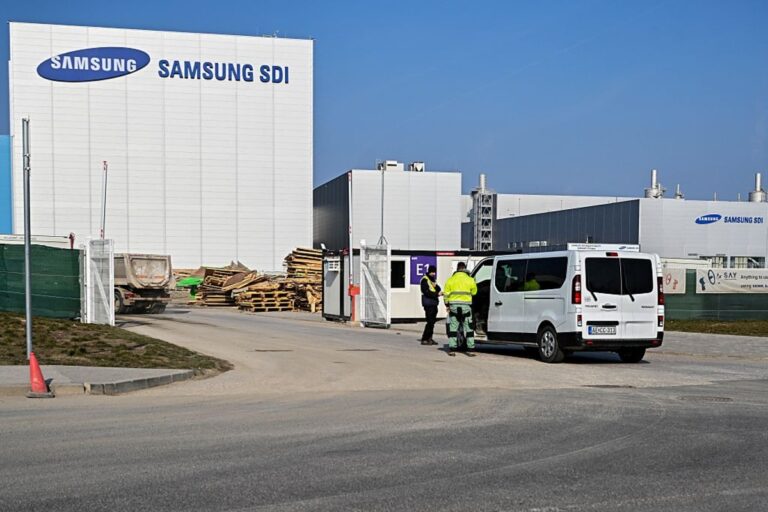
Samsung SDI said the purpose of the sale is “securing investment capital to establish future growth engines.” Capital is broadly expected to flow toward the company’s facility investment pipeline — starting with a 680-acre (275-hectare) battery plant under construction in New Carlisle, Indiana, where specific plans are still being finalized following Samsung SDI’s acquisition of General Motors’ 49.99 percent stake earlier this month.
The structure of the transaction matters. Rather than an equity offering that would dilute existing shareholders, or debt that would add to the company’s ₩12.1 trillion (approximately $8.76 billion) in total liabilities, Samsung SDI is unlocking passive value already sitting on its balance sheet. The Samsung Display cross-holding was not an operational relationship that needed preserving — Samsung SDI will remain a meaningful minority shareholder after the sale — it was a legacy of the chaebol’s layered affiliate structure, and selling it cleanly at a premium-to-book price is how the company avoids the capital markets entirely while still raising what amounts to roughly 60 percent of a full year of revenue at 2026 quarterly run rates.
Samsung SDI Cashes Out a Legacy Display Cross-Holding
In a regulatory filing Friday, Samsung SDI said it will transfer 13.09 million Samsung Display shares at ₩340,000 (approximately $246) per share, for a total of ₩4.45 trillion (approximately $3.22 billion). Samsung Display will buy the shares as treasury stock, making the transaction a clean intra-group cash transfer that sidesteps the open market entirely. After the deal closes, Samsung SDI will retain 26.77 million Samsung Display shares, equivalent to a 10.22 percent stake, down from its prior 15.2 percent. The final share count and total value could shift slightly during the repurchase process, Samsung SDI noted.
Where the Money Goes: ESS, Indiana, and the AI Power Problem
The battery maker’s stated destinations for the capital are not hypothetical. Samsung SDI returned to profitability in Q2 2026 for the first time in seven quarters, reporting operating income of ₩203.8 billion (approximately $147.5 million) on revenue of ₩3.77 trillion (approximately $2.73 billion) — both above analyst expectations. In the first quarter, the company had posted a ₩155.6 billion operating loss (approximately $112.6 million), itself a narrowing of 64.2 percent year over year, on revenue of ₩3.58 trillion (approximately $2.59 billion).
The turnaround has a specific engine: energy storage systems for AI data centers and the grid. AI server infrastructure requires uninterrupted, stable power around the clock. Utility-scale battery systems — ESS installations that sit between the grid and a data center or solar farm — provide that stability by absorbing excess generation when supply exceeds demand, then releasing stored energy during peak loads or outages. Samsung SDI has been winning long-term supply agreements with major US ESS customers at an accelerating rate: secured orders cover capacity through 2029, with demand expected to exceed production capacity from 2028 onward, according to Executive Vice President Yonghui Cho speaking on the company’s second-quarter earnings call on July 30.
That order visibility is the reason the Display stake sale matters to investors. The company can now point to a concrete capital source for the capacity it needs to build before demand outstrips supply.
Why LFP Chemistry Is the Structural Advantage — and Why FEOC Rules Cement It
Not every battery chemistry is suited for grid storage, and Samsung SDI’s choice of lithium iron phosphate — LFP — for its US ESS production is a deliberate engineering decision, not a cost-cutting compromise.
A battery cell for an electric vehicle must carry its energy density across miles of road. Every additional kilogram adds weight and erodes range; every added liter crowds out cargo or passengers. Nickel-manganese-cobalt, or NMC, chemistry delivers roughly 200 to 250 watt-hours per kilogram — high energy density at the cost of thermal sensitivity and a cycle life of roughly 500 to 1,500 full charge-discharge cycles over its useful life.
A grid-storage battery sits in a steel container on a concrete pad. Weight and volume constraints are essentially nil. What matters instead is how many thousands of times it can charge and discharge over 15 to 20 years before degrading, how safe it is under sustained thermal stress, and how much it costs per kilowatt-hour of installed capacity. LFP chemistry answers all three questions better than NMC for stationary applications: it sustains 3,000 to 5,000 cycles or more, does not carry the thermal runaway risk that NMC cells do under the same conditions, and costs 20 to 30 percent less per kilowatt-hour for grid installations.
What amplifies this technical advantage in the US market is regulatory architecture. Under the Inflation Reduction Act’s Foreign Entity of Concern rules, batteries whose cells or key materials originate from Chinese-controlled suppliers are ineligible for federal tax credits on grid storage procurement. Seven of the world’s top ten ESS suppliers by shipment volume are Chinese, led by CATL, BYD, and Sungrow — and all three face FEOC restrictions on US government procurement, with the Defense procurement bar on Chinese batteries taking effect in 2027. Samsung SDI is, according to its own disclosure, the only non-Chinese prismatic LFP battery manufacturer with a US production base. For utility-scale ESS buyers who need FEOC-compliant cells to access subsidized procurement, that status makes Samsung SDI structurally indispensable in ways that have nothing to do with price.
The company has spent 2026 building the supply chain to back that position: it has secured LFP cathode materials through partnerships with Korean and US suppliers, established a compliant supply chain for other key components through localization, and is on track to begin cell production planned for October 2026 at the StarPlus Energy facility in Kokomo, Indiana (its existing Stellantis joint venture), with customer deliveries of its Samsung Battery Box 2.0 (SBB 2.0) expected before the end of 2026.
Indiana: A Blank-Slate Plant Newly Funded
The New Carlisle plant — the most likely near-term destination for a portion of the Display stake proceeds — sits in a situation that is unusual in the current battery industry restructuring: it is a completed building with no production machinery installed. General Motors spent roughly $300 million developing the 680-acre (275-hectare) campus to a finished structure before the joint venture paused construction. When Samsung SDI acquired GM’s stake on August 11, it inherited a facility that requires no demolition of existing EV-specific equipment to convert to LFP ESS production. Investment plans for the now wholly owned plant have not yet been finalized — the company said it would make further regulatory disclosures as those plans take shape.
The broader pattern that the Indiana plant sits within is visible across North American battery manufacturing. When Stellantis sold its 49 percent stake in the NextStar Energy EV battery joint venture in Windsor, Ontario to LG Energy Solution for $100 (in a nominal-consideration transfer) in February 2026, it followed the same logic: automakers exiting EV battery commitments while Korean battery makers absorb the capacity and redirect it toward ESS applications. LG Energy Solution aims to boost its global ESS capacity to more than 60 GWh in 2026, with more than 50 GWh of that in North America.
For Samsung SDI, New Carlisle represents a second, larger, wholly owned ESS production node in the same state as Kokomo — at precisely the moment when its own order books are filling faster than its capacity can accommodate.
All-Solid-State and Physical AI: The $1.4 Billion Market That Does Not Exist Yet
Beyond the near-term ESS buildout, Samsung SDI is deploying a longer-horizon technology bet that the Display stake proceeds also helps fund: all-solid-state batteries for what the industry calls physical AI — humanoid robots, autonomous drones, and advanced wearables that demand compact, high-density, high-output power with minimal fire risk.
At InterBattery 2026 in Seoul on March 11, Samsung SDI unveiled a pouch-type all-solid-state battery sample under development for physical AI applications, specifically naming humanoid robots as the first intended commercial use case. The company is already sending samples to prospective customers. Mass production is targeted for the second half of 2027 — an ambitious but technically grounded goal: Samsung SDI is working with Solid Power, a Colorado-based solid-state technology developer, and BMW under a joint evaluation agreement that is advancing sulfide-based solid electrolyte development and manufacturing process validation.
The market these cells would address is currently almost too small to measure. Company executives said on the Q2 2026 earnings call that the global robot battery market forecast projects roughly a 47-fold increase from 0.03 gigawatt-hours in 2025 to approximately 1.4 gigawatt-hours by 2030, as humanoid robotics adoption expands across industrial, logistics, and consumer applications.
All-solid-state cells address two specific requirements that conventional lithium-ion chemistry struggles with in robotics. A humanoid robot that falls, twists, or operates in confined spaces needs a cell that will not rupture, leak flammable electrolyte, or enter thermal runaway under mechanical stress — the same safety failure mode that grounds lithium-ion in aircraft cargo holds and motivates fire suppression requirements in data center battery rooms. And a robot chassis has strict weight budgets; the higher energy density that solid-state chemistry can achieve allows more capability per kilogram of battery mass than today’s cells.
A Samsung Group Capital Moment
The Display stake sale did not happen in isolation. On the same day Samsung SDI disclosed the transaction, Samsung Electronics — the conglomerate’s crown jewel — announced a shareholder return program that dwarfs it by a factor of more than 20.
Samsung Electronics said its board of directors approved a record ₩90-110 trillion shareholder return plan for 2026 — estimated at ₩90 trillion to ₩110 trillion (approximately $65.1 billion to $79.6 billion) — the largest shareholder payout ever by a Korean company, and approximately five times the company’s previous record of ₩20.3 trillion (approximately $14.7 billion) set in 2020. The announcement came days after rival SK Hynix disclosed a ₩40 trillion (approximately $28.9 billion) buyback program, the largest in South Korean history. Samsung Electronics also said it would pay approximately ₩30 trillion (approximately $21.7 billion) in cash dividends in the third quarter of 2026, with remaining returns to be decided by the board in January 2027.
The force behind both announcements is the same: Samsung Electronics reported that its chip division delivered ₩89.2 trillion in operating profit — a roughly 19-fold jump for the company’s consolidated operating profit compared with the same quarter a year earlier — in the second quarter of 2026. Its shares have climbed roughly 185 percent over the past 12 months. Together, Samsung Electronics and SK Hynix are projected to accumulate $263 billion in combined cash by year’s end — more than double the estimated $102 billion held by Nvidia.
What makes August 21, 2026 notable for the Samsung group is that both announcements reflect the same underlying dynamic: the AI infrastructure buildout is simultaneously generating record semiconductor profits at Samsung Electronics, while creating demand for the battery infrastructure — grid storage, data center backup power, robot propulsion — that Samsung SDI is now urgently funding. The capital being returned to shareholders at Samsung Electronics and the capital being raised by Samsung SDI are, in a structural sense, different responses to the same macroeconomic force.
What the Stake Sale Actually Changes
Samsung SDI will remain a meaningful Samsung Display shareholder after the transaction, retaining a 10.22 percent stake. No strategic realignment in the display relationship is implied, and the business arrangements between the two affiliates are expected to continue unchanged.
What changes is Samsung SDI’s ability to invest without issuing new shares or taking on additional debt. The company is now pursuing expansion across energy storage systems, humanoid robot batteries, aerospace cells, lithium iron phosphate production, and all-solid-state batteries simultaneously. It is also integrating the New Carlisle plant into its balance sheet as sole owner, without the operational planning that had been underway when GM was a partner. It is building a FEOC-compliant supply chain for LFP cathode materials, a task that requires material commitments to upstream suppliers before production begins.
None of that is cheap, and all of it needs to happen faster than the market is moving — because from 2028, Samsung SDI’s own management believes demand will exceed what the company can produce.
The ₩4.45 trillion (approximately $3.22 billion) raised from Samsung Display does not solve that entirely. But it eliminates one of the funding constraints at a moment when the company’s order book is the best argument it has ever had for investing aggressively.
Exchange rate as of August 21, 2026: $1 USD = ₩1,382 KRW; all won-to-dollar conversions throughout this article are approximate and reflect the live mid-market rate at time of publication.
Frequently Asked Questions
Why is Samsung SDI selling its Samsung Display stake rather than borrowing money or issuing new stock?
Selling the Display stake converts a passive financial holding — shares in an affiliated display company that generate no operational revenue for Samsung SDI — into active investment capital without adding debt or diluting existing shareholders. Samsung SDI already carries ₩12.1 trillion (approximately $8.76 billion) in total liabilities, and the company returned to profitability only in Q2 2026 after seven consecutive loss quarters. Monetizing a legacy cross-holding at current market prices is the cleanest capital source available: no interest expense, no shareholder dilution, and no operational disruption to the display relationship, since Samsung SDI retains a 10.22 percent stake.
What is LFP, and why does it matter for Samsung SDI’s US ESS strategy?
Lithium iron phosphate, or LFP, is a battery cell chemistry that uses an iron phosphate cathode instead of the nickel-manganese-cobalt combination found in most EV batteries. LFP trades lower energy density for dramatically better cycle life (3,000 to 5,000 full charge-discharge cycles versus 500 to 1,500 for NMC), superior thermal stability, and lower cost per kilowatt-hour — all of which matter more in a stationary grid-storage installation than in a moving vehicle. The additional dimension that makes LFP strategically critical in the US specifically is FEOC policy: Chinese battery makers, who dominate global LFP production, face restrictions on US federal and defense procurement under the Inflation Reduction Act’s Foreign Entity of Concern rules. Samsung SDI is the only non-Chinese prismatic LFP manufacturer with a US production footprint, which makes its FEOC-compliant cells the practical choice for any US grid storage customer seeking subsidized domestic procurement.
When will Samsung SDI’s all-solid-state batteries actually reach commercial production?
Samsung SDI’s stated target is the second half of 2027, with humanoid robots as the first intended commercial application. The company has been sending samples to prospective customers and is working with Solid Power and BMW under a joint electrolyte evaluation program. That timeline is more credible than prior industry forecasts that have repeatedly slipped, because Samsung SDI is targeting a specific, bounded market — robot cells require high energy density and mechanical resilience but not the extreme cycle life that grid storage demands — rather than trying to immediately replace high-volume EV battery production. The global robot battery market was roughly 0.03 gigawatt-hours in 2025; even a modest beachhead in a market projected to reach 1.4 gigawatt-hours by 2030 would be commercially meaningful for a company whose current ESS capacity is orders of magnitude larger.
Does the same-day Samsung Electronics shareholder return announcement affect Samsung SDI investors?
Not directly — Samsung SDI and Samsung Electronics are separate publicly traded companies. But the context matters: Samsung Electronics’ ₩90 trillion to ₩110 trillion (approximately $65.1 billion to $79.6 billion) shareholder return program is funded by the same AI chip boom that is driving demand for Samsung SDI’s ESS and backup power batteries. The two companies are capturing different parts of the AI infrastructure value chain — semiconductor memory at Samsung Electronics, battery storage infrastructure at Samsung SDI — and both are using today’s announcements to signal that they intend to be major players in that infrastructure for the rest of the decade. For investors evaluating the Samsung group broadly, the paired announcements describe a conglomerate systematically reallocating capital toward AI-era positions across its most strategically relevant affiliates.