HomeAuto CERN Confirms Big Bang Plasma Can Form in Nuclei Far Smaller Than Lead
CERN Confirms Big Bang Plasma Can Form in Nuclei Far Smaller Than Lead
August 21, 2026:
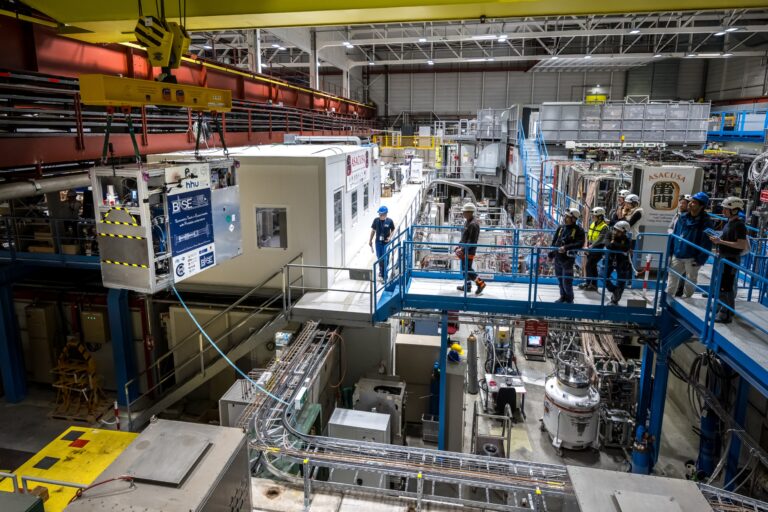
A specially designed portable cryogenic Penning trap device filled with a cloud of 92 antiprotons is transferred onto a truck during a successful test drive of the world’s first antimatter delivery system, conducted by CERN’s BASE-STEP experiment, which transported antiprotons by road across the organization’s main site, in Meyrin near Geneva, on March 24, 2026. Fabrice COFFRINI/AFP via Getty Images
For more than half a century, physicists assumed that recreating the universe’s earliest state of matter required a battering ram the size of a lead nucleus — 208 protons and neutrons colliding at near-light speed. A paper published in Physical Review Letters as an Editors’ Suggestion last week has broken that assumption, and in doing so validated an entirely new way to photograph the insides of atomic nuclei.
The international ALICE collaboration at CERN’s Large Hadron Collider has confirmed that quark-gluon plasma — the primordial “soup” of unbound quarks and gluons that filled the universe in its first millionth of a second — forms in collisions involving nuclei as small as oxygen-16, which has just 16 nucleons, and neon-20, with 20. That is more than 12 times lighter than lead. Crucially, the experiment did something further: it read the geometric shape of each colliding nucleus from the particle-flow patterns the plasma left behind, as the Niels Bohr Institute press release confirms.
The result, led by researchers from the Niels Bohr Institute at the University of Copenhagen, is being called a potential paradigm shift — not only for understanding the threshold conditions for Big Bang plasma formation, but for nuclear structure physics itself. The same plasma that probes the universe’s first moments is now confirmed to encode the blueprint of the nucleus that created it.
Quark-Gluon Plasma: What It Is and Why Producing It Required a Battering Ram
In ordinary matter, quarks — the fundamental constituents of protons and neutrons — are permanently confined by gluons, the carriers of the strong nuclear force. The strong force is one of the four fundamental forces of nature, and it is the most powerful at short distances: it keeps atomic nuclei together and binds quarks within each nucleon.
But in the universe’s first fraction of a second, the temperature exceeded 100,000 times that of the sun’s core. At those extremes, confinement breaks down: quarks and gluons roam freely in a dense, near-frictionless fluid. This is quark-gluon plasma (QGP) — the earliest form of matter physicists can recreate in a laboratory.
Experimenters produce it by accelerating two atomic nuclei to nearly the speed of light and smashing them together. The collision creates a microscopic fireball — a QGP droplet that exists for less than a trillionth of a trillionth of a second before cooling into a spray of detectable particles. Since 2000, when CERN first reported evidence for QGP using lead nuclei, the field has assumed that large, heavy nuclei were required: the bigger the nucleus, the more nucleons crash simultaneously, the more energy density is deposited, and the more reliably the phase transition to QGP occurs.
The new paper shatters that working assumption. Oxygen-16 and neon-20 are not only far smaller than lead — they are closer in mass to a proton than to a lead nucleus. Yet when the ALICE collaboration compared their collision data against hydrodynamic model predictions that explicitly incorporated the nuclear geometry of each species, the signature was unambiguous: both produce QGP, and each leaves a geometrically distinct footprint in the particles that stream outward as the plasma expands and cools, as the Niels Bohr Institute press release confirms.
How Bowling-Pin Neon Gets Its Shape — and How Plasma Reads It
The connection between nuclear shape and particle-flow pattern runs through a well-established QGP diagnostic called elliptic flow. When two non-spherical nuclei collide, the overlap zone where they interact is not circular — it is asymmetric. The hot QGP droplet that forms inherits that asymmetry as a pressure gradient: more pressure drives particles outward along the shorter dimension of the collision zone, producing an elongated (elliptic) angular distribution in the detected particles. The more elongated the collision zone, the larger the elliptic flow coefficient.
Oxygen-16 has a roughly spherical nuclear structure, arising from a compact arrangement of four alpha particles (each alpha being a helium-4 nucleus — 2 protons and 2 neutrons) in a tetrahedral configuration. When two oxygen nuclei collide, the overlap zone is approximately symmetric, and the resulting particle-flow pattern is roughly isotropic, as CERN’s preliminary shape-shifting collisions analysis confirmed in September 2025.
Neon-20 is different. It has five alpha clusters arranged in an elongated configuration — what the researchers informally describe as a bowling-pin shape. In central (head-on) collisions of two neon nuclei, this elongation produces a larger elliptic flow coefficient than the comparable oxygen collision. The ALICE detector measured exactly this asymmetry, and hydrodynamic simulations incorporating neon’s geometry matched the data at a level of agreement comparable to that achieved for much heavier lead collisions.
“The particles from the primordial matter are directly governed by the geometric shape of the atomic nucleus,” explained Postdoctoral Researcher Emil Gorm Dahlbæk Nielsen from the Niels Bohr Institute, a co-author of the study. “If the two nuclei we smash together are spherical, we get one pattern. If they are shaped like bowling pins, we get another.”
Nielsen described the technique’s underlying logic with a vivid analogy: “It is a bit like shining light on an object and seeing its shadow. You cannot see the object directly, but its shadow reveals its shape. In the same way, the movement of the particles reveals the geometric shape of the atomic nuclei that was present at the beginning of the collision.”
The methodological elegance is worth emphasizing: by comparing two similarly sized nuclei with contrasting geometries — spherical oxygen and elongated neon — the researchers effectively canceled out many of the systematic uncertainties that complicate single-nucleus analyses. The difference in flow patterns isolates the nuclear geometry signal cleanly.
What It Means That a Nucleus 12 Times Lighter Than Lead Can Trigger a Phase Transition
“We have pushed the boundary for how small the atomic nuclei can be while still recreating this primordial matter — what you could call a Little Big Bang,” said Associate Professor You Zhou, who led the experiment at the Niels Bohr Institute and is now at Aarhus University. “We now know more about the fundamental conditions required for matter to transition into this extreme state.”
The physical significance is considerable. If a 16-nucleon system can generate genuine QGP, the governing variable for the phase transition is not the absolute size of the colliding nucleus — it is the energy density achieved in the collision zone. This reframes the question from “how heavy must nuclei be?” to “how dense must the collision zone be, even briefly?” The answer has implications for understanding QGP in cosmic rays, where protons and light nuclei collide at ultra-high energies in the upper atmosphere, potentially producing QGP-like conditions that have been debated for years.
Earlier in the same research campaign — based on data from the July 2025 LHC light-ion run — all four major LHC experiments (ALICE, ATLAS, CMS, and LHCb) had already reported preliminary signs of QGP signatures in oxygen and neon collisions, including parton energy loss and anisotropic flow patterns consistent with heavy-ion results, as documented in CERN’s July 2026 summary. The new Physical Review Letters paper provides the peer-reviewed confirmation using nuclear geometry as an independent and particularly clean probe.
A Question with 70-Year Roots at the Niels Bohr Institute
The question of nuclear shape is not a recent obsession. It has occupied nuclear physicists since the late 1940s, and it has deep institutional roots at the institute where this research was led.
It was Aage Bohr — son of Niels Bohr and a physicist at the same institute — who, together with Ben Roy Mottelson and James Rainwater, demonstrated that atomic nuclei are not uniformly spherical. Their work established that collective nucleon motion can distort a nucleus into asymmetric, elongated shapes. That finding earned Aage Bohr, Mottelson, and Rainwater the 1975 Nobel Prize in Physics.
Fifty years later, the same institution is using the highest-energy collider ever built to read nuclear shapes through the lens of Big Bang plasma — a technique that would have been unimaginable to the Nobel laureates who first mapped nuclear deformation.
“A precise understanding of nuclear structure helps us understand the strong force,” said You Zhou. “But instead of carefully investigating nuclei at low energies, we smash them together at the highest energies we can create and can now read their shape from the imprint they leave behind.”
What’s Next: Helium-4, and a New Nuclear Imaging Instrument
Researchers caution that the precise lower boundary for QGP formation remains unknown. The next experimental frontier is helium-4, with just four nucleons — a system so small that it would challenge even current theoretical models of how quickly a droplet of matter can thermalize into QGP. Whether helium-4 produces genuine QGP is a genuinely open question, and the team plans to pursue it.
Beyond the threshold question, the researchers describe the technique itself as potentially the experiment’s most durable contribution. If the plasma-as-shadow-box method generalizes robustly across the nuclide chart — if any nucleus’s shape can be read from the particle-flow patterns it produces — it would give nuclear physicists an entirely new imaging instrument: one that operates at relativistic energies and is independent of the low-energy spectroscopic techniques that have defined the field for decades. Nuclei whose geometric structures are not yet well-characterized could be studied by firing them into the LHC and reading their silhouette from the plasma they create.
“What is fascinating is that we can use the same experiment both to learn about the structure of atomic nuclei and to gain a better understanding of what happened during the birth of the Universe,” Zhou concluded. “These two things turn out to be much more closely connected than one might initially think.”
The work was carried out as part of the ALICE collaboration at CERN, with central contributions from You Zhou, Emil Gorm Dahlbæk Nielsen, and Zhiyong Lu at the Niels Bohr Institute. It was supported by the European Research Council project InitialConditions, per the University of Copenhagen announcement.
Frequently Asked Questions
Why did scientists previously think only heavy nuclei like lead could produce Big Bang plasma?
The assumption was that QGP requires a sufficiently large collision zone — enough simultaneous nucleon-nucleon impacts to deposit the energy density needed to trigger the phase transition from ordinary nuclear matter to free quarks and gluons. Lead-208 (208 nucleons) produces hundreds of simultaneous sub-collisions when two lead nuclei collide head-on, reliably generating the required energy density. Lighter nuclei were assumed to fall short. The new result shows that the threshold can be crossed even in systems as small as 16 or 20 nucleons — the governing variable is energy density, not system size.
How does a nuclear shape like a “bowling pin” leave a visible fingerprint in particle data?
When an elongated nucleus collides with another, the overlap zone between them is asymmetric rather than circular. The hot QGP droplet that forms inherits this geometric asymmetry as an unequal pressure gradient — particles are driven more strongly outward in one direction than another. This produces an elliptic (rather than circular) angular distribution in the detected particles, measured as the elliptic flow coefficient (v₂). The more elongated the nuclear shape, the larger the asymmetry in the particle spray — making the shape directly readable from the data, even though the QGP droplet itself exists for less than a trillionth of a trillionth of a second.
What does this result mean for nuclear structure physics beyond quark-gluon plasma research?
The team validated a new nuclear imaging technique: any nucleus with a distinctive geometric shape should leave a correspondingly distinctive fingerprint in the particle-flow patterns produced by its collisions at the LHC. This opens the possibility of using high-energy collisions as a general tool for mapping the shapes of nuclei that are difficult to study by conventional low-energy spectroscopy — including exotic or short-lived nuclei. The technique works by cancelling the systematic uncertainties of heavy-ion physics against each other, using the geometry contrast between two different nuclear species as a precision observable.
With the LHC in Long Shutdown 3 until roughly 2029, when will more data from this program be available?
The oxygen and neon data analyzed in this paper were collected during a six-day light-ion run in July 2025, before the LHC shut down on June 27, 2026, for its $1.5 billion High-Luminosity upgrade. Analysis of that 2025 dataset will continue through the shutdown period. The next step — attempting similar experiments with helium-4 — will require a future LHC run. The High-Luminosity LHC, expected to begin operations around 2029–2030, will deliver significantly higher luminosity and could enable deeper studies of light-ion systems.