August 21, 2026:


Resort Island Simulator — a first-person management game where you inherit a war-scarred island and try to turn it into a profitable resort while pirates, zealots, and morally ambiguous guests complicate every transaction — launches on Steam August 28, 2026. Developed by Tenjin Games and published by Poland’s PlayWay S.A., the game is already playable through a free Prologue that has been available on Steam since March 27.
If you are the kind of player who prefers to test before buying, the Prologue is the clearest argument for doing so before August 28. It carries the same first-person perspective, management systems, and open-world feel as the full game — making it a genuine preview rather than a trailer dressed up as a demo.
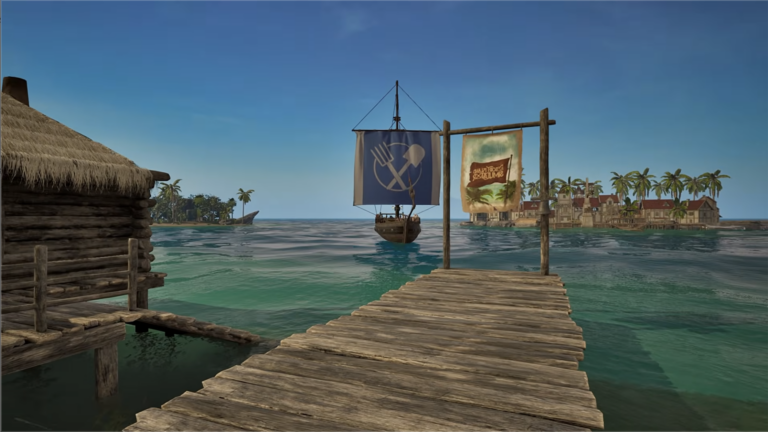
The premise: a man, tired of his old life, sells everything he owns to buy an island and build a hotel. The island comes with a history. A war between rival clans has just ended, and peace, as the in-game character Captain Old Salt puts it, has simply made the island’s pirates richer.
What follows is not a cozy builder. The player steps into a world populated by tricksters, zealots, treasure hunters, and guests who do not always arrive with clean intentions. Managing the resort means hunting and farming for supplies, decorating facilities to raise guest satisfaction and revenue, and unlocking new areas of the island as funds permit. Some visitors will present moral dilemmas with real in-game consequences; the game does not let you ignore the people on the other side of the spreadsheet.
The core loop supports four distinct playstyles — Explorer, Survivor, Resorter, and Trader — letting players shape how they approach the same goal: making the resort prosper. A player who wants to chart unknown corners of the island has a different path through the game than one who wants to optimize guest revenue or master the trading economy. The design appears built to support multiple approaches, though whether the full game executes all four with equal depth is something the Prologue can only partially answer.
The Resort Island Simulator Prologue has been available on Steam at no cost since March 27, 2026. As of August 2026, it has accumulated 52 user reviews, sitting at a Mostly Positive rating of 76%. That is a modest sample — not enough to draw firm conclusions — but it represents a real audience who played the demo and came back to write something about it. For a pre-release title with no critical reviews yet on Metacritic, 76% across 52 reviews is a reasonable early signal.
The Prologue remains free and downloadable now for anyone who wants to evaluate the gameplay before committing to a purchase on August 28.
Tenjin Games has disclosed, on the game’s Steam store page, that artificial intelligence tools assisted with the game’s voice acting and localization translations. This is worth noting for two reasons.
First, the disclosure itself is meaningful information for players who have strong preferences about AI-generated content in games they purchase. The full audio is available in English and Turkish; all other languages among the 15 supported by the Prologue get interface and subtitle support only, with those translations assisted by AI tooling.
Second, the wider context: Valve has required mandatory AI content disclosure on Steam since January 2024, and by the middle of 2026, roughly one in three new Steam releases carries such a label. A study examining nearly 10,000 paid Steam titles released across 2025 found that an AI disclosure correlated with materially fewer reviews on average, with the effect strongest among higher-ambition games — precisely because the players most likely to leave reviews are the engaged genre fans most sensitive to AI content decisions. That finding is reported, not independently verified, but it reflects a real tension in how AI disclosures land with the audiences that build a game’s community.
A 2026 GDC survey found that 52% of game developers believe generative AI is bad for the industry. Resort Island Simulator is transparent about its use; whether that transparency helps or complicates its reception will become clear after August 28.
PlayWay S.A. is Poland’s largest independent video game publisher, listed on the Warsaw Stock Exchange and built around a portfolio strategy of publishing dozens of simulator titles simultaneously to diversify commercial risk. The company’s biggest commercial hits include House Flipper 2, Car Mechanic Simulator, and Crime Scene Cleaner — all titles that found genuine audiences through the same Steam-first, sim-focused approach.
That portfolio approach means Resort Island Simulator is not PlayWay’s flagship release — it is one of many simultaneous bets the publisher places each season. That is neither a red flag nor a guarantee; it is simply the context a player should have when evaluating an indie title under the PlayWay banner. Some PlayWay-published sims become durable hits; others stay niche. The Prologue exists partly to help answer which category this one falls into before you spend money.
Tenjin Games is a small studio for whom Resort Island Simulator appears to be a debut title of scale. The game represents a genuine genre ambition — layering open-world survival and moral decision-making onto what could have been a straightforward resort builder — and that ambition is either the game’s best argument for itself or the likeliest source of gaps between promise and delivery.
The minimum specification is accessible: an Intel Core i7-6700 or AMD Ryzen 5 1600 processor, 8 GB of RAM, and an Nvidia GeForce GTX 1060 6GB, AMD Radeon RX 580 8GB, or Intel Arc A380 graphics card. DirectX 11 is required, and storage footprint is just 5 GB — notably light for an open-world game.
The recommended specification represents a meaningful jump on the processor side: an Intel Core i7-12700 or AMD Ryzen 7 7800X3D alongside 12 GB of RAM and an Nvidia GeForce RTX 2080, AMD Radeon RX 5700 XT, or Intel Arc A770. DirectX 12 is recommended. The GPU requirement does not climb as steeply as the CPU requirement — which suggests the open-world simulation systems, including NPC behavior and resort management calculations, are the primary compute workload, not visual rendering.
Windows 11 is the recommended operating system; Windows 10 with the latest service pack meets minimum requirements.
The game carries a mature content advisory for sexual content, suggestive themes, occasional violence and blood, combat, and characters wearing partially revealing clothing. Parental guidance is appropriate for younger audiences.
The resort management genre has been well-populated on Steam through 2025 and 2026, with competitors including Tropical Resort Simulator and several life-sim titles adding beach content. What Resort Island Simulator reaches for is a different register: less relaxation, more controlled risk. The post-clan-war island setting, the pirates-as-permanent-residents design, and the four-playstyle architecture suggest a game with more friction and moral texture than a typical hospitality simulator offers.
Whether the execution matches the ambition is the question the Prologue helps answer. The free demo has been playable since March; the full game arrives in eight days. That window exists precisely to help you decide.
Resort Island Simulator is scheduled to launch on Steam August 28, 2026. As of August 20, the game is not yet released, but a free Prologue has been available since March 27, 2026, and is downloadable now.
The full game is a paid title, though the exact purchase price has not yet been disclosed on the Steam store page ahead of launch. A free Prologue is available on Steam at no cost and provides a genuine preview of the full game’s systems and setting.
Tenjin Games discloses that AI tools assisted with the game’s voice acting and localization translations, in compliance with Valve’s mandatory AI content disclosure policy. Full voice audio is available in English and Turkish; the other 13 of the 15 supported languages in the Prologue receive interface and subtitle support, with those translations AI-assisted. Whether that distinction affects your experience depends on which language you play in and how you weigh AI content in games you purchase. Valve has required this disclosure for all applicable games since January 2024.
Resort Island Simulator layers survival mechanics, open-world exploration, and moral choice events on top of the traditional resort-building loop. The island setting has a post-war history, and the game populates it with pirates, treasure hunters, zealots, and guests with hidden agendas — creating situations where the management spreadsheet and the player’s judgment interact. The four playstyle tracks (Explorer, Survivor, Resorter, Trader) let players approach the same goal through different primary activities. Whether that design coheres at full-game scale is what August 28 will reveal.