HomeAuto Parking Robot Architecture Split: Why Indoor AMR and Outdoor LiDAR Cannot Share Platform
Parking Robot Architecture Split: Why Indoor AMR and Outdoor LiDAR Cannot Share Platform
August 21, 2026:
En.hlrobotics.co.kr
South Korea’s HL Robotics disclosed on Thursday that concrete garage floors and open airport tarmacs impose incompatible engineering constraints on autonomous parking robots, according to an HL Robotics statement — and that the company’s answer is to field two fundamentally different machines at once. Indoor specialist Paky navigates without GPS or Wi-Fi using onboard SLAM mapping, while outdoor veteran Stan relies on a 3D LiDAR array paired with cameras and ultrasonic sensors to move vehicles weighing up to 3 metric tons (6,614 lbs) across all-weather airport lots — capabilities that cannot coexist in a single commercial platform at current engineering cost and scale.
The announcement comes as Paky nears its first public-facing airport deployment — a visitor service at Gimpo Airport that HL Robotics expects to certify by year-end — and as an updated Stan prepares a full reveal at the ITS World Congress in Gangneung, South Korea, on October 19-23. Both milestones mark a transition from controlled pilots to large-volume commercial deals: the company said it is already in active talks with major Korean airports, ports, and logistics hubs about specific deployment terms for Stan.
What the Concrete Ceiling Does to a Parking Robot
The distinction between Paky and Stan is not product segmentation — it is the direct consequence of two environments that impose irreconcilable demands on a robot’s navigation and communication architecture.
Underground parking garages block GPS signals entirely. Reinforced concrete absorbs the radio frequencies that standard Wi-Fi networks use, making conventional wireless unreliable for a fleet of robots that must communicate continuously. A parking robot operating in a basement level cannot depend on satellite positioning or uninterrupted 802.11 connectivity; it must build and maintain a real-time map of its environment entirely from onboard sensors.
Paky, known by its full commercial name PARKIE, addresses this through SLAM — Simultaneous Localization and Mapping — a class of algorithms that construct a spatial model of a dynamic environment while tracking the robot’s location within it, without any external reference point. The robot slides beneath an arriving vehicle at 89 mm (3.5 inches) clearance, identifies wheel spacing and the vehicle’s center, lifts, and autonomously routes to the nearest open bay. It requires no floor markers, no guiding infrastructure, and no modifications to the existing facility. HL Robotics pairs Paky with Cisco’s Ultra-Reliable Wireless Backhaul — a deterministic, low-latency industrial wireless protocol specifically engineered for multi-robot coordination in environments where standard Wi-Fi fails — giving fleet-management software a stable channel for robot coordination across multiple robots moving simultaneously in the same concrete structure.
The result is a documented 30% parking capacity gain over conventional self-park layouts. That figure reflects a specific physical mechanism: human-driven parking requires door-swing clearance of roughly 28 to 30 inches on each side of every vehicle, plus driving aisles wide enough for a car to maneuver. A robotic system eliminates both requirements. No driver ever exits inside the robot zone, so cars can be packed inches apart, and aisle width narrows to the robot’s own footprint.
What Open Sky Does to the Same Problem
Outdoor airport lots present an entirely different engineering problem. GPS works; the RF spectrum is accessible; the surface is level, weathered, and continuous. But the vehicles are heavier, the operating envelope is far larger, and precipitation, temperature extremes, and UV exposure must be tolerated around the clock.
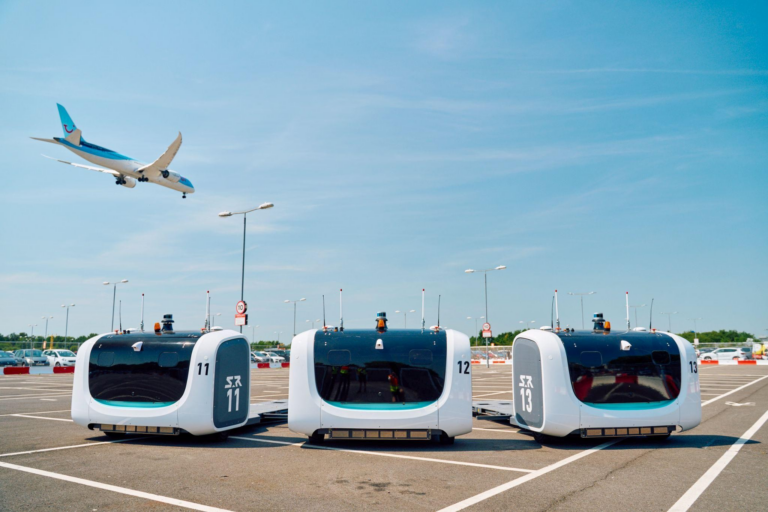
Stan, HL Robotics’ outdoor platform acquired with French startup Stanley Robotics in October 2024 for ₩32 billion (approximately $23 million USD), addresses these constraints through a different sensor suite. The robot uses a 3D LiDAR sensor array — which measures distance by timing the return of pulsed laser light, generating millimeter-precision 3D point clouds in real time — combined with cameras and ultrasonic proximity sensors. This multi-modal perception system maps the outdoor environment continuously as conditions change. Stan operates by lifting vehicles by their tires rather than their undercarriage — the driver enters a dedicated cabin, scans a booking, removes belongings, locks the vehicle, and walks to the terminal with keys in hand; a robot then loads the car and routes it to secure storage.
The outdoor architecture produces a capacity gain of its own: Stanley Robotics reports that Stan packs 50% more cars within the same surface area compared with conventional lot layouts, for the same door-zone and aisle-elimination reasons that apply to Paky indoors. Stan’s rated maximum load of 3 metric tons (6,614 lbs) covers the vast majority of consumer and commercial vehicles; Gatwick’s operating parameters specify a maximum vehicle weight of 2.6 tonnes (approximately 5,732 lbs) with a maximum wheelbase of 3.3 meters (10.8 feet).
Why No Single Robot Serves Both
The engineering incompatibility between Paky and Stan runs deeper than sensor choice. AMR-class indoor robots are designed and calibrated for bounded, mapped interior environments with known dimensions, predictable traffic, and manageable payloads. Their SLAM algorithms assume consistent structural geometry and depend on onboard-only positioning. When that geometry opens to an unstructured outdoor area — variable terrain, unknown vehicle sizes, precipitation — the indoor navigation model breaks down.
Outdoor AGV-class systems like Stan are built for open-area logistics: heavier structural frames, weatherproofed electronics, longer-range LiDAR calibrated for parking-lot distances rather than basement-aisle clearances, and vehicle-handling mechanisms rated for substantially greater mass. Adapting an outdoor system to work in a low-clearance underground garage would require shrinking the frame while maintaining the heavy-lift capacity and weather-resistant construction — an engineering exercise that produces either a compromised indoor robot or an outdoor robot at indoor cost. HL Robotics resolved the trade-off by acquiring Stanley Robotics’ operational data — along with the engineering team that accumulated it over nearly a decade — rather than attempting to develop an outdoor platform from scratch.
“Domestic market interest in and demand for parking space optimization and vehicle logistics automation are growing rapidly,” said Kim Yun-gi, chief executive of HL Robotics. “We will actively create new business opportunities through Paky and Stan.”
From Pilot to Platform: Paky at Gimpo, Stan at Gatwick and Beyond
Paky’s commercial trajectory began at a content business support center in North Chungcheong Province, where Kakao Mobility ran South Korea’s first robot valet service in September 2025. The robot then moved into validation testing at Gimpo Airport in May 2026, where HL Robotics is working through certification requirements before opening the service to the public. The company expects to complete Gimpo Airport certification by year-end, after which visitors will be able to use the robotic parking service — the first civilian-facing autonomous parking deployment at a Korean airport.
South Korea’s regulatory environment is moving to match. The Ministry of Land, Infrastructure and Transport recently revised the Parking Lot Act in a change widely interpreted as opening apartment complexes and multi-story parking towers to parking and logistics robots — expanding the addressable market beyond airport and commercial facilities to Korea’s densely populated residential stock.
Stan’s international track record is the longer one. Stanley Robotics established world’s first robotic valet at Lyon-Saint-Exupéry Airport in France, where the service went live in early 2019. Since then, Stan has expanded to a rail logistics center in Toronto and, most recently, to Gatwick Airport in the United Kingdom — where London Gatwick became the first UK airport with robotic parking on July 23, 2026. The Gatwick service operates at the South Terminal’s Long Stay car park; Clément Boussard, CEO of Stanley Robotics, called the deployment “a major milestone for Stanley Robotics in the UK” and highlighted airport parking capacity challenges ahead of planned growth.
Stan’s domestic South Korean debut came in July 2026. An updated version with a new design and expanded capabilities is scheduled for a full public unveiling at the ITS World Congress in Gangneung — the world’s largest intelligent transport systems event, drawing more than 60,000 attendees from 90 countries — on October 19-23 at the Gangneung Olympic Park.
What the Two-Robot Integration Play Actually Means
HL Robotics is not marketing Paky and Stan as standalone products. The stated goal is to combine the two robots into a unified automation service spanning parking, vehicle transfer, storage, and logistics — treating a vehicle’s complete journey from drop-off to storage and retrieval as a single orchestrated workflow. The pitch is particularly compelling for large mixed-use facilities — airport campuses, logistics parks, and port complexes — where a vehicle might move between an indoor garage and an outdoor staging or transfer area in a single workflow.
HL Robotics is a wholly owned subsidiary of HL Holdings, which is itself part of HL Group, a Korean conglomerate with roots in automotive components and construction. The robotics push represents HL Group’s bid to build a recurring-revenue technology business around vehicle automation infrastructure, a category the group entered through HL Mando’s development of the Parkie prototype that won CES 2024 innovation honors. The Stanley Robotics acquisition brought in nearly a decade of operational deployments across three continents without the years of testing that developing an outdoor platform from scratch would have required.
The global automated parking system market is currently valued at approximately $2.2 billion, with multiple industry forecasters projecting 18-20% annual growth to $6 to $7 billion by 2030, driven by urban density increases and the rising cost of structured parking in dense metro areas. Korea’s combination of high urban density — more than 82 percent of its population lives in cities — and regulatory reform creates one of the more favorable near-term deployment environments in that market.
Frequently Asked Questions
Why can’t a single autonomous robot handle both indoor and outdoor parking?
The two environments impose conflicting engineering constraints at the architecture level. Indoor concrete garages block GPS satellite signals entirely, and the reinforced concrete absorbs standard Wi-Fi frequencies, so indoor robots must use onboard SLAM algorithms for positioning and industrial-grade wireless protocols for fleet coordination. They are built for bounded, mapped interior spaces with known dimensions. Outdoor robots need to be weather-resistant, carry heavier loads (airport vehicles include larger and heavier models than a typical basement garage handles), operate over larger open-area distances, and use LiDAR systems calibrated for outdoor range. Adapting one architecture to satisfy both constraint sets simultaneously would produce a robot too expensive for either market, or one that compromises critical performance in one environment.
How does an autonomous parking robot create more parking capacity without expanding the garage?
Every conventional parking space reserves 28 to 30 inches of clearance on each side so drivers can open doors and exit — a clearance zone that consumes a significant share of each space’s footprint. Garages also include driving aisles wide enough for a full-size vehicle to maneuver. Robotic systems eliminate both: no driver ever exits inside the robot-operated zone, so vehicles can be packed inches apart, and access aisles shrink to the robot’s own width. Paky achieves a documented 30% parking capacity gain within the same floor area through this mechanism; Stan achieves up to 50% in outdoor surface lots by the same principle.
Which airports currently use Stan’s robotic parking system?
As of August 2026, Stan is commercially deployed at Gatwick Airport’s South Terminal in the United Kingdom — the first UK airport to offer the service, opened in July 2026 — and at Lyon-Saint-Exupéry Airport in France, where the service has operated since early 2019. A rail logistics center in Toronto, Canada, also runs Stan in an outdoor logistics context. Gimpo Airport in South Korea is currently in certification testing with Paky (the indoor AMR), with public service expected by year-end.
Is robotic airport parking available in the United States?
No commercial robotic airport parking service using platforms like Stan is currently operating at a US airport as of August 2026. Hyundai Wia’s parking robots — a separate synchronized-pair system not affiliated with HL Robotics — operate at Hyundai’s Metaplant America facility in Georgia, but that is an internal industrial deployment, not a public airport service. The global automated parking market is growing at roughly 18 to 20 percent annually; US airports represent a logical future expansion target for platforms proven at Gatwick and Lyon.