HomeAuto Ben-Gurion Airport Opens Live Startup Pilots: No Demo Floors, Real Queues
Ben-Gurion Airport Opens Live Startup Pilots: No Demo Floors, Real Queues
August 21, 2026:
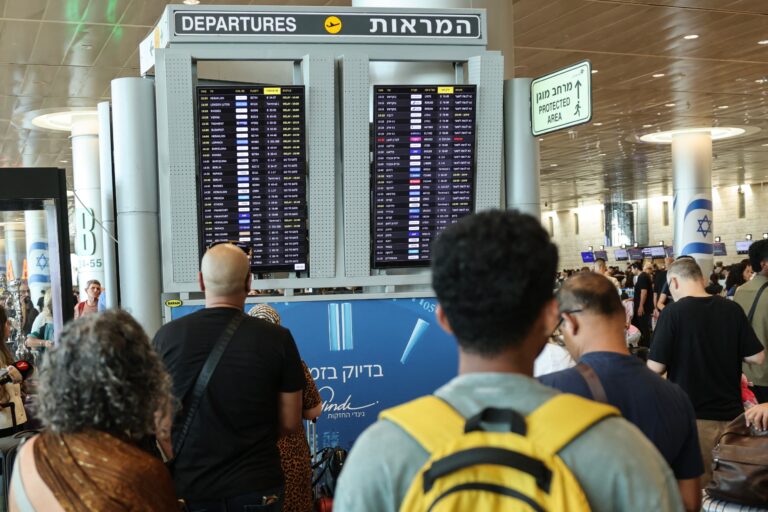
Passengers check a flight information board amid disruptions caused by a surprise staff strike at Ben Gurion Airport in Lod, near Tel Aviv, on August 20, 2026. Jack GUEZ/AFP via Getty Images
One of the world’s most security-intensive airports is now accepting technology proposals from companies willing to test their products not in a mock terminal, but alongside real passengers, real security protocols, and real operational pressure — and a validated deployment here may be worth more to a startup than any controlled demonstration ever could be.
The Israel Airports Authority (IAA) announced on August 19 the launch of RUNWAY 2-6, a structured live-pilot program that opens Ben-Gurion International Airport — located 12 miles (19 km) southeast of Tel Aviv — to technology companies and startups for real-world deployment across its operations. An initial call for proposals is now open, under which up to three companies will be selected to deploy and test their products while the airport handles actual passengers, baggage, and aircraft.
The program’s name nods to Runway 08/26 — Ben-Gurion’s 11,998-foot (3,657-meter) primary operational strip — signaling that RUNWAY 2-6 is intended as foundational infrastructure for technology engagement, not a one-off accelerator cohort.
Live Operations or Nothing
The gap between airport technology pilots and airport technology deployments has long been the industry’s most expensive quiet problem. Vendors can pass controlled demonstrations, perform well in simulated terminal environments, and satisfy an RFP’s stated requirements — only to encounter conditions in live operations that no demo floor can reproduce: actual crowd density during peak morning rushes, security integration requirements that constrain what systems can access what data, and the kind of throughput variability that only an IATA Level 3 airport generates in real time.
Ben-Gurion is that airport. It carried approximately 19.16 million passengers in 2025 and is IATA Level 3 — meaning demand for flights exceeds available infrastructure capacity during peak periods. That designation is not a marketing label; it describes an airport under genuine operational pressure that any technology deployed here must handle without degrading.
That pressure is precisely what makes RUNWAY 2-6’s architecture unusual. The IAA is not issuing an RFP for a specified solution. It is inviting companies to deploy into live operations, work alongside IAA professionals throughout the pilot, and receive feedback before any commercial relationship is determined. The authority will evaluate whether to enter further engagements based on what the pilots actually produce — not on what proposals promised.
For a technology company, this is a substantially different ask than a conventional pilot: the validation environment is real, the stakes are real, and the credential that comes from succeeding is correspondingly more transferable. A system that works at Ben-Gurion — with its documented security protocols, active passenger throughput, and geopolitically complex operating context — has an argument to make in procurement conversations at airports worldwide that no sanitized demonstration can match.
What the IAA Is Looking For
RUNWAY 2-6 spans four operational domains, each targeting a layer of airport function that passengers either experience directly or depend on invisibly.
Passenger journey technologies are the primary focus: automation, artificial intelligence, self-service, line and crowd management, navigation and wayfinding, and biometric passenger journey technologies applied to the journey from terminal entry to aircraft boarding. This is the layer of airport operations most visible to the traveling public, and the one where Ben-Gurion’s documented pain points — overcrowding, queues, and delays — are most acute.
Baggage and operations form the second pillar: baggage tracking and handling systems, smart maintenance, robotics, and facility management — the coordinated back-of-house infrastructure that keeps aircraft turns on schedule and bags reaching their owners.
Security and cybersecurity receive dedicated focus, which is consistent with Ben-Gurion’s global reputation. The airport is routinely cited as operating one of the most stringent security regimes of any commercial airport in the world, which means that security-adjacent technology here faces a higher integration and compliance bar than at most comparable facilities. New entrants in threat detection, access management, or cyber resilience will find a testbed that is both demanding and reputationally significant.
Commercial operations round out the call, covering terminal retail, dwell-time management, and passenger-facing services — recognizing that revenue and experience optimization inside the terminal are as operationally consequential as airside efficiency.
A Structural Shift in How Airports Buy Technology
RUNWAY 2-6 arrives as airports globally are building more structured pathways between their procurement processes and the technology industry — but most of those pathways still stop short of full live-environment deployment.
The Airports for Innovation (A4I) coalition — ten founding members including Aeroporti di Roma, Aena, Munich Airport, and Dubai International — received 292 proposals from 283 startups across 36 countries in its first joint call for proposals in 2024, selecting 25 finalists for deployment across member airports. Aeroporti di Roma runs its own Call4Startups program from an innovation hub physically located inside the terminal, now in its fourth edition. Amsterdam Schiphol operates Airport Innovation Runway (AIR), a structured proof-of-concept pathway with mentorship and scaling support.
What distinguishes RUNWAY 2-6 from these models is the explicit commitment to operational deployment rather than hub-based development or controlled-environment testing. The IAA is not running a co-working space or a pitch competition; it is opening its terminal, gates, and back-of-house operations to technologies it has not yet procured, under conditions it cannot sanitize.
Why Ben-Gurion, Why Now
The immediate context is documented passenger frustration. Ben-Gurion has contended with overcrowding, queues, and operational disruptions as traffic has recovered from years of conflict-related disruption — the airport only fully reopened in April 2026 following a ceasefire. Scheduled departure capacity for July 2026 was approximately 29 percent higher than July 2025, according to OAG Schedules Analyser data, reflecting the pace of recovery.
But the longer-term pressure is structural, not cyclical. Ben-Gurion is approaching its effective operational ceiling. IATA’s own data projects the airport reaching maximum capacity around 2030. The Israeli government approved simultaneous planning for two new international airports in February 2026 — one at Ramat David in the north and one in the south — citing congestion at Ben-Gurion as the primary driver.
RUNWAY 2-6 enters an airport that is not waiting for technology to mature before deploying it. It is deploying concurrently with infrastructure expansion, which means the technologies selected now have a genuine possibility of being integrated into systems that are themselves being rebuilt.
Global Airport Technology Context
The broader aviation technology landscape that RUNWAY 2-6 is entering is accelerating. Artificial intelligence has moved from experimental to operational in airports: 53 percent of airports now apply AI to aircraft turnaround — up from 36 percent in 2024 — and 73 percent use AI in some operational context. According to SITA’s 2025 Air Transport IT Insights report, biometric border control is live at 54 percent of airports globally and is expected to reach 83 percent by 2028.
In the Middle East specifically, SITA and Qatar Airways launched opt-in face biometrics for check-in, bag drop, security, and boarding at Hamad International Airport, connecting more than 700 touchpoints into a single biometric journey — described as one of the largest deployments of its kind in the region.
Yet SITA’s own research identifies the primary barrier to maximizing these investments: not the technology itself, but the absence of data integration across multi-partner operations. SITA CEO David Lavorel noted in the company’s 2025 insights publication: “The technology is there. The data infrastructure isn’t always there.” It is precisely that integration challenge — testing technology inside a real operational environment where those multi-partner data flows are live, not simulated — that gives a live-pilot model like RUNWAY 2-6 its structural advantage over any demo environment.
Does a Ben-Gurion Credential Actually Travel?
For the startups and scale-ups that make RUNWAY 2-6’s inaugural cohort, the program offers something beyond a single contract: a proof-of-concept established inside an environment that no other airport can replicate on request.
The combination of elements that define Ben-Gurion’s operational environment — security integration requirements, capacity pressure under an IATA Level 3 designation, the geopolitical complexity of its operating context — means that a technology which performs reliably here has been validated under conditions more demanding than most airports will impose on a procurement evaluation. That argument travels.
The IAA has not specified a timeline for selecting the inaugural cohort. Up to three companies will be chosen in this first round, and the program is designed to iterate based on what the pilots reveal.
Whether RUNWAY 2-6 produces a replicable model will depend on what the pilots actually deliver. But the structural question it poses to the airport technology industry is straightforward: if your product works in a controlled environment but you have never run it while a security-intensive airport’s morning rush is in progress, what exactly have you proven?
Frequently Asked Questions
What is the RUNWAY 2-6 program, and how can companies apply?
RUNWAY 2-6 is a live-pilot program launched by the Israel Airports Authority (IAA) that invites technology companies and startups to deploy and test their products inside active Ben-Gurion Airport operations, not in a controlled demo environment. The program’s initial call for proposals is now open, with up to three companies to be selected. The four focus areas are passenger journey technologies (including AI, biometrics, and crowd management), baggage and operations, security and cybersecurity, and commercial operations. Information on submission is available through the IAA.
How is RUNWAY 2-6 different from other airport startup programs like Aeroporti di Roma’s Call4Startups or Schiphol’s Airport Innovation Runway?
The key structural difference is the point of deployment. Programs like Aeroporti di Roma’s Call4Startups operate from an innovation hub located inside the terminal, and Schiphol’s Airport Innovation Runway runs proof-of-concept roadmaps with mentorship support — but both involve some degree of controlled or hub-based development before operational integration. RUNWAY 2-6, by contrast, places selected companies directly inside live airport operations from the pilot’s outset. Companies work alongside IAA operational staff while the airport is actively serving passengers, meaning the technology is evaluated under real throughput pressure, real security integration requirements, and real operational variability.
Why does a validated deployment at Ben-Gurion specifically matter for a technology company’s global prospects?
Ben-Gurion is IATA Level 3, meaning demand for flights exceeds available infrastructure capacity during peak hours — it is not merely busy, it is operationally constrained. Its security regime is among the most stringent of any commercial airport worldwide. These are not conditions an airport can agree to simulate for a vendor evaluation. A technology that performs reliably at Ben-Gurion under those conditions has been tested against a harder set of real-world constraints than most airports will impose during procurement. That validation is transferable: a system that works in a security-intensive, capacity-pressured, geopolitically complex environment has a credible argument in any airport procurement conversation globally. For more on IATA Level 3 designation, see IATA’s coordinated airports page.
What is driving airports to invest so heavily in AI and biometrics in 2026?
Passenger volume is growing faster than airports can comfortably absorb. IATA projects 4.9 percent year-on-year passenger traffic growth for 2026. Against that demand, airports are adopting AI for turnaround management, biometrics for contactless passenger processing, and integrated data platforms to coordinate decisions across their multi-stakeholder environments. SITA’s 2025 research found that 53 percent of airports now use AI for aircraft turnaround, up from 36 percent in 2024, and that biometric border control is live at 54 percent of airports globally, expected to reach 83 percent by 2028. The primary barrier identified is not the technology itself but the data integration challenge — getting systems that were built by different vendors for different functions to share a consistent operational picture in real time.