August 20, 2026:


Twisted Tower, the long-awaited first-person horror shooter from indie developer Thomas Brush and publisher 3D Realms, launched on PC via Steam on August 18, 2026, and walked away from its first day with a Very Positive Steam rating of 94% across 119 user reviews and a Metacritic score of 79 based on ten critic reviews — a “Generally Favorable” verdict for a $14.99 indie title that has been in development for nearly five years. The 10% launch discount brings the game to $13.49 through September 1.
For a compact, roughly four-to-six-hour indie FPS arriving from a micro-studio, that opening represents a clear critical success — though a closer look at the full critical landscape reveals both enthusiasm and a sharp outlier: The Wand Report, one of the ten Metacritic critics, awarded the game a 20 out of 100, calling it “sloppy, buggy, and derivative.” That dissent sits alongside eight positive reviews, including a 100 from Try Hard Guides and a 90 from both DualShockers and Gamer Social Club. The split is not unusual for an ambitious indie title that reaches for something distinctive — but buyers should know the consensus comes with a minority view worth reading.
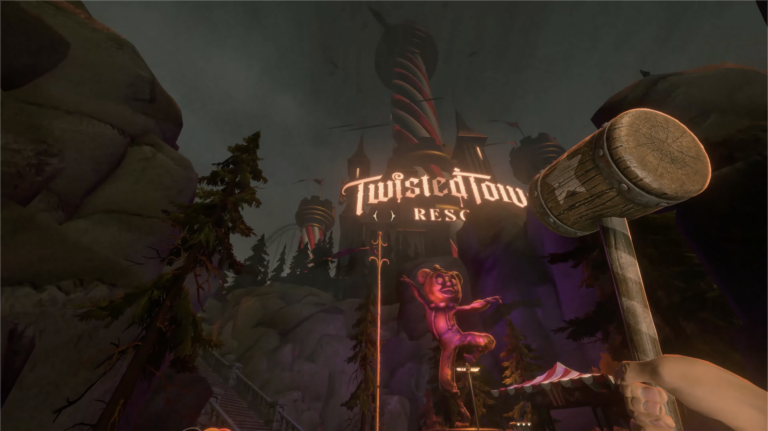
The premise is built on a specific emotional hook. Players take on the role of Vincent, a young man who has just proposed to his girlfriend Charlotte at a drive-in movie theater. He wakes the next morning to find her gone — not gone willingly, but taken: a message has been slipped under his door by the eccentric and rhyme-speaking film director V.C. Twister, who has kidnapped Charlotte and brought her to the Twisted Tower resort. If Vincent wants her back, he’ll have to climb to the top of the tower — a journey through five themed floors of corrupted fairy-tale dread: a decaying hotel, a mermaid-themed waterpark, a clown casino, a carnival forest complete with a massive Ferris wheel, and, as a late-game surprise, a space station. V.C. Twister taunts Vincent over TVs mounted throughout the levels as Charlotte screams in the background. The whole setup takes less than two minutes before the combat begins.
The emotional register is carnivalesque horror run through dark comedy: cheerful-gone-rotten, colorful and deeply unsettling, the kind of atmosphere that only arrives when things meant to delight have been thoroughly broken. It sits closer in tone to American McGee’s Alice than to BioShock’s claustrophobic art deco — bright, absurd, and disturbing in a way that requires both to work at once.
Developer Thomas Brush has been transparent from the beginning about BioShock as his primary reference point. The comparison is legitimate in the areas that matter: both games use a decayed, once-grand environment as a primary narrative device; both have an in-world economy (tickets in place of ADAM) tied to weapon upgrades; both build toward an explanation of the resort’s downfall. DualShockers, awarding the game a score of 90 out of 100, described it as a “polished and genuine love letter to the dramatic narrative of BioShock, with plenty of thrilling combat to keep players busy.” The publication noted the game’s world is “impressively vast, with so much to explore from one playthrough to the next.”
Where the comparison ends is in the weapons and traversal. Twisted Tower’s arsenal consists of carnival-themed toys rather than modified firearms — a Twisted Mallet, a rubber-band pistol, a marble-shooting magnum revolver, a tommy gun, the Shartgun (a flatulence-powered shotgun), a bubblegum-spitting chain gun, a sniper slingshot, and a rocket launcher. Weapons upgrade at kiosk stations using ticket currency and enemy drops. Movement expands over the course of the game through traversal items — fairy wings for dashing across gaps, clown shoes for amplified trampoline jumps, and a jet pack that functions as a double jump. The game also features a room-flipping mechanic: switches physically invert sections of a level, exposing hidden geometry and new paths on repeat playthroughs.
Heidi Hawes, reviewing for WayTooManyGames, awarded the game 8.5 out of 10 and described the combat as “a ton of fun, being incredibly fast-paced with responsive controls,” adding that the wide variety of weapons kept the game feeling fresh throughout. Noisy Pixel’s 70 out of 100 review offered a counterpoint: the humor “misses more often than it lands,” and the narrative “is often a bit too talkative.” Both assessments are visible in the Metacritic aggregate: the game earns consistent praise for its atmosphere and gunplay while collecting more measured marks for its writing and pacing.
The most substantive negative review belongs to The Wand Report, which gave the game a 20 out of 100. The review describes the game as lacking “sincerity and consideration” in its humor — pointing specifically to jokes that cross into disrespect toward mental and cognitive illness — and argues that the game evokes the “Eurojank of the 2000s” without the ambition that made those games interesting. This is not the only rough edge critics noted: GameSpace’s review gave the game an 80 out of 100 while acknowledging “faulty currency balance, boring cutscenes, and overly simple puzzles,” and Noisy Pixel’s review noted the comedy “misses more often than it lands.”
What emerges from the ten-critic aggregate is a picture of a game that has genuine personality and delivers on its central promise — horror-comedy FPS in a carnival gone wrong — while carrying the imperfections of an indie title built by a micro-team over five years. The 79 Metascore is not a ceiling; it is an honest summary. Eight of ten critics found something worth recommending.
The campaign runs approximately four to six hours. New Game Plus unlocks previously boarded-up sections of each floor, providing material for a second run. The room-flipping mechanic and branching paths mean a second playthrough is not simply a re-traversal of known space — structurally inaccessible areas become reachable once a player knows where the switches are.
Whether the runtime is a limitation or a feature depends on expectation. For $13.49 (before September 1) or $14.99 thereafter, a well-constructed four-to-six-hour horror experience with replay incentives is a defensible value proposition. WayTooManyGames noted the game “can be completed in one sitting”, which for the right type of player is a selling point rather than a complaint. GameSpace, despite its mixed notes on currency balance and puzzle design, called the short runtime “a breath of fresh air” after “endless 100-hour AAA open-world masterpieces.”
Twisted Tower was built by Thomas Brush under his studio Atmos Games, with early contributions from lead artist Felipe Caravelli, programmer Ajay Venkat, musician Krys Polezoes, and sound designer Hector Rodriguez. By December 2024, the team had completed their contracted work and moved on; Brush finished the final phase of development alone, funded through personal savings and income from his YouTube channel Full Time Game Dev, which teaches indie development to aspiring developers. The game is published by 3D Realms, a label within Saber Interactive, which also publishes Ion Fury and CULTIC.
The game is available as a standalone purchase or as part of the Ultimate Mascot Horror Bundle games, which bundles Twisted Tower with Dark Pals: The 1st Floor, Choo-Choo Charles, and Finding Frankie. No console version has been announced.
At its current launch-discount price of $13.49 (through September 1), yes — for players who enjoy horror-comedy FPS games with BioShock-style atmosphere and short, focused runtimes. The Metacritic score of 79 and 94% Steam user approval reflect a game that delivers on its central premise: a corrupted carnival resort with imaginative weapons, a genuinely disturbing atmosphere, and fast-paced combat. The caveats are real — the humor does not always land, some puzzles are underwhelming, and one critic (The Wand Report, 20/100) found the whole package sloppy and derivative. Buyers who are specifically sensitive to the game’s described humor issues should read that review in full before purchasing. Everyone else is likely to find what eight of ten critics described: a distinctive, enjoyable indie FPS with its own point of view.
Players control Vincent, a young man whose girlfriend Charlotte has been kidnapped by V.C. Twister, an eccentric film director and billionaire who runs the Twisted Tower game show. To rescue her, Vincent must climb through all five floors of the tower — a corrupted 1950s resort whose themed areas (hotel, waterpark, clown casino, carnival forest, space station) are staffed by murderous costumed mascots. The story is told through TVs broadcasting Twister’s taunts, tape recorders left throughout the levels, and environmental details hidden in each area. The full narrative arc runs approximately four to six hours.
The gap is notable in the positive direction: Metacritic’s generally favorable score of 79 comes from ten professional critics, while Steam’s 94% of 119 user reviews landed as “Very Positive” — a rating above what critics as a group awarded. This is not unusual for horror-comedy games with niche appeal; the audience that gravitates specifically toward this type of game tends to rate it more warmly than general-audience critics. The critical spread also matters: eight of ten Metacritic critics were positive, one was mixed, and one (The Wand Report) was strongly negative with a 20/100. The aggregate softens what is, for most critics, a clear recommendation.
Yes, more than most games of its length. New Game Plus unlocks previously inaccessible areas on each floor, and the room-flipping mechanic — switches that physically invert sections of a level to reveal new geometry — means some pathways are structurally blocked on the first run. The toy-based traversal system (fairy wings, clown shoes, jet pack) also opens alternate routes that reward revisiting sections after new items are unlocked. A second run is not just a replay of the same rooms in the same order; it is a meaningfully different spatial experience.