August 19, 2026:


Discounty — the critically acclaimed cozy management sim about running a failing supermarket in a small town that may or may not want you there — landed on iOS and Android on August 18, 2026, and the mobile version ships as the most complete package the game has offered in its nearly one-year life. Players downloading it for $12.99 get the full base game, the free “People or Profit?” expansion with its entire new chapter, and three branching endings, all in a single purchase. That matters, because the expansion answers the central criticism the game carried at launch: that its choices never quite added up to anything.
Developed by Crinkle Cut Games — a Danish studio founded by three game-development graduates and based in Aalborg, now grown to a team of five — and published by PQube on PC and consoles and by Swedish mobile specialist Snapbreak for iOS and Android, Discounty launched to a Metacritic 79 in August 2025 and a “Very Positive” rating on Steam across more than 2,700 total reviews. The game compares easily to Stardew Valley in its pixel-art visual style and cozy life-sim rhythm — you farm townsfolk relationships instead of crops — but its tone is more specifically interested in what happens when a discount chain rolls into a harbor town on the financial ropes.
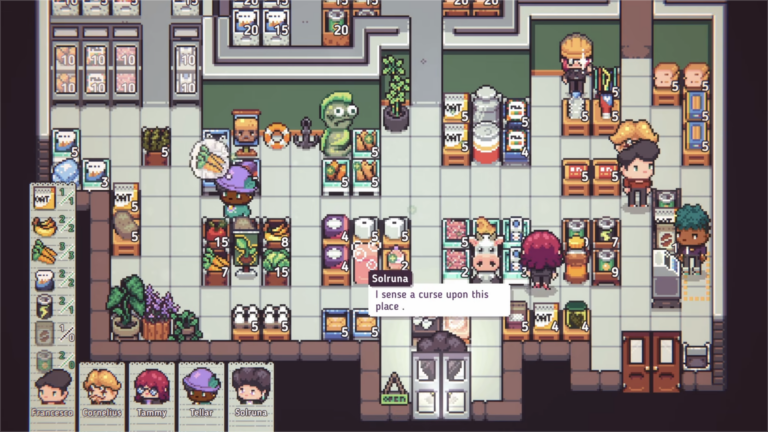
Set in the fictional coastal community of Blomkest, Discounty drops the player into their aunt’s struggling store with an implicit question baked into every management decision: are you healing this town by expanding, or accelerating its decline? Day-to-day, that means stocking shelves, working the register, negotiating trade deals with local vendors, and keeping the floor clean before Ms. Andersen notices the milk section is empty. After closing time, the game opens into something closer to a life sim — players can explore Blomkest, build or damage relationships with a cast of deliberately prickly residents, and slowly pull back a curtain on a community whose problems predate your arrival.
The emotional register is charming and cozy on the surface, with a chiptune soundtrack and bright pixel art that signals a welcoming world. But the discomfort arrives early and stays: your aunt has “generously” set you up in a trailer behind the shop, the locals make their skepticism about the store’s impact known, and the game’s mechanics keep asking whether growing the business and protecting the community are actually the same thing. That question is the game’s central dramatic tension, and it does not resolve neatly — which was both its distinguishing quality and, for many early players, its main frustration.
Crinkle Cut Games has been candid about player feedback following launch. The most common criticism: the game’s original three-chapter ending felt abrupt, and the choices players made throughout the campaign did not seem to land. The free “People or Profit?” expansion, released on PC on June 6, 2026 — and later in July 2026 for Nintendo Switch, PlayStation 5, and Xbox Series X|S — was built directly in response.
The expansion adds an entirely new fourth chapter set immediately after the original ending, in which Aunt Tellar finally hands full control of Discounty and Blomkest’s future over to the player. Three new characters added in Chapter 4 include Gaspard, Tammy’s disgraced brother who envisions a hydroponic farm; Angeel, a “bougie city girl” opening a luxury grocery branch called Muimerp; and Casey, a “troubled” teen offering goods from the trunk of a car. Depending on which of these characters players ally with through the branching questline, they reach one of three distinct endings.
Beyond the narrative additions, the expansion also introduced a town restoration mechanic — players collect resources and convert them into building materials to repair Blomkest’s crumbling infrastructure — plus 35 new inventory items, a self-checkout system, a house the player can actually buy (departing the trailer), random shop events like game-day customer rushes and sheep wandering through the floor, and hundreds of new reactive dialogue lines. The studio’s team of four people built the entire expansion over the first half of 2026.
The expansion was shadow-dropped at Wholesome Direct 2026 on June 6, surprising an audience expecting only a preview.
Critical reception across platforms has been warm but measured. Nintendo World Report’s Switch review scored the game 7/10, landing on a characterization that captures the prevailing critical view: the game sits at an interesting halfway point between a fun indie shop sim and a game with something real to say about corporate expansion in struggling communities, without fully committing to either direction. That critical ambivalence — the sense of untapped potential alongside genuine satisfaction — runs through much of the coverage.
The game’s defenders are more enthusiastic: DigitalChumps awarded it 9.5 out of 10, calling it an addictive and ever-expanding cozy experience, while Try Hard Guides gave it a 9/10 and described it as a midpoint between Stardew Valley and Supermarket Simulator. On OpenCritic, 44 critics produced an average score of 76, with 75% recommending it.
Steam community response tells a similar story. English-language reviews stand at 83% positive across more than 1,500 reviews, rising to 87% among recent English-language Steam reviews. Some negative feedback centered on the NPCs’ morality — characters who are deliberately unsympathetic — reading those choices as unintentional rather than satirical. Others read the prickly cast as exactly the point. The “People or Profit?” expansion appears to have addressed some of the structural narrative complaints, with the score trending higher since its release.
The mobile version’s campaign runs approximately 15 to 20 hours — consistent with the PC build — and the core management loop (shelf-stocking, checkout, inventory ordering, store layout design) maps reasonably well to a touchscreen, based on Snapbreak’s track record with similar narrative-management titles. Snapbreak is a Swedish mobile publisher with more than 30 million downloads across its catalog, including Snufkin: Melody of Moominvalley; its focus is premium, story-driven mobile games rather than free-to-play.
At $12.99, Discounty Mobile is priced below the PC base price of $19.99 and comparably with other premium mobile narrative sims. The version includes the complete post-launch content, meaning a player picking up the mobile version today encounters a substantially different — and more complete — game than the one that received its original reviews in August 2025.
Crinkle Cut Games originated from three game-development graduates who received a cultural grant from the Danish Film Institute (DFI) to build their debut title — a public-funding model used across Nordic creative industries to support work with artistic merit beyond pure commercial calculus. That origin is visible in Discounty’s structure: the satirical premise, the deliberately uncomfortable social dynamics, and the game’s refusal to let corporate expansion look simply heroic are choices a commercially optimized studio might have softened.
In their most recent developer communication, Crinkle Cut Games confirmed no further major updates are planned for Discounty. The studio describes itself as in early development on an unannounced new project. The “People or Profit?” expansion is the game’s final major content chapter — the closing argument of a game that spent a year building to a satisfying response to its own original incompleteness.
For players who bounced off the original PC release before the expansion arrived, the mobile launch represents a clean re-entry point: the game is now what it was always trying to be. For players new to Discounty entirely, $12.99 for a 15-to-20-hour management sim with social commentary and three distinct endings competes favorably with the genre.
A free demo remains available on Steam for PC players who want to test the game before committing. The base PC game is currently on Steam daily sale for $11.99 through August 19.
Yes. The iOS and Android version of Discounty, which launched on August 18, 2026, for $12.99, includes all post-launch updates — including the free “People or Profit?” expansion and its new fourth chapter with three distinct endings. Mobile players are not purchasing the original launch version; they are getting the complete, post-expansion game.
The main campaign runs approximately 15 to 20 hours. The original three-chapter game ended in a single way; the “People or Profit?” expansion, now bundled with all versions of the game, adds a fourth chapter in which player choices and alliances lead to one of three distinct endings, addressing the most common criticism of the launch version.
Discounty shares Stardew Valley’s pixel-art aesthetic and life-sim structure — building town relationships, managing a business, exploring after hours — but replaces farming with supermarket management and foregrounds a more explicitly satirical question about whether commercial growth helps or harms a struggling small community. Critics have broadly recommended it to fans of the genre, though those seeking a more complex narrative or deeper store management mechanics may find it stops short of both. It earned a Metacritic score of 79 on PC and a 75% critic recommendation rate on OpenCritic across 44 reviews.
The key difference is the presence of a branching narrative and a defined satirical premise. Supermarket Simulator and comparable titles prioritize management depth and business-optimization loops without significant story investment. Discounty layers relationship-driven quests and a community-impact question on top of a lighter management loop, then uses the “People or Profit?” expansion’s three-ending structure to give those choices consequence. The result is closer to a narrative adventure with management mechanics than a pure simulation.