August 19, 2026:


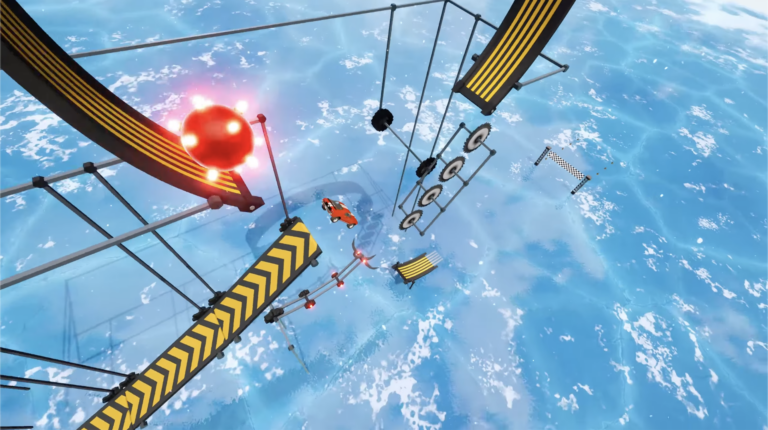
Brinemedia opened the Stunt Paradise 2 playtest on Steam on August 17, 2026 — the opening day of the Ukrainian Games Festival 2026 — giving players their first access to a sequel that runs on a fundamentally different movement architecture than the original. The two-person Ukrainian studio replaced the invisible-boundary guidance system that powered the 2024 original with a spline-based NVIDIA PhysX movement system, and the difference shows up in what the levels can now do: one track launches the player out of a cargo plane mid-flight; another collapses a frozen lake beneath the car to reveal an underground cave, as documented in a July 2026 developer interview on 80.lv. That kind of scripted set-piece was off the table in the previous architecture. The playtest is now open for access requests on Steam; accepted players will be notified when slots become available.
In Stunt Paradise (2024), Brinemedia kept vehicles on track partly by placing invisible collision boundaries that subtly guided the car along the road. The workaround was effective, but it constrained level design: any track element that required the car to leave a predefined corridor would break the system. For the sequel, the studio scrapped that approach and rebuilt around a spline-based movement system. A spline is a mathematical curve that defines the driving path geometrically; instead of enforcing invisible walls, the system uses NVIDIA PhysX developer documentation — the same open-source real-time physics middleware used in a wide range of Unity-based games — to simulate suspension, gravity, torque, collision, and traction, while the spline provides the path logic that keeps controls predictable.
The practical effect is that Brinemedia can now build track sections where the car truly goes airborne, where the terrain beneath it changes state mid-run, and where environmental objects — a shark clearing the water during a coastal jump sequence, for instance — need to interact with the vehicle without breaking the physics model. Oleksii Netrebenko, the studio’s game developer, described the design standard in an 80.lv interview from July 2026: “Players should always understand why something happened. If they approach a jump with the correct speed and timing, the outcome should be consistent every time.” The spline system is what makes that consistency possible despite the more complex level geometry.
Steering, acceleration, and body lean during cornering were also rebuilt, and the engine audio was redesigned from scratch to communicate the weight and power of each vehicle more accurately.
According to Brinemedia’s official Steam playtest announcement, the biggest change from the previously available demo is the level design. The team reworked tracks to be shorter, faster-paced, and more dynamic — a direct response to player feedback gathered during earlier testing phases, including the Baltic Showcase 2026 in June. The studio is asking playtesters specifically to weigh in on difficulty, level design, and overall gameplay feel.
The expanded hazard set is central to that feedback request. Stunt Paradise 2 introduces lasers, buzzsaws, mines, explosives, and rockets as track obstacles, turning each run into what the developers describe as pure arcade chaos. Each obstacle type has distinct timing and behavior, requiring different routing strategies — a laser that sweeps horizontally calls for a different approach than a minefield that punishes slow movement. Players in the early community have noted the difficulty curve is steeper than the original, with some flagging the precision demands as a significant step up, as seen in community discussions on Steam.
The ragdoll stunt driver is another addition. Every vehicle now contains a driver with ragdoll physics: on a heavy impact, the driver can be launched through the windshield, turning a failed run into a brief comedic moment before the next attempt, as Brinemedia described in the 80.lv interview. The design intent, Netrebenko explained, was to make crashes entertaining rather than frustrating — a mechanic with precedent in the FlatOut racing series, which used similar ragdoll ejection as a core feedback loop.
Beyond the main level gauntlet, Stunt Paradise 2 introduces Trials Mode: short, demanding tracks focused entirely on precision driving and timing, aimed at players who want the hardest version of what the physics system can produce, as Brinemedia explained to 80.lv. It is a separate track category from the main game, not a difficulty setting within it.
The vehicle roster will include around ten distinct cars for the final release, with a paint and appearance customization system for visual personalization. Brinemedia made a deliberate design decision to keep all vehicles on the same baseline physics rather than differentiating them by speed or handling statistics. Game designer Ruslan Zainchukovskyi explained the reasoning: building levels around precise timing and carefully tuned jumps meant that any significant per-vehicle physics difference changed how a level played entirely, which worked against skill-based fairness. Car choice is, as he put it in the Brinemedia 80.lv developer interview, “a matter of personal style and visual expression” rather than a meta decision.
A checkpoint system is also new to the sequel: players no longer restart from the beginning of a track after a crash, which softens what could otherwise be an unforgiving difficulty wall given the precision the new level geometry demands, per the Gematsu game listing.
Stunt Paradise 2 is built in Unity, a choice Brinemedia made specifically for cross-platform flexibility over visual fidelity, as the developers told 80.lv. Unreal Engine offers easier photorealism, but Unity gives a two-person team the ability to target PC, PlayStation, Xbox, and Nintendo Switch from a single codebase — and to extend that reach to mobile and web platforms later without rebuilding the project. For an indie studio whose first game shipped on four platforms simultaneously, portability is a more useful asset than render quality.
The sequel nonetheless represents a substantial visual upgrade over the original, with modern shaders, particle effects, and improved lighting applied throughout. Crash sequences and mid-air stunts are noticeably more spectacular than in the 2024 game. The art pipeline runs through Blender for 3D modeling, Photoshop for textures and UI, and GoldWave for audio editing. The soundtrack is composed by a professional guitarist, a detail the developers have highlighted across their promotional materials, and the environmental audio was rebuilt alongside the engine sounds to support the new physics model. The game launches in a wide selection of interface languages.
One technical issue has surfaced in the Steam community since the demo: a black screen on startup affecting at least one user running an RTX 5080 at 4K resolution. The playtest is the appropriate venue for identifying and resolving bugs of this kind before the full launch, but players on high-end hardware at high resolutions should be aware of the reported compatibility issue.
The Stunt Paradise 2 playtest is most valuable for players who found the demo’s difficulty ceiling interesting rather than punishing, who specifically want to give feedback on level pacing and trap design, or who want to test the rebuilt physics ahead of the full release. The playtest is not an open beta with an unlimited player count — Brinemedia will notify accepted players when slots become available. Players unsure whether the series is for them have access to the free demo on the Stunt Paradise 2 Steam page, which remains available separately from the playtest.
Brinemedia timed the playtest launch to coincide with the opening day of the Ukrainian Games Festival 2026, a week-long Steam event running through August 24 that features more than 680 Ukrainian game projects. During the festival, the original Stunt Paradise is available at 50 percent off — a straightforward entry point for anyone who has not played it — via the Steam festival sale page. The first Stunt Paradise on Steam carried a 96 percent positive rating across its reviews, making the festival discount a reasonably low-risk way to evaluate whether the series’ physics-platformer sensibility is the right fit before the sequel arrives.
Per the Steam listing, Stunt Paradise 2 requires Windows 10 or later. The full system requirements call for an Intel Core i5-8400 or AMD Ryzen 5 3500, 8 GB of RAM, and a GTX 1050-class GPU at minimum. The recommended configuration steps up to an RTX 2060 or RX 6600 alongside 16 GB of RAM and DirectX 12 support. Storage requirements are modest: 1 GB minimum, 2 GB recommended.
Console versions — PlayStation, Xbox, and Nintendo Switch — are planned for the full release. The Blue’s News report on the playtest noted that the console playtest itself is expected to follow the current PC test. A full release date beyond the 2026 window has not been announced; COGconnected’s December 2025 report specifically identified Q4 2026 console launch as the target.
Visit the Stunt Paradise 2 Steam page and click the “Request Access” button in the Playtest section. Brinemedia will notify accepted players when a slot becomes available. This is an access-request model rather than an open beta, so notification may not be immediate. Players who want to try the game in the meantime can download the free demo, which remains available on the same page.
The most significant change is the movement system. The original Stunt Paradise kept vehicles on track using invisible collision boundaries. Stunt Paradise 2 replaces these with a spline-based NVIDIA PhysX system — a physics middleware used across a wide range of Unity titles — that simulates vehicle dynamics in real time and defines the driving path geometrically rather than through hidden walls. This change enables the set-piece moments new to the sequel: cargo-plane launches, terrain that collapses mid-run, environmental objects that interact physically with the vehicle. Additional changes include a checkpoint system, a ragdoll stunt driver, Trials Mode, a paint-based car customization system, and completely rebuilt engine audio.
Stunt Paradise 2 is planned for release on PlayStation, Xbox Series X/S, and Nintendo Switch alongside PC in 2026. COGconnected confirmed a Q4 2026 target window for the full console launch. No specific date has been set, and the current Steam playtest is PC-only; a console playtest is expected to follow.
Trials Mode is a separate track category from the main game, consisting of short, demanding levels built specifically around the precision demands of the spline-based physics system. Unlike the main gauntlet levels — which combine speed, trap avoidance, and environmental set pieces — Trials tracks focus entirely on precise timing and vehicle control. They are aimed at players who want the hardest version of what the physics engine can produce and are available as a standalone mode, not a difficulty setting within the existing levels.