

A Community Leader Fights for Haitians in Ohio, While Worrying About His Own Fate

August 13, 2026:

A Community Leader Fights for Haitians in Ohio, While Worrying About His Own Fate

Viles Dorsainvil, co-founder of Haitian Support Center, poses for a picture at his office in Springfield, Ohio, on July 29, 2026. —Jim Vondruska—Reuters

Viles Dorsainvil doesn’t have time to think about his own future.

His days are filled with responding to increasingly frantic calls from fellow Haitians in Springfield, Ohio, where he is a community leader known for helping make sense of immigration issues. Then he spends his evenings up late, often until midnight, working on his own schoolwork, as he pursues dual master’s degrees in public administration and international relations at Wright State University near Dayton.

Amid this hectic pace, Dorsainvil, 40, is grappling with the same situation as many of those around him. He came to the U.S. in 2020 under what’s known as Temporary Protected Status, or TPS. Last week, a federal court confirmed that the Trump administration’s bid to end TPS for Dorsainvil and roughly 330,000 other Haitians had succeeded, setting the stage for scores of deportations in the coming months. 

In recent weeks, Haitians across the country have received a stark warning from the Department of Homeland Security: accept $2,600 and return to Haiti, or refuse and be fitted with an ankle monitor, allowing Immigrations and Customs Enforcement (ICE) to easily detain them for deportation at any point in the future. Some Haitians are preparing to flee to another country. Others are resigned to returning to Haiti. 

Dorsainvil has yet to receive a letter from DHS. He is trying to keep from becoming overcome by fear, especially while others in the community still depend on him. But his precarious situation feels untenable. 

“I don’t know which plan I should have,” he says.

In Springfield, fear of this moment has been rooted deeply in the community’s psyche since the last presidential campaign, when Donald Trump and JD Vance helped spread false rumors about Haitian migrants eating residents’ pets in Springfield. Last June, then-Secretary of Homeland Security Kristi Noem first announced that TPS for Haitians would be terminated.

That set off a monthslong legal fight that officially ended this month, with a federal judge affirming the Supreme Court’s decision from June. “These individuals can either self-deport or we’ll arrest you and send you back,” Secretary of Homeland Security Markwayne Mullin told NewsNation last week.

The Haitian Support Center in Springfield that Dorainvil co-founded in 2023 has seen calls spike from Haitians worried about their future in the wake of the Supreme Court ruling. On the other end of each line is another Haitian immigrant trying, like him, to rebuild a life in America after leaving a home country torn by deadly earthquakes and endless gang violence. 

Since late July, at least 50 people in Springfield have received a DHS letter about their deportation status, according to the center’s own tally. The letters instruct them to come to the nearest local ICE offices for a check-in appointment and preview the choice they will be asked to make. 

Dorsainvil, who has accompanied some Haitians to provide translation, says most check-ins unfold the same way: after immigration officers confirm an immigrants’ identity and status, they offer the $2,600 payment and deportation, which the immigrant usually refuses. Then they are outfitted with an ankle monitor, despite objections from their lawyer who often argue for less intrusive measures. 

None of the court rulings can alter the chaotic reality that still engulfs Haiti. The State Department continues to warn American citizens not to travel to the country, citing the risk of “crime, kidnapping, terrorism, unrest, and limited health care.” The Department also recommends U.S. citizens who need to travel to Haiti leave DNA samples and dental records with trusted people to make it easier to identify their remains. 

Dorsainvil stresses that many Haitians in the U.S. would love to return to their homeland if that was a viable option. “So far, we just don’t have a country to come back to,” he says.

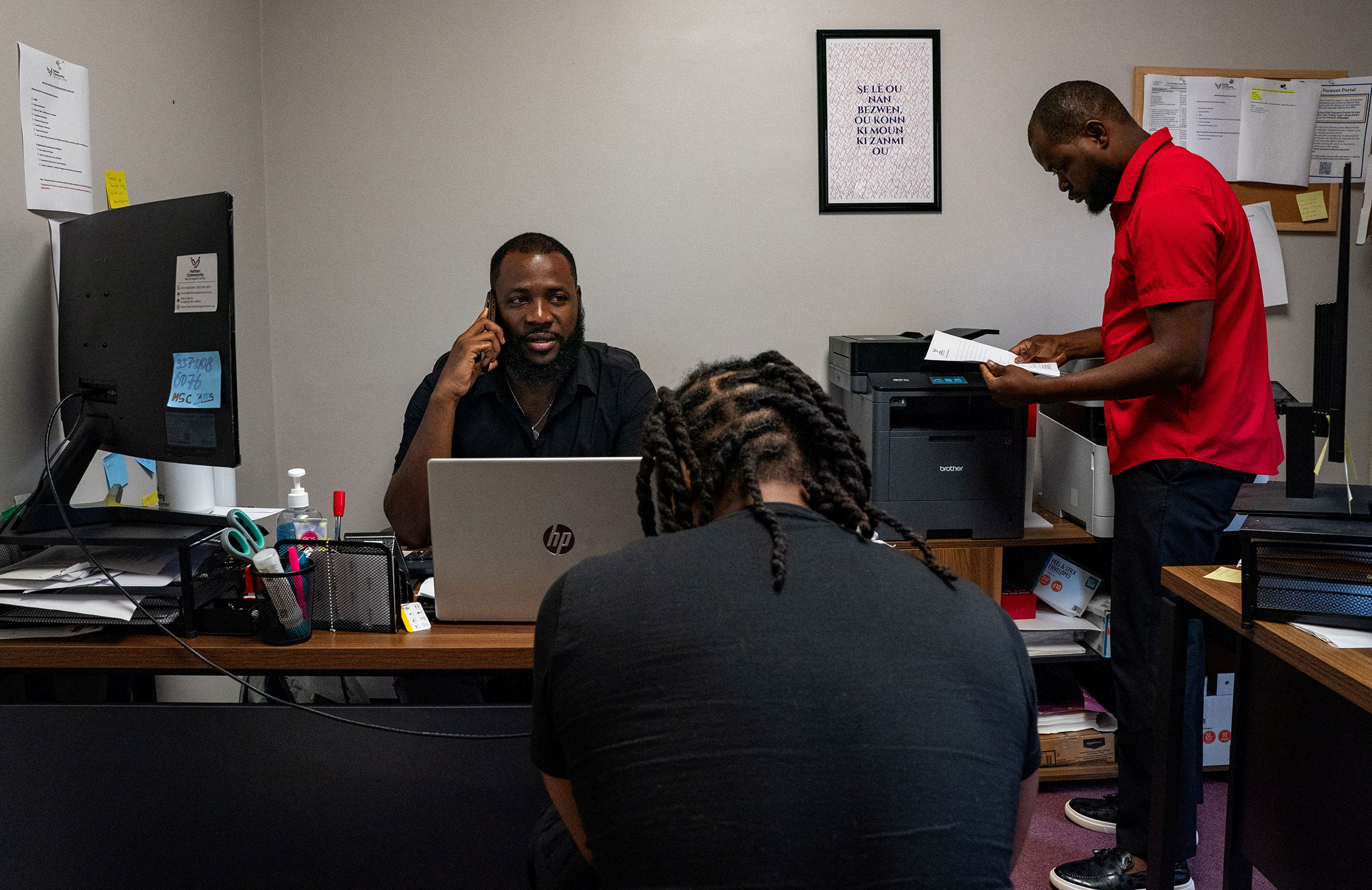
James Fleurijean helps a Haitian immigrant with paperwork at the Haitian Support Center in Springfield, as Dorsainvil (right), reviews paperwork for another Haitian immigrant, on Aug. 3, 2026. —Seth Herald—Reuters

Haitian migrants scared to leave their homes

Two weeks ago, Dorsainvil made the difficult decision to close down the Haitian Support Center for two days over fears of a rumored ICE operation in Springfield. He feared ICE agents might stake out the center’s office to catch Haitians coming there for help. The heightened vulnerability has left Springfield’s Haitians in a state of panic. Many of those who haven’t fled their homes are staying indoors and keeping their kids home from school. 

The anxiety among Haitian immigrants isn’t confined to Ohio, where Gov. Mike DeWine has limited state cooperation with ICE and praised Haitians for helping revitalize Springfield’s economy. In Florida, home to the nation’s largest Haitian population, immigrants face intensified enforcement as the Republican-controlled state government closely aligns itself with Trump’s mass-deportation agenda. Last year, Governor Ron DeSantis mandated all local officials work with ICE operations, and the state government has threatened officials who hesitate to do so with criminal penalties. 

State authorities in Florida are now required to make immigration-related arrests on behalf of ICE. It’s a dynamic that has left the state’s Haitian immigrants “paralyzed,” says Anne Piervil, an immigration attorney based in Orlando.

“People aren’t driving. People aren’t taking public transportation. People are scared to go to the airport,” she says, adding that some TPS holders have lost their driver’s license because renewal was tied to their immigration status.

An ICE spokesperson said in a statement that TPS had been allowed to function as a de facto amnesty program and that the program was always intended to be temporary.  

“What we would say now is it’s closing time which means you don’t have to go home, but you can’t stay here,” the spokesperson said in an unsigned statement. “The good news is it’s not too late to get a $2,600 check and a free flight home.”

Scores of Haitian immigrants have also reportedly lost their jobs. Piervil said large amusement parks, hotels, and nursing homes in Orlando have begun dismissing hundreds, if not thousands, of Haitian workers since the Supreme Court ruling.

The fraught situation in the U.S. is prompting some Haitians to contemplate fleeing to a third country, despite the obstacles. Aside from the costs and a possible language barrier, many Haitian immigrants are also concerned about their own safety if they move to a third country, according to Felipe Sousa-Lazaballet, a community organizer in central Florida. That fear was heightened after reports in February that four decapitated Haitian women were found in the Dominican Republic—Haiti’s neighbor—after they had been deported from Puerto Rico. The Dominican Republic has also been deporting hundreds of thousands back to Haiti each year.

The option to move to Canada is also becoming increasingly infeasible. Earlier this year, Canada tightened its immigration laws in response to an influx of migrants. Any TPS holders who try to cross the border risk being returned immediately to the United States and into ICE custody.

For many Haitians in the U.S., the only realistic option is to simply wait for what comes next. The community in Springfield is left collectively holding its breath, wondering if a rumored mass deportation operation will come to pass.

For now, Dorsainvil, along with many volunteers in the community, continues to provide as much support as he can, from daily transportation and translation to grocery shopping. Like many other Haitians living in Springfield, he also finds solace in prayer and meditation.

“I meditate to reboost my system and mental health,” he says, “just so that I can continue to serve my community again tomorrow, and the next day.”

Source link