
Max Miller, Graham Platner, and the Bipartisan Allure of Toxic Men: Opinion

August 4, 2026:

Max Miller, Graham Platner, and the Bipartisan Allure of Toxic Men: Opinion

Democrats don’t need to copy the Republican playbook to win back young, male voters. The left has been winning elections with its own brand of joyful, responsible men. 

Man in a suit points to himself using this left thumb.

New domestic violence accusations against Republican congressman Max Miller of Ohio, coming quickly on the heels of the sexual assault scandal that ended Graham Platner’s Maine Senate race in July 2026, have me thinking: As more Millennial and Gen Z men run for office, we’re going to have to address the edgelord issue. 

The webspeak term “edgelord,” which originated online sometime around 2010 but became more common parlance by 2018, refers to people embracing subversive bigoted attitudes to seem cool or edgy. 

Merriam Webster defines an edgelord as “someone who makes wildly dark and exaggerated statements (as on an internet forum) with the intent of shocking others.” But there’s more to this digital-era “edginess”: Edgelords like the manosphere podcaster Joe Rogan and the right-wing agitator Nick Fuentes don’t necessarily mean what they say; often, they’re just trying to get a rise out of us. Their “shock jock” attitude provides cover to defend bad behavior—like, say, offensive tattoos or misogynistic behavior—as simply guys being guys. 

The young male attraction to edgelord “edginess” has helped Trump and MAGA Republicans win over more white men, especially young men. Gen Z guys, especially, seem drawn to the feeling of acceptance in this online man’s world—even, or perhaps particularly, if these young men don’t feel so successful in real life.  

Republicans and Democrats handled the allegations against their candidates differently. After Platner was accused of rape in July 2026, he quickly lost his party’s support and dropped out. So far, GOP leadership is standing by Miller’s re-election. 

But with the midterms fast approaching, why would Democrats ever embrace this destructive ideology at all? After all, the left already has a much more appealing brand of masculinity that’s actually won races—the joyful, responsible masculinity embodied by many of its rising stars.

What is an edgelord politician?

Platner, 41, ran an openly edgelord Senate campaign. 

A Marine turned oyster farmer who was once a mercenary soldier for the private military firm Blackwater (now Constellis) in the Middle East, he had an apparent Nazi tattoo whose symbolism he initially denied understanding. Platner dismissed a trail of homophobic, racist, and sexist comments on Reddit as a “stupid joke.”

Rather than disqualify him from representing all Mainers—including women, Jews, people of color, queer people, and people who might have concerns about mercenary soldiers—some members of the Democratic Party saw Platner’s toxic masculinity as a political asset. 

In a GQ profile published in October 2025, a few months into Platner’s primary campaign, writer Ross Barkan described Platner as “the virile, earthy working man many male politicians wish they were.” (When I read this out loud to a girlfriend, we both expelled an audible eww.) Barkan described him as having “forearm tattoos and visible muscle,” and the piece quoted Platner boasting about his familiarity with firearms. 

Weapons savvy could be an asset in Maine; the state’s voting record doesn’t really paint a clear picture on that. But gun control is a standard Democratic issue, and it seemed conspicuously absent in a piece touting the candidate’s left-wing creds. (Platner previously stated he supported background checks but not an assault weapons ban.) 

I had more questions after reading this story: Could voters trust a man with a history of sexist remarks to, say, support policies that would address sexual assault in the military? Would Platner prioritize protecting abortion and ensure that a Medicare for All policy would cover reproductive health-care? Would he vote for guns to be kept away from domestic abusers? 

Barkan, the author, implicitly rejected such concerns as less important than the perceived need to win back men. 

‘Political masculinity’

It’s true that Black men’s support for the party fell from 87 to 75 percent between the 2020 and 2024 presidential elections, according to Pew Research. Hispanic men’s support fell from 57 to 48 percent over the same time period, too. But polls show women also voted Republican in higher proportions than in previous elections. Meanwhile, 77 percent of Black male voters and 69 percent of Jewish male voters still voted for Kamala Harris. 

Yet political analysts and pundits still declared that the Democratic Party had a problem with men. Maybe that explains why women’s concerns about Platner were dismissed early on by Platner’s campaign.

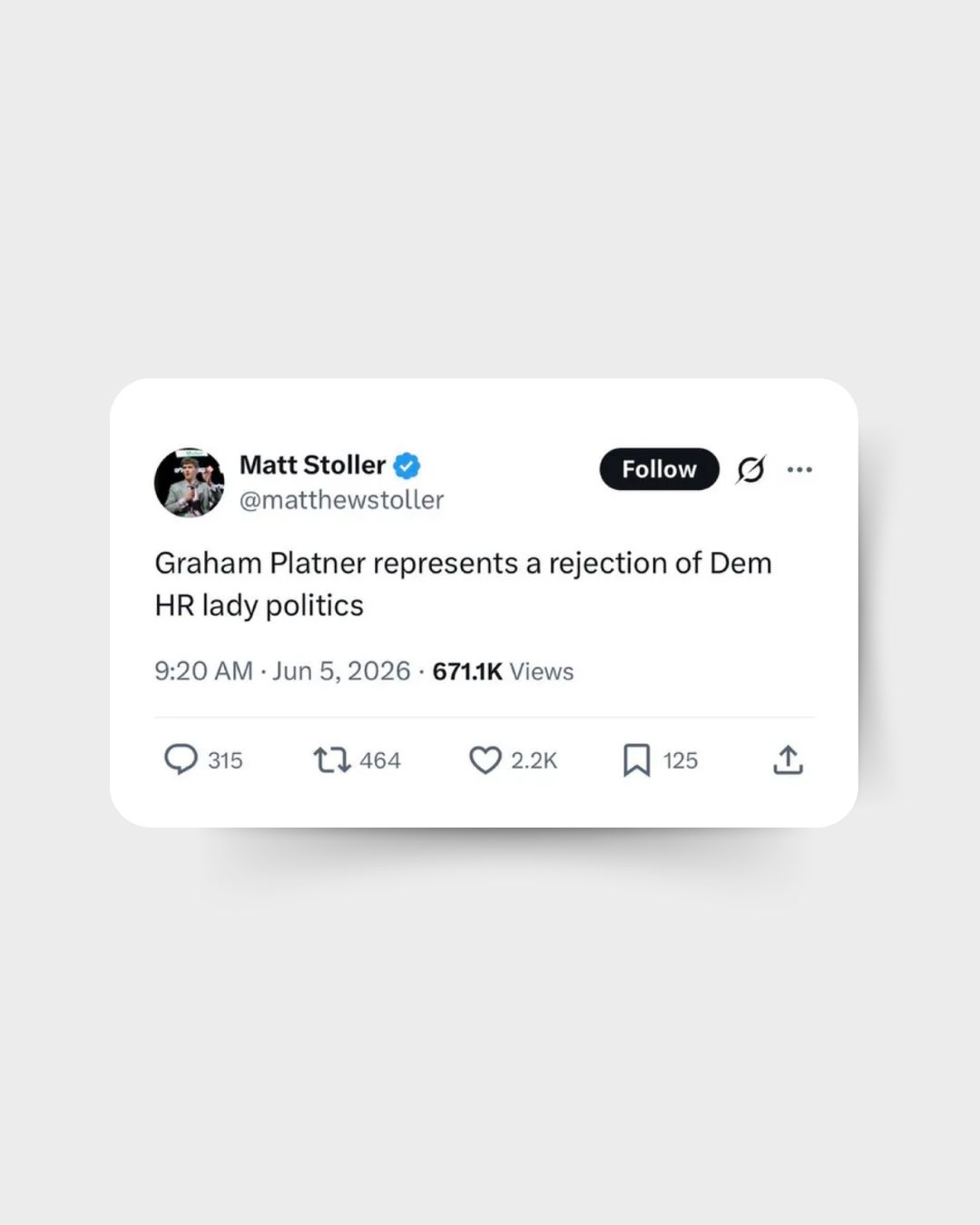
In fact, some of his supporters seemed to see his toxic masculinity as a positive for his candidacy. In a now-deleted June 5, 2026, post on X, Matt Stoller, a political commentator and researcher at the nonprofit American Economic Liberties Project, said that Platner’s primary win was a rejection of “Dem HR lady politics.” 

Max Miller Graham Platner

Both Barkan’s profile and Stoller’s X post express an appreciation of what I’ll call “political masculinity.” This masculinity is all for show (as a lot of politics is). To exemplify political masculinity, a candidate needs to shoot guns, display anger, express grievances, and perform physicality—take Health Sec. Robert F. Kennedy Jr.’s pushups, for example, or Russian President Vladimir Putin’s bare-chested horseback riding.

Political masculinity shows disdain for social norms that ask men to participate actively in building a more equal society. It is a masculinity of rugged individualism and is, therefore, deeply American. A century ago, Teddy Roosevelt exemplified this political masculinity, with his war-righting and game-hunting. In the Bush years, it might have been exemplified by the kind of politician you wanted to “flip burgers and drink a beer with.” 

Now, it seems, political masculinity has become the candidate young men want to troll with on Reddit.

The Mamdani man

Consider, now, the alternative: New York City Mayor Zohran Mamdani and Georgia Sens. Jon Ossoff and Raphael Warnock—three election-winning Democratic men. 

All model collective responsibility and, often, joy. None have repeatedly, performatively flexed their muscles, Pete Hegseth-style, for political capital. I can’t find any Platner-esque interviews where they brag about how well they shoot a gun (particularly telling for Warnock and Ossoff who represent Georgia, where gun ownership could be an asset). 

And yet, poll numbers released on July 29, 2026, show Ossoff leading in his re-election campaign. (Warnock isn’t up for reelection until 2028.)

Why is Mamdani’s brand of joyful, responsible masculinity ignored—or even denigrated by pundits and his political opponents? It’s hard here to avoid Mamdani’s race and faith: He’s a brown Muslim man. Ossoff is Jewish. Warnock is Black.

Analysts and other talking heads only seem to see Democratic politicians as “masculine” if their manliness looks like Platner’s or that of Sen. John Fetterman, the hulking Pennsylvanian who was elected to the Senate in 2022 on his working-class macho guy image.

If political masculinity must be muscular and pugnacious, what about Pete Buttigieg? The former Indiana mayor and federal transportation secretary served in the military. But as a gay man, his particular masculinity would likely never be touted to voters. So, it seems political masculinity also aligns with heterosexuality.

Another male Democrat who doesn’t subscribe to toxic masculine norms is James Talarico, a deeply Christian Democrat who is running for Senate in Texas. Republicans have made masculinity a central issue in that race, with Talarico’s opponent Ken Paxton accusing him of being “too low-T for Texas.” White House Deputy Chief of Staff Stephen Miller also called Talarico “transgender” as an insult. 

Talarico, fittingly, has responded to these attacks not by performative displays of toxic masculinity, but by emphasizing how men can prioritize responsibility and service to others. 

“A man takes responsibility,” he said on June 11 to MS NOW’s Jen Psaki. “A man upholds his commitments to his family and his neighbors. A man does what’s right, even when no one is watching.”

How to win elections

It’s like the Democrats are trying to follow the Republican playbook. But candidates who get Republican votes are inherently—because of their party affiliation—not the same candidates as those who win over Democrats. 

And the voters they’re apparently trying to cater to—white voters, specifically men—are consistently the demographic that least identifies with the Democratic party. 

The real party stalwarts are Black, Hispanic, and Asian voters, and women. Women as a bloc vote Democratic at higher rates than men, with at least a 10 percent gender gap in the last four elections. Black women are the party’s most stalwart voters.

If this is the base of the party, what are the issues they care about? 

It’s not masculinity. In 2024, according to the KFF Survey of Women Voters, their most important issue was inflation, with “threats to democracy” second, and immigration and abortion tied for third. If you look just at Black women, rising costs, democracy, and abortion rank in the top three issues, with gun policy ranking fourth. If you focus on women voters under 30, abortion is their top concern. 

Mamdani, Ossoff, and Warnock have all won elections while speaking persuasively and compassionately to these kitchen-table issues. Edgelord politicians speak—angrily, combatively—to the grievances of white men. After Mother Jones broke news of the horrific abuse allegations against Max Miller, his response was to call his ex a liar.

Let’s learn the right lessons here. If the Democrats want to regain power in Washington, the party should stop playing the Republican’s masculinity game and start championing its own brand of positive masculinity—you know, the kind that actually wins elections.

Source

Source link