July 11, 2026:

This weekend, Linda Nosková will face Karolína Muchová and Jannik Sinner will play against Alexander Zverev in the much anticipated Wimbledon finals. The world will be watching.
Wimbledon endures not because it’s the most prestigious tournament, but because it’s the one that most feels like it belongs to everyone—from royals to regular fans. The groundskeepers tend it like family. And generation after generation of fans gets to inherit it like one.
Every spring, months before a single ball is struck, the groundskeepers of the All England Lawn Tennis Club begin their most important work of the year. In May 2023, I was invited to spend time with the staff during their preparation for Wimbledon. I hopped on the first flight, arriving at the club outside London in a dewy morning fog.
For a lifelong tennis player and fan, it was a kind of pilgrimage. I bent down to touch the grass and hoped a few shards of green would rub off on my palm so I could tuck them into a vial. Will Brierley, Lead Groundsperson at the All England Lawn Tennis Club, showed me how they mow, trim, massage, roll, and paint some of the world’s most famous tennis courts.
As I sat in their clubhouse, a well-worn break room filled with whiteboards containing the day’s assignments, black-and-white photos of past groundskeepers, and books from James Patterson thrillers to a Scrabble dictionary, what struck me most was the dynamic among the groundskeepers and the shared language between them. It’s a unique form of family that gathers here before the Grand Slam begins.
The groundskeepers, who don’t really follow tennis, spoke about each court as if it were a sibling or cousin—some demanding and temperamental, others easy to maintain. Some, they joke, they can tend with their eyes closed. They’re exhausted by the time the tournament starts, especially if it’s been raining. They know these courts as family.
When the players arrive, something similar happens in the stands. Wimbledon is the one Grand Slam that, in my view, consistently draws not just fans but families, by blood or chosen.
Unlike any other major sporting event, Wimbledon still allows fans to queue for a chance to buy same-day show-court seats at face value, or enter the grounds for as little as £33. This creates an atmosphere in which families can afford to attend and celebrate in community.
Last year, even though I had a media pass, I spent a morning in the queue to experience that particular camaraderie. Every other group I spotted in line was playing a board game, a card game, soccer, or participating in some other analog communal engagement as they waited, sometimes with champagne at 9 a.m. Some people spoke English, others in German, French, and Japanese. Everyone was excited.
I saw multi-generational groups, or groups of 60-something gals in hand-embroidered hats who’ve been coming for decades to queue together, picnic on Henman Hill together, and treat the fortnight as an annual retreat.
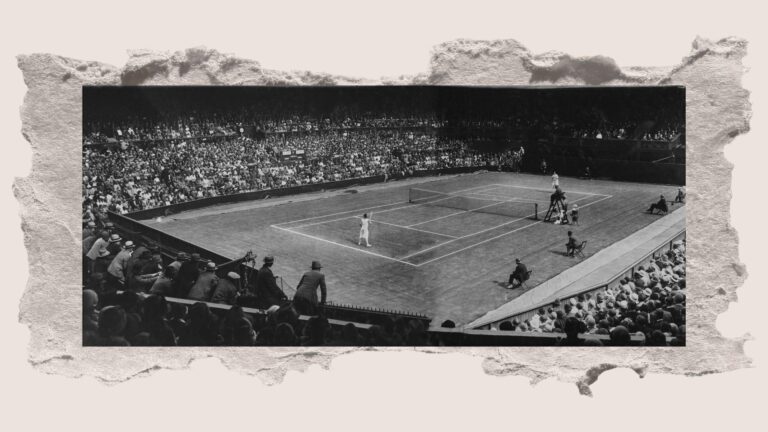
Wimbledon’s roots were not quite of the people, at least not at first. The tournament started in 1877, an outgrowth of the exclusive Victorian croquet club, as lawn tennis rose in prominence in the UK. Some 200 people attended the first final, crowded among three stands. The All England Club introduced the queue in 1922 once the venue changed from a small meadow to larger grounds on Church Road, still in the famed SW19 postal code area. Every-day fans could buy tickets on the day of play.
Over the years, the queue and the tournament became the most sought-after events in the sport’s annual calendar. Fans would give anything to witness the world’s oldest tennis tournament and Centre Court, where greats from Arthur Ashe to Serena Williams to Roger Federer became legends. For the lucky fans attending this year, they’ll witness legends anew as Serena and Venus Williams play doubles together for the first time since 2022—yet another family reunion at Wimbledon.
The more I spent time with Wimbledon’s groundskeepers—before the tournament, during it, and while on breaks—the more I realized that Wimbledon is a family reunion. There are, in fact, literal family members on the grounds staff, including two sets of brothers among the team.
Most of the groundskeepers don’t particularly follow tennis. They align themselves, first and foremost, with Premier League teams: Liverpool, Arsenal, or Chelsea. They have little investment in who wins the tennis matches. Their only real chatter revolves around which players’ movement styles damage or preserve the grass.
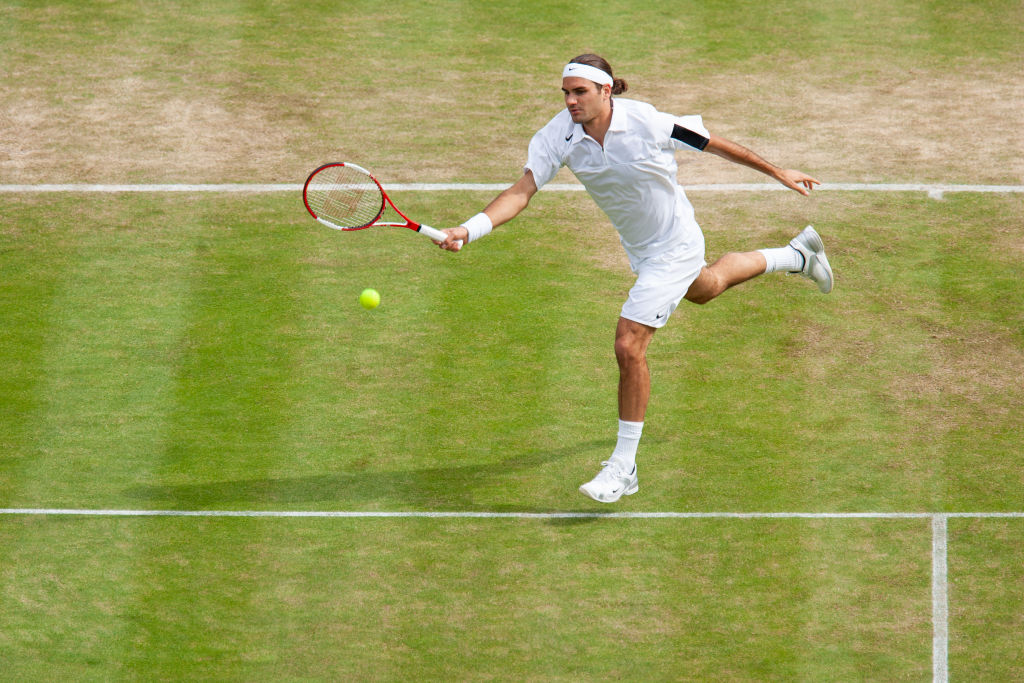
A player who drags their back foot up to meet their front foot when serving kills the grass, which is why you see sharp brown lines form behind the baseline in the first week of the tournament. “Foot draggers!” the groundskeepers grumble. Players who move balletically, though—the groundskeepers love them. They care for the grass through the way they play. No surprise: Roger Federer was good for the grass.

When I asked Brierley and the team to tell me about the differences between the courts, he pointed at a map on the wall in the clubhouse. They also keep photographs of the courts from past years, records of perfection or near-perfection, as a kind of institutional memory.
“Some of these ones are much more difficult to get ready or keep ready than ones even right next to them,” he said, pointing around the map. “Obviously, everyone cares the most about…” he trailed off, pointing to Centre Court, the center of Wimbledon’s beating heart.
Court 2 puts them through the most, and they love it for that. The court sits below ground level, beneath the water table, which means its soil stays wet longer. But it also dries and heats faster than its neighbors, owing to the angles of light.
The mind of a groundskeeper works on sundial terms, always aware of how grass courts play differently in the morning and evening, and the angles of shade affect the texture and firmness of the plot hour by hour. The team works toward a reading of around 200 gravities for the start of the tournament, and 300 for wheelchair tennis: the ideal resistance for bounce on a grass court. Every day, as the team assembles, Court 2 requires checking on: rolling, measuring, watering, redirecting. It is the difficult cousin. By contrast, Courts 5 and 6, two among the eight sibling courts just south of Centre Court called “The Octuple,” have optimal growing conditions and no shade issues.
Wimbledon’s irrigation system runs on a fully computerized grid with laser precision. At night, guard dogs and surveillance teams monitor the grounds year-round, because catastrophe at Wimbledon comes in the form of a two-foot-long fox slinking onto a court and marking its territory. Rufus the hawk handles deterring the pigeons from disrupting play by eating grass seed.
And none of this would be sufficient if the tennis going on inside the gates at the All England Club weren’t so wonderfully, maddeningly unpredictable.
Most tennis players count Wimbledon as their most prized Slam title. It is the “most beautiful tournament, most beautiful court, most beautiful trophy,” as Carlos Alcaraz said after winning in 2024. Three-time Wimbledon men’s singles finalist Andy Roddick has likened the grounds to another world entirely: “I love it. I can’t talk about it in a rational way.”
But this is also the quirkiest, most unforgiving surface in the sport. Grass courts hardly exist outside of these two weeks. Most players don’t grow up playing tennis on grass. The bounce is low and fast and strange. Footwork and sliding are risky business.
This has produced upsets, like defending champion Steffi Graf’s loss in the first round in 1994, Rafael Nadal’s second-round loss in 2012, and Novak Djokovic’s third-round loss in 2016. The seedings become suggestions as the players relearn grass for a short burst of their seasons. Spectators get to witness the quirky, mythic sporting event that is Wimbledon.
That’s why we love tennis: the possibility of the erratic and unexpected. It reveals something like an inner-child curiosity in all of us, what happens when expected order gives way to wonder.
Wimbledon is where we feel that wonder most acutely, because the stakes are high and the surface is unforgiving and the whole thing feels, somehow, like it’s been handed down—by a groundskeeper who has been working at Wimbledon for decades, or Vicky and Nigel Broad who have been at the front of the queue since John McEnroe was competing in the early 1980s.
The tennis courts themselves are alive. As is everything around them.