Lina Ghotmeh, Riding Solo

July 1, 2026:

Lina Ghotmeh, Riding Solo

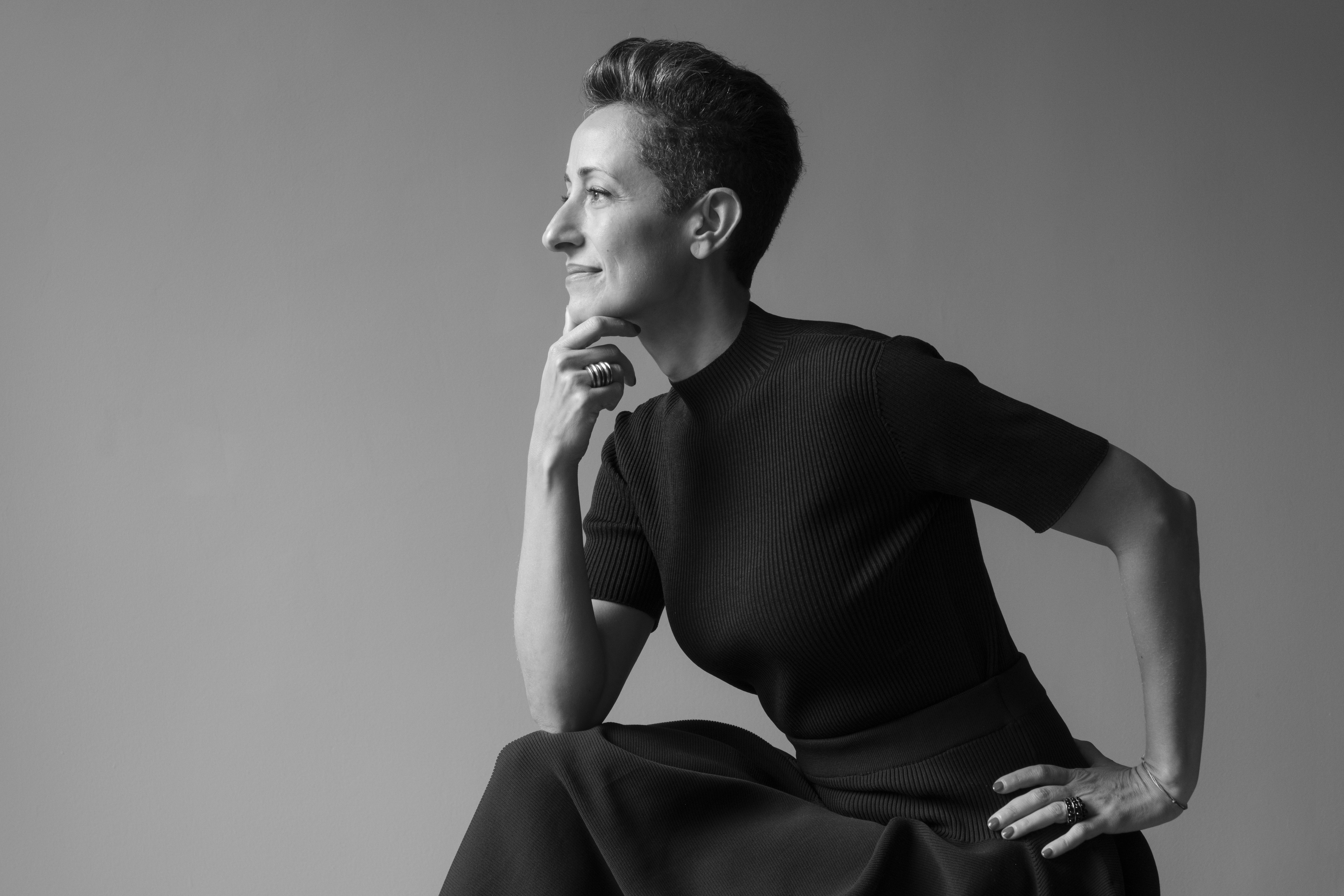
—Photograph by Brigitte Lacombe

This article originally appeared in TIME France

There are voices that make you lower the volume—on your phone, your intercom, or, in this case, my recorder—the moment you hear them. That is not the case with Lina Ghotmeh. Listening back to our interview, the volume button is pushed all the way up. The image comes back: amid the various models filling her studio in Paris’s 11th arrondissement, she speaks softly, pointing to the projects around her, slowly enough that the beads on the ring on her left hand do not knock together. The architect is not one of those people who needs to speak loudly or make grand gestures to be heard. Instead, she pours you another cup of genmaicha, and now you are the one whispering.

That bubble, as if suspended in midair, stands in stark contrast to her presence in recent months in the media and architectural worlds: unavoidable, even thunderous. Recently, she won the competition for the renovation of the British Museum in London; the major contemporary art museum in AlUla, Saudi Arabia; installed a fuchsia labyrinth in a Byzantine palace at the Venice Biennale and designed Qatar’s pavilion in the city’s Giardini—the first one built there in 30 years and the first in history by a woman.

Before that, the British had discovered her through the prestigious Serpentine Galleries; athletes at the 2024 Olympics through her design of a building in the Olympic Village; and her fellow Lebanese through the construction in Beirut of her very first Lebanese project, The Stone Garden, a building that survived—we will come back to it—the port explosion on Aug. 4, 2020.

It is here, in her native city so often knocked to the ground, that the young Lina paradoxically chose the profession of building. The daughter of a construction entrepreneur and a mother with an architecture degree who never practiced (“we were four children,” she says, without really acknowledging that her path might reflect a desire to give her mother something she had not been able to accomplish—“perhaps something of that sort, yes”), the little girl drew constantly. Landscapes, the world around her, as if to create a new one, to search for beauty, in a family that never left the country during the war.

“Precise Acts“ Ateliers Hermès in Normandy, France. —Photograph by Iwan Baan

She dreamed of becoming a geneticist or an archaeologist. Enrolled at the American University of Beirut, a temple of interdisciplinarity, she took as many biology classes as architecture ones. Her first projects helped her decide. At 22, looking for an internship, she applied—where else?—to Jean Nouvel’s studio and was chosen, from among the candidates, to watch the man in black at work. A week later, she was in Paris, literally falling in love with the city while wondering why everyone looked so unhappy. Six months later, she returned to Lebanon. Then she was called back for a London project, on which two of the era’s “starchitects,” Nouvel and Foster (whom she now calls by his first name, Norman), were working side by side. From the first, she learned that being an architect means remaining a child, continuing to dream. From the second, how a firm is structured. Later she would make her own blend, somewhere between the two, without abandoning her initial ambition.

At just 26, there she was, browsing a website listing architecture competitions around the world. In Estonia, a national museum project on a former Soviet military runway that looked like a giant 1970s recording studio caught her eye. The first colleagues she approached declined. Two others agreed to join her. They barely knew one another and created a structure bearing their three names for the occasion—DGT, for Dorell Ghotmeh Tane. Out of 106 applications, the odds were slim, but a miracle happened. “Usually in architecture, you end with the biggest project. I started with 40,000 square meters,” she says with a smile today. At the time, though, “everyone thought it was just an idea, that it would never be built.” 

The trio traveled to Estonia every two weeks to negotiate, to prove they were capable. Three years to sign the contract, meet politicians and mayors, and place themselves within a vision strong enough to carry an entire system. It was an accelerated education in the profession, but over a long stretch of time. Ten years later, when she went to inaugurate it, faced with that highly graphic structure risen from the ground, she grasped her responsibility as an architect. As for the rest, the three of them now had that beautiful project—the only one, in fact—in their portfolio, something to build on and carry forward. “But she wanted to strike out on her own,” recalls one observer from the time. They split in dramatic fashion. On the website of their former practice, which now points to each of their three separate agencies, the images illustrating it are, in fact, photographs of one of her works. Bjarke Ingels—the Danish star architect who never hesitates to put on a show in a more vocal style than his colleague—knew her at the start: “I was immediately impressed by Lina. She had a quiet strength and clarity of mind that foretold a long and brilliant career. Winning the international competitions our industry demands the way she has is no small feat; it is a real sign of endurance,” he says.

She created the agency bearing her name—or not quite, since her actual surname is El Ghotme—alone, in her apartment, without real vertigo: “It comes from being Lebanese. I never thought I was allowed to be afraid.” Though she never utters the language of resilience—“the R word,” her compatriots call it—she moves forward. Deep research on places beforehand. A precise answer to the brief. A style that adapts. “You can recognize Frank Gehry’s buildings anywhere in the world, and Zaha Hadid’s too. It is like a signature stamped onto a globalized industry. I do not think we are yet at that kind of production,” she says.

Usually in architecture, you end with the biggest project. I started with 40,000 square meters.

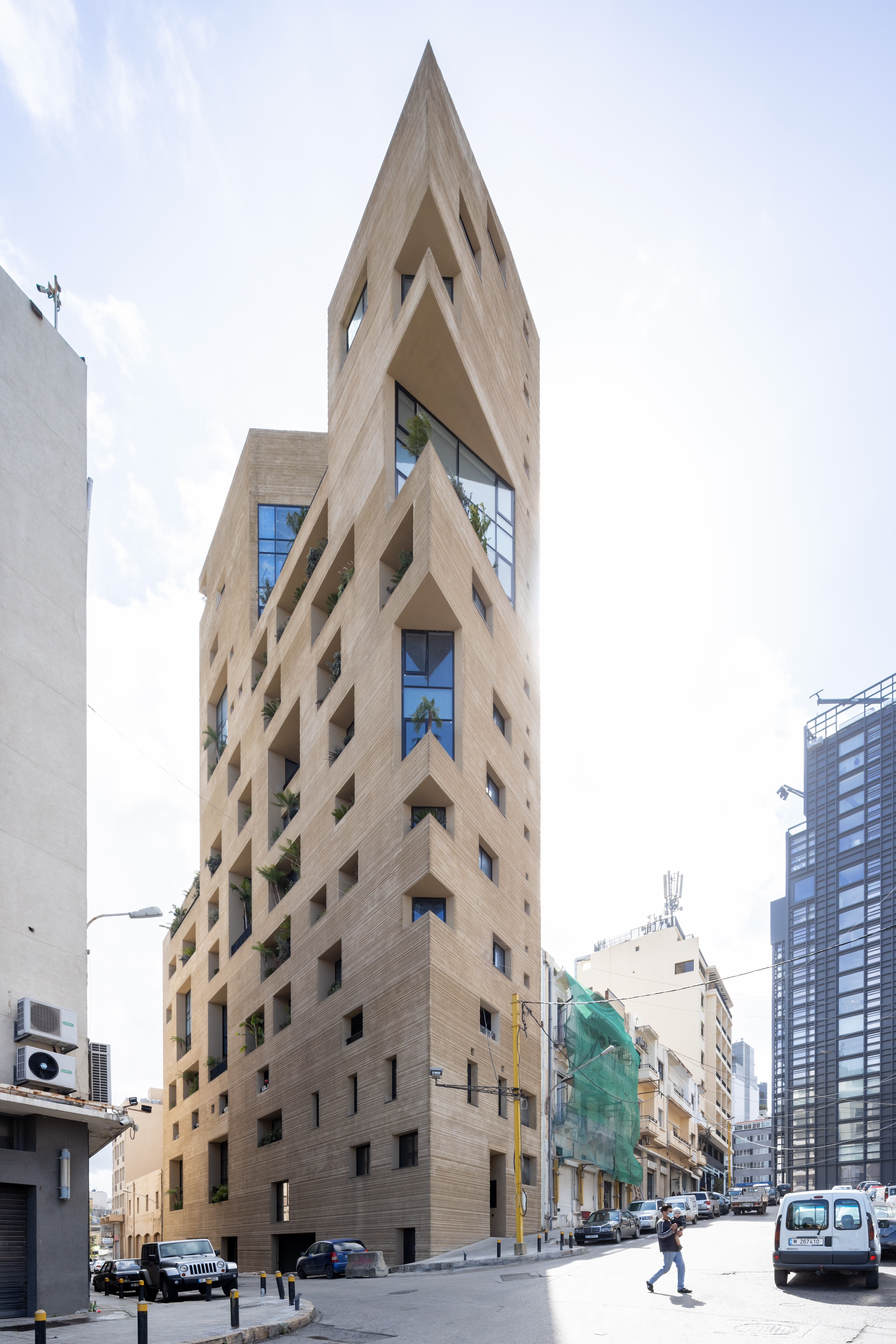
“The Stone Garden” in Lebanon, Beirut. —Photograph by Laurian Ghinițoiu

With Lina Ghotmeh, every project is conceived as an object. An object in its own right. “If you draw a parallel with literature, you can, for instance, recognize that the same poet wrote these three books without it being obvious at first glance. It is a more complex process.” There is indeed little obvious lineage between a restaurant at the Palais de Tokyo in Paris, a Hermès workshop in the Eure department, and, in 2020, Stone Garden, a virtuoso building erected like a sculpture on the site of the former office of the great Lebanese architect Pierre el-Khoury and delivered one month before the Beirut explosion, 500 meters away. She was there that very day, in another neighborhood, and thought to herself: “Everything was new, and now it is over.” While the windows and interiors were destroyed, her building held up. “It looked as if it had not been there during the disaster,” she says today. Did she have a lucky star? Not really. The facade integrated into the structure did not let the blast wave through.

Five years later, on the strength of a not yet immense portfolio, she found herself among the TIME 100 Next rising stars. “It has never unsettled me to surprise people, but I have lived the surprise.” People open their eyes wide when they learn that she—a woman—built a museum, a tower. In a world stingy with female role models, she has built her own defense system: a form of mystery and control. She does not let people get close easily. A journalist can spend three days traveling abroad with her and know no more about her at the end of the trip than at the beginning. Extremely reserved, she gives an embarrassed laugh when asked about her family and personal life. She likes vibrant cooking, lives a few yards from her office, and recently liked a book about the way food explains world geopolitics—that is all. She will say nothing about her architect husband or her son, a little math prodigy who dreams of becoming an engineer. What she does matters above all; it is up to us to try to understand her. In the same way that she thinks about adding an extra combed layer to create texture on one of her buildings, Lina Ghotmeh—her short hair part of her identity, most often dressed in black like Jean Nouvel, though more often in Issey Miyake—takes care with her image, building meaning even into the way she dresses. “What we wear is our first envelope.”

“She truly inhabits a garment,” says fashion designer Rabih Kayrouz, who for a long time had a boutique facing one of her Levantine construction sites. “Like anyone standing before a mirror, she wants to look beautiful, but she does not look at the other person or at what people see in her. The clothes have to help her be who she is—that is how she chooses.” He dressed her in pink at the British Museum and in couture red in Hollywood. “Even when she changes her clothes, it becomes a uniform.” Her image meets the moment, and the moment embraces it.

She is clearly riding solo. She clearly belongs to no chapel and, to my knowledge, is not part of any collective. But when a man is not, nobody reproaches him for it.

——Emmanuelle Borne
The Estonian National Museum in Tartu, Estonia. —Photograph by Takuji Shimmura

Olivier Raffaelli, founding architect of Triptyque Architecture, has often crossed paths with her in competitions. He remembers in particular the one for the Hermès workshop in Louviers. “It was not an easy project.” When he discovered the rival proposal, he found “the drawing very beautiful, the project simple and obvious, the images magnificent.” But when he entered the room and saw her, he thought: “No chance—if there is one person who embodies Hermès in architecture, it is her.” To leave nothing to chance, she even had every interior brick stamped with the brand identity. If someone discovers them centuries from now, they will see in them a gesture—hers—and that of her theory of “future archaeology,” first articulated with the Estonian museum. 

For the rest, Lina Ghotmeh is not an ideologue, in contrast to what French architecture seems increasingly to be moving toward.

“She is clearly riding solo. She clearly belongs to no dogma and is not in the spirit of the collective. But when a man is not, nobody reproaches him for it,” explains architecture critic Emmanuelle Borne.

In this competitive game, she also sees her clients as partners. Ted Chung is one of them. Vice president of finance at the Hyundai group, sharp-minded and passionate about art, already behind 30 architectural projects, he entrusted her with the group’s bookstore in South Korea and remains fascinated by their conversations, by the way she probes people and spaces. “Lina shines without trying to shine,” he says. When he saw how much time she was spending on his “small project” even as she had just won the British Museum commission, he even called her up, as if to relieve her of any guilt if she needed to step back. Her answer: never in a million years.


So what can one still dream of at 46, after landing such a prestigious commission? “Emergency housing in Lebanon, building my own house one day, perhaps,” and winning the competition for the Opéra Bastille, for which she is one of the five finalists, as well as the one in Strasbourg, which she is currently working on. The opportunity to be more present in France, her adopted country, while her major projects continue to develop abroad. Until then, she will have to take on the renovation of a British myth. How does one even approach that? 

“Over the years, additions were made in a rather anarchic way, including covered courtyards, which made circulation more difficult and crushed sublime works,” she explains. “What you want is light, volume. The building lacks breath.” Lina Ghotmeh fully intends to give it that. And besides, she is not afraid.

Read more from TIME France

Source link