


What you need to know
- Samsung doubled XR display brightness to 40,000 nits, potentially solving one of AR glasses’ biggest limitations: outdoor visibility.
- The new RGB OLEDoS panels deliver brighter and more vibrant visuals by generating red, green, and blue light directly instead of relying on color filters.
- Samsung showcased the tech through interactive demos, including AR smart glasses with translation and navigation features, plus MR experiences like Synth Riders.
Getting enough brightness into a lens to actually read a map outdoors usually means building a headset so bulky you wouldn’t want to wear it in public. But at the Augmented World Expo (AWE) 2026 in Long Beach, Samsung Display showed off a sliver of hardware that finally solves this trade-off.
Samsung Display said in a blog post that its newest iteration of RGB OLEDoS panels increases peak brightness to an eye-popping 40,000 nits, twice the 20,000 nits it displayed last year. The company is hoping these small yet super-bright displays will help solve one of extended reality’s greatest challenges: delivering clear visuals in small headsets and smart glasses.
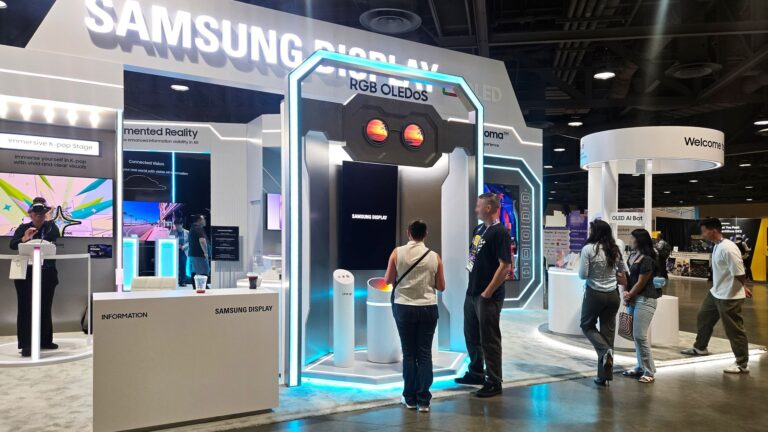
Samsung’s booth is centered around a dark room experience called “The Big Dipper.” Seven displays form the famous constellation, two of which feature Samsung’s new 1.3-inch RGB OLEDoS panels. This configuration is intended to show the difference in brightness and color reproduction in relation to traditional display technologies.

RGB OLEDoS is the differentiator

For those unfamiliar with the technology, OLEDoS (OLED on Silicon) is basically a microdisplay directly on a silicon wafer. Samsung takes a different approach, using RGB to generate red, green, and blue light directly, rather than a white OLED layer with color filters.
And Samsung isn’t stopping at demos behind glass. The company also showed off a prototype of AR smart glasses, featuring a 0.62-inch RGB OLEDoS panel. Visitors can view digital overlays against a simulated Long Beach backdrop, with features including real-time translation, navigation directions, and weather information.
Elsewhere, a separate mixed reality area is allowing attendees to try out an MR headset that uses the same display tech. The company is showcasing what these panels can do with immersive experiences like K-pop concerts and the rhythm game Synth Riders.
Whether these 40,000-nit panels end up in Samsung’s own products or in those of other brands, the technology is moving fast. The next step is to take these amazing prototypes and turn them into actual hardware that people can wear every day.
Android Central’s Take
For my money, these ultra-bright panels are exactly what we need to make AR glasses genuinely useful in the real world. You finally have a HUD that doesn’t require you to wear a heavy, socially awkward cyberpunk helmet to beat back the midday sun. But I’ll hold my applause until I can actually buy one. You know, the ones that the big tech companies love to show off at trade shows, only to ship a heavily nerfed, laughably expensive version three years later. Certainly, 40,000 nits appears impressive in theory; however, until Samsung demonstrates that this technology will not deplete a headset’s battery within twelve minutes or cause harm to my eyes, it remains merely another flashy booth demonstration.