


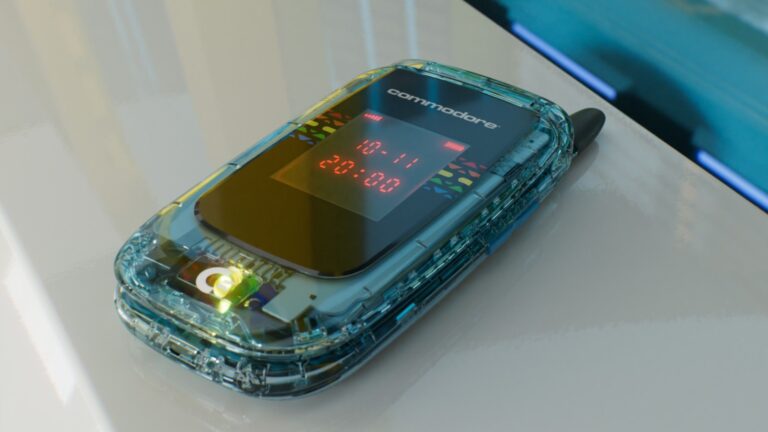
What you need to know
- The Commodore Callback 8020 is a Y2K-inspired flip phone designed to combat smartphone fatigue.
- The flip phone combines early-2000s aesthetics with a customized Sailfish OS developed alongside Finnish company Jolla.
- Sailfish OS can run more than 99% of Android apps, including WhatsApp, Maps, Spotify, and Signal.
We are all tired of our glowing black rectangles. Between the endless doomscrolling, constant workplace pings, and the stress of a hyper-connected world, smartphone fatigue is at fever pitch. Commodore – yes, the legendary computing pioneer – wants to break that cycle. Officially, the brand is back to bring us the Callback 8020, a flip phone that sits exactly between a dumbphone and a smartphone.
The Commodore Callback 8020 is a retro-inspired flip phone for those who want to spend more time living outside their screens. Unlike most modern phones, the Callback 8020 lacks social media, email, and a web browser.
It arrives as worries about screen addiction, online distractions, and kids’ digital lifestyles continue to grow. The device was built to bring technology back to its original purpose, which is to serve users, not compete for their attention, says Commodore.

CEO Peri Fractic says becoming a parent made him think twice about his own smartphone habits. Years ago he swapped his smartphone for a basic phone and has since spent less time reaching for his device and more time interacting with the world around him.
The problem, Fractic said, was that the existing dumbphones took away too much functionality. The Callback 8020 sits somewhere between a feature phone and a smartphone, what Commodore calls a “not dumb dumbphone.”
Visually, the phone is very much a Y2K nostalgia play. It’s designed in a flip-phone style that reminds us of early 2000s hardware, but it has modern features thanks to a collaboration with Finnish company Jolla.
The device runs a custom version of Sailfish OS, a Linux-based platform with its roots in Nokia’s mobile software efforts. Jolla was started by former Nokia employees and has spent over a decade developing Sailfish as an alternative to Android and iOS.
One of the biggest surprises of all is the app support. The Callback is completely de-Googled, but thanks to the compatibility layer, Sailfish OS can run over 99% of Android apps. That means you still have access to essentials like WhatsApp, Google Maps, Spotify, Signal, and iMessage via a third-party solution that needs temporary access to a Mac.
The Callback’s headline feature might well be the things it won’t do. Commodore’s patent-pending technology blocks social media platforms and internet browsers at the system level. Instead of constant pop-up alerts, you get a dome-shaped LED notification system designed to reduce distraction. Commodore said the phone was also designed with schools in mind, but users should check local requirements before relying on it in classrooms.
Image 1 of 5


Privacy is a core selling point
Neither the company nor the phone monetizes personal data, said Commodore. The Callback does not track cookies and promises not to collect user information without permission.
The Callback is built to do many everyday things, even without a browser. You get QR codes, maps, home security apps, global cellular bands, predictive text messaging, and popular communication app support. The phone also resurrects features that are less common on modern devices, including a removable battery and interchangeable covers.
Music fans also get an audiophile-grade DAC, in-ear monitors with a 3.5mm headphone jack bundled in, FM radio support, and high-definition audio tracks from artists like LukHash and Anders Enger Jensen.
The Callback 8020 will be available later this year in five different finishes. The Commodore standard line includes BASIC Beige, ProtoPET White, and SX Silver, each costing $500. For something a little more special, there is a translucent Starlight Edition for $550 and a premium Founders Edition with a PVD gold finish and 24K gold-plated Commodore button for $640.
Pre-orders should be opening soon, with Commodore stating that shipping is currently targeted for Q4 2026.
Android Central’s Take
I think the Callback 8020’s biggest strength is that it recognizes something many of us already know but rarely do anything about: our phones have become exhausting. I like the idea of keeping the useful tools like messaging, maps, and music but getting rid of the endless feeds that somehow turn a 5-minute check into an hour-long scrolling session. And there’s something amusing about the fact that after years of telling us we needed bigger screens, more notifications, AI assistants, and foldable everything, a company is now asking for $500 to help us escape the problems those same devices caused.