Strait of Hormuz: Which countries’ ships has Iran allowed safe passage to? | US-Israel war on Iran News

March 16, 2026:

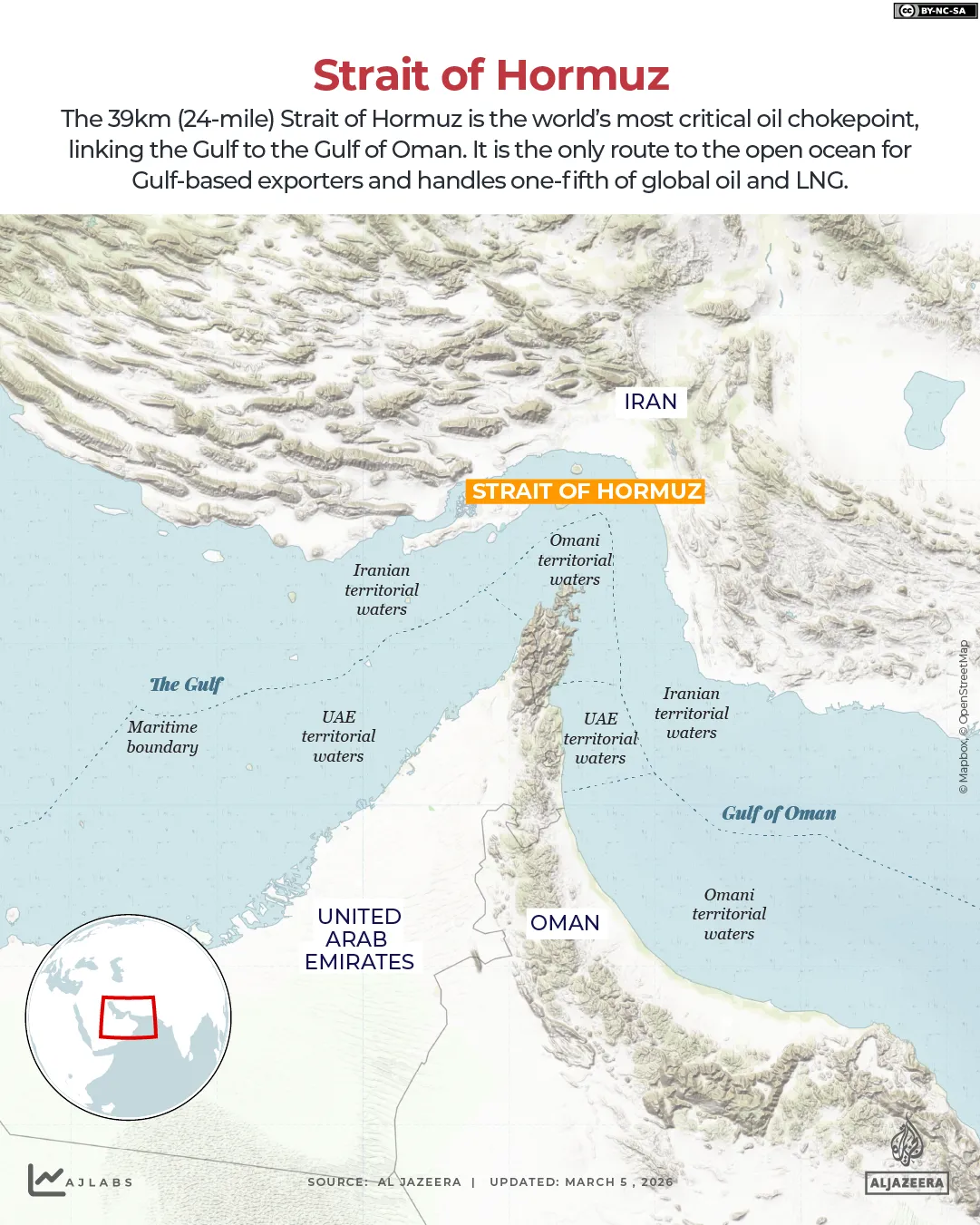
During the United States-Israeli war on Iran, Tehran has said the Strait of Hormuz is open to all except the US and its allies. One-fifth of the world’s oil shipments transit through the strait.

On March 2, Ebrahim Jabari, a senior adviser to the commander-in-chief of Iran’s Islamic Revolutionary Guard Corps (IRGC) announced that the strait was “closed” and if any vessels tried to cross it, the IRGC and the navy would “set those ships ablaze”.

The move sent oil prices soaring above $100 per barrel from a pre-war price of about $65.

A barrel of Brent crude, the international benchmark, was up 2.5 percent at $105.70 on Monday. That is more than 40 percent higher than before the war began on February 28.

Iranian Foreign Minister Abbas Araghchi told the US television network CBS on Sunday that Tehran had been “approached by a number of countries” seeking safe passage for their vessels “and this is up to our military to decide.” He added that a group of vessels from “different countries” had been allowed to pass, without providing details.

Here is what we know about which countries’ ships are being allowed to pass through the strait and which nations are reported to be negotiating for safe passage.

Pakistan

A Pakistani-flagged Aframax tanker called Karachi sailed out of the Gulf through the Strait of Hormuz on Sunday, Bloomberg News reported.

India

On Saturday, Iran’s ambassador to India, Mohammad ⁠Fathali, said Tehran had allowed some Indian vessels to pass through the Strait of Hormuz in a rare exception to the blockade that has disrupted global ‌energy supplies.

Fathali did not confirm the number of vessels. However, on the same day, New Delhi said two Indian-flagged tankers carrying liquefied petroleum gas bound for ports in western India had passed through the strait.

“They crossed the Strait of Hormuz early morning safely and are en route to India,” Rajesh Kumar Sinha, special secretary of the Ministry of Ports, Shipping and Waterways, said at a news briefing in New Delhi.

Turkiye

A Turkish-owned ship that had been waiting near Iran was allowed to pass through the strait after authorities received permission from Tehran, Turkish Transport and Infrastructure Minister Abdulkadir Uraloglu said in comments to Turkish media on Friday.

“Fifteen ships [with Turkish owners] were there. We obtained permission from the Iranian authorities for one of them that had used an Iranian port, and it passed,” Uraloglu said.

China

China is in talks with Iran to allow crude oil and Qatari liquified natural gas carriers safe passage through the Strait of Hormuz, the Reuters news agency reported on March 5, quoting three unnamed diplomatic sources.

China, which has friendly relations with Iran and relies heavily on Middle Eastern petroleum supplies, is unhappy about Iran’s decision to paralyse shipping through the strait and is pressing Tehran ⁠to allow safe passage for its vessels, according to the sources.

China receives 45 percent of its oil via the Strait of Hormuz.

France and Italy

The two European nations are understood to have requested talks with Iran about allowing their ships to pass through the strait, the UK’s Financial Times has reported, citing unnamed officials.

What is the naval coalition Trump proposed for the strait?

US President Donald Trump called for a naval coalition to join the US Navy in deploying warships to secure the strait.

“Hopefully China, France, Japan, South Korea, the UK, and others, that are affected by this artificial constraint will send ships to the area so that the Hormuz Strait will no longer be a threat by a nation that has been totally decapitated,” Trump wrote in a Truth Social post on Sunday.

However, the countries Trump mentioned have made no promises to join such an operation.

On Monday, Germany and Greece ruled out military involvement.

A German government spokesperson said: “As long ⁠as this war continues, there will be no participation, ⁠not even in ⁠any effort ⁠to keep the Strait of Hormuz open by military ‌means.”

Greece ⁠will also not ⁠engage in ⁠any military operations ‌in the Strait of Hormuz, government spokesman ⁠Pavlos ⁠Marinakis said.

Despite pressure from the Trump administration to provide support to the US in its war on Iran, United Kingdom Prime Minister Keir Starmer told the media on Monday: “We will not be drawn into the wider war.”

Rodger Shanahan, a Middle East security analyst, told Al Jazeera it is “unlikely” US allies will get involved in securing the Strait of Hormuz as the Trump administration suggested.

Shanahan said because most US allies “opposed this war to begin with”, it makes them “feel relatively less inclined to provide support to it”.

“Besides, there’s a practical issue. If you want naval support for some kind of coalition protection operation, it takes you a long time to get ships to sail to that area. You can’t do this kind of stuff on the fly.”

INTERACTIVE - Strait of Hormuz - March 2, 2026-1772714221
(Al Jazeera)

Source link