What do Iran’s Kurds actually want?

March 10, 2026:

Last week, President Donald Trump spoke with Iraqi and Iranian Kurdish leaders, reportedly offering “extensive US aircover” and logistical support for armed groups to cross the border from Iraq into Iran to push out regime forces. As one of these leaders put it, his message was that “Kurds must choose a side in this battle — either with America and Israel or with Iran.”

Turning to Kurdish ethnic minorities, who are spread across multiple countries in the region, to be America’s frontline fighters is a formula that’s worked before, most recently in the fight against the Islamic State. But the plan seemed to fizzle out this time, and over the weekend, Trump changed his tune, telling reporters, “We don’t want to make the war any more complex than it already is. I have ruled that out, I don’t want the Kurds going in.”

The Kurds are not yet in a position to launch an attack, according to Abdullah Mohtadi, an Iranian Kurdish leader in an undisclosed location outside the country, who I spoke with over the weekend. Mohtadi, secretary general of the Komala Party of Iranian Kurdistan, said there were “several thousand” fighters or peshmergas under their command in Iraq, and “tens of thousands” of young people in Iranian Kurdistan who would be willing to take up arms if they were given protection. But the Iranian regime was still too strong, even with US support, to take on.

“For us to make any move, we need to have the Revolutionary Guards and repressive forces of the Iranian regime sufficiently weakened — weakened enough for the people in the cities to rise and the Peshmerga forces to come in,” he said. “Before that, we will avoid it.”

Despite some contradictory reporting last week, Mohtadi said that Kurdish fighters had not yet crossed the border into Iran, but were maintaining a “defensive position” in their camps in Iraq where they are under constant fire from Iranian drones and missiles.

The back and forth between Trump and the Kurds speaks to one of the underlying tensions of the war. The US and Israeli aerial bombardment has had stunning success at killing senior Iranian leaders and destroying key infrastructure, but air campaigns are historically not well-suited to actually dislodging regimes or forcing them to surrender. For that you need troops on the ground — and in Iran, the domestic opposition is not well armed.

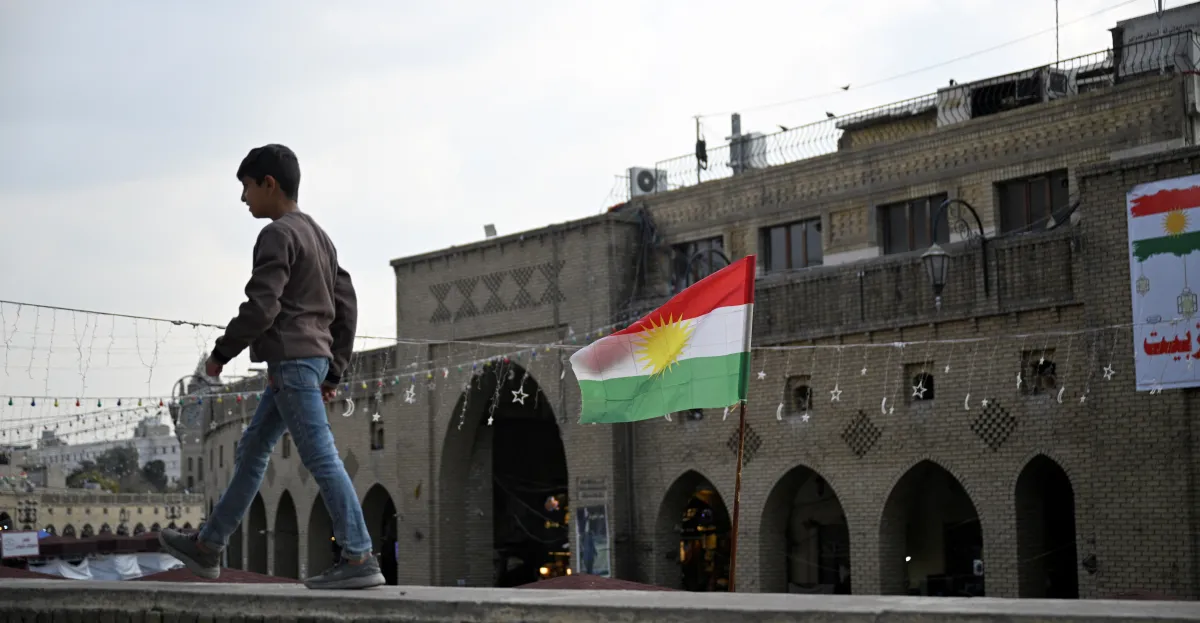
This left Washington considering backing armed Kurdish groups, as it has numerous times in the past. Often called the world’s largest ethnic group without a state of its own, there are an estimated 25 million to 30 million Kurds, living mainly in Iran, Iraq, Syria, and Turkey.

They have been historically marginalized and discriminated against — often worse —in all those countries, including Iran, home to around 10 million to 15 million Kurds who live mainly in the country’s northwest, bordering Iraq and Turkey. In 2022, when an Iranian Kurdish woman named Mahsa Amini died under suspicious circumstances in custody after her arrest by Iran’s morality police, it sparked nationwide protests and the Kurdish slogan “woman, life, freedom” was adopted by the wider Iranian opposition.

Across the border in Iraq, the Kurdish region in the country’s north has enjoyed a much greater degree of autonomy since the US imposed a no-fly zone after the first Gulf War in 1991. This part of Iraq is also host to a number of exiled Iranian Kurdish groups, who recently formed an alliance to take on the regime if the opportunity presents itself.

There have been media reports that Iraqi Kurdish leaders are reluctant to get involved in the current fight between the US and Iran. “They have hosted us for a long time, but they’re weary of the Iranian threats,” Mohtadi said, noting that the Kurdish Regional Government’s capital, Erbil, which hosts a US military base, has been under near constant Iranian missile bombardment since the war began.

Iranian Kurdish forces, even with full American support, are not in a position to march on Tehran and overthrow the Islamic Republic regime. The objective in any military offensive, rather, would be to restore safety and security in their own region. Mohtadi denied, however, that the goal was to establish an independent state.

“We see some reports that portray us as separatists, “ he said. “That’s not true. We are for a democratic, secular, unified Iran where the rights of Kurds and other ethnic minorities are respected. What we want is a democratic Iran that is unified, but at the same time decentralized in the form of a federal system.”

Mohtadi also pushed back against the notion that backing armed militias within Iran could lead to civil war or regional destabilization, arguing that it was the regime itself that is causing chaos at home and abroad.

“Who shoots missiles to neighboring countries? Who massacres their own people? It’s not us, it’s not the Iranian opposition, it’s not the Iranian civil society, it’s the Revolutionary Guards,” he said.

There’s an old saying that Kurds, with a long history of guerilla warfare in multiple countries, have “no friends but the mountains.” Often, the United States has had a warm relationship with the Kurds, but that friendship has limits. In the 1970s, the United States, working with the then-US-aligned Iranian government, backed Kurdish groups fighting the Soviet-backed Iraqi government, then later withdrew that support, leading to a massacre. “Covert action should not be confused with missionary work,” Secretary of State Henry Kissinger said, reflecting on what many saw as a betrayal. A similar dynamic played out when the United States encouraged Iraqi Kurds to rise up during the first Gulf War.

More recently in Syria, Kurdish rebels worked closely with the US military to fight ISIS, establishing a semi-independent enclave in the country’s northeast in the process. In January, Syrian government forces, now under the US-aligned President Ahmed al-Sharaa, overtook much of the region. Rather than coming to their aid, the US urged their Kurdish allies to merge with Syrian security forces. This effectively brought an end to the short-lived Syrian Kurdish statelet known as Rojava. In a Sunday Reuters article, Syrian Kurds are quoted warning their Iranian brethren against aligning with the United States, only to be abandoned when the geopolitical winds shift.

Mohtadi interpreted this history differently, pointing out that it was US air support that allowed the establishment of the Kurdish Regional Government in Iraq (after the massacre of thousands by Saddam Hussein’s Hussein’s airforce) and that protected Kurdish regions from ISIS’s genocidal offensive in 2014.

“I personally have witnessed many instances since 1991 that the United States helped Kurds and saved them,” he said.

Though formed as a left-wing militant group prior to the Iranian revolution, Mohtadi’s Komala Party has become far more moderate and pro-American in its decades in exile. Mohtadi expressed gratitude to the Trump administration, saying, “they kept their promises and came to help the Iranian people by striking the Iranian regime and defeating them on the battlefield.”

It remains unclear exactly what prompted Trump’s shift on aligning with the Kurds. It may have been doubts about their military capabilities, concerns about chaos within Iran, or reactions from regional allies. (Turkey is perennially concerned about upsurges of Kurdish nationalism and its president, Recep Tayyip Erdoğan, is an influential Trump ally.)

Mohtadi, who at 76 has been witness to multiple eras of Kurdish politics in multiple countries, argues that this moment of weakness for the Iranian regime is a “unique opportunity…not only for Kurds but for the whole Iranian people, and to change the face of the entire Middle East.”

How Trump will approach this moment in the days and weeks to come remains a mystery, as is what it will mean for Iranians of all ethnicities. For now, those plans don’t appear to include any extravagant promises of support to the Kurds. That leaves them in a familiar place: in a regional war they didn’t start, looking for the best way to navigate the dangers.

Source link